MUSIC 332: Aesthetics of Music
Laura Gray
Estimated study time: 3 hr 5 min
Table of contents
What is the “Aesthetics of Music”?
What is Aesthetics?
The word aesthetics comes from the Greek for “to perceive sensuously” — perception through the senses. The Oxford English Dictionary offers several interlocking definitions: aesthetics is the philosophy of the beautiful or of art; it encompasses systems of principles for the appreciation of the beautiful; it refers to the distinctive underlying principles of a work of art, a genre, or the works of an artist or culture. Though questions about beauty and art stretch back to antiquity, the term “aesthetics” itself is a product of the modern age of rationalism, first explicitly used around 1750 (the OED records it from 1770).
What is the Aesthetics of Music?
There are many ways to define the aesthetics of music. Lydia Goehr, in the Grove article “Philosophy of Music, III: Aesthetics, 1750–2000” (2001), describes it as “theoretical reflections on the status of music as an art and as a form of meaningful articulation.” Around 1750, a paradigm shift occurred: music began to claim autonomy from function, language, and religion, and its status as a fine art was established for the first time. The aesthetics of music has deep connections with philosophy, but it is also an area of inquiry with its own established history within the discipline of music — a broader context in which we examine the nature of, and seek meaning in, music.
Our Approach
Can we take a general aesthetics of art and apply it to music? There are certainly principles and questions that apply to all the arts, and artistic movements that cut across media. But music also has special attributes: its own technical language, its nature as a performing art, and the fact that it unfolds in time. Moreover, music’s identity has changed over the centuries — it has not always been considered an art in the way we understand that word today.
This course takes a chronological approach, tracing how aestheticians and theorists build on — or react against — the work of their predecessors, shaped by the concerns, questions, and obsessions of their own time. The approach is broad, attending to the sociological, political, artistic, technological, and scientific tendencies in different periods that shape how people think about music and its meaning.
What Is the Aesthetics of Music?
Opening: A Question Worth Asking
What is music, really? Not in the technical sense — not the intervals and harmonics and voice-leading you may have studied before — but in the deeper sense: What is it? Why does it move us? Does it mean something, or does it only seem to? Is it beautiful by nature, or have we simply agreed to call it so? And who decides?
These are not easy questions, and they are certainly not new ones. Thinkers have been wrestling with them for as long as people have made music. Yet here is the remarkable thing: after centuries of argument, the questions remain. They keep returning, reshaped by each new era, pressed into the context of each new culture, tested against each new sound. This course, MUSIC 332: Aesthetics of Music, is an invitation to join that conversation — to examine what some of the most penetrating minds in Western (and non-Western) history have said about music’s nature, its meaning, and its value.
But before we can begin that conversation, we need to understand the terms. What is aesthetics? What does it mean to approach music aesthetically? And why does this field of inquiry live inside a music department rather than a philosophy department?
What Is Aesthetics?
The word itself comes from the Greek, meaning to perceive sensuously — to take in the world through the senses. At its root, aesthetics has to do with sensory perception, with the experience of encountering something in the world and being affected by it. Already, you can see why music would be central to this inquiry: of all the art forms, music may be the most immediately, viscerally sensory. It enters through the ears and seems to do something to the body and the emotions before the mind has a chance to catch up.
The Oxford English Dictionary defines aesthetics as the philosophy of the beautiful or of art, a system of principles for the appreciation of the beautiful, and more specifically, the distinctive underlying principles of a work of art, a genre, an artist’s body of work, or the arts of a culture. These four dimensions of the definition are worth sitting with: aesthetics is at once a philosophical discipline (what is beauty?), a critical one (what principles guide our appreciation?), and a historical one (what are the underlying assumptions that shape how a particular culture hears music?).
Crucially, the term aesthetics as a formal discipline belongs to the modern age. Its first explicit use in something close to its current sense dates to around 1750, emerging from the age of rationalism. That date is not a coincidence, as we shall see — it coincides with a profound shift in how European culture understood what music was and what it was for.
When we turn from philosophy generally to music specifically, the Grove Dictionary of Music and Musicians offers a sharper definition. In her article on the philosophy of music, Lydia Goehr characterizes the aesthetics of music as “the theoretical reflections on the status of music as an art and as a form of meaningful articulation.” That phrase — the status of music as an art — is telling. It implies that this status is not self-evident. Music has not always been considered an art form in the way we understand art today. The field of musical aesthetics, in part, is the sustained inquiry into what music is, and what it ought to be — and those are two different questions.
A Turning Point: Music Becomes Autonomous
To understand why 1750 matters so much, consider what music was before that moment. For most of Western history — and across many non-Western traditions as well — music was understood as subordinate to something else. It was tied to dance, to ritual, to religion, to language. In particular, music was long thought of as a servant of words: a way to heighten a text, to make a liturgical prayer more solemn or a lyric poem more affecting. On its own, without words or ceremony, it was difficult for pre-modern thinkers to say what music actually was or why it mattered.
Around the mid-eighteenth century, something shifted. Music began to claim an autonomous role for itself — an identity not defined by its service to other arts or functions. Instrumental music, which had previously occupied a lower rung in the hierarchy of musical forms, rose to a position of prestige. The symphony, the string quartet, and the sonata became the paradigm cases of what music could be at its most pure. By the time of the great German Idealist philosophers, some thinkers were prepared to argue that music, precisely because it was not tied to words or images, was the most spiritual of all the arts — the form closest to pure feeling, or even to the structure of the universe itself.
This is the intellectual world that MUSIC 332 largely inhabits: the questions, arguments, and aesthetic programs that arose from and responded to this paradigm shift. And it is no accident that some of the most important writing in the history of musical aesthetics comes from German-speaking culture — from philosophers like Hegel, Schopenhauer, and Hanslick, from critics like E.T.A. Hoffmann and Robert Schumann, and from composers like Wagner who were also passionate theorists of their own art.
Aesthetics of Music as a Discipline
It is worth pausing to clarify the relationship between musical aesthetics and philosophy proper. There is certainly overlap — many of the figures we will read are philosophers in the traditional sense. But the aesthetics of music is not simply a branch of philosophy borrowed by musicians. It has its own established history within the discipline of music, shaped by the discourse and debates that have arisen specifically in musical contexts over centuries. The questions that animate musical aesthetics are not identical to the general philosophical questions about art; they are inflected by music’s special properties and by the internal history of how musicians, theorists, and critics have talked to and argued with one another across time.
This is why MUSIC 332 is a music course, not a philosophy course. The thinkers we will read are responding to one another within a tradition — building on what came before, arguing against it, extending it, or arriving at moments of crisis when the whole framework seems to require reconstruction.
Music’s Special Character
One reason musical aesthetics cannot simply be reduced to a general theory of art is that music has attributes that make it genuinely distinctive. Can we take a broad aesthetic theory — one developed, say, for the visual arts or for literature — and apply it to music without remainder? Some thinkers, including Schumann, say yes: the principles that define Impressionism in painting, for instance, have recognizable analogues in Debussy’s music, and the symbolist aesthetic of Mallarmé and Verlaine finds expression in Debussy’s Prélude à l’après-midi d’un faune, which takes as its starting point a symbolist poem. Across the arts, there are correspondences; many arts aspire to qualities they associate with music — its ephemerality, its apparent freedom from concrete reference.
Yet music also resists absorption into a general aesthetics. It has its own technical language, one that non-musicians may not share. It is a performing art, which means it exists in performance and is not identical to its score. It unfolds in time: unlike a painting, which you can stand before and take in at your own pace, music requires you to follow it, to hold its unfolding in your memory as it moves. And its very identity is historically unstable — what counts as music, what counts as art, and who counts as a musician have all changed dramatically across time and culture.
A Chronological Approach
Given this, the course takes a chronological approach, tracing the history of ideas about music from antiquity to the present. The reason for this structure is not merely organizational. The thinkers we will read are always responding to what has come before — building on earlier arguments, extending them, contesting them. Ideas about music are not discovered in isolation; they are produced in dialogue, often in fierce polemic. To understand what any particular thinker is saying about music, you need to know what conversation they are entering.
We begin with the ancient Greeks. Plato was not primarily a music theorist, but music appears in his political philosophy as a matter of deep concern: what kinds of music should citizens hear, and what effects will different musical modes have on the character of the state? Aristotle, in turn, raises the question of music’s role in education. Already in antiquity, music is not simply a pleasant art form; it is a force that shapes persons and societies, and the aesthetics of music is inseparable from ethics and politics.
In the medieval period, music occupied an unexpected place in the intellectual hierarchy: it was classified not as an art but as a science, specifically as a branch of mathematics. Music sat alongside arithmetic, geometry, and astronomy in the quadrivium — the higher division of the liberal arts curriculum. For the medieval scholar, music was first and foremost a matter of ratios and proportions, of the mathematical order underlying the cosmos. This may seem remote from anything we would recognize as aesthetics, but it represents a coherent and influential theory of what music fundamentally is.
The course then moves through the Renaissance and Baroque periods, into the pivotal eighteenth century, the great age of German aesthetics, the Romantic period, the crisis-laden decades between the World Wars, and into the twentieth century and beyond — encountering, along the way, figures as varied as Theodor Adorno, John Cage, R. Murray Schafer, and theorists of non-Western musical traditions.
The Questions That Keep Returning
Throughout this chronological sweep, certain questions appear again and again, in different guises and different cultural contexts. They are worth naming at the outset, because they will serve as orientation points across the whole term.
What is music? This may seem like a question with an obvious answer, but defining music in a way that is both precise and inclusive — that captures what Beethoven’s Eroica and Cage’s 4'33" and a Javanese gamelan and a West African drum circle all share — turns out to be extraordinarily difficult. What is the difference between music and noise? Between music and sound? The question is not merely definitional pedantry; how you answer it reveals deep assumptions about what you think music is for.
What does music mean? Does music have content, in the way that a poem about longing contains a thought about longing, or a painting of a landscape contains an image? Or is music, as some have argued, purely abstract — a play of sound-forms without semantic content? If music does mean something, how does it mean it, and how do we know what it means?
How does music relate to emotion? Music seems to express emotion and to arouse it, but how? When a piece of music strikes us as sad, is there sadness in the music, or only in us? And is a piece of music that makes us feel sad thereby a good piece of music?
Finally, how do we assess music? Are there principles that we can apply to evaluate whether a piece of music is excellent, mediocre, or bad — or is musical value entirely subjective, a matter of individual taste?
Challenging Our Assumptions
One of the most important things the aesthetics of music can do is challenge the assumptions we did not know we had. All of us come to this course with ideas about music that we take for granted — ideas about what counts as serious music, what counts as beauty, what a composer does, what it means to listen well. Many of these ideas are historically conditioned: they were produced at a specific moment in history, in a specific cultural context, often in the service of specific interests. The German Romantic idea that great music is autonomous, emotionally profound, and produced by a solitary male genius is an idea — not a fact — and it is an idea with a history, a politics, and a set of consequences.
The critic and philosopher Theodor Adorno, whom we will read later in the term, argued with characteristic intensity that the modern music industry had lulled listeners into a kind of passive consumption, making them comfortable with music as a commodity rather than challenging them to genuinely hear what music could be. Writing in the context of radio broadcasts and popular music in the 1930s and 1940s, Adorno was polemical — and more than a little elitist, as Prof. Gray freely acknowledges — but his underlying question is a serious one: What happens to our capacity to listen when music becomes background, when it is designed to be familiar and comforting rather than demanding and revelatory?
This course is, in part, an invitation to become a more conscious, more historically informed, and more critical listener — not in order to enjoy music less, but in order to hear it more fully.
What Lies Ahead
The history of ideas about music is vast and surprising. It includes mathematicians and mystics, Romantic poets and political ideologues, sociologists and semioticians. It spans cultures and centuries. It contains some of the most fierce intellectual arguments in the history of the arts — the Wagner-Brahms polemic of the nineteenth century, for instance, which divided European musical culture for decades over the question of what music’s future should look like.
None of the big questions have definitive answers. That is not a failure of the discipline; it is the nature of the questions. They arise from the very strangeness of music — from the fact that this organized vibration of air has, in every human culture, been invested with meaning, power, beauty, and significance that outstrips any easy explanation. The goal of this course is not to settle these questions but to think about them more carefully, more historically, and more richly than you did before.
So: what is music? We begin there, and we will return there, again and again, throughout the term.
Aesthetics of Antiquity
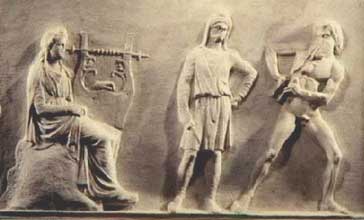
Welcome to Lesson 1b. In this lesson we are looking at ideas about music from antiquity — specifically from three of the most influential thinkers the ancient Greek world produced: Pythagoras, Plato, and Aristotle. As you work through these readings and this lesson, you will likely find some of their ideas surprising, perhaps even unsettling. They held views about music that are very different from what most of us assume today — and yet you may also find some uncomfortable points of recognition. That tension is exactly what makes this material worth studying.
The relief at the top of this page depicts the famous contest of Apollo and Marsyas, carved at Mantineia around 350–320 BCE. The myth is fitting: a god of musical reason facing down a wild satyr who played the reed pipe in a frenzy. The contest and its outcome neatly encapsulates the arguments all three thinkers were making about what music should and should not be.
Pythagoras
Pythagoras (ca. 580–500 BCE) was a Greek philosopher and mathematician who flourished in the sixth century BCE. You almost certainly know his name from high school geometry — a² + b² = c² — but within the history of music theory he carries a different and equally foundational reputation: he was credited by antiquity as the inventor of music itself. That is an extraordinary claim, and it is worth pausing on what it means.
Our primary source for Pythagoras’s musical ideas is Nicomachus of Gerasa (Gerasa is now part of modern Jordan), a Roman philosopher who wrote his Enchiridion Harmonices — a harmonic handbook or manual — in the second century BCE. It is through Nicomachus that we learn the famous legend.
The Legend of the Blacksmith Shop
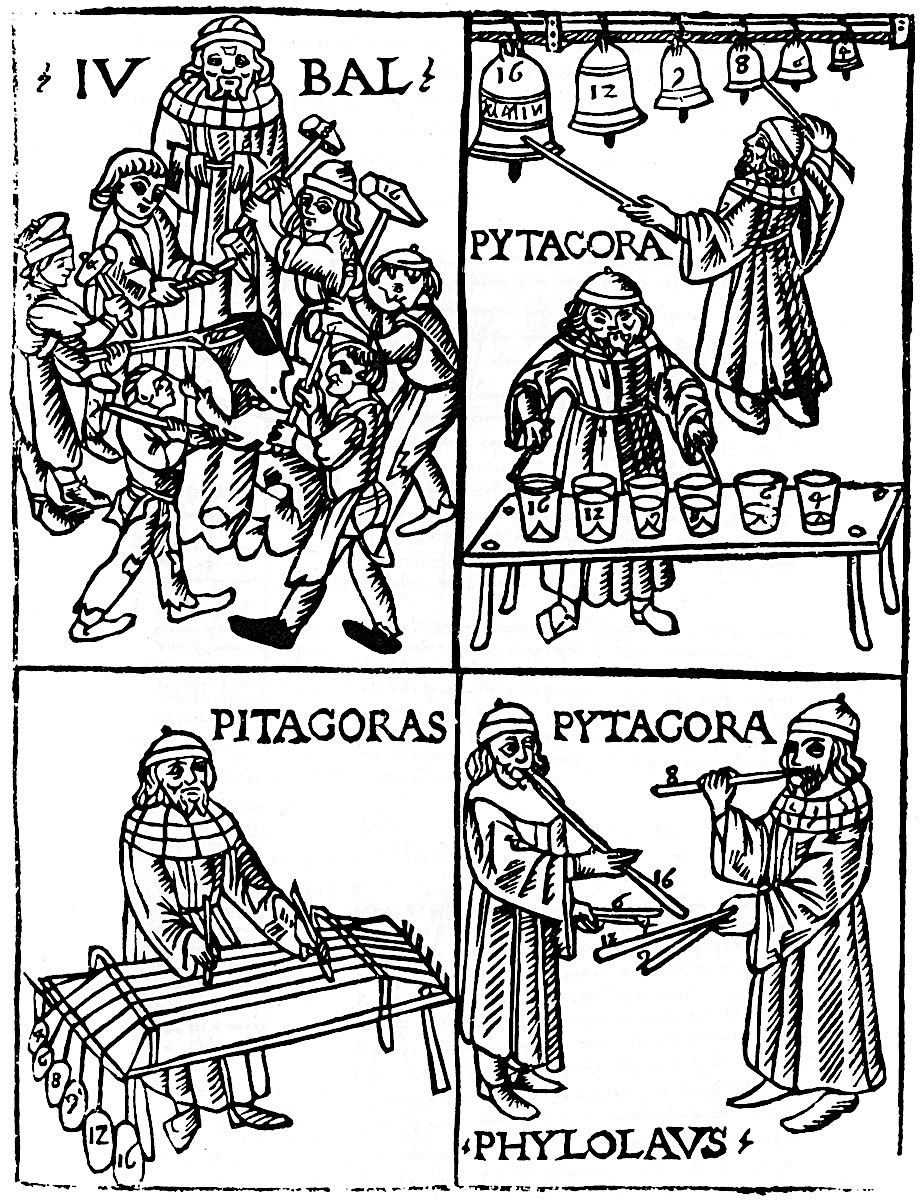
According to the story, Pythagoras was in deep thought, trying to devise some kind of instrument — something that could demonstrate musical intervals as clearly as a compass reveals geometrical relationships to the eye. While walking, he happened to pass a blacksmith’s shop and heard hammers striking an anvil. The hammers were producing consonant intervals — the octave, the fifth, the fourth — and then a more dissonant, crunching interval: the second. Intrigued, Pythagoras entered the shop and discovered that it was the weight of the hammers that determined the intervals. Different weights, different pitches, different relationships.
From this discovery he returned home and devised his own experiments. He stretched a string from wall to wall, hung weights from it, and plucked the string to compare the intervals produced by different tensions. He tried strings over a bridge-like instrument. He tested different sizes of pipes, comparable to organ pipes. All of these experiments led to the same conclusion: the numerical ratios governing basic musical intervals are precise and consistent. The octave corresponds to a ratio of 2:1, the fifth to 3:2, the fourth to 4:3, and the second (the interval between the fifth and the fourth) to 9:8.
Is the legend literally true? Probably not entirely — there are other physical factors that affect vibration beyond weight alone — but the underlying ratios are real. We know today that a pitch vibrating at twice the frequency of another is exactly an octave above it. The A above middle C vibrates at 440 Hz; go up an octave and you reach 880 Hz. The mathematics works out. What is remarkable is that Pythagoras was arriving at these proportional relationships more than two thousand years before modern acoustic science.
The woodcut above, from Franchino Gafurius’s Theorica Musicae (1492), tells the story visually: Pythagoras is depicted conducting experiments with bells, strings, and weights — the legend rendered as a kind of scientific diagram. The monochord, the single-string instrument he devised for his acoustical experiments, became the standard teaching tool for musical proportions throughout the medieval period.
The Harmony of the Spheres
But Pythagoras did not stop at the practical question of how strings vibrate. He extended his mathematical discoveries into a grand cosmological theory: the harmony of the spheres (harmonia mundi). In his conception, the same numerical proportions that govern musical intervals also govern the movements of celestial bodies — the sun, moon, and planets — as they revolve in their orbits. The universe itself, in other words, is organized according to musical ratios.
The key phrase here is inaudible harmony. The harmony of the spheres is not something we can actually hear — it is not sound in any conventional sense. It is a structural, mathematical order that underlies both music and the cosmos simultaneously. From this it follows that music is not primarily an art or a form of entertainment: it is a branch of mathematics, as closely related to astronomy as to song. For the Pythagorean tradition, the mathematics of musical sound and the greater cosmic order are the same thing described in two different registers.
These are genuinely challenging ideas. Music as mathematics. Music as astronomy. Music as a doorway to cosmic structure, not as a source of pleasure. That reconception of what music is will echo through everything we look at in this course, from the medieval curriculum to the Renaissance to the Scientific Revolution.
Plato
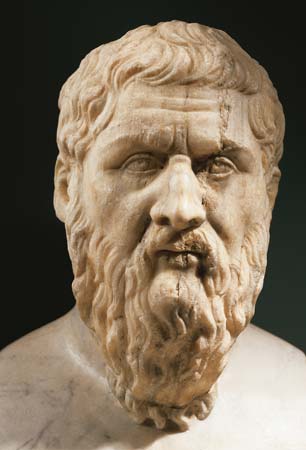
Plato of Athens (ca. 428–348 BCE) was a pupil of Socrates and the founder of an Academy in Athens that would become the seedbed of Western philosophy. He came from an aristocratic family that was deeply opposed to the democratic regime that had tried and executed his teacher. That background matters: Plato was conservative, reactionary, and openly nostalgic for what he imagined as a lost golden age of order and virtue. Those attitudes shape everything he writes about music.
Plato’s major works were composed in dialogue form, staged as philosophical conversations. His best-known are The Republic, written in the middle of his career; The Laws, composed late in his life; and Timaeus, a cosmological dialogue that became by far the most widely known of his texts during the Middle Ages, largely because it was the only Platonic dialogue translated into Latin — by the Roman statesman Cicero — and therefore the only one accessible to medieval readers.
It is worth noting that Plato does not write treatises about music. His musical ideas emerge as isolated comments scattered through texts that are fundamentally about politics, ethics, and cosmology. Music, for Plato, is never merely a topic in itself — it is always evidence for something larger about how human beings and societies behave.
Music and the State
Plato’s controlling idea about music is that it must be subject to state authority. He looked down with contempt on the use of music for pleasure alone and had no patience for what he called meaningless virtuosity — technical display for its own sake. In his view, music has power over human character, and that power is too dangerous to be left in the hands of individual performers or the whims of audiences. Free choice of rhythm and melody, he argued explicitly, should be forbidden. Sober music makes people better; vulgar music makes them worse. And in what may be his most arresting formulation: “Our songs are our laws.”
In The Laws and The Republic, Plato develops a theory of musical morality that amounts to a slippery slope argument. If musicians are allowed to play whatever they wish, without state regulation, then that constitutes contempt of musical law. And contempt of musical law, he argues, inevitably breeds contempt of law in general — the whole fabric of civil order begins to unravel. People start challenging authority. Society slides, as he puts it, toward “a hell of unending misery.” What disturbed him in particular was what he called the sovereignty of the audience displacing the sovereignty of the best. Rather than listening in attentive silence, deferring to the judgment of experts, audiences were clapping and cheering and expressing their own preferences — an ignorant, democratic mob substituting its taste for proper aesthetic and ethical authority. Innovation in music was equally suspect: do not invent new forms, do not experiment, do not depart from the established musical types that have been assigned their proper time and place.
Modes and Their Effects
One of the most concrete expressions of Plato’s views on music concerns the modes — the scales and melodic frameworks that organized Greek music, and the specific ethical character each was understood to carry. In The Republic, through a dialogue between Socrates and his interlocutor, Plato proposes banning most of the modes. He permits only two. The Dorian mode he retains because it imitates “the tones and accents of brave men” — it was associated with Sparta, the restrained, militaristic city-state that Plato admired and contrasted approvingly with the more chaotic democracy of Athens. The Phrygian mode he also allows, because it imitates moderate, temperate behavior. All other modes are to be banned from the ideal city. The idea that modes carry specific ethical powers — what the Greeks called ethos — is one of the most persistent and influential concepts in the entire history of music theory.
Instruments: The Aulos and the Kithara
Plato extended his prohibitions to specific instruments. The aulos — the double reed pipe that you can see in the relief above — was banned outright. Plato regarded it as a foreign instrument, and more importantly as exciting, even orgiastic in its effect. Think back to the myth of Apollo and Marsyas: the aulos was Marsyas’s instrument, the instrument of the satyr, associated with Dionysian frenzy. Plato wanted nothing to do with it in his ideal city.
What he preferred were plucked string instruments: the kithara and the lyra.

The kithara was a seven-stringed instrument and, crucially, it was considered the instrument of Apollo — the god of reason, order, and the sun. The lyra was its smaller sibling. Their calm, rational association made them acceptable. Technical virtuosity on any instrument, including the kithara, was still frowned upon — the point was not dazzling performance but the cultivation of musical virtue.
Forms, Imitation, and the Timaeus
Plato’s most philosophically ambitious musical ideas appear in the Timaeus, and they are rooted in his broader theory of forms. Forms, in Plato’s system, are entities accessible to the mind alone — not to the physical senses. Justice, beauty, equality: these are forms. They are real in the deepest sense, apprehensible only through reason. The physical, sensible world we perceive around us consists of copies of these forms — imperfect, perishable imitations of eternal originals.
Art, including music, is therefore mimesis — imitation. But it is imitation twice removed. A physical object imitates an eternal form; a work of art imitates that physical object; music, as a sensory phenomenon, is thus a copy of a copy. This might seem like a dismissal of art’s value, and in some moods Plato treats it that way. But the Timaeus offers a more redemptive possibility. Music, Plato argues there, “reflects the inaudible harmony of the soul, which reflects the harmony of the universe” — it is “an imitation of the divine harmony revealed in mortal motions.” Harmony and rhythm are related to the motion of the soul, and properly constituted music can therefore correct inner discord and restore order to a disordered soul. That corrective power is the one function of music that Plato endorses unreservedly. And because the Timaeus was the only text of Plato’s to survive into the medieval West, it was precisely this idea — music as an image of cosmic order, music as a medicine for the soul — that would shape musical thinking for the next thousand years.
Aristotle
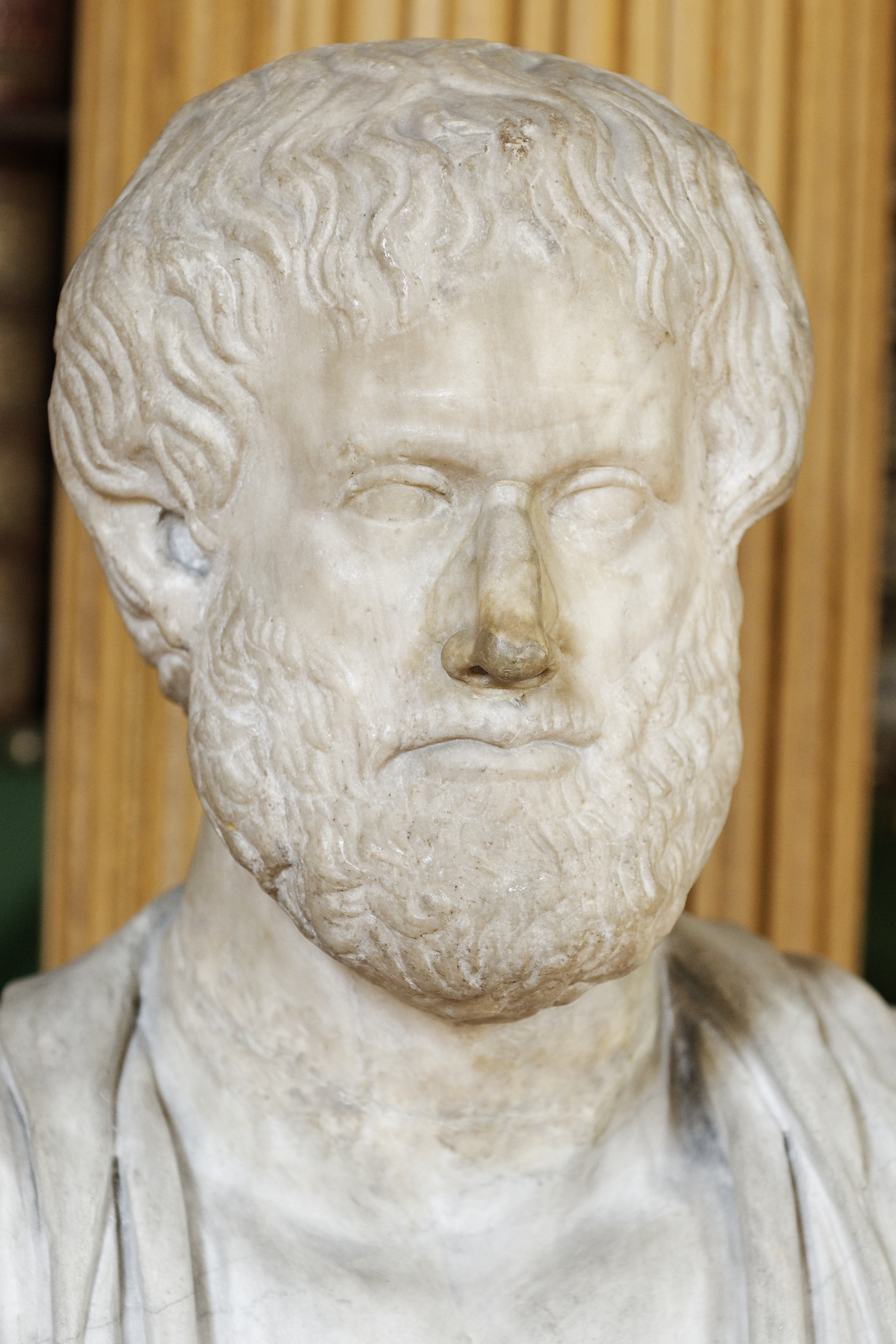
Aristotle (384–322 BCE) was a Greek philosopher, pupil of Plato, and, for a period between 342 and 335 BCE, the private tutor of a young Macedonian prince who would become Alexander the Great. His works — The Metaphysics, The Physics, The Poetics, and The Politics (the last left incomplete at his death) — cover virtually every domain of knowledge. He was, to a remarkable degree, an encyclopedia in one person.
Aristotle largely disappeared from the Latin West after the fall of Rome, until the twelfth century CE, when his writings were rediscovered in Latin translation through Arabic intermediaries. Their arrival in Paris transformed the intellectual landscape of medieval Europe. But for now, what matters is how Aristotle’s ideas about music differ from his teacher Plato’s — and they differ significantly.
The word that best describes the difference is practical. Where Plato was an idealist constructing a vision of a perfect city-state and bending all his musical arguments to fit that vision, Aristotle was an observer of the world as it actually exists. He asked not “what should music be in a perfect society?” but “what does music actually do for human beings, and what purposes does it legitimately serve?”
The Purposes of Music
Aristotle identifies several distinct purposes of music, and his willingness to acknowledge more than one is itself a departure from Plato’s essentially single-minded approach. First, and most important to him, is education — music as a tool for developing the character, intellect, and taste of the young. Second is catharsis: music can produce purgation and relief from negative emotions. The Greek term catharsis (κάθαρσις) denotes a kind of cleansing or release — the idea that experiencing strong emotions through art discharges them safely rather than inflaming them. This is almost the opposite of Plato’s anxiety that music inflames the passions; for Aristotle, the emotional experience music produces is therapeutic. Third, music contributes to the cultivation of leisure — it helps form the character in moments of rest, and it engages the intellect. And fourth — and here Aristotle parts most clearly from Plato — music enjoyed for pure pleasure is entirely acceptable. Pleasure, in this context, means relaxation, and relaxation is a cure for the ills that accumulate from the pressures of daily life. Some of these ideas may resonate quite directly with how you think about music today.
Music in Education
Aristotle’s most developed argument about music concerns its role in education, drawn from The Politics. His position is that children should be taught music, and taught it actively — meaning they should learn to perform on an instrument or sing, not merely listen. The reason is characteristically practical: you cannot judge music properly unless you have actually played it. Experience as a performer, even at a non-professional level, develops genuine appreciation and discrimination. That judgment — the ability to assess what is good in music and what is not — is the real educational goal.
However, Aristotle imposes a careful limit. Musical training should be undertaken in youth, and then given up. The child should practice, develop judgment and taste, and then, as an adult, step back from active performance. The reason is social, and it reveals the values of his society with uncomfortable clarity: to play music at a professional level is to be a paid employee. In Aristotle’s Athens, professional musicians occupied a lower social rank — they were not free men in the full civic sense. To continue striving for virtuosity as an adult would therefore compromise one’s standing as a free citizen. Technical virtuosity — aulos playing especially — is explicitly not the goal.
The purpose of musical education, then, is the development of judgment, appreciation, character, and taste. A person who has played music as a child will be a better listener, a more discerning audience member, and a more cultivated individual throughout their life. The activity is instrumental — in the non-musical sense — to the formation of the whole person.
Looking Forward
These three thinkers gave Western musical thought most of its foundational vocabulary: the harmony of the spheres, musical ethos, mimesis, catharsis, musical education as character formation. What is striking, looking back, is how thoroughly they agreed that music is not a trivial entertainment — that it matters, that it does something to human beings, that societies need to think carefully about how it is used and controlled. Where they disagreed, sometimes sharply, was on what that something is and what the appropriate response should be.
As you continue through this course, you will see these ideas returning in new forms — in medieval theory, in Renaissance humanism, in the debates of the Baroque era. The questions Pythagoras, Plato, and Aristotle were asking are, in important ways, still our questions. What does music do? Should it be free or regulated? Is it mathematics, ethics, therapy, or pleasure? Think about what struck you as most surprising or most familiar in these readings — that reaction is itself a form of musical self-knowledge.
Medieval Aesthetics of Music
Boethius and the Inherited World
To understand medieval music aesthetics, we need to begin with a figure who bridges the ancient world and the Christian Middle Ages: Boethius, whose full name, Anicius Manlius Torquatus Severinus Boethius, is almost comically grand for a man whose ideas would do their most important work long after his death. Born around 480 CE into a wealthy Roman family, Boethius was a philosopher, statesman, and Christian theologian who rose to the highest levels of power as the closest advisor to the Ostrogoth king Theodoric, whose empire stretched from parts of France to Serbia. The reign was brutal, and in 524 CE Boethius was imprisoned and executed on suspicion of treason. The Catholic Church later recognized him as a martyr and a saint — a testimony to the precariousness of intellectual life at the intersection of Roman civilization and barbarian conquest.
What makes Boethius so consequential for the history of music theory is not any original musical insight but rather his role as a custodian of the traditions of antiquity. At a moment when the accumulated learning of the ancient Greek world was in real danger of being lost, Boethius set himself the task of translating and transmitting that heritage into Latin. His De institutione musica (The Principles of Music) stands as the major musical treatise of its era precisely because it did not invent but rather preserved: it summarized ancient Greek thought on music in a form that medieval scholars could access, and it served as the principal source for understanding music as a mathematical subject for roughly a thousand years. The Platonic-Pythagorean influence that Boethius channeled persisted, through him, well into the Renaissance.
Music and the Liberal Arts
Central to Boethius’s conception of music is its place within the educational curriculum of the liberal arts — arts proper to liberi, free men, as opposed to the manual trades of slaves. The curriculum was divided into two tiers. The trivium formed the elementary level, comprising grammar, dialectic, and rhetoric — the arts of language, argument, and oratory. Above it sat the quadrivium, the four arts of measurement: geometry, astronomy, arithmetic, and music. That music belongs in this elevated company alongside geometry and astronomy tells us everything about how Boethius understood it. Music here means harmonics: the science of musical sounds understood as mathematical structures and numerical proportions. This is emphatically not the playing of instruments or the singing of songs. It is theory — the rational investigation of the divine proportions underlying sound.
The connection between mathematics and music that Boethius articulates still resonates. The anecdote that mathematicians and computer scientists tend to be accomplished musicians is not merely coincidence; it reflects a deep structural relationship between musical pattern and numerical reasoning that Boethius was among the first to put into systematic form for medieval Europe.
Three Kinds of Music
Drawing directly on Platonic thought, Boethius divides music into three kinds, and the distinctions matter enormously for understanding the medieval worldview.
Musica mundana — the music of the universe — is observed in the heavens, the elements, and the turning of the seasons. Everything in the cosmos fits together in a fixed order of perfect balance: earth, air, fire, and water; fall, winter, spring, and summer. Boethius argues that it is quite impossible that the movements of the heavens — the sun, moon, and stars — should produce no sound at all. There must be some celestial sound generated by those motions, even if it lies beyond human hearing. Musica mundana is thus partly metaphysical harmony, the perfect interlocking of cosmic forces, and partly an actual if inaudible celestial music. As one student in the lecture put it, this is the “metaphysical harmony of their natures” rather than a sound we could ever perceive — and Boethius agrees, while insisting the sound must exist nonetheless.
Musica humana — the music of human beings — mirrors that celestial harmony within the human body and soul. This is where the famous doctrine of the four humours enters the picture. Human harmony, for Boethius, has to do with the relative proportions of four bodily fluids, and those proportions determine a person’s temperament and constitution. An excess of yellow bile produces the choleric type: hot-tempered, aggressive. An abundance of blood makes a person sanguine: amorous, courageous, outgoing. Too much phlegm yields the phlegmatic character: calm and unemotional. Black bile — melankholía in Greek, giving us the modern word — is associated with the spleen and produces despondency, sleeplessness, and sadness. Health, and human harmony, requires these fluids to be in just the right balance, just as the seasons must each arrive in proper order for the harvest to succeed. The critical point — one that surprises students encountering it for the first time — is that musica humana has nothing to do with singing or playing. It is an internal, physiological harmony, a mirror of the universal balance, not music we hear at all.
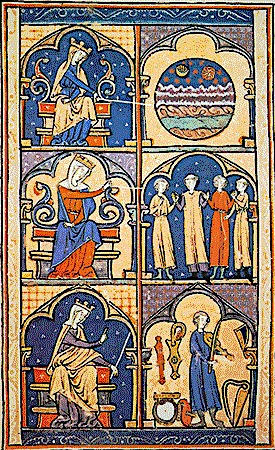
This remarkable illumination, produced around 1300 in connection with Notre Dame Cathedral in Paris, captures all three levels of Boethius’s scheme in a single image. The figure of Musica appears in three registers, using her pointer to indicate her manifestation in each domain: first the cosmic — the sun, moon, stars, and four elements; then the human — four figures representing the four temperaments; and finally the instrumental, where she wags her finger in unmistakable admonition at a fiddle player. The gesture is telling. That she is scolding him rather than praising him reflects perfectly Boethius’s attitude toward actual music-making.
Musica instrumentalis — music made by instruments — encompasses the audible, physical sounds produced by human performers. Boethius mentions string instruments (the kithara), wind instruments (the tibia, flutes and pipes), and percussion. Sound is created either by tension on a string or by breath through a wind instrument. This is the lowest of the three categories, however wondrous the sounds it produces may be.
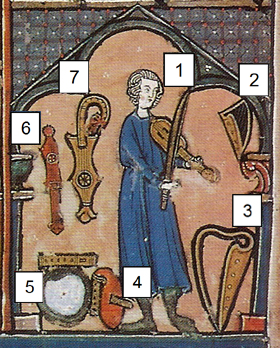
The illustration of musica instrumentalis gives us a vivid inventory of medieval instruments: the vielle (bowed string instrument), a harp-psaltery, a harp, bagpipe, pipe and tabor (a hand drum), a free-neck citole (plucked string), and a thumb-hole citole. The image looks almost like a medieval music room, with instruments arrayed around the central figure — not unlike, the professor notes with a laugh, a modern home with guitars and ukuleles propped against every wall.
The Four Humours, Elements, and Seasons
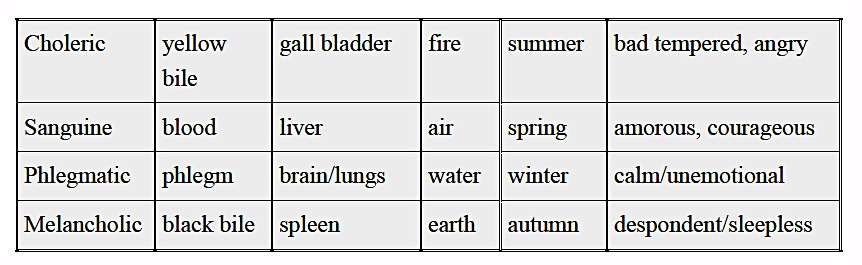
The diagram connecting humours, elements, and seasons makes the symmetry of Boethius’s cosmology visible. Fire corresponds to summer and the choleric temperament; air to spring and the sanguine; water to winter and the phlegmatic; earth to autumn and the melancholic. These cycles interlock perfectly: just as an absence of winter disrupts the sequence of seasons and ruins the harvest, an imbalance in the bodily humours disrupts the human constitution. The same logic of proportional harmony operates at every level of creation, from the rotation of the stars to the chemistry of the human body.
Who Is a Musician?
Perhaps the most provocative part of De institutione musica is Boethius’s three-part taxonomy of musicians, which inverts virtually every modern assumption about the term.
The lowest type is the instrumentalist, who exhibits manual skill — a laborer of the body, whose activity Boethius classifies alongside the work of slaves. Singers likely belong here too, even though Boethius does not spell this out explicitly. Above the instrumentalist sits the composer (or poet), who produces music through natural instinct. This is a slight elevation, but Boethius regards composition by instinct as essentially unthinking — the composer acts without fully understanding what he is doing.
The true musician (in the Boethian sense) is the one who through careful rational contemplation has gained the knowledge of making music. This person judges instrumental performances and composed songs; he uses reason, which is sovereign above all else. Boethius’s famous declaration — “How much nobler is the study of music as a rational science than as a laborious skill of manufacturing sounds!” — captures the entire hierarchy in a single sentence. The real musician is the music theorist, the person who understands the mathematical and philosophical principles at work, not the performer sweating on stage.
This is, as students in the lecture observe, almost perfectly backwards from how we think today. Modern culture celebrates virtuoso performers and productive composers; the music analyst who can explain what they are doing but cannot play a note is not usually the one who gets the fame. But Boethius was a product of his class — wealthy, educated, intellectually aristocratic — and of a tradition stretching back through Plato that systematically devalued sensory experience in favor of rational understanding. His ideas persisted not because everyone agreed with them but because he occupied the social position from which ideas get transmitted. The practical musicians in his audience, the fiddlers and pipers, left us no counterargument.
Music as a Liberal Art: The Scholia enchiriadis
If Boethius represents the foundational statement of medieval music aesthetics, the Scholia enchiriadis — written by an anonymous Frankish monk sometime in the ninth or tenth century — shows us those ideas at work in a living scholarly tradition approximately four hundred years later.
The full title can be rendered as Scolica enchiriadis, meaning “handbook commentary”: it is a dialogue-form commentary on a musical textbook called the Musica enchiriadis (ca. 859 CE), which is itself remarkable for containing some of the earliest surviving examples of polyphony in Western music — specifically organum, the practice of adding one or more additional voice parts to an existing melody. When the Musica enchiriadis first appeared, polyphony was regarded with considerable suspicion; having more than one melodic line sounded like chaos to ears trained on the ordered unity of plainchant. Yet there it was, already being described and taught.
The Scholia enchiriadis extends this practical material by situating music rigorously within the quadrivium, exploring its relationship to arithmetic, geometry, and astronomy. It refers explicitly to Boethius, invoking his language of “unchanging substances” and truths “existing by reason alone.” This is the Boethian cosmos intact: abstract, mathematical, knowable through mind rather than sensation.
The anonymous monk’s central argument perpetuates Boethius’s division of the curriculum: mathematics provides theoretical knowledge that is abstract, without matter, accessible through mind alone. Music, as a mathematical discipline, is bound up in the system of numbers. The study of notes in harmony and discord proceeds by measurement; everything is explained in numerical terms; intervals and proportions — the 2:1 ratio of the octave, the 3:2 ratio of the fifth — are the basic vocabulary. In one of the most evocative sentences in medieval music theory, the Scholia enchiriadis declares: “Notes pass away quickly; numbers, however, though stained by the corporeal touch of pitches and motions, remain.” Physical sound is transient, mortal, a mere stain on the eternal truth of number. The numbers endure. This is Pythagoras filtered through Plato filtered through Boethius, still fully operative six centuries after Boethius wrote.
The Scholia enchiriadis also adds something Boethius did not emphasize: a reinterpretation of the entire musical-mathematical tradition in explicitly Christian terms. The investigation of divine works through the mathematical disciplines is now overtly oriented toward Christian ends. The quadrivium’s abstract truths serve not just philosophical wisdom but the knowledge of God. This Christianization of the Boethian framework would prove equally durable, persisting as the standard justification for music’s place in the medieval university curriculum for centuries to come.
Renaissance Aesthetics
A New World Begins
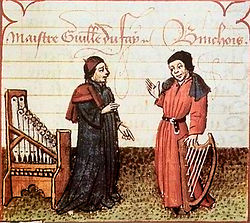
This illumination, dating from around the 1440s, depicts two of the most celebrated musicians of the early fifteenth century: Guillaume Dufay and Gilles de Bins, called Binchois. They are exactly the composers who occupy the transition point between a dying medieval world and the emerging Renaissance — the very figures that Johannes Tinctoris, writing a generation later, would name as teachers and models. That the illumination exists at all, commemorating living musicians in manuscript art, is itself a small sign of the cultural shift under way.
The word Renaissance means rebirth, and it names a period beginning around 1450 in which European intellectual life underwent a fundamental reorientation. For music, the transformation was profound and multi-dimensional. There was a recovery of interest in ancient Greek theory, with Greek writings on music being translated into Latin and newly accessible to scholars. But the more consequential shift was in how music was conceptualized: in the fifteenth century, music gradually migrated from its medieval identity as a branch of mathematics toward a new identity as a sonorous art — an art made of actual sound. By the late fifteenth century, music was being discussed as a form of human activity, something people do, something that can be judged by listening, something that has better and worse practitioners whose techniques can be analyzed and emulated.
This reorientation did not occur in a vacuum. The Renaissance was also an age of discovery — geographical (Africa, the Americas, new sea routes), technological (the compass, the printing press), and religious (the Reformation and Protestantism, which implicated music directly in some of its most contentious debates). Gutenberg’s Bible appeared in the 1450s, and by around 1500 music was being printed as well — a quantum shift in how musical knowledge was disseminated, standardized, and preserved. These are the conditions in which Tinctoris and Glarean wrote.
Johannes Tinctoris: The Ear as Judge
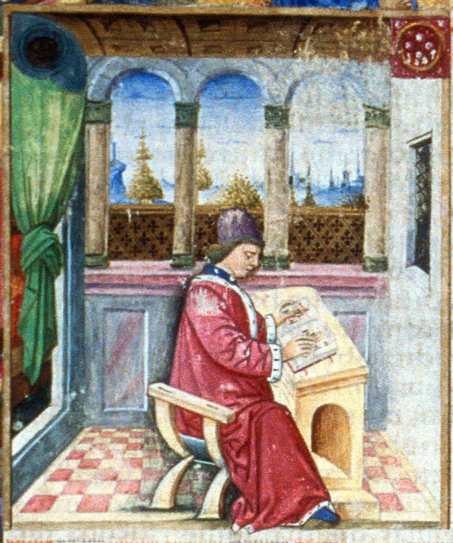
Johannes Tinctoris (ca. 1436–1511) was Belgian by birth and, like Boethius before him, occupied a position of high social standing that gave his words authority. From 1476 he served as chaplain to Ferdinand I, King of Naples; from 1484 to 1500 he worked at the papal chapel in Rome. In 1495 his Terminorum musicae diffinitorium was printed — the first music dictionary ever published, containing 291 definitions and laying out the technical vocabulary of the field with a precision it had never before possessed. He was also a composer, and this combination of practical craft and theoretical learning shaped everything he wrote.
The work that matters most for this lesson is the Liber de arte contrapuncti (Book on the Art of Counterpoint, 1477). Its significance lies less in its technical content — though that is substantial — than in the aesthetic stance it represents. Tinctoris’s treatise is an early Renaissance counterpoint manual, but it signals a new way of hearing and thinking about music. Where Boethius had turned to abstract numerical proportions to understand music, Tinctoris turns to the ear. In the spirit of humanism — the Renaissance’s trust in human perception and experience as the measure of things — Tinctoris judges music by listening to it. He refers to actual musical works. He names contemporary composers as his models. The shift from mathematical speculation to auditory judgment is enormous.
Tinctoris’s survey of contemporary musical practice in the Liber establishes a set of aesthetic norms that would govern Western polyphony for more than a century. He articulates a strong preference for consonance, with thirds, fifths, sixths, and octaves as the favored intervals. He forbids parallel fifths and octaves — the consecutive motion of two voices at those intervals — as archaic and unacceptable. And he insists on strict control of dissonance: dissonant intervals are permitted only in restricted contexts, as passing tones or neighbor tones on unstressed beats, approached and left in prescribed ways. This careful handling of dissonance, codified by Tinctoris, would define polyphonic writing well into the early seventeenth century; it is precisely the tradition against which Monteverdi would push when he began his famous experiments with unprepared dissonance around 1600.
The 40-Year Verdict
The most provocative dimension of the Liber de arte contrapuncti is Tinctoris’s explicit periodization of musical history. He draws a sharp line between a new aesthetic — the music of his own time — and an older practice that preceded it. His point of reference is the music of the two preceding generations: Ockeghem, Busnois, and their teachers Dunstable, Binchois, and Dufay. These are his models, the composers whose command of consonance and whose craft he takes as exemplary. Anything before them, he dismisses.
“Nothing worthy of performance more than 40 years old,” Tinctoris essentially declares — a statement of startling aesthetic confidence. Music older than that generation, he argues, is characterized by “more dissonance than consonance”: it simply does not sound right by the new Renaissance standards. He dates the beginning of the true art to roughly the 1430s, and what came before that he regards as the beginning of the Renaissance a contrario — he identifies it precisely by its failure to meet Renaissance ideals. This is what makes Tinctoris’s treatise historically remarkable: he is the first major theorist to name a contemporary aesthetic revolution in music, to say that something changed around the 1430s, and to locate that change in specific composers and specific practices rather than in abstract principles. Music theory, in his hands, becomes music criticism.
Heinrich Glarean: Expanding the Modal System
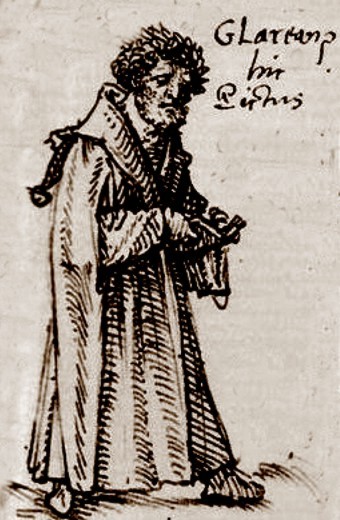
Heinrich Glarean (1488–1563) was Swiss, and his career traces a path through the highest circles of Renaissance intellectual and political life. In 1512 he was crowned poet laureate by the Habsburg emperor Maximilian I — a distinction that placed him among Europe’s recognized men of letters. He was associated for a time with reformers in Switzerland but eventually turned away from them, unwilling to follow where Zwingli and others were leading. His major contribution to music theory came late in his career with the Dodecachordon of 1547.
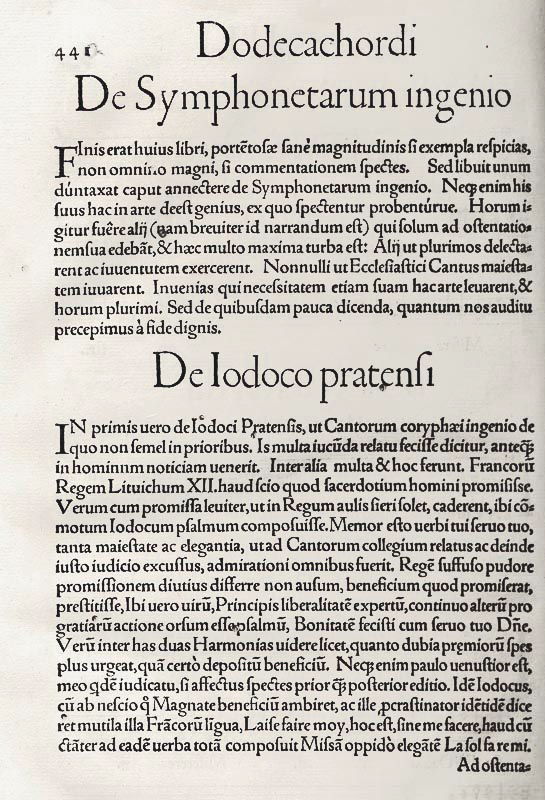
The title means “instrument of 12 strings,” and the number twelve is the point: Glarean’s treatise offered the first full theoretical codification of twelve modes, expanding the traditional medieval system of eight church modes by four. The existing eight modes — Dorian, Hypodorian, Phrygian, Hypophrygian, Lydian, Hypolydian, Mixolydian, Hypomixolydian — had governed the pitch organization of plainchant and polyphony for centuries. Glarean argued that practice had moved beyond what theory acknowledged. Composers were writing music that operated in scale patterns not covered by the eight modes, and theory needed to catch up.
His four additions were: Aeolian (with its final on A, running A–E–A in authentic form), Hypoaeolian (the plagal version, running E–A–E), Ionian (with its final on C, running C–G–C), and Hypoionian (running G–C–G). Looking back from today, we can see that Aeolian corresponds to the natural minor scale and Ionian to the major scale — two of the most fundamental tonal resources of Western music from the seventeenth century onward. Glarean himself did not use those terms, and to say he “discovered” the major and minor scales would be to impose our categories on his; he was working within the inherited modal framework, not dismantling it. But he was recognizing what composers were already doing, and giving it theoretical legitimacy.
The 5 Pairs and the 2 Rejected Modes
Glarean’s system works by pairing each authentic mode with its corresponding plagal mode. In an authentic mode, the range extends roughly from the final upward by an octave; in a plagal mode, prefixed hypo- (“below”), the range extends a fourth below the final and a fifth above it. The distinction matters because it affects the reciting tone — the pitch on which much of the chant gravitates — and the overall character of the melodic line.
Glarean actually considered six new modes before settling on four, and he rejected two: Hyperaeolian (beginning on B) and Hyperphrygian (beginning on F with B as a prominent structural tone). The reason for their rejection is the same in both cases: the tritone. The tritone — the interval of an augmented fourth or diminished fifth, sometimes called diabolus in musica (the devil in music) — had long been avoided in medieval and Renaissance music because of its extreme dissonance. In a modal system, a key structural requirement is that the interval between the final (the “home note” of the mode) and the fifth above must be a pure perfect fifth. In the Hyperaeolian mode starting on B, the fifth above B is F, and B–F is a tritone, not a perfect fifth. The mode is structurally unsound. The same problem afflicts the Hyperphrygian starting on F, where the tritone between F and B corrupts the foundational interval. Glarean rejects both without hesitation and retains only the four modes that satisfy the structural requirements.
The Dodecachordon includes musical examples throughout — most prominently works by Josquin des Prez (ca. 1450/55–1521), whom Glarean regarded as the greatest composer of the age and whose music he analyzed in the new modal terms. This is itself a significant gesture: like Tinctoris before him, Glarean grounds his theoretical claims in actual music, in the sound of specific works. Two of Josquin’s pieces that illustrate the aesthetic world of the Dodecachordon are Mille regretz — a chanson of striking emotional directness, its text expressing the pain of departure — and the motet Ave Maria…virgo serena, a work of extraordinary sustained consonance and modal clarity that would have served Glarean beautifully as an example of refined polyphonic craft.
Josquin des Prez, Mille regretz
Josquin des Prez, Ave Maria…virgo serena
The Ancient World as Legitimation
One of Glarean’s most characteristic moves — and one that reveals the deep logic of Renaissance scholarship — is his insistence on invoking ancient culture to legitimize his new theoretical proposals. He cannot simply declare that there are twelve modes because that is what composers are doing. He must demonstrate that the twelve modes are not a novelty but a recovery, that they were always there in the ancient system even if medieval theorists failed to recognize them. This appeal to antiquity as a guarantor of validity is the defining intellectual gesture of Renaissance humanism: innovation justified as rediscovery.
Glarean’s influence was immediate and lasting. Gioseffo Zarlino (1517–1590), the most systematic music theorist of the later sixteenth century, took Glarean’s modal expansion and built upon it a comprehensive account of Renaissance polyphony that shaped compositional practice and theoretical thinking for generations. The twelve modes became the accepted framework, and the Ionian and Aeolian modes — Glarean’s new additions — quietly became the conceptual ancestors of the major and minor tonalities that would organize Western music from the Baroque period forward.
From Number to Sound: The Arc of Two Lessons
Looking across lessons 2a and 2b together, the arc of transformation becomes clear. Boethius, writing around 500 CE, defines music as a mathematical science, places it in the highest tier of the liberal arts, and regards the actual performance of music as the lowest of intellectual activities. The anonymous monk of the Scholia enchiriadis, four centuries later, reproduces this framework intact, adding only its Christianization. For almost a millennium, the received answer to the question “what is music?” was: a branch of number theory, the human echo of cosmic harmony, best understood through rational contemplation rather than sensory experience.
Tinctoris, writing in 1477, introduces a different answer: music is what you hear. The ear judges. Contemporary composers are the models. And anything that sounds like “more dissonance than consonance” — regardless of its theoretical pedigree — is not worth performing. Glarean, writing in 1547, extends this empirical turn: what matters is what composers are actually doing, and theory must accommodate practice, not the other way around. Both men still invoke ancient authority, but the direction of their argument has reversed. Antiquity is no longer the source of timeless mathematical truth; it is a storehouse of legitimating precedents for ideas generated by present experience.
This is the fundamental shift of Renaissance music aesthetics, and it is why these four texts — Boethius, the Scholia enchiriadis, Tinctoris, and Glarean — form such a coherent intellectual sequence. They are not just four different authors with opinions about music. They mark the passage from a world in which music was a property of the cosmos to a world in which music was a property of human beings listening to each other.
Baroque Aesthetics
The Late Renaissance and the Question of Rules
Every major shift in the history of Western music has involved a confrontation between those who guard established practice and those who are pushing past it. At the turn of the seventeenth century, that confrontation took an unusually public and acrimonious form. It pitted a conservative theorist named Giovanni Maria Artusi against a composer who would go on to define the early Baroque aesthetic: Claudio Monteverdi. What makes this dispute so valuable for us is that it was not simply a quarrel about notes on a page — it was a fundamental argument about what music is for.
To understand why the argument mattered, we need to situate Artusi in his intellectual lineage. He was building directly on the work of two earlier theorists: Glareanus, and then Zarlino, the great systematizer of sixteenth-century counterpoint. For Artusi and for the Renaissance tradition he represented, the rules of part-writing were not arbitrary constraints but the very foundation of musical perfection. Dissonances — notes that clash against each other — had to be carefully prepared and resolved. A dissonance arriving on a strong beat, approached by leap rather than by step, was not edgy or expressive; it was simply wrong. It was a deformation of the musical fabric.
Cruda Amarilli and Artusi’s Attack
In his treatise On the Imperfections of Modern Music (1600), Artusi launched a pointed attack on a specific piece he had apparently heard at a private gathering — a madrigal called Cruda Amarilli (“Cruel Amaryllis”), which Monteverdi had been circulating in manuscript during the 1590s. The piece sets a poem about unrequited love: Amaryllis is cruel to her admirer, who is besotted and helpless. In Monteverdi’s setting, the music does something unusual to bring out the harshness of that word “cruel.” The bass leaps down unexpectedly while upper voices sustain their notes, creating a sudden, jarring dissonance on a strong beat — exactly the kind of unprepared clash that Zarlino’s rules forbade. It happens again, and again. Artusi itemized these moments with the precision of a prosecutor: here the bass descends by leap against a held upper voice; there the alto and soprano land on pitches that collide with the bass line below them; elsewhere a note that should resolve downward by step instead leaps further away.
For Artusi, these were not the flourishes of a daring new expressivity. They were “imperfections” — errors of craft that no properly trained composer should make. He acknowledged the music might sound interesting, even striking, to untrained ears, but maintained that an aesthetic effect achieved through faulty technique was no justification at all. The rules existed for good reason, and flouting them was not innovation; it was ignorance.
Monteverdi published Cruda Amarilli in 1605, in his fifth book of madrigals, and pointedly placed it first in the collection. That was a provocation — a declaration that he stood behind his methods. In the preface to that same publication, he announced that a fuller defense of his approach was forthcoming, and in Scherzi musicali (1607) his younger brother Giulio Cesare Monteverdi stepped forward with that defense on his behalf.
First Practice, Second Practice
Giulio Cesare introduced a distinction that became one of the organizing concepts of early Baroque aesthetics. He distinguished between a First Practice (prima prattica) — the older polyphonic tradition in which, as he put it, “harmony is mistress of the text” — and a Second Practice (seconda prattica), in which “the text is mistress of the harmony.” This was the crux of the whole dispute. In the First Practice, musical rules governed how notes related to each other, regardless of the words being set. In the Second Practice, the expressive demands of the text took priority, and the composer was free to handle dissonance with greater liberty when the meaning of the words called for it. Cruel Amaryllis deserves cruel music. If representing cruelty means breaking a rule about dissonance preparation, then the rule must yield.
Claudio Monteverdi himself was careful to say he was not abandoning the First Practice — it remained valid for its own repertoire. He was, rather, articulating a second mode of musical thinking suited to a different aim. This is the move from the Renaissance ideal, in which perfection of harmony was the supreme value, to the early Baroque ideal, in which the expressive power of the word became paramount. It is not a coincidence that recitative — that new manner of sung speech pioneered by the Florentine Camerata in the 1580s and 1590s — was being invented at precisely the same moment. The Camerata, a circle of Florentine intellectuals and musicians, had been asking how ancient Greek drama might have been performed. They theorized that the plays must have been delivered in a kind of heightened, musical speech — not quite singing, not quite talking — and their experiments produced what we now call recitative: a solo vocal line over a minimal bass accompaniment, following the natural rhythms and inflections of the text. Both the recitative experiments and Monteverdi’s madrigals were expressions of the same aesthetic revolution: music must serve and amplify the expressive content of words.
The Mature Baroque: The Doctrine of the Affections
The Artusi-Monteverdi dispute was, in a sense, the opening skirmish. As the seventeenth century progressed and the early Baroque gave way to the mature Baroque, composers and theorists developed a much more systematic account of what musical expression meant and how it worked. This account is what we call the Doctrine of the Affections (in German, Affektenlehre).
The foundation of the doctrine was borrowed from ancient Greek and Latin theories of rhetoric. Aristotle and Cicero had written extensively about the art of the orator — how a skilled speaker could use particular rhetorical devices, turns of phrase, gestures, and cadences to move the passions of an audience. A great orator did not simply convey information; he produced an emotional state in the listener. Baroque theorists applied this framework directly to music. The composer, like the orator, aimed above all to arouse the passions. The techniques of musical composition — melodic figures, rhythmic patterns, harmonic progressions, instrumentation — were the composer’s rhetorical devices, and their ultimate purpose was emotional persuasion.
What made the Baroque understanding of emotion distinctive, however, was its conception of what an emotion is. The affections were understood not as fleeting, fluctuating feelings — the moment-to-moment ebb and flow of mood that we tend to think of today — but as rationalized abstract emotional states: stable, categorizable, almost object-like. Sadness, joy, love, anger, wonder — these were the primary passions, and each was conceived as a distinct, definable condition. Because of this, a single piece or a single movement was expected to sustain one affection throughout. This unity of affection is one of the hallmarks of mature Baroque style. Think of a Bach prelude: it establishes an emotional atmosphere at the outset and maintains it with remarkable consistency to the end, never pivoting unexpectedly into a contrasting mood. That consistency is not a lack of imagination; it is a deliberate aesthetic principle.
Descartes and the Physiology of Passion
For this doctrine to carry weight, there needed to be some account of how music actually moves the emotions — a mechanism. The philosopher and mathematician René Descartes (1596–1650) provided the most influential attempt in his Passions of the Soul, written in 1645–46. Descartes defined the passions as “emotions of the soul” — states that we do not choose or control but that happen to us. His explanation was physiological. The soul, he argued, resided in a small gland in the midbrain — what we now call the pineal gland. From the brain’s ventricles, minute particles he called animal spirits flowed through the nerves and the bloodstream, ultimately reaching the heart. Each individual passion was caused by one particular pattern of movement among these spirits. Fear, wonder, desire, joy, sadness, hatred — Descartes identified six primitive passions from which all others derived, and each corresponded to a specific agitation of these internal fluids.
What made Descartes’s account significant for musicians was its implication that the passions were, in principle, intelligible and predictable. If each emotion corresponds to a particular movement of the spirits, and if music can produce particular movements of the spirits through its sound, then a composer who understands both the affections and musical technique can reliably induce a desired emotional state in listeners. Descartes was drawing, in part, on the ancient theory of the four humours — the idea that different balances of bodily fluids produce different personality types — and his account in turn gave Baroque composers a quasi-scientific rationale for what they were already doing intuitively. He also offered a moral dimension: the passions, if properly governed by virtue, need not tyrannize the soul. Hatred was a passion to be avoided; the pursuit of virtue could restore inner equilibrium. Music that aroused the passions was thus not mere entertainment — it was, potentially, a form of moral education.
Mattheson and the Codification of Emotions
By the early eighteenth century, the Doctrine of the Affections had become systematic enough that theorists were attempting to catalogue and codify it in practical terms. The most important of these late Baroque theorists was the German writer Johann Mattheson (1681–1764), whose The Complete Music Master (Der vollkommene Capellmeister) appeared in 1739.
Mattheson’s great contribution was a shift in the object of musical imitation. In the early Baroque, the object of imitation had been speech itself: recitative imitated the rhythms, inflections, and accents of the speaking voice. But Mattheson argued that by the mature Baroque, composers had moved beyond that. The object of imitation was now the emotion itself — not the voice that expresses it, but the underlying affective state. This was a philosophically significant step. It meant that music could imitate something invisible, interior, and abstract — not a sound in the world, but a condition of the soul. And it opened the door, ultimately, to the idea that purely instrumental music, with no words at all, could be as emotionally powerful as vocal music. That was a genuinely radical implication, and it pointed forward toward the concerto, the sonata, and eventually the symphony.
To make this concrete, Mattheson turned to dance. He observed that different dance types were associated with specific affections: the sarabande, slow and in triple metre with a characteristic weight on the second beat, expressed something grave, ceremonious, and majestic — a soft, passionate movement apt to disturb the tranquility of the mind. The gigue conveyed excitement and animation. The allemande expressed a moderate contentment. Each dance type carried an emotional signature that any cultivated listener would recognize, and a composer who wrote an aria in sarabande rhythm was deliberately invoking that emotional signature. Handel’s aria “V’adoro, pupille” from his opera Giulio Cesare (1724) is a perfect illustration: Cleopatra, attempting to seduce Caesar, deploys a sarabande to create precisely that grave, disturbing beauty Mattheson describes.
Mattheson also helps us see that the Baroque period was not a monolith. Between the early Baroque of Monteverdi’s time and the late Baroque of Handel and Bach, there was a substantial evolution. In the early Baroque — around 1600 — the prevailing aesthetic was one of fluid, speech-like recitative: transient, responsive, following the text through moment-to-moment changes of feeling. Monteverdi’s L’Orfeo (1607) contains a celebrated messenger scene in which a character delivers the devastating news of Eurydice’s death. The music here is free, flexible, and intensely responsive to the text: it is the early Baroque ideal in its purest form, speech raised to music. By the late Baroque, something very different had emerged: larger, more static structures built on the foundation of dance types, sustaining a single affective state across a whole movement with monumental consistency. Opera seria — the dominant genre of early eighteenth-century opera — formalized this into a rigid system of aria types, each associated with a specific affection and characterized by specific rhythmic and melodic features. The improvisation of recitative and the monumentality of the da capo aria existed side by side, representing the two poles of Baroque expression that Mattheson was trying to systematize.
What connects Artusi’s complaint, Monteverdi’s defense, Descartes’s physiology, and Mattheson’s codification is a single underlying question: what is music’s relationship to human emotion? The Baroque answer — that music is an art of emotional persuasion, rooted in rhetoric, grounded in the body, and aimed at moving the passions of the listener — shaped not just a period, but a way of thinking about what music can do that echoes far beyond the seventeenth and eighteenth centuries.
Classical Aesthetics
The Classical Era in Music
What do we actually mean when we say “Classical” music? The term is surprisingly ambiguous. In everyday usage, it can refer to the entire tradition of Western art music — but in a more specific sense, it denotes the Classical period, roughly spanning from the 1730s to about 1815, with the core decades often given as 1750 to 1800. This is the age of Haydn, Mozart, and Beethoven. The label itself draws an analogy to the art and architecture of ancient Greece and Rome, evoking ideals of balance, proportion, clarity, and formal perfection. And just as Greek and Roman art served as a model for visual artists and architects, the aesthetic principles of that ancient world shaped the musical thinking of the late eighteenth century.
The intellectual backdrop to all of this is the Enlightenment — that great age of reason, nature, and progress. Scientific advances in the seventeenth and eighteenth centuries had demonstrated the power of reason, experience, and observation, and these methods were now being applied well beyond the laboratory: to emotions, social relations, and politics. There was a growing belief in natural law and in the rights of the individual. Thinkers like Voltaire and Rousseau articulated doctrines of individual rights and universal education that would cross the Atlantic and find expression in the work of Jefferson and Franklin, ultimately shaping the American Constitution. Humanitarianism flourished: movements like Freemasonry promoted ideals of universal brotherhood, and the arts increasingly turned their attention to common people. Culture was no longer the exclusive preserve of the aristocracy — it was, at least in aspiration, for all.
Features of Classical Music
So what does this Enlightenment sensibility sound like? Classical music prizes simplicity, balance, and formal perfection — the musical equivalents of a well-proportioned Greek temple. There is a premium on diversity within unity: a single work encompasses a range of contrasting ideas that nonetheless cohere as a whole. This stands in marked contrast to much Baroque music, where a single movement might sustain one emotional state from beginning to end. In a Classical sonata or symphony, we hear a diversity of emotions within one piece — shifting moods, surprising turns, passages of wit and charm. Excessive ornamentation is stripped away in favour of clean melodic lines. And the audience matters enormously: the best Classical music is designed to satisfy both the amateur listener and the connoisseur, sounding perfectly natural and pleasing on the surface while concealing considerable sophistication beneath.
A Side Trip into Aesthetics
The Imitation Theory and Its Crisis
Behind the music lies a profound shift in how people thought about what music is and what it does. For centuries, the dominant framework was the Imitation Theory, founded on the ideas of Plato and Aristotle. Music, in this view, was tied to rhetoric — it imitated words and speech. Vocal music was the paradigm: the voice carried meaning, and the music illustrated and amplified that meaning. But what happens when music has no words at all? The rise of abstract instrumental music — especially the virtuosic Italian violin repertoire of the seventeenth and eighteenth centuries — posed a serious challenge to imitation theory. As instrumental music grew in status and autonomy, it became harder to explain its power in terms of imitating speech. By the late eighteenth century, a decisive break occurred: a paradigm shift that replaced the old imitation theory with a new understanding of music as expression. This is the framework we still inhabit today.
The French Perspective: Rousseau
Not everyone welcomed this shift. The French, in particular, resisted. Jean-Jacques Rousseau, in his Dictionary of Music (1768), insisted that instrumental music was essentially “meaningless” and unnatural — mere “instrumental brilliance” without substance. For Rousseau, the aim of music was to produce emotion through imitation of the human voice and the spoken word. Music’s power, in his view, was inseparable from language.
Rousseau stood at the centre of a furious dispute in 1750s France known as the Querelle des Bouffons — the “war of the comic actors.” On one side were defenders of the existing French operatic tradition, the grand operas of Lully in the late seventeenth century and Rameau in the early eighteenth. On the other side were champions of the newer Italian comic opera style, which offered simplicity, clarity, warm Italian melodic writing, naturalism, simple harmony and accompaniment, and frequent repetition. Rousseau was firmly in the Italian camp, and in 1752 he put his principles into practice by composing Le devin du village (The Village Soothsayer). The aria “J’ai perdu tout mon bonheur,” sung by the character Colette in the opening scene, exemplifies everything the Italian partisans admired: a transparent melody, uncluttered accompaniment, and direct emotional appeal.
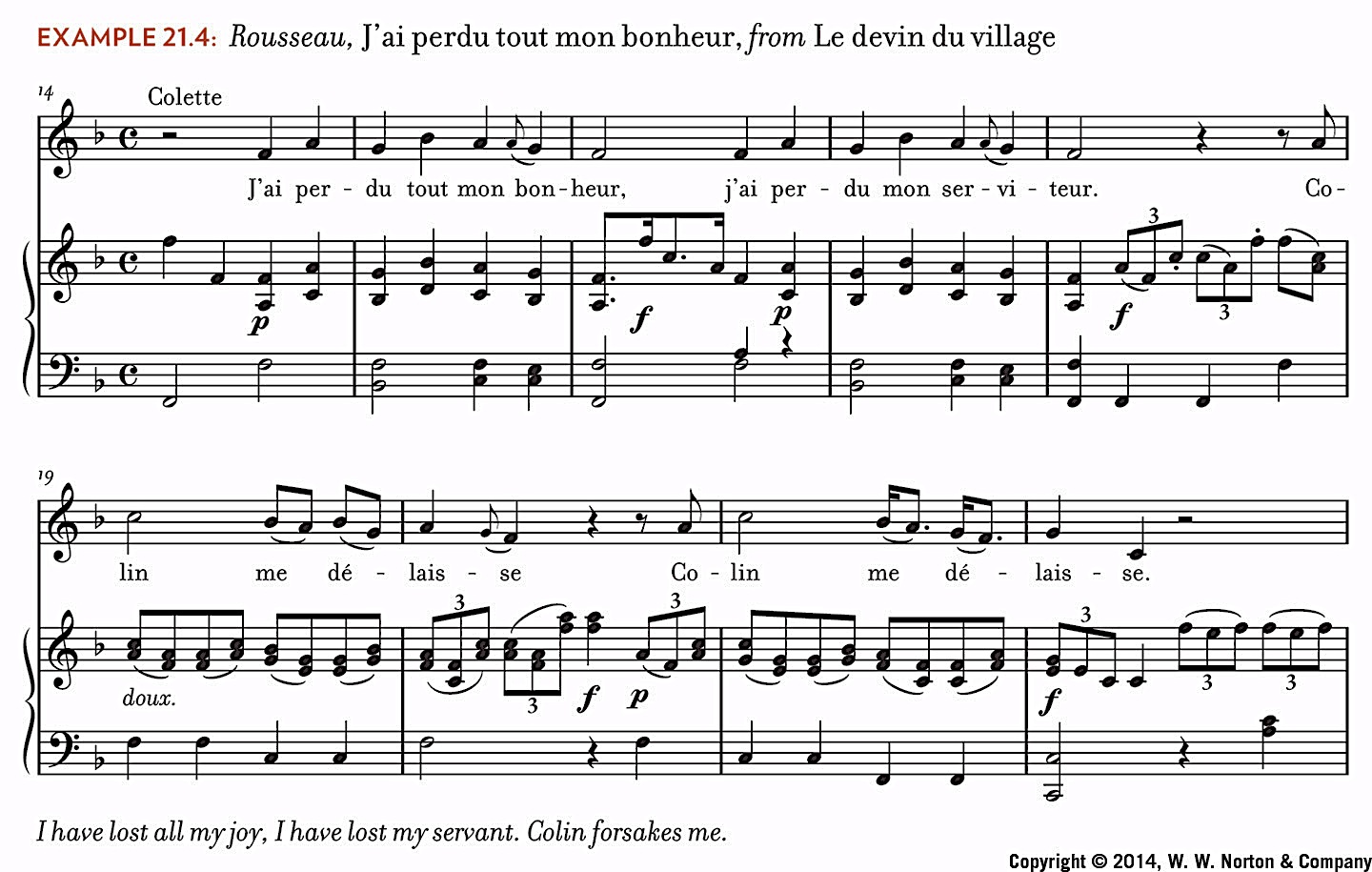
Rousseau, “J’ai perdu tout mon bonheur” from Le devin du village
The British and Scottish Thinkers
Across the Channel, a series of British and Scottish writers were arriving at very different — and, for the future of music, far more consequential — conclusions.
Charles Avison (1709–1770), in his An Essay on Musical Expression (1752–53), argued that music acted directly on the emotions, bypassing the intellect entirely. This was a controversial idea. For Avison, the aim of music was to affect the passions “pleasingly.” He did not completely rule out imitation, but he insisted that it must never sacrifice the essential qualities of melody (“air”) and harmony. If imitation was employed, it should follow the general drift of a poem rather than imitating specific words. When a composer resorted to crude imitative “contrivances,” Avison warned, the listener’s attention was diverted to what was being represented and to the cleverness of the composer’s craft — away from genuine musical expression.
James Beattie, in his Essay on Poetry and Music, as They Affect the Mind (1762, published 1778), was influenced by Avison but pushed further. Beattie described the pleasure of music in what we might call absolute terms: it comes from the notes themselves and can divert us from the cares of life. Crucially, he advocated training — what we would today call music appreciation — arguing that exercising the musical ear, as opposed to remaining an “untutored hearer,” increases the listener’s pleasure. The ear, Beattie declared, is the “supreme judge” of music: the proper arrangement of concords and discords is determined not by theoretical rules but by the ear’s own verdict.
Thomas Twining, a classicist, published Aristotle’s Treatise on Poetry, Translated… in 1789 (second edition 1812). For Twining, the issue of musical imitation was essentially dead. He identified three effects of instrumental music’s expressive power: it delights the ear (the sense), raises the passions (emotions), and stirs the imagination (ideas). Music, Twining argued, is not imitative but suggestive — and what it suggests depends on the individual hearer. He invoked the authority of Aristotle himself: “music, even without words, has expression.” And he quoted the historian Charles Burney’s memorable declaration that instrumental music “is itself the language of the heart and of passion.”
Adam Smith and the Autonomy of Music
The culmination of this British tradition comes, perhaps unexpectedly, from the philosopher and economist Adam Smith (1723–1790). In his Essays on Philosophical Subjects, published posthumously in 1795, Smith no longer expects music to “raise the passions” at all. Instead, music becomes an object of intellectual contemplation — something that can stand entirely on its own. What helps us comprehend music, Smith suggests, is “time and measure,” which give our memory and foresight something to grasp. The relationships within music are inter-musical: its meaning is completely in itself. The subject of instrumental music, Smith concludes, is nothing more — and nothing less — than a “combination of notes.” With this formulation, we have arrived at a fully autonomous conception of instrumental music, one that would resonate through the nineteenth century and beyond.
What began as a crisis — how to explain music without words — ended as a liberation. The aesthetic journey from imitation to expression to autonomy is one of the most consequential intellectual shifts in the history of Western music, and its effects are still with us every time we sit in a concert hall and listen to a symphony, a string quartet, or a sonata, expecting the music to speak for itself.
Romantic Aesthetics of Music
The Romantic Turn
What does it mean for music to be free? For most of Western music history, the answer would have seemed like a strange question — music served patrons, it accompanied worship, it set poetry to sound, it illustrated drama. By the early nineteenth century, however, something had changed, and changed so fundamentally that it amounted to what scholars have called a radical paradigm shift: the idea that music could and should exist entirely on its own terms.
The Romantic period in music spans, roughly, the years from around 1830 to 1900, though the intellectual currents feeding it reach back into the late eighteenth century. Its roots lie, as with so much in German cultural life, in literature: Byron, Scott, Wordsworth, Goethe, Victor Hugo, Balzac — writers who turned against the cool rationalism of the Enlightenment in favor of imagination, feeling, and a longing for transcendence. Romanticism as a cultural movement grew out of this revolt, and in the German-speaking world it developed a particularly intense philosophical dimension. That is why the key figures in Romantic music aesthetics — Kant, Hegel, Schopenhauer, Nietzsche, Hanslick — are all writers working in German, and why understanding their ideas means understanding a broader argument about the nature of mind, spirit, and the limits of reason.
The paradigm shift unfolded in two related but distinct ways. First came the autonomy of music: the gradual emancipation of music from the social function of serving a patron. Haydn, for example, composed what his employer the Esterházy family wanted — symphonies when they wanted symphonies, operas when they wanted operas. By the era of Beethoven, the ideal of the artist as a kind of romantic hero had taken hold. Beethoven became the emblematic figure: a man who composed from inner compulsion, who overcame deafness and personal suffering, whose Eroica Symphony expressed heroic idealism and whose Fifth Symphony drove from the darkness of C minor to the triumphant light of C major. Music was no longer a service; it was a calling.
Second came the liberation of music from subservience to other arts. Recall that as late as Monteverdi, around 1600, the prevailing doctrine was that the word was the master and music its servant. Rousseau in the eighteenth century still held that instrumental music without a text was essentially empty. By the Romantic period, that hierarchy had inverted entirely. Absolute music — pure, self-contained instrumental music, not subordinate to a literary text or program — was now exalted as the highest musical expression. The symphony became, for many thinkers, the pinnacle of artistic achievement.
Within this broad transformation, two aesthetic priorities emerged and competed. The aesthetics of expression held that music’s power lay in its ability to communicate feeling and emotional experience; the listener’s response — their inner life stirred by the music — was central. The aesthetics of form held instead that musical value resided in the structures and inner logic of the work itself, independent of any emotional associations. These two orientations, as we will see, shaped the great debates of the nineteenth century.
Kant and the Sublime
No philosopher is more important for understanding the groundwork of Romantic music aesthetics than Immanuel Kant (1724–1804), even though Kant himself was, by his own account, somewhat perplexed by music. His Critique of Judgement (1790) is a late eighteenth-century work, but its influence on subsequent thought stretched well into the twentieth century.
Kant’s discussion of music is, as scholars have noted, patchy — he was not a music theorist, and his personal relationship with music was ambivalent. He famously compared music’s relationship to its neighbors to the way a smell intrudes on those nearby: one cannot easily escape it, and in that sense it commits a kind of “want of civility,” a “violence to the freedom of others.” Yet despite this rather grumpy beginning, his ideas about music’s place in the system of the arts proved enormously productive.
Kant organized the arts into three broad categories: the arts of speech (rhetoric and poetry), the formative arts (sculpture, architecture, painting — the so-called plastic arts), and the arts of beautiful play of sensations, which includes music. Within this third category, he distinguished between two possibilities depending on the listener’s perception: agreeable sensation, which yields merely pleasurable but aesthetically insignificant experience, and the beautiful play of sensations, which constitutes genuine fine art.
Music’s position in Kant’s hierarchy is telling and, in retrospect, productively unstable. On the one hand he ranks it second only to poetry with respect to “charm and mental movement” — that is, its capacity to engage the emotions and produce vivid experience. On the other hand, he regards it as the lowest of the arts with respect to “culture supplied to the mind,” since it, in his view, merely plays with sensations rather than engaging the intellect. It provides enjoyment, but not — or at least, not primarily — genuine intellectual experience.
More consequential still is Kant’s distinction between dependent beauty and free beauty. Dependent beauty is what we find in almost all the arts: painting, literature, vocal music, sculpture — all of these can express aesthetic ideas, can carry meanings that appeal to the mind and spirit, and can serve some representational or expressive function. Free beauty, by contrast, is beauty that is purely formal, dependent on nothing outside itself for its aesthetic significance. Kant’s striking claim is that instrumental music belongs to the category of free beauty, precisely because it cannot, by his lights, express aesthetic ideas in the way a painting or a poem can. The consequence is double-edged: instrumental music is in one sense elevated — it has a purity, an independence from external meaning — but in another sense it is diminished, since for Kant it is precisely the capacity to embody aesthetic ideas that marks the work of genius. Free beauty, for all its formal purity, is not a product of genius in the way that great poetry is.
What Kant does offer that is forward-looking is his insistence that form — the structural organization of the work, as distinct from its content, its meaning, or any purpose external to it — is the primary element of aesthetic value. Form, for Kant, is a property of the mind; it is the mind that imposes form upon the material world and in doing so makes aesthetic experience possible. This elevation of form would be taken up in different ways by almost every major aesthetic thinker who followed him.
Hegel and the Inwardness of Music
If Kant’s attitude toward music was at best ambivalent, Georg Wilhelm Friedrich Hegel (1770–1831) offered a substantially more positive assessment — one that placed music near the very apex of the arts. Hegel was born in the same year as Beethoven, though he died four years after him, and the ideas contained in his Lectures on Fine Arts (1835) — published posthumously from students’ notes — reflect an age in which music had risen enormously in cultural prestige.
Hegel’s disagreement with Kant runs deep. Where Kant made form the primary criterion of aesthetic value, Hegel was emphatically an anti-formalist: for him, music is true art only when it possesses spiritual content and genuine expression. Art’s fundamental purpose, he argued, is the disclosure of truth and the enhancement of understanding. The content of art is what he called the “sensuous appearance [Scheinen] of the Idea” — the work addresses us through our senses, but what it ultimately communicates is something that appeals to mind or spirit, the Concept (Begriff) in its concrete, perceptible form.
Central to Hegel’s thought is his historicism — the conviction that ideas and norms are not fixed and eternal but historically conditioned, culturally determined, and always in development. This development, for Hegel, reflects the movement of Geist (Spirit) through history, a progressive self-realization of mind in the world. The arts, he argued, are not timeless but belong to their historical moment.
From this standpoint, Hegel distinguished three great types of art corresponding to different historical stages. Symbolic art, exemplified by architecture, is the earliest stage: here the Idea is not yet fully at home in its sensuous material; the material remains heavy, opaque, not fully spiritualized. Classical art, exemplified by Greek sculpture, achieves a perfect balance between Idea and material — the human body becomes the ideal vehicle for the expression of spirit. But the third stage, which Hegel calls Romantic art (encompassing all post-classical art: painting, music, and poetry), marks a new development in which the balance tips: spiritual inwardness becomes so dominant that it begins to turn away from sensuous form altogether.
This is the key to Hegel’s account of music. The progression from architecture to sculpture to painting already shows a gradual withdrawal from the heavy, spatial materiality of stone and bronze toward the two-dimensional, more inward world of the painted surface. Music takes this process further: it exists not in space at all but solely in time, unfolding and then vanishing, each sound “constantly dying away” — what Hegel calls a kind of self-negation. Music, he declares, is the art of the soul. It is the most inward of all the arts, the art most emancipated from external reference, most closely resembling pure thinking.
There is a notable irony, however, in Hegel’s musical tastes. For all his philosophical elevation of music, he was deeply conservative in practice. He did not respond well to the abstract and dramatic music of his contemporaries — the sudden dynamic contrasts, unexpected harmonic shifts, and juxtaposed emotional states that we find in Haydn, Mozart, and above all in Beethoven. He complained of “today’s dramatic music” with its “violent contrasts,” opposing passions thrust into a single work. His philosophical framework proclaimed music the art of spiritual inwardness; his actual listening experience apparently could not keep pace with the music his age was producing.
Nevertheless, Hegel’s central claim — that music is the art form most perfectly suited to express what cannot be expressed spatially or materially, the “inwardness of self-consciousness” — would prove profoundly influential, preparing the ground for Schopenhauer’s even more radical elevation of music as the direct voice of the Will.
Schopenhauer: Music as the Will
It would be difficult to overstate the influence of Arthur Schopenhauer (1788–1860) on the aesthetics of late Romanticism. Wagner read him and was transformed by him; nearly every significant German composer and artist of the second half of the nineteenth century came under his spell. Yet Schopenhauer’s great work, The World as Will and Representation (Die Welt als Wille und Vorstellung, 1819; second edition 1844), made almost no impact for several decades after its initial publication. It was only in the 1850s and 1860s that Schopenhauer’s ideas began to circulate widely, arriving precisely when late Romanticism was taking shape.
Schopenhauer drew his influences from a striking range of sources: Kant, above all, but also Plato, and the ancient Hindu scriptures together with Buddhist thought — as filtered, inevitably, through the lens of a German intellectual of the early nineteenth century. His central metaphysical insight is both simple and devastating: behind the world as we perceive it — the world of objects, appearances, representations — lies a single, blind, purposeless force that he calls the Will (Wille). The Will is not a conscious intention; it is an unconscious striving, an insatiable drive that underlies all things. Every organism, every physical force, every human desire is ultimately an expression of this ceaseless Will. And since the Will can never finally be satisfied, existence is characterized by constant lack of fulfillment, conflict, and suffering.
The correspondence with Buddhist thought is clear: desire itself is the source of suffering. And Schopenhauer’s aesthetics follow from this diagnosis. Art offers one of the few avenues of temporary release from the compulsion of the Will. When we are absorbed in aesthetic experience, we become, momentarily, pure knowing subjects rather than striving, desiring individuals. The grip of the Will is loosened. In this sense, art can lead us toward what Schopenhauer calls “perfect resignation” — the giving up of all willing.
Schopenhauer ranks the arts in a hierarchy parallel to his metaphysical scheme, from architecture (lowest) through sculpture, painting, and tragic poetry (highest). But music occupies a unique position: it stands entirely apart from this hierarchy. While the other arts represent the Ideas — the Platonic forms or essences that stand behind individual objects — music does something more fundamental. Music is, for Schopenhauer, an immediate copy of the Will itself. It does not represent the phenomenal world of appearances at all; it bypasses the world of Ideas entirely and gives direct expression to the Will’s innermost nature. It speaks a language that reason cannot understand, yet which the entire being comprehends.
The practical upshot of this is that music possesses an almost terrifying power. It is “the most capable of freeing us from the force of the Will” precisely because it is not tied to representation or imagery. It “reproduces the movements of the innermost being but remote from the misery of the phenomenal world” — it lets us feel the pulse of existence itself without being trapped in any particular suffering. And since the Will is universal, music expresses not any particular person’s emotions but emotions in the abstract, “in their form” as Schopenhauer says. This is close to what later generations would call the aesthetics of expression, but with a crucial qualification: the feelings expressed are not biographical, not the composer’s private feelings, but something more like the emotional shape of existence as such.
Schopenhauer was, accordingly, a firm advocate of absolute music — the pure language of tones, instrumental music free of literary program or textual association. He was ambivalent about opera and skeptical of program music, since both attached music to something external, to representation rather than pure Will-expression. There is a rich irony here: Wagner, who was profoundly influenced by Schopenhauer’s philosophy, composed music-drama — the very hybrid form Schopenhauer was most skeptical of. And Schopenhauer, for his part, did not return the admiration. He did not find Wagner’s music to be the pure language of tones he had theorized; their aesthetic sympathies, despite Wagner’s veneration, never fully aligned.
Wagner and the Total Artwork
Richard Wagner (1813–1883) was, above all else, a composer — but he was also one of the most prolific and combative musical theorists of the nineteenth century. His aesthetic writings, particularly Opera and Drama (1851) and the essay The Artwork of the Future (1850), articulate a vision of musical art that set the terms of debate for the entire second half of the century.
Wagner’s central concept is the Gesamtkunstwerk — the “total artwork,” or more literally, the “collective artwork of the future.” The idea was that the highest form of art would be a synthesis of all the arts: poetry, music, gesture, visual spectacle, and drama unified into a single, indivisible whole. Wagner rejected what he saw as the degradation of conventional opera, in which the music merely served as a vehicle for vocal display and the drama was an afterthought. His vision was the reverse: a music-drama in which every element — the orchestra, the voice, the text, the staging — was fully integrated into a seamless expressive totality.
Central to this integrated musical-dramatic language was the leitmotiv (leading motif), a short, distinctive musical phrase associated with a particular character, object, emotion, or idea in the drama. Rather than serving as mere illustration, the leitmotiv became a structural and expressive element woven through the entire fabric of the work, capable of transformation, combination, and development as the drama progressed. When a character sings about one thing while the orchestra presents a leitmotiv associated with something else entirely — another character, a hidden desire, a looming fate — the gap between what is said and what is musically declared becomes the very substance of dramatic meaning.
Wagner coined the term absolute music, though with a meaning that would later be turned against him. For Wagner, absolute music — meaning music cut off from drama, poetry, and all human significance — was an impoverishment, a kind of musical abstraction that had reached its limit in Beethoven’s symphonies. Beethoven, he argued, had pushed purely instrumental music to the point where it could go no further; the next step was necessarily the music-drama, the union of music with poetic and theatrical meaning. The symphony had been transcended.
It was precisely this vision that made Wagner the lightning rod for one of the great aesthetic battles of the nineteenth century — the war with Eduard Hanslick over the nature and purpose of musical beauty.
Hanslick: The Beautiful in Music
Eduard Hanslick (1825–1904) occupies a peculiar position in music history: he was simultaneously the most powerful music critic in the German-speaking world for roughly fifty years and the author of what remains perhaps the most rigorous and influential short treatise on musical aesthetics ever written. His On the Musically Beautiful (Vom musikalisch-Schönen, 1854) went through numerous editions during his lifetime, and its central arguments still provoke debate today.
Hanslick was the first music professor at the University of Vienna, and his critical opinions carried enormous weight. He championed Brahms and Schumann and regarded Wagner and Liszt with contempt — a position that made him, in the eyes of Wagner’s supporters, the great enemy of musical progress. The hostility was mutual and personal. Wagner caricatured Hanslick as the pedantic critic Beckmesser in Die Meistersinger von Nürnberg, and the polemic between the two camps — the so-called War of the Romantics — became one of the defining cultural conflicts of the second half of the nineteenth century.
The argument of On the Musically Beautiful can be stated simply, though its implications are far-reaching: the aesthetically specific content of music — what makes music music rather than something else — cannot be the representation or expression of feelings. Hanslick was not denying that music can arouse feelings in listeners, or that listeners often experience strong emotions when they hear music. What he denied was that the communication or expression of determinate emotional content is music’s defining aesthetic function, or that the standard by which we should evaluate music.
His attack on what he scornfully called the “worm-eaten aesthetic of feeling” was aimed at listeners who approach a symphony by constructing little stories or pictures in their minds, or who measure the music’s worth by the intensity of their own emotional response. Feelings, he argued, are phenomena like any others; they have no special privilege in the domain of music. If music can convey anything emotional, it is only the dynamic aspects of feelings — the motion, the rise and fall, the tension and release — but not the specific emotional content itself. A musical figure might be agitated in a way that resembles anger, or yearning, or joy, but nothing in the music itself determines which of these it is. The emotional identification always comes from the listener, not the music.
What, then, is the proper content of music? Hanslick’s famous answer is that the content and object of music are “forms set in motion by sounds” — the German tonend bewegte Formen, “tonally moving forms.” The beauty of music is not dependent on anything outside the music itself: no feeling, no literary idea, no program, no extramusicall reference. Musical beauty is concrete, sensuous, and immediate — it inheres in the actual sonic fabric of the work, in the relationships between tones, rhythms, harmonies, and forms as they unfold in time. This is why Hanslick insists that musical beauty is inseparable from its specific technical realization: you cannot say what the music “means” apart from the notes themselves, any more than you could describe a painting’s visual beauty in non-visual terms.
A crucial nuance in Hanslick’s position concerns the relationship between form and content. He was not, despite how he is sometimes read, arguing that music is nothing but empty formal structure. He insisted that form is not separate from content in music — the musical form is the content, the “immanent” substance of the work, its inner organic logic. What he was opposing was the idea that this inner substance is translatable into emotional or programmatic terms. The form of the work is its own kind of meaning, not a vehicle for some other kind of meaning.
Hanslick also addressed the question of whether music is a language. His answer was precise: music is language-like but not a language. Like language, music unfolds in time, has syntactic organization, and can seem to be “saying” something. But unlike language, it cannot denote, cannot refer, cannot predicate. It moves us without telling us anything. This distinction was crucial for his case against both Wagner (who wanted music to be the vehicle of specific dramatic meaning) and the programmatic tradition generally.
It is worth noting the curious historical relationship between Hanslick and the concept of absolute music. The term itself was actually coined by Wagner — who used it critically, to describe the impoverishment of music cut off from drama and human meaning. Hanslick took the concept, stripped it of Wagner’s negative valuation, and made it the cornerstone of a positive aesthetics. For Hanslick, absolute music — purely instrumental music, answerable to nothing outside itself — was not the music of abstraction and poverty but the music of the highest aesthetic achievement.
Nietzsche: Apollo and Dionysus
The third major figure of late Romantic aesthetics, Friedrich Nietzsche (1844–1900), came to music philosophy by a very different route. A classical philologist by training, he was appointed professor at the University of Basel in Switzerland at the remarkably young age of twenty-four, in 1869. His first book, The Birth of Tragedy from the Spirit of Music (Die Geburt der Tragödie aus dem Geiste der Musik, 1872), is not a work of musicology but of cultural diagnosis — an attempt to understand the origins of Greek tragedy, and through that, the predicament of modern culture.
The spark that ignited Nietzsche’s thinking was a performance. In 1868, he heard Wagner’s Tristan und Isolde — specifically the Prelude — and the experience was, by his own account, overwhelming. He felt that Wagner’s music was realizing something his own philosophy was reaching toward. For nearly a decade, Nietzsche was Wagner’s disciple and ally, and The Birth of Tragedy was, among other things, a philosophical vindication of Wagnerian music-drama.
Nietzsche’s framework is built on a fundamental opposition between two ancient Greek deities and the artistic principles they represent. Apollo, the god of light, reason, and beautiful form, presides over the Apollonian dimension of art: restraint, measure, order, self-control, objectivity, clarity. Apollonian art is the art of beautiful surfaces — sculpture, the plastic arts, the world of images and forms. Its instrument, significantly, is the kithara, the plucked string instrument that Plato had approved. The Apollonian ideal is a kind of luminous dream — life shaped into beautiful, comprehensible form.
Dionysus, the god of wine, frenzy, and dissolution, presides over the Dionysian dimension: ecstasy, the breaking of norms, subjectivity, sensuality, emotional abandon, the shattering of individual boundaries in collective rapture. Dionysian art does not create beautiful forms but dissolves them; it does not individuate but reunites the individual with the primal ground of existence. Its instrument is the aulos — the double reed instrument that Plato had distrusted and banned from his ideal republic, precisely because of its capacity to provoke irrational, ecstatic states.
For Nietzsche, music is the Dionysian art par excellence: it is “imageless art,” non-representational, non-spatial, and in that sense the opposite of sculpture or painting. It does not present images of the world but plunges beneath images altogether, touching the primordial will — here Nietzsche’s debt to Schopenhauer is explicit. Tragedy, the highest Greek art form, was born from the synthesis of these two impulses: the ecstatic Dionysian musical chorus that embodied the primal unity of existence, and the Apollonian dream-world of scenic images and characters that gave that ecstasy a form the intellect could contemplate. Neither principle alone was sufficient; the greatness of tragedy lay in their fraternal union, their creative tension.
The tragedy of Greek tragedy, for Nietzsche, was its destruction. He blamed Euripides, and behind him the philosopher Socrates, for replacing the Dionysian spirit with a new ideal: theoretical man, the rational, optimistic being who believes that existence can be corrected and understood through reason. Socrates killed tragedy with the spirit of reason, and Euripides drove the Dionysian music out of drama, replacing ecstatic participation with intellectual argument. “Death of tragedy through the spirit of reason” was Nietzsche’s indictment.
But Nietzsche’s book was ultimately hopeful, even triumphant in tone — because he believed he saw the rebirth of tragedy happening before his eyes in the music-dramas of Wagner. Wagnerian music-drama, as he understood it, was the modern restoration of the ancient synthesis: the Dionysian power of the music (especially the orchestra, the direct voice of the primordial Will) united with Apollonian dramatic form. The fraternal union of Apollo and Dionysus would redeem modern culture from its Socratic rationalism.
The break, when it came, was dramatic and bitter. In 1878, after hearing Parsifal — Wagner’s final music-drama, suffused with Christian mysticism and the imagery of redemption — Nietzsche turned against him. Wagner, he now felt, had surrendered the Dionysian spirit for a sentimental, life-denying religiosity. The later Nietzsche became one of Wagner’s most withering critics, authoring The Case of Wagner in 1888 and, in a striking reversal, declaring that the genuinely Dionysian work of his era was not Wagner’s Tristan but Bizet’s Carmen — light, Mediterranean, life-affirming, free of romantic fog and Christian bad conscience.
Coda: The Battle of Aesthetics
Taken together, the five thinkers examined in this lesson map the main fault lines of Romantic music aesthetics. Kant established the terms: the distinction between form and content, the peculiar freedom of instrumental music, the primacy of formal properties in aesthetic judgment. Hegel pushed toward expression and spirit, elevating music as the art of inwardness, the Romantic art form par excellence. Schopenhauer radicalized Hegel’s insight by identifying music not merely with spiritual inwardness but with the Will itself — the metaphysical ground of all existence — and in doing so gave late Romantic composers a philosophical vocabulary for understanding why their art felt so immense.
Wagner translated these ideas into compositional practice and cultural program: the Gesamtkunstwerk, the music-drama, the leitmotiv, the claim that music united with drama could achieve what neither could alone. Hanslick countered with a rigorous formal aesthetics: music’s beauty is in its sonorous forms, not in the feelings it may or may not express, and the highest music is the music most fully emancipated from external reference. And Nietzsche, beginning as Wagner’s champion and ending as his most eloquent critic, introduced a mythological framework — Apollonian clarity against Dionysian ecstasy — that would outlast the specific debates of the nineteenth century and continue to shape how we think about the fundamental tensions in Western art.
What resonates across all five thinkers, despite their disagreements, is the shared conviction that music matters — that it is not mere entertainment or agreeable sensation, but something that touches the deepest structures of human experience and perhaps of existence itself. The question they argue about is not whether music is important, but why.
Early Twentieth Century — A New Sound and a New Aesthetic
Introduction: Dreamers Beyond the Tradition
What unites Ferruccio Busoni, Luigi Russolo, and Edgard Varèse — three very different figures from the early twentieth century — is a shared disposition of impatience. Each of them was chafing against the tradition he had inherited and dreaming of possibilities that lay beyond it. Busoni thought carefully about different ways of dividing the octave, arguing that the major-minor system was a profoundly impoverished fraction of what harmony could be. Russolo was far more radical and essentially wanted to throw out the whole edifice: life had changed, he insisted, and music should sound like the world we actually inhabit — dynamic, machine-driven, noisy. Varèse dreamed on the grandest scale of all, imagining music as a kind of four-dimensional sound mass moving through space, and envisioning instruments not yet built that would realize a composer’s thoughts with perfect precision, unadulterated by any performer’s interpretation. Each one was a visionary. Each one was looking, urgently and imaginatively, for some way forward.
Ferruccio Busoni: Liberating the Octave
Ferruccio Busoni (1866–1924) belongs to the same generation as Debussy, Sibelius, and Erik Satie — his dates in fact align almost exactly with Satie’s, both born in 1866, Busoni dying one year before him. He was one of the most prominent musicians of his era, recognized simultaneously as a composer, a virtuoso pianist, and a conductor who toured Europe, Scandinavia, and the United States. He was more or less headquartered in Germany, which is why his theoretical work, the Sketch of a New Aesthetic of Music, appeared in German in 1907. His actual music, it is worth noting, remained deeply rooted in the Romantic tradition — his Indian Fantasy for Piano and Orchestra is hyper-late-Romantic in idiom — which makes the radicalism of his theoretical ideas all the more striking. He was dreaming of liberation while still, in practice, working within the very tradition he critiqued.
The Sketch opens with a vision of music as something fundamentally free. Busoni thinks of music like a child: naturally free, but subjected to the rules of adults who have no business imposing them. Music “floats on air,” he writes — it is incorporeal, weightless, and should resist being pinned down to representation or description of the external world. In rejecting program music, he is arguing for a purity of musical experience that transcends narrative or pictorial function.
When Busoni turns to form, his argument becomes pointed. Musical forms such as sonata form were, he concedes, natural products of their age — they sprang organically from the thoughts and sensibilities of the eighteenth century, and they worked beautifully then. But they have since been retained not because they still live but because the Gesetzgeber — the “lawgivers” — cling to them as symbols of authority. Busoni reaches for a striking image: the death mask, cast in plaster from a real face but now, having passed through too many hands, no longer retaining any trace of the life it once recorded. Form, he argues, has become precisely such a mask. It is a mold into which content is poured, but the content of the present age no longer fits the mold. What he calls true absolute music — as distinct from the “absolute music” theorized by earlier writers — is music that stands in active opposition to inherited form, refusing to be contained by it.
On the question of tradition more broadly, Busoni is uncompromising: “Whoever follows prescribed rules ceases to be a creator.” Real creation must be independent of tradition and must move toward genuine individuality. This was, as he acknowledged, not a new sentiment — Monteverdi had needed to break rules to express what he needed to express, three hundred years earlier. What was newer was where Busoni’s argument went next, into a sustained critique of the Western tone system itself.
That system, he writes, is “profoundly limited” and “lagging behind.” He identifies two fundamental problems. First, there is the tyranny of fixed tuning: keyboards must be tuned once and then left, and everything else must conform to their fixed pitches, even though singers and string players are naturally capable of far more flexible intonation. Second, and more philosophically, there are only two scales — major and minor — and these have accumulated an entirely spurious symbolic meaning: major as happy, minor as sad. Busoni rejects this opposition as a trained habit of perception, not a natural fact. He then goes much further, demonstrating that from the existing seven-note scale one can derive 113 different scales (plus transpositions), and that beyond these lie microtones — divisions of the tone into thirds and sixths. The “eternal harmony,” he insists, is the infinitely divisible octave. He even footnotes an invention from 1906, the dynamophone (or Telharmonium), which produced scientifically precise tones through electrical means — evidence that he, like Russolo and Varèse after him, was already looking toward machines as the means of musical liberation. His younger Czech contemporary Alois Hába took some of these ideas directly into practice, writing pieces for a specially constructed quarter-tone piano — an instrument that required the entire piano to be retuned before a performance could happen.
Luigi Russolo and the Art of Noises
Where Busoni argued for an expansion of the tonal system from within, Luigi Russolo (1885–1947) argued for its wholesale replacement. Russolo came to music not from the conservatory but from painting: he was a prominent figure in the Italian Futurist movement and had produced a substantial body of work before, in 1913, he issued L’arte dei rumori — The Art of Noises: A Futurist Manifesto. The manifesto represents one of the most radical aesthetic positions in the history of Western music.
The Futurists, under the banner of their founder Filippo Marinetti, had declared a “desire to renovate all things.” For Russolo, the collapse of traditional tonality — which he understood as a historical rupture already underway — opened the door to something entirely new. The Romantic ideal had held that music was a world apart, a realm transcending everyday life and transporting the listener somewhere elevated and removed. Russolo rejected this root and branch. Life was no longer like that. The modern world was saturated with the sounds of machines — factories, automobiles, trains, explosions — and music, still clinging to its refined concert-hall sounds, had become extraneous to that life. It no longer awakened emotion in the listener because it no longer sounded like anything the listener actually experienced. “Musical sound is too limited in its variety of timbres,” he argued; it had nothing like the infinite timbral variety of noise.
Russolo’s proposal was to embrace noise as the new material of music. Every noise, he observed, has a discernible pitch — or at least a dominant pitch — and an identifiable timbre. These properties could be organized just as musical sounds are organized: with fixed pitches, distinguishable timbres, and rhythmic structure. The result would not be imitation of the sounds of life but, as he put it, “purely acoustic enjoyment from combinations of noises.” The art of noises was not sound effects. It was composition with the full sound-world of modern industrial life as its palette.
To realize this vision, Russolo designed and built a series of new instruments he called the intonarumori — literally “noise intoners” or noise machines. He proposed a Futurist orchestra organized around six families of characteristic noises, each family requiring its own class of instruments. These were not conventional instruments modified but wholly new sound-producing devices, built specifically to generate the growls, crackles, rustles, crashes, and booms of the industrial world.
The paintings Russolo made during this period embody the same aesthetic: House + Light + Sky (1914) and Dynamism of an Automobile (1914) both capture the energy, speed, and sensory overload of modern life in visual terms — the very qualities he was simultaneously pursuing in sound.
Simultaneous Movements of a Woman (1913), painted in the same year as the manifesto, layers multiple positions of a moving figure onto a single canvas — the eye receives all moments at once, just as the ear receives a simultaneity of noise-streams. Impressions of Bombardment, Shrapnel and Grenades, from the 1920s, came after the First World War had rendered the idea of explosive noise grimly literal.
Russolo was connected with Busoni through the broader Futurist milieu: the painter Umberto Boccioni — whose The City Rises (1910) is often cited as the first truly Futurist painting, depicting a runaway horse and struggling workers in a blur of kinetic energy — actually painted a portrait of Busoni, and the two figures knew each other well.
In 1914, Russolo, Marinetti, and the musician Ugo Piatti posed with the intonarumori and gave the first public concert of noise intoners. Within the same year they were performing alongside a conventional orchestra — a remarkable willingness on the part of audiences, a hundred years ago, to engage with something utterly unprecedented.
His piece Risveglio di una città (“Awakening of the City”), composed for the intonarumori, gives a vivid sense of what he was after: not melody, not harmony in any traditional sense, but a sonic landscape — layered, timbral, alive.
Russolo, “Awakening of the City” — performed on reconstructed intonarumori
Demonstration of the intonarumori
Edgard Varèse: Music as Organized Sound
Edgard Varèse (1883–1965) was born in France but arrived in New York City in 1915 and eventually became an American citizen. He founded the International Composers’ Guild in New York, an organization dedicated to presenting the work of progressive composers in the early twentieth century. As a composer, he carried out one of the most decisive moves of the era: the dethronement of pitch as the primary generator of musical form. In his works, rhythm and timbre took over that structural role, and he famously defined music simply as “organized sound” — a definition deliberately broad enough to encompass the noise world that Russolo had opened up. He was deeply influenced by Debussy’s focus on timbre and non-developmental approach, by Schoenberg’s chromatic saturation, by Stravinsky’s layered block construction, and — crucially — by the Italian Futurists’ dream of music for the urbanized mechanical world.
Varèse’s Ionisation (1931) is one of the founding documents of percussion-ensemble music: a work for thirteen performers playing approximately thirty-six instruments, in which pitch as an organizing principle is almost entirely absent for most of the piece. Form here emerges not from tonal motion but from the interaction of rhythmic layers and timbral contrasts — organized sound, exactly as defined.
Varèse, Ionisation (1931) — conducted by Pierre Boulez
“New Instruments and New Music” (1936)
Varèse’s essays, collected under the title “The Liberation of Sound” and compiled by a student, document the development of his thought across several decades. In the first, a lecture from 1936, he calls for an embrace of the changing world — not a retreat to the past but a commitment to living toward the future. He characterizes the present moment as a “new primitive era”, deliberately invoking early medieval musicians who were grappling with how to notate music at all, working out the most basic tools of their craft from scratch. The analogy is pointed: we are, Varèse argues, at an equally foundational moment, and the old tools will not serve.
The key, he argues, lies in the collaboration of art and science. Science can allow music to change with the times. He even imagines a kind of musical laboratory — a controlled environment for exploring sound possibilities — that anticipates the electronic music studios that would emerge after the Second World War. What he needs from new instruments is the ability to write music exactly as he conceives it. He conceives of music in terms of sound-masses and shifting planes — solid, sculptural constructs in acoustic space rather than lines of melody or blocks of harmony. He hears music as having four dimensions: the familiar horizontal (melody) and vertical (harmony), but also the dynamic swelling or decreasing of sound intensity, and a fourth — what he calls “sound projection” — a kind of journey into space, like a beam of sound moving through the room.
Integral to this conception are what he calls “zones of intensities," differentiated from each other by timbres and dynamics. Timbre and color, in his view, are not ornamental additions to form but constitutive of it — they are form-creating, embedded in the structure rather than applied to it. Form itself he redefines as the interaction of “attractive and repulsive forces” — language borrowed from physics, carrying a suggestion of electromagnetic fields rather than architectural containers. He envisions a machine instrument that a composer could simply program with exact specifications and that would produce the result without any mediating human performer. Such an instrument would require a new notation — seismographic in its precision, capable of translating the composer’s conception directly into sound.
“Music as an Art-Science” (1939)
In his 1939 lecture, Varèse reaches back to the medieval university curriculum — the trivium (grammar, rhetoric, dialectic) and the quadrivium (arithmetic, geometry, astronomy, and music) — to make an argument about music’s dual nature. Music was always understood as both an art and a science. The trouble with contemporary musical education, he contends, is that it has become dominated by the trivium, by the “grammar” of music — its rules of construction, its inherited syntax — at the expense of the quadrivium’s spirit of inquiry and experiment. Music is, at its root, a physical phenomenon, and treating it as grammar rather than physics misses something fundamental.
Composition, he insists, depends on the “inner ear” — what he calls the “ear of imagination” — not on recycling the sounds and laws of the past. It requires irreverence and bold experimentation. The artist, he argues, neither runs ahead of the times nor falls behind them: the artist crystallizes the age, giving precise form to the sensibility of the present moment.
For his own compositional conceptions, he dreams of a sound-producing machine — not a sound-reproducing one, but a machine that generates new sounds — that would realize his music with total fidelity: “Whatever I write, whatever my message, it will reach the listener unadulterated by interpretation.” He lists some eight advantages such a machine would offer, including liberation from the arbitrary tempered system, the possibility of any subdivision of the octave, and access to registers and timbres unavailable to conventional instruments. By 1958, some of this was becoming real: he used magnetic tape for his Poème Électronique, composed for the Brussels World’s Fair and performed through loudspeakers in Le Corbusier and Xenakis’s Philips Pavilion. He lived until 1965, long enough to encounter the first synthesizers and early computer music systems — prescient even in his old age.
“Rhythm, Form and Content” (1959)
The final lecture, from 1959, finds Varèse clarifying and correcting. He had been criticized, and he wanted to set the record straight. On the question of electronic instruments: he was not proposing the destruction of existing instruments. Every new instrument in the history of Western music has been additive — like a graft onto a living plant, adding without destroying. The rich tradition of European music was built precisely through the constant addition of new instruments, and electronic instruments belong to that tradition rather than opposing it. And do not, he adds with characteristic directness, expect miracles: electronic instruments can only produce what you put into them.
The deeper subject of the lecture is rhythm and form — which he names as still the most important unsolved problems in music. By rhythm, he does not mean mere meter or accent. Rhythm gives life. It holds a piece together. It is the generator of form, operating at a level far more fundamental than beat patterns. And form itself, in his mature understanding, is not a mold to be filled with content but the result of a process — like the growth of a crystal. He quotes a Columbia professor of mineralogy: “Crystal form itself is a resultant rather than a primary attribute — it is the consequence of the interaction of attractive and repulsive forces and the ordered packing of the atoms.” Form is not imposed from without; it grows from within. Even the composer, Varèse suggests, may not know what form the work will ultimately take. The work discovers its own form. And because form emerges from the same forces that generate the content, the two are finally not distinct at all: form and content are one.
In making this argument, Varèse enters a long-standing philosophical debate about the relationship between form and content — the same debate that Busoni had engaged from the opposite end, arguing that old forms had become empty containers. Both men were dissatisfied with inherited containers. Both were looking for a music that would grow organically from the inside out, shaped by the forces of the present age rather than the molds of the past. And Russolo, in his way, was after the same thing — pulling music out of the concert hall and into the street, into the factory, into the full acoustic reality of the modern world.
Together, these three figures mark a decisive turn. The tradition they inherited was not bankrupt to them in the way it might have seemed to a conservative critic: they knew it, loved parts of it, and argued with it seriously. But they each looked beyond it with a clarity and an urgency that would echo through the rest of the twentieth century — in Cage’s exploration of noise as music, in electronic and computer music, in the entire subsequent history of music that asks: what counts as sound, and what counts as music, and who gets to decide?
The Second Viennese School
Vienna ca. 1900: A City of Scandal and Inwardness
To understand the Second Viennese School, you first need to understand the city that produced it. Vienna around 1900 was a place of extraordinary creative tension — a metropolis where a severely conservative concert-going public coexisted, not peacefully, with a generation of revolutionary artists. The visual arts had Gustav Klimt; the concert hall had Gustav Mahler, one of the great conductor-composers of the age and an early, energetic supporter of the young composers we will study here. When Mahler died in 1911, Arnold Schoenberg was said to be devastated. And beyond the concert hall, Sigmund Freud had published The Interpretation of Dreams in 1900, opening the door to the unconscious — the idea that beneath the surface of rational thought lay a churning interior life that demanded expression. These forces collided in a city already prone to what contemporaries called Skandalkonzerten: concerts that ended in riots. It was not only in Paris, with the premiere of Stravinsky’s Rite of Spring in 1913, that new music provoked physical confrontations. It was happening in Vienna several years earlier.
Out of this volatile environment emerged the artistic movement known as Expressionism, which Wassily Kandinsky described as the pursuit of “pure inwardness” — art stripped of decorative surface and aimed directly at the raw inner life of the artist. Kandinsky led a group called Der Blaue Reiter (The Blue Rider), named after one of his own paintings, which flourished between about 1911 and 1914.
The composers of the Second Viennese School were not merely contemporaries of this artistic ferment — they were participants in it. The name “Second Viennese School” itself carries enormous weight, since the first such school is generally understood to be Haydn, Mozart, and Beethoven. To be associated with that lineage was to claim a place in the central tradition of Western art music — and that claim is entirely deliberate.
The Second Viennese School consists of three composers: Arnold Schoenberg (1874–1951) and his two students, Alban Berg (1885–1935) and Anton von Webern (1883–1945). Together they broke from tonality around 1908–1909, developing what is often called free atonality, and Schoenberg later formalized a new compositional framework known as twelve-tone composition — or, as he preferred, composition with twelve tones related only to one another. What is crucial to understand about these composers — and what distinguishes them sharply from the radical futurists we encounter in other parts of this course — is that they did not see themselves as destroying a tradition. They saw themselves as continuing it. They spoke about the dissolution of tonality in evolutionary terms, as something that had been happening within the music of Wagner, Strauss, Mahler, and Debussy for decades, and which was simply following its natural course.
Arnold Schoenberg — “Wer bin ich / Who I am,” Arnold Schönberg Center (2019)
Arnold Schoenberg (1874–1951)
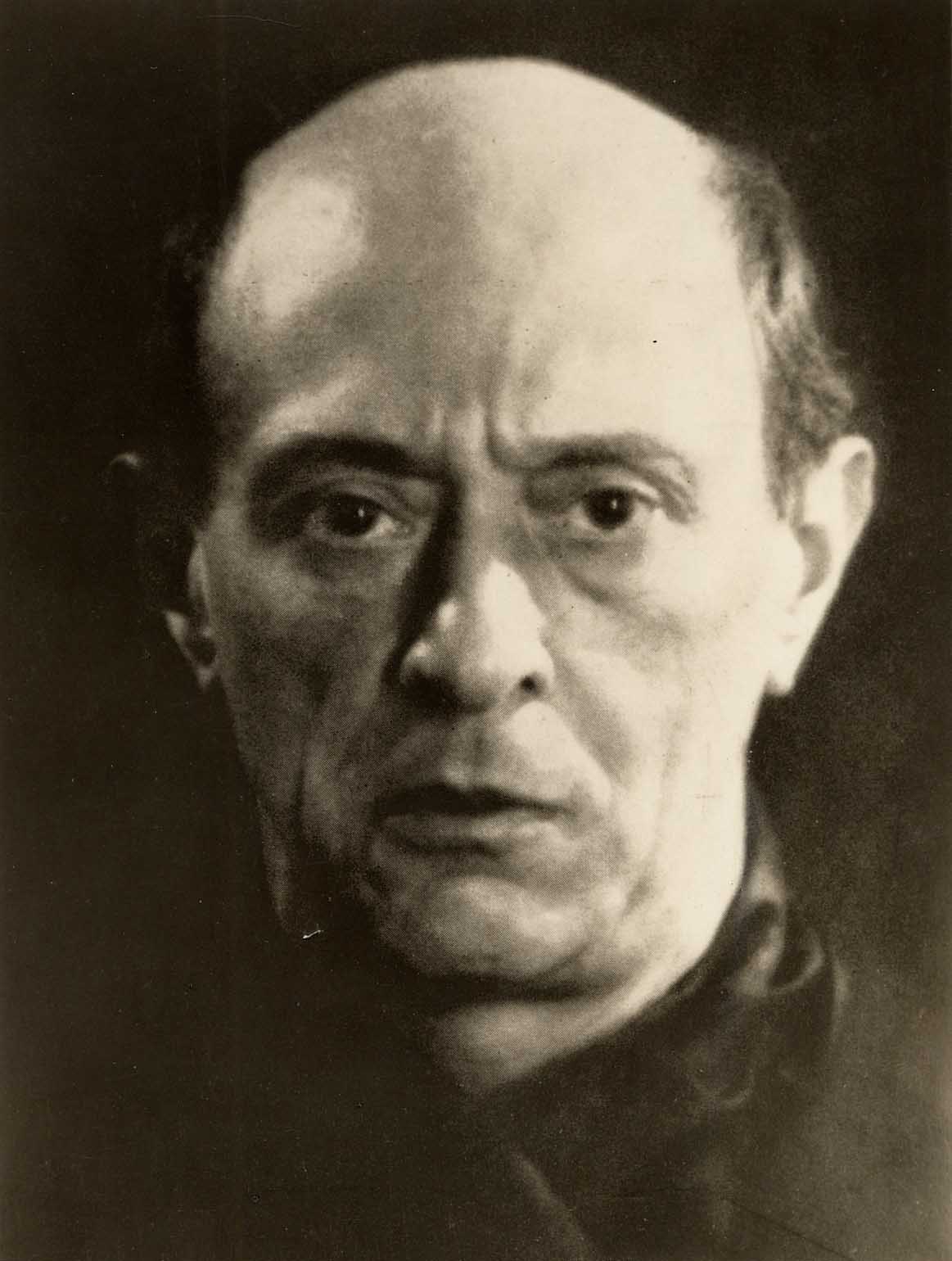
Arnold Schoenberg was born in Vienna in 1874 into a family that was not particularly musical — his parents ran a shoe shop — but he took to instruments on his own, teaching himself violin and cello and pursuing composition largely without formal conservatory training. His father died when he was about sixteen, and Schoenberg had to leave school to help support the family. Despite this, he developed a rigorous self-education, and he became a celebrated teacher of harmony and theory, receiving important help early on from his friend and mentor Alexander Zemlinsky, whose sister Mathilde he married in 1901.
The years around 1908 were among the darkest of Schoenberg’s personal life. That year, his wife Mathilde left him for the Expressionist painter Richard Gerstl, who was living next door. Mathilde eventually returned to Schoenberg and their children, and Gerstl — only about twenty-five years old — took his own life in November 1908. The biographical resonance with his musical output is hard to ignore: 1908 is also the year Schoenberg’s music moved decisively away from tonal organization.
Schoenberg went on to hold prestigious teaching posts, most notably in Berlin. In January 1933, when Hitler became chancellor, one of the first orders of business was the removal of teachers of Jewish heritage from their positions. Schoenberg — who had converted to Lutheranism earlier but now reconverted to Judaism in a conscious act of solidarity — left Germany with his family, spent time in France, and arrived in Los Angeles in 1934, where he eventually taught at UCLA. Financial difficulties followed him throughout his life; even after retirement, with a new wife and three young children, his pension amounted to roughly thirty-eight dollars a month. He died in Los Angeles in 1951.
Schoenberg was not only a composer. He was also a painter, and a serious one. His self-portraits from around 1910 are unmistakably Expressionist: accuracy of representation is abandoned in favour of raw inner feeling, each canvas projecting a different emotional state.
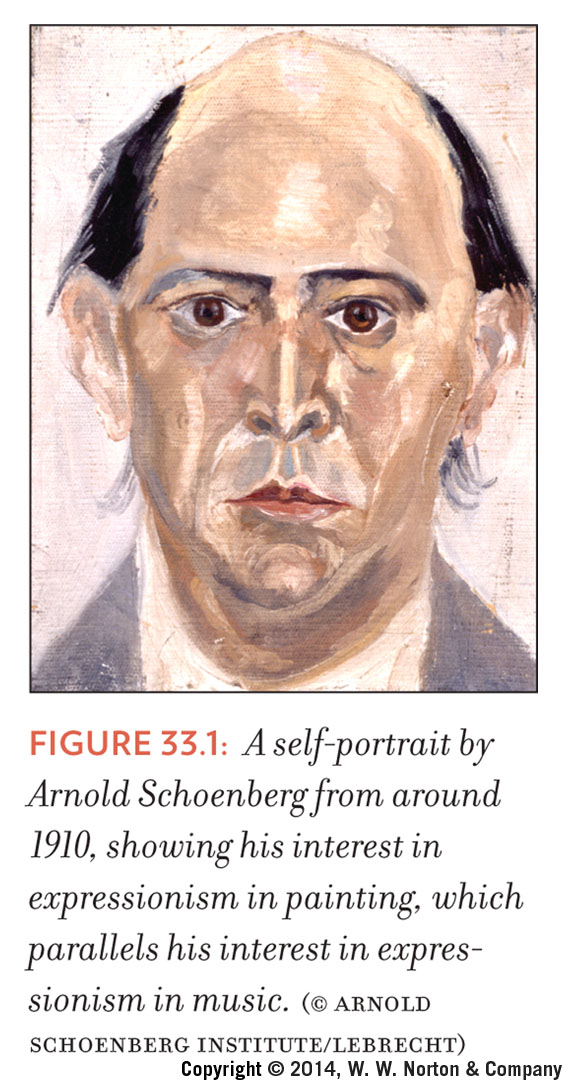
Schoenberg exhibited his paintings alongside the Blue Rider group, the circle around Kandinsky. This was not a peripheral activity. It places Schoenberg at the centre of the Expressionist movement in the visual arts as well as in music, and it reinforces how completely that pursuit of inwardness — of getting past the conventional surface to something more essential — unified the intellectual life of that Viennese circle.
Schoenberg on Tonality, Pantonality, and the Emancipation of Dissonance
Schoenberg’s most important theoretical writings appear in a collection called Style and Idea, and a key passage for this course is the essay “Opinion or Insight?” (1926). A few ideas from this essay deserve careful attention.
First, Schoenberg rejected the label atonal. The word struck him as meaningless — it literally suggests “without tones,” which is absurd. He proposed instead the term pantonality, though he conceded this was not much of a slogan either. His own preferred description was technical rather than catchy: “composition with twelve tones related only to one another” — a formulation that places the emphasis on the relationships between tones, the intervallic patterns formed among the twelve pitches of the chromatic scale, rather than on what has been left behind.
Second, he argued that tonality is not an end in itself but a means to an end — only one resource among several for achieving the true compositional goals of unity and comprehensibility. This is a pivotal claim. It means that abandoning tonality is not the abandonment of music’s deepest values; it is only the abandonment of one particular tool that served those values. The values themselves — coherence, unity, intelligibility — remain firmly in place and continue to govern everything he writes.
Third, and perhaps most famously, Schoenberg coined the phrase “emancipation of the dissonance." The idea is that dissonance and consonance are not opposites but differ only in degree — a matter of the listener’s familiarity and acclimatization. Dissonance, freed from the obligation to resolve into consonance within a tonal framework, can exist on equal footing. Schoenberg traced this emancipatory process in the works of Wagner, Richard Strauss, Mahler, Max Reger, Debussy, and even Puccini — composers whose music had been steadily placing the “tonal centre of gravity in jeopardy” for decades.
This leads to the question that frames Schoenberg’s entire project: can one attain formal unity and self-sufficiency without tonality? He was honest about the difficulties. In the period of free atonality, before twelve-tone composition offered a new framework, he found himself limited to shorter pieces, or pieces that relied on a literary text to supply the cohesive element — a poem, a libretto, a programme. The text, he observed, can serve as the connective thread when musical tonality cannot. Longer purely instrumental forms were temporarily out of reach. The deliberate exclusion of consonant triads was part of the same logic: if a consonant chord appears, it brings harmonic implications and consequences that must be followed up and resolved, making the piece longer and more constrained. Excluding consonance was, paradoxically, a form of artistic economy.
Alban Berg (1885–1935)
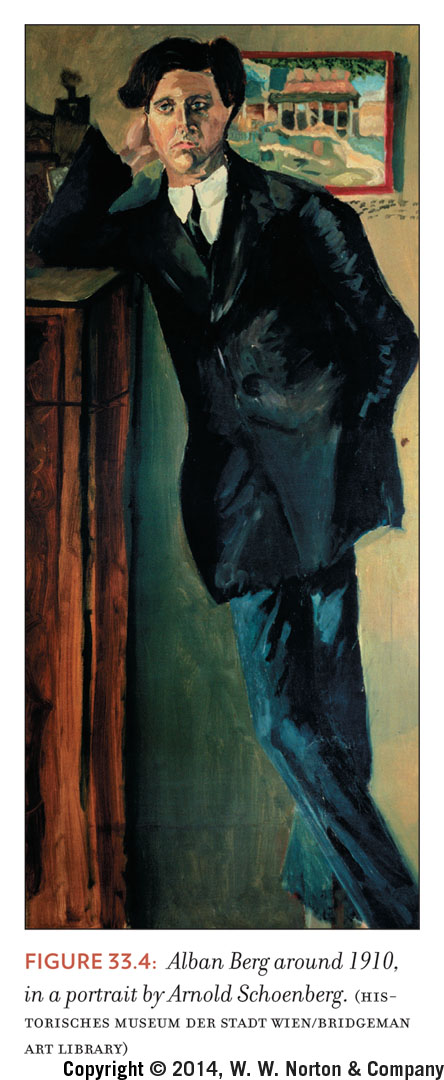
Alban Berg’s childhood was difficult. His father died in 1900 when Berg was about fourteen or fifteen — a loss that echoes Schoenberg’s own experience — and the family was not prosperous. He began studying with Schoenberg in 1904 and continued for seven years, until 1911. This means he was studying with Schoenberg at precisely the moment when tonal organization was dissolving in his teacher’s work. It was a thorny relationship: not easy, often difficult, but intellectually formative in the deepest sense.
Berg’s two best-known works illuminate very different aspects of his sensibility. The opera Wozzeck, written in free atonality, was his biggest popular success. It is a profoundly Expressionist work, based on an early-nineteenth-century play that had attracted new attention around 1914 — a story of a poor soldier ground down by an indifferent social world. The Lyric Suite for string quartet (1925), one of his most celebrated instrumental works, operates on a different register: the score secretly documents a love affair Berg conducted with a woman named Hanna Fuchs. He embedded their initials as a musical motif. His own initials, A and B, correspond in German musical nomenclature to A and B-flat. Her name, Hanna Fuchs, yields H (which in German notation is B natural) and F — a tritone apart. As Berg noted, with characteristic dark wit, a tritone name promises trouble.
On Christmas Eve, 1935, Berg died of blood poisoning from an infected insect bite. He was fifty. That same year he had been working on his Violin Concerto, dedicated, in his own words, “to the memory of an angel” — the teenage daughter of Alma Mahler and the architect Walter Gropius. It is the most performed of all his works.
Berg, Violin Concerto — Itzhak Perlman, Boston Symphony Orchestra
The Society for Private Music Performances
Berg’s essay “Society for Private Music Performances in Vienna: A Statement of Aims” (1919) gives us a remarkable window into the institutional circumstances surrounding this music. Schoenberg founded the Society in November 1918, right at the end of the First World War, in direct response to a pressing practical problem: new works were rarely performed, and when they were, they were poorly performed. With no radio broadcasting yet established and recordings still rudimentary, the only way to encounter new music was live — and if live performances were inadequate, the composer’s intentions were simply not reaching audiences.
The Society’s solution was built around three principles. First, clear, well-rehearsed performances: works would be rehearsed thoroughly, repeatedly, so that the music could be heard as the composer intended it. Second, frequent repetitions: a work would be performed multiple times, not just once, so that listeners could genuinely come to know it. Third, no publicity: the Society was explicitly private. Guests could not be admitted without membership; members were obligated not to write or inspire reviews, notices, or discussions of performances in periodicals. There would be no applause. This was not a public showcase but a protected environment for serious listening.
The Society was also semi-pedagogical in aim — a space for younger composers and less commercially established performers to work with this repertoire in earnest. Because there was no budget to hire a full orchestra, works were performed either as chamber pieces or in piano arrangements — sometimes piano four-hands, sometimes eight-hands for the thicker textures of orchestral reductions. Berg himself argued this was not necessarily a disadvantage: stripped of orchestral colour, the work’s inner structure becomes audible in a different, revealing way.
The repertoire was telling. Despite common assumptions that the Society existed to promote Schoenberg’s own music, the most frequently performed composers were Debussy, Max Reger, Mahler, and Alexander Scriabin. The Society folded in 1921 due to the severe inflation that followed the war. But its implications are wide-ranging and worth dwelling on. By isolating the new music from general concert life, the Society fundamentally repositioned the relationship between performer, audience, and public. What is the social function of a concert? Is it entertainment? Is it education? Is the musical work an autonomous object existing for its own sake, indifferent to social utility? The Society’s practices embody a conviction — later developed theoretically by Theodor Adorno — that the musical work can be autonomous, free from the obligation to please a general public or serve an immediately social function.
Anton von Webern (1883–1945)
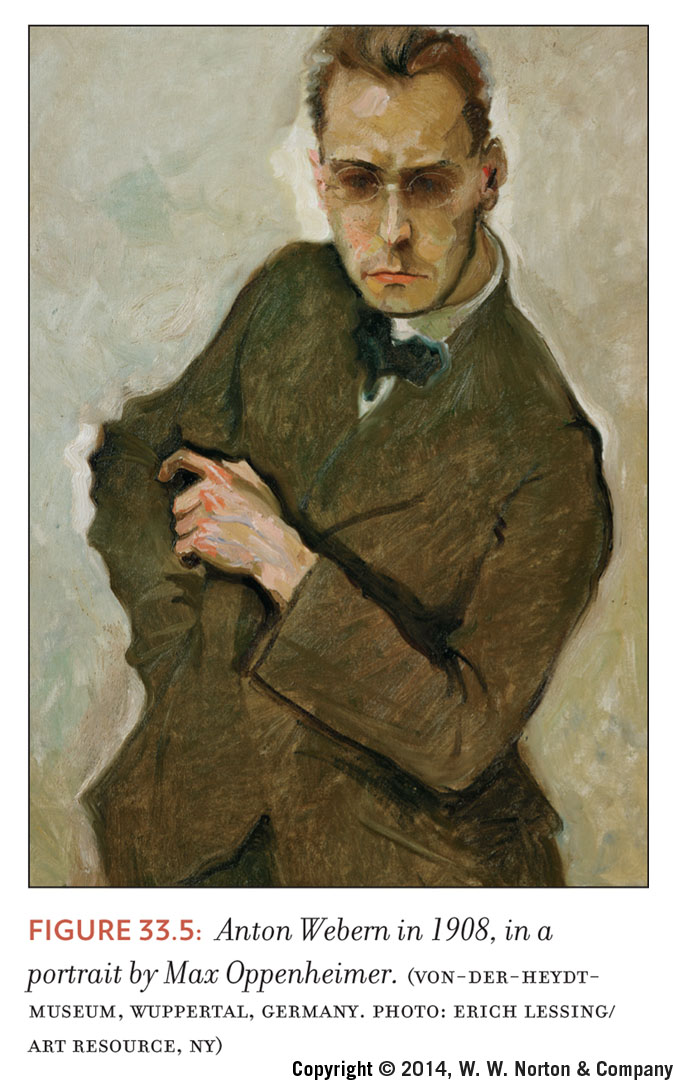
Anton von Webern was, in several respects, the most extreme and the most influential of the three. Unlike Schoenberg and Berg, he was born into minor nobility and raised in comfortable circumstances, without the material deprivation that marked his teacher’s and fellow student’s early lives. He studied with Schoenberg between 1904 and 1908 — the formative years immediately preceding the break with tonality — and was, by all accounts, intensely devoted to Schoenberg to the point of obsession.
Webern was also the only one of the three to hold a university degree. In 1906 he earned a Ph.D. in musicology from the University of Vienna, with a dissertation on the polyphony of the fifteenth- and sixteenth-century composer Heinrich Isaac. This immersion in Renaissance canonic techniques was not simply academic: canons — the compositional technique of strict melodic imitation, like a round — became central to Webern’s own musical language. The logic of the canon, in which patterns recur and unfold within a rigorous framework, found a natural counterpart in twelve-tone composition.
Through the 1920s and until 1935, Webern worked primarily as a conductor, including with radio orchestras. His career came to an abrupt halt in 1938 when the Nazi regime labelled his work entartete Musik — degenerate music — the same designation applied to jazz-influenced works and to virtually any art that departed from official aesthetic norms. He retired to Mittersill with his family. In May 1945, in the weeks immediately following the end of the war, he was shot by an American soldier under circumstances that remain murky — apparently he was outside after curfew, smoking a cigar on the veranda. His death was sudden, accidental, and devastating.
Yet during the war years, while his music was banned and unknown, Webern had continued to compose. When a new generation of European composers — Pierre Boulez, Karlheinz Stockhausen, Luigi Nono — discovered his work in the late 1940s, they were astonished. His techniques had anticipated directions they were only beginning to explore, and they extended those techniques further than even Webern had imagined. It is possible to argue that Webern’s posthumous influence on the trajectory of Western art music in the 1950s and 1960s exceeded even that of Schoenberg or Berg.
What made Webern’s music so arresting was its extreme concentration. His entire output — from his earliest published works to his last — amounts to roughly four hours of music. Individual pieces are extraordinarily short, not from laziness but from a quality of thought in which every note carries immense weight. His Six Bagatelles for string quartet (Op. 9, 1911) is a case in point: none of the six pieces runs longer than about forty seconds, and the whole set takes approximately four minutes.
Webern, Six Bagatelles for String Quartet, Op. 9 (with score)
The Path to Twelve-Note Composition
Webern’s essay “The Path to Twelve-Note Composition” derives from sixteen private lectures he gave in Vienna in 1932 and 1933 — in a private house, to a small paying audience, in circumstances that deliberately recalled the intimacy of the Society for Private Music Performances. The lectures were transcribed in shorthand by a lawyer named Rudolf Fodor, who took his own life in September 1933. The idea of publishing the transcription in the 1930s was floated and abandoned — doing so would have put Webern in grave danger from the Nazi authorities, who had just come to power. The lectures were finally published in German in 1960 and translated into English in 1963.
The title of the lecture series was not Webern’s own: it was given to him by Schoenberg, who supplied it. This small detail is itself revealing — it speaks to the lasting intellectual authority Schoenberg held over his students even decades later.
Webern begins by rejecting the term atonal on much the same grounds as Schoenberg: the word is literally meaningless, suggesting music without tones, which is impossible. What is actually meant, he says, is music with no definite key — the key has disappeared. He insists, again and again, on the overriding importance of unity and comprehensibility. The disappearance of the key is not the disappearance of everything; it is the disappearance of one particular means of achieving coherence, and the challenge is to find new means.
Webern then traces the historical process by which tonality dissolved — and his account is gradual, organic, almost geological. In sonata movements of the late nineteenth century, the main key was increasingly forced to one side, while subsidiary keys and “radicalising” chords — chords that no longer functioned as supports for a tonic — became more and more independent. All of this, he emphasizes, happened within the bounds of harmonic progression. It was not a violent rupture; it was an internal development. He uses the phrase “suspended tonality” to describe the state of affairs in composers like Wagner and Strauss — tonality held at arm’s length, deferred, never quite arriving. He also references the whole-tone scale, which divides the octave into six equal parts and thereby assigns equal rights to all twelve notes, making any one of them as much a tonal centre as any other — which is to say, rendering none of them a centre at all.
The pivotal moment, as Webern identifies it, is Schoenberg’s Second String Quartet of 1908–09 — specifically its fourth movement, which is the only one without a key signature. A soprano voice enters the quartet singing Stefan George’s line: “I feel the air of another planet." The tonal centre of gravity is simply gone. As Webern quotes from Schoenberg’s own writings: “In this musical material new laws have come into force, which have made it impossible for a piece to be described as being in one key or another.”
The period between roughly 1908 and 1922 — between the disappearance of the key and the emergence of twelve-tone composition — is what musicians now call free atonality. There is no overriding system replacing tonality, only an absence. The consequence Webern describes most vividly is a compositional and formal one: without tonality as an organizing principle, how do you build coherent large-scale works? The immediate answer, in the years of free atonality, was: you do not. You write short pieces. You let brevity itself become a formal principle. The Six Bagatelles are the clearest example: once the compositional material has been fully traversed, the piece is simply complete.
The compositional process Webern describes for twelve-tone writing has a vivid pedagogical concreteness. You write out the chromatic scale and cross off notes one by one as you choose them. You seek the maximum variety of intervals in your tone row — the ordered sequence of all twelve pitches that will serve as the work’s foundational material. You avoid sounds that imply tonal functions, because they pull the music in the wrong direction. The law that emerged from this practice was strict: until all twelve notes have occurred, none may be repeated. Repetition of a note would create emphasis; emphasis would create something like a tonal centre; and that would undermine the entire project of equal treatment for all twelve tones.
Webern is emphatic that this process was not cold, cerebral, or mathematical. He stresses the words inevitability, intuition, and unselfconsciousness — even compulsion. He and his colleagues were not imposing a system from outside; they were following something that felt like a natural law, the same way one follows the laws of physics. The twelve-tone system was not invented but discovered. This is the rhetoric of evolutionary necessity that runs through all three composers’ writings: they were not radicals tearing down the past but inheritors of a tradition following its own inner logic to its inevitable destination.
Taken together, the writings of Schoenberg, Berg, and Webern form a remarkably coherent intellectual position. They share an unshakeable commitment to unity, comprehensibility, and coherence as the ultimate values of musical composition. They share a reading of Western music history as a progressive emancipation of dissonance, in which their own work is the natural culmination rather than a departure. And they share an awareness — sometimes anxious, sometimes defiant — that the audiences of their time were not always prepared to follow them. The Society for Private Music Performances was one institutional response to that gap; the twelve-tone system was the compositional one. In both cases, the goal was the same: to make music that could stand on its own, unified and self-sufficient, in the absence of the tonal framework that had sustained Western music for three centuries.
Music, Society, and the Culture Industry
What does it mean for a piece of music to be honest? Is a symphony less truthful because it sells well? Can a composer working in a tonal idiom in 1930 be taken seriously, or has history already rendered that choice a kind of lie? These are not rhetorical provocations — they are among the central questions that animate the two critics at the heart of this lesson: the German philosopher and sociologist Theodor W. Adorno and the British composer-critic Constant Lambert. Writing from very different positions and temperaments, both men arrived at a shared conviction: that the musical life of the early twentieth century was in serious trouble, that something essential had been lost or betrayed, and that the fashionable solutions on offer were making things worse. Their diagnoses, however, diverged in illuminating ways.
Adorno and Critical Theory
Theodor Wiesengrund Adorno (1903–1969) is routinely described as the most important philosopher, music sociologist, and music theorist of the twentieth century — and the description is not an exaggeration. He studied at Frankfurt University and taught philosophy there at the Institute for Social Research, the intellectual home of what became known as the Frankfurt School and its project of critical theory: a form of philosophical inquiry that refuses to separate ideas from the social conditions that produce them. He also studied composition with Alban Berg, which meant that he revered the Second Viennese School — Schoenberg, Berg, and Webern — not merely as an outsider admirer but as someone who had sat at the knee of one of its masters. In April 1933, his teaching authorization was revoked because he was half-Jewish. The Institute was closed by the Nazis shortly after Hitler became chancellor, and Adorno was forced into exile — first to England for several years, then to the United States in 1938, and finally back to Frankfurt in 1949, where he taught for another two decades.
That biography matters. Adorno’s thinking is inseparable from the experience of watching fascism rise, of seeing a highly cultivated society collude in barbarism, and of living through the full industrialization of cultural life in the American context. He was, by his own admission, unapologetically elitist, and his prose style — dense, allusive, resistant to easy summary, so knotted that Germans coined the term Adorno-Deutsch to describe it — performs its own refusal of easy consumption. You cannot skim Adorno. He demands that you work.
Philosophical Inheritance: Kant, Hegel, and Marx
Adorno did not spring out of nowhere. His thinking is a synthesis of three great nineteenth-century philosophical traditions, each of which contributes a distinct layer to his aesthetic theory.
From Immanuel Kant he inherited the concept of purposiveness without a purpose — the idea that artworks are autonomous objects with their own internal logic, not instruments in service of some external end. An artwork does not have to serve a patron, a program, a political cause, or a public. Its autonomy is precisely its defining feature. But Adorno also criticizes Kant for failing to address specific works, for treating aesthetic judgment in an ahistorical vacuum that ignores the socially conditioned nature of art. Kant, he noted, didn’t really know much about music and regarded it with some suspicion — as something unavoidable, like an odor you cannot escape — and this limited his thinking about it considerably.
From Georg Wilhelm Friedrich Hegel came the concept of historicism: the insistence that nothing can be understood outside of its historical context. Art is historically conditioned. It embeds the contradictions and tensions of the society that produces it. Hegel also gave Adorno the notion of truth-content — the idea that artworks are not merely beautiful objects but carriers of genuine cognitive and moral significance.
From Karl Marx came the analysis of art as a commodity — that artworks exist within economic systems and are shaped by them, whether their creators intend it or not.
The genius of Adorno’s synthesis is that these three inheritances are kept in productive tension with one another. Art is simultaneously autonomous (Kant), historically embedded (Hegel), and economically implicated (Marx). None of these three positions cancels out the others, and the friction between them is precisely where Adorno’s most original thinking occurs.
Autonomy, Function, and the Culture Industry
The central paradox in Adorno’s aesthetics can be stated fairly simply, even though unpacking it is anything but simple. Autonomous art — art that refuses to serve any direct social function — acquires its social significance precisely because of that refusal. A work of music that demands full, active attention; that rejects easy pleasures; that alienates itself from its potential audience: this is the music that most powerfully critiques the society from which it has withdrawn. Its principal social function, paradoxically, is social critique — not through any explicit political content, but through its very form. The critique is embedded in the innermost structure of the work, not in any message it proclaims.
This is why Adorno was so hostile to what he and his Frankfurt School colleague Max Horkheimer called the culture industry. Commodification of art does not just change how music is distributed — it changes what music is. When music becomes a commodity, it is subject to the same forces that govern any other market product: it must be standardized, it must be accessible, it must promise satisfaction and deliver a reliable, repeatable experience. The result, Adorno argued, is a kind of permanent fraud: the culture industry always promises and always cheats its consumers. It offers the simulation of pleasure, fulfillment, and even artistic depth, while systematically preventing any genuine engagement that might disturb the social order.
A key consequence of this process is what Adorno called the regression of listening. Commodity music requires no real listening effort. The listener is invited to recognize familiar melodies, to feel comfortable, to consume without thinking. Adorno compared this to the convenience of a pancake mix — everything pre-measured, pre-mixed, requiring only the addition of water. The apparent ease is the point. Just as the pancake mix replaces the skill, judgment, and effort of cooking from scratch, commodity listening replaces the active, demanding work of genuine musical attention. And just as no one would claim that Aunt Jemima’s pancake mix represents the height of culinary achievement, Adorno would say that music engineered for effortless consumption cannot be artistically serious, regardless of what it calls itself.
The regression of listening also produces what Adorno called atomistic or quotation listening: instead of hearing a work as an integrated whole, the listener latches onto recognizable fragments — a famous melody, a catchy rhythm — and relates to those bits and pieces rather than to the work’s total logic. The work becomes a collection of souvenirs rather than a developing argument.
Adorno is careful, however, to note that the problem is not limited to popular music. Some music that presents itself as serious art has also been neutralized — its revolutionary potential drained away as it has become absorbed into the commodified system. A symphony that once challenged listeners can become, through radio broadcast, recording, and the standardization of concert programming, just another comfortable background to bourgeois life.
The Historical State of the Musical Material
One of Adorno’s most distinctive and controversial ideas is that musical material — the tonal system, formal conventions, harmonic vocabularies — is not a neutral toolkit available to any composer at any time. The material is historically conditioned. It carries within it what Adorno calls social sediment: layers of historical meaning accumulated through use.
Consider his example of the minuet. The minuet began as a dance — a social practice embedded in a specific historical moment. As it was absorbed into the classical symphony in the eighteenth century, it was abstracted from its original social context and became a formal movement type. But it retains the sediment of its origins, and by the twentieth century that sediment has become archaeological — the trace of a world that no longer exists. To use the minuet unself-consciously in 1930 is not tradition; it is confusion.
The same argument applies to tonality as a whole. Adorno argues that tonality — the system of major and minor keys that organized Western music from roughly 1600 to 1900 — has collapsed. This is not a normative claim that tonality is aesthetically inferior; it is a historical claim that the material has exhausted itself. The contradictions embedded in tonal harmony were resolved, pushed to extremes, and ultimately dissolved by the late Romantic composers. By the time of Schoenberg’s free atonal works around 1908–1913, the historical logic of the material had arrived at its destination. Atonality is not a stylistic preference — it is a historical reality, whether one calls it atonality, pantonality, or simply the disappearance of key.
What this means for a composer working after that moment is clear: to write tonal music as though nothing has happened is dishonest. The material itself bears witness to history, and ignoring that testimony is a form of regression. The only honest use of tonal gestures in the modern period, Adorno suggests, is ironic — deployed with full awareness of their historical belatedness.
Art, he adds, contains in its innermost structure the contradictions of social reality. And crucially — here is where Adorno parts from Hegel’s optimism — those contradictions cannot be resolved. This is the meaning of negative dialectics: opposing forces (autonomy and commodity, individual and society, tradition and rupture) are held in permanent, unresolvable tension. There is no synthesis waiting on the other side.
Schoenberg vs. Stravinsky: The Argument of Philosophy of New Music
All of this comes to a head in Adorno’s 1949 book Philosophie der neuen Musik (Philosophy of New Music), which is structured as a direct confrontation between two towering figures of early twentieth-century music: Arnold Schoenberg and Igor Stravinsky.
For Adorno, Schoenberg — especially in his free atonal works — represents the only music that truly faces up to the historical state of the material. Schoenberg’s music is difficult, alienating, anti-commercial. It refuses to give the listener easy pleasures. It rejects its audience. In doing so, it is the most socially critical music available, not because it has a political message but because its very form refuses the logic of commodity culture.
Stravinsky, by contrast, is condemned. His neoclassicism — the works he produced after the First World War in which he reached back to eighteenth-century forms and tonal vocabularies — represents, in Adorno’s view, a catastrophic regression. Stravinsky is pretending that history did not happen. He is using the tonal material without irony, without acknowledging its historical exhaustion. The *Rite of Spring had been a genuinely radical work; but the neoclassical turn was, for Adorno, a betrayal — an abdication of the composer’s responsibility to the historical moment.
“A Social Critique of Radio Music” (1945)
Written during Adorno’s American years, “A Social Critique of Radio Music” is, by his standards, one of his most accessible documents — which still places it well above average in difficulty, but gives the reader a clearer window into the practical implications of his theoretical framework.
Adorno begins, somewhat wryly, with the question that marketing analysts ask: How can good music be conveyed to the largest possible audience? He treats this question as a symptom of the problem. The moment music is subject to audience delivery as an optimization problem, something has already gone wrong. You cannot study listener attitudes without considering how deeply those attitudes are conditioned by the broader structure of society. To survey what people say they want to hear without interrogating what social forces shaped those wants is to mistake the effect for the cause.
He then lays out what he calls certain axioms of the musical situation. Music has become a commodity, and this commodity character radically alters it — not physically (the sounds are the same), but in terms of what it means, how it functions, and what kind of attention it receives. Familiar works become trademarks, their names serving as brand identifiers rather than invitations to genuine engagement. The result is uncritical, drowsy listening — a kind of comfortable stupor that Adorno feared had a profoundly ideological effect: it kept listeners from criticizing social realities, from noticing what was wrong with the world, from thinking at all. The apparent pleasure of radio music was, in this sense, a form of social control.
Adorno also argued that radio had proved to be an impetus to progress neither in music itself nor in musical listening. It standardized programs and performances, atomized works into memorable fragments, and produced what he called retrogression of listening — a movement backward in terms of attentiveness and engagement, away from the kind of total, active hearing that serious music demands.
Constant Lambert and Music Ho!
If Adorno is the uncompromising Frankfurt School theorist, Constant Lambert (1905–1951) is something altogether more English and more personal: a working musician who wrote brilliantly about the music he loved and the culture he feared was squandering it. Lambert was a conductor at the Sadler’s Wells Ballet, a composer (his Rio Grande from 1927 remains his most celebrated work), a critic, and a writer of considerable wit and range. His brother was an artist, his father a sculptor; his son would go on to manage The Who — a detail that nicely captures the peculiar cultural position Lambert occupied, somewhere between the bohemian and the establishment.
Music Ho! A Study of Music in Decline was published in 1934, when Lambert was still in his late twenties, and it drew on a column he had written for the Sunday Referee from around 1927 onward. It went through multiple editions and was widely read. Its subtitle signals its tone: Lambert is pessimistic, provocative, and often very funny.
The Age of Pastiche
The chapter “The Age of Pastiche” is Lambert’s sustained critique of what he saw as the defining failure of contemporary musical culture. Pastiche — the assembly of a work from fragments of borrowed, pre-existing material — was, for Lambert, not merely a stylistic choice but a symptom of a deeper cultural crisis: a civilization that valued the past more than the present, that preferred time-traveling to confronting its own historical moment.
The target, as with Adorno, is largely Stravinsky. After the First World War, Stravinsky turned to what critics called neoclassicism — reaching back to the forms and idioms of the eighteenth century, to Bach, to Pergolesi, and embedding distorted echoes of those styles into new works. Lambert describes Stravinsky and his impresario Diaghilev as convenient time travelers: they could position themselves in whatever decade suited them, pulling fragments from here and there without any obligation to coherence.
Lambert’s specific complaint is about what happened before the war. By 1913, he argued, music had reached what he called a psychological cul-de-sac — an absolute limit of complication, in every dimension simultaneously: from the perspective of composers, performers, listeners, and even instrument makers. There was nothing in the music of the 1930s more complicated, from any point of view, than what Schoenberg, Stravinsky himself (in The Rite of Spring), or Scriabin had already achieved two decades earlier. This was not a cause for despair in itself — it was an invitation. The composer’s task now was not further experiment but consolidation: the difficult work of digesting, integrating, and moving forward from that extraordinary period of discovery.
In jumping back 150 years to the eighteenth century instead, Stravinsky was, in Lambert’s view, abdicating that responsibility. A work like L’Histoire du soldat (The Soldier’s Tale, 1918) mixed a waltz, a tango, and a ragtime into a single piece — not as a coherent synthesis but as a kind of scrapbook, cutting pictures from different places and gluing them together on the same board. The result was, to Lambert’s ear, both surrealist (in its juxtaposition of incompatible elements) and cubist (in its fragmentation and distortion of recognizable musical objects), but ultimately incoherent. What music had lost, in this account, was not technical sophistication but the musical impulse — a genuine, forward-moving creative drive that could generate works of internal unity and necessity.
Lambert and Adorno: Convergence and Divergence
The similarities between Lambert and Adorno are striking. Both identified neoclassicism, and Stravinsky’s neoclassicism in particular, as symptomatic of a dangerous cultural regression. Both believed that musical works needed genuine coherence and inner logic to be artistically serious. Both were hostile to the kind of easy eclecticism that treats the whole of musical history as a wardrobe from which to pick fashionable costumes. And both wrote in a period when the commodification and mechanization of music — through radio, recording, and mass entertainment — were rapidly transforming the conditions under which music was made and heard.
But they differed significantly in what they offered as a counterweight. Adorno’s standard was the Second Viennese School and, above all, the radical atonality of Schoenberg. Lambert — who was, after all, a British composer writing for British audiences and working in a tradition with its own pressures and possibilities — was far more sympathetic to composers like Jean Sibelius, whom he regarded as virtually the only composer to have genuinely advanced the symphony in the twentieth century. Adorno would have found such a claim baffling or worse. For Adorno, Sibelius represented a kind of romanticized, culturally nationalist regression; for Lambert, he was a figure who had found a way to synthesize the complexity of the late Romantic inheritance into something genuinely new without resorting to pastiche.
This divergence is instructive. Both critics agreed that the musical culture of their moment was in trouble; both agreed that Stravinsky’s solution was evasion; but their visions of what genuine musical progress would look like were shaped by their very different positions within European music culture — Adorno’s rooted in the specifically German tradition of Beethoven, Brahms, and Schoenberg, Lambert’s more broadly pluralist and distinctly British.
Synthesis: What Music Owes to History
Both Adorno and Lambert force us to confront a question that remains uncomfortable: does a composer have obligations to history? Not moral obligations in any simple sense, but something more like intellectual honesty — a duty to acknowledge the state of the musical material at the moment of writing, to resist the temptation of nostalgia or easy eclecticism, to do the difficult work of genuine synthesis rather than the easier work of clever quotation.
Adorno’s answer is the more uncompromising: the historical logic of the material is not a recommendation but a verdict. To ignore it is to produce inauthentic music — music that, however pleasing, is in bad faith with respect to its own historical moment. Lambert’s answer is more pragmatic and more pluralist, but he shares the underlying conviction that coherence and necessity — qualities that arise from a genuine engagement with the musical material rather than a raid on the historical wardrobe — are what distinguish meaningful music from sophisticated decoration.
Whether one finds these arguments ultimately persuasive or not, they raise questions about musical value that no serious student of the aesthetics of music can afford to dismiss. And they point, together, toward a deeper claim: that music is not merely sound, but a form of historical testimony. What a composer chooses, how they choose it, and what they refuse — all of this speaks, whether they intend it to or not, about the world in which they are making music and the world they imagine when they imagine that music being heard.
Post-War Directions and Debates — Cage, Boulez, Babbitt
The Post-War Musical Landscape
The years immediately following the Second World War were a strange, exhilarating, and deeply contested time in Western art music. With Nazi Germany defeated and the cultural censor lifted, composers in Europe and North America suddenly had access to a body of work that had been suppressed, banned, or simply unavailable for the better part of two decades. Chief among the rediscoveries was the music of Anton Webern, the Viennese serialist who had been shot dead in an accidental encounter with an American soldier in September 1945. Webern’s extraordinarily compact, rigorously organized works — barely known even before the war — now appeared to a new generation of composers as a kind of compass pointing forward.
At summer courses in Darmstadt, West Germany — which became a central gathering point for the European avant-garde from the late 1940s onward — young composers absorbed the logic of the twelve-tone method and asked a provocative question: if Arnold Schoenberg had applied serial ordering to pitch, why stop there? Why not impose the same rigorous logic on rhythm, dynamics, and timbre? This ambition — to apply serial organization to every dimension of a musical work — came to be called total serialism, and it defined one of the dominant poles of post-war musical thought.
At the same time, and on the other side of the Atlantic, another kind of radicalism was brewing. Rather than more control, more organization, and more systematic pre-compositional planning, a small circle of American composers began asking what would happen if composers gave up control altogether — if chance, indeterminacy, and the sounds of the environment were allowed to constitute music on their own terms. The result was an avant-garde that ran directly counter to the European impulse, and the productive tension between these two poles — total control versus total openness — gave the post-war era much of its intellectual energy.
The three figures at the centre of this lesson — Pierre Boulez, Milton Babbitt, and John Cage — represent that tension in its sharpest form. Remarkably, all three lived to very old age: Boulez to nearly ninety-one, Babbitt to just short of ninety-five, and Cage to eighty. Whatever the personal costs of their radical musical commitments, longevity does not seem to have been among them.
Pierre Boulez and Total Serialism
What does it look like when a mathematician becomes a composer? Pierre Boulez — born in 1925 in Montbrison, France — might offer the answer. Trained in both mathematics and composition (he studied with Olivier Messiaen and, briefly, with Schoenberg’s pupil René Leibowitz), Boulez became one of the most formidable analytical minds in twentieth-century music, as well as one of its most celebrated conductors. But in 1952 he fired a polemical salvo that established him, almost overnight, as the conscience of the European avant-garde.
The article was titled “Schoenberg Is Dead,” and its audacity was deliberate. Schoenberg had died in 1951, and Boulez’s essay — first published in 1952 — used the occasion not to mourn but to diagnose. The argument was surgical: Schoenberg’s achievement was real and irreversible. He had traced a necessary historical path from the suspended tonal system — the gradual erosion of tonal gravity in late Romanticism — through free atonality, the expressionist phase in which chromaticism was unleashed without a governing organizational principle, and finally to the twelve-tone method (also called dodecaphonic technique), in which all twelve pitches of the chromatic scale are arranged in a fixed ordering, or row, that governs the pitch content of an entire work. This was a genuine revolution. Schoenberg had even recognized that the new serial language demanded new approaches to melody and harmony, introducing anarchic intervals — wide leaps, tritones, and other relationships that undermined the sense of tonal hierarchy — and expanding the registral range of his musical gestures.
Yet for all that, Boulez argued, Schoenberg had not gone far enough. The contradiction at the heart of Schoenberg’s twelve-tone output was this: having invented a radically new pitch language, he continued to pour it into old containers. He returned to minuet-and-trio forms, to sonata form, to the accompanied melody of nineteenth-century Romanticism. These were, in Boulez’s withering phrase, “pre-classic or classic forms” that “have no historical link to the dodecaphonic discovery.” The new language demanded new forms, not old molds. Worse still, Schoenberg’s serial organization applied only to pitch. Rhythm, articulation, and dynamics — the dimensions that give music its physical character and expressive profile — were left to habit, to what Boulez called “pre-existing rhetoric.” They were composed in the old way, as if the revolution in pitch had not happened.
The serial domain, Boulez insisted, had to be extended. Schoenberg’s successor Webern had at least gestured toward Klangfarbenmelodie — literally “tone-color melody” — a technique in which a single melodic line is fragmented across different instruments, so that the color of the melody shifts with each note (horn plays two pitches, then harp, then bass clarinet, then cello). This was a step toward thinking about timbre as a compositional parameter. But even Webern had not systematized the full range of musical dimensions.
Boulez’s own answer came in the same year as his polemic: Structures Ia, for two pianos (four hands), composed in 1952. This was the first composition fully grounded in total serialism, and its construction makes the ambition visible. Drawing on a pitch row derived from Messiaen’s Mode de valeurs et d’intensités, Boulez generated not one series but four interlocking ones: a series of twelve pitches, a series of twelve durations (measured from a thirty-second note up to a dotted quarter note, each value adding one unit), a series of twelve dynamic levels (from quadruple piano to quadruple forte), and a series of twelve attack types or articulation markings. Every note in the piece simultaneously occupies a position in all four series. The music does not merely deploy a tone row; it is governed at every level — sonic, temporal, and expressive — by serial pre-organization.
Heard today, Structures Ia sounds angular, unpredictable, and somewhat opaque — qualities it shares, paradoxically, with Cage’s indeterminate music of the same period. This resemblance on the surface masks a fundamental philosophical difference: Boulez demanded absolute precision in performance. Every pitch, duration, dynamic, and articulation is specified and must be executed exactly. A mistake does not just sound wrong — it structurally disrupts the work. The rigour that drove the total serial enterprise was, in Boulez’s vision, the only honest response to the historical demands of the moment.
Boulez and Cage, incidentally, were close personal friends during these years. But their friendship was always shadowed by a fundamental disagreement. When Cage began developing his chance-based methods, Boulez drew a line: indeterminacy was the one road he could not take. For Boulez, to abandon compositional control was to abandon the composer’s responsibility to the logic of the work.
Milton Babbitt: Music as Specialist Knowledge
Across the Atlantic, an American composer and Princeton mathematics professor was arriving at a parallel destination by a somewhat different route. Milton Babbitt (1916–2011) developed his own version of total serialism independently of the Darmstadt school, extending the twelve-tone method to encompass what he called the five dimensions of each atomic musical event: pitch class, register, dynamic, duration, and timbre. Like Boulez, he believed that the new music demanded a comprehensiveness of serial organization that Schoenberg had not provided. Like Boulez, he produced music of extraordinary density and precision.
But it was an essay rather than a composition that made Babbitt a cultural flashpoint. In 1958, the magazine High Fidelity published a piece by Babbitt under the deliberately provocative title “Who Cares If You Listen?” — a title the editors chose; Babbitt’s own title was the more sober “The Composer as Specialist.” The distinction matters, because the article is less a manifesto of contempt for the audience than a calm, analytical argument about the social and institutional conditions of advanced contemporary music. It is also, depending on one’s sympathies, one of the most honest and one of the most infuriating documents in twentieth-century musical thought.
Babbitt’s central observation was straightforward: there had been an unprecedented divergence between composers working at the frontier of the art and the concert-going public. This gap was not, he argued, a temporary embarrassment or a failure of communication that better marketing could resolve. It was structural, inevitable, and perhaps even desirable. The new music was simply more complex than previous music — not arbitrarily so, but necessarily so, given the direction the art had taken. Each note now served multiple simultaneous functions across five dimensions; the harmonic, rhythmic, and dynamic vocabulary had been systematically stripped of the redundancy (the repetitions, the familiar patterns, the return of themes) that made older music immediately graspable. A suitably equipped receptor — Babbitt’s technical phrase for a knowledgeable and experienced listener — could follow and appreciate this music. Someone without that preparation could not.
Rather than treating this as a problem, Babbitt drew an analogy that struck many readers as either penetrating or scandalous. Consider, he suggested, how we treat specialists in physics or mathematics. No one expects a layperson to walk into a lecture on advanced topology and follow it without preparation. The work is complex, its methods unfamiliar, its rewards invisible to the untrained. We accept this completely, even admiringly — specialization is understood as the mark of a mature discipline. But in music, and in the arts generally, we maintain a double standard: every listener considers themselves competent to judge, and music that ordinary audiences find difficult is dismissed as decadent or deliberately obscure. Why should music be exempt from the logic of specialization that governs every other advanced intellectual field?
The practical implication followed from the argument. If advanced composition was properly the province of specialists — written by them, for them, evaluated within their community — then it should find its institutional home accordingly. Babbitt pointed to the university as the natural patron, a place where experimental work was sheltered from market pressures and where a suitably equipped community of composers and listeners actually existed. This was not, he insisted, a withdrawal from the world but a rational adaptation to it.
The Columbia-Princeton Electronic Music Center, where Babbitt spent much of his career, embodied this vision. The gleaming RCA Mark II synthesizer that dominated the studio gave composers, for the first time, direct access to sound itself — bypassing performers and their inevitable imprecisions, enabling the kind of total control that total serialism demanded. For Babbitt, the synthesizer was not a novelty but a necessity: only electronic media could achieve the precision his music required.
One can admire the internal consistency of Babbitt’s argument while still finding its cultural politics troubling. By the early 1960s, the model he described — university-funded, audience-indifferent, institutionally sheltered — was operating across North American and Western European conservatories and music departments. Whether Schoenberg’s prediction that twelve-tone technique would ensure the future of music for a hundred years came true is debatable; in practice, the dominance of total serialism as an institutional norm lasted roughly four decades before newer tendencies — minimalism, spectralism, post-minimalism, a return to lyricism — began to assert themselves. The money, too, eventually dried up. Universities shifted their priorities, and the kind of open-ended institutional patronage Babbitt had counted on became harder to sustain.
John Cage and the Aesthetics of Chance
If Boulez and Babbitt represent the extreme of compositional control — the attempt to pre-organize every dimension of a musical work — then John Cage (1912–1992) represents its absolute opposite. Where they imposed more structure, Cage dismantled it. Where they sought to determine every parameter, Cage sought to remove the composer’s will from the process altogether.
This was not, it should be emphasized, a position Cage arrived at casually. He had begun his career as a twelve-tone composer, studying directly with Schoenberg and absorbing the serial method. He had also studied with the American experimentalist Henry Cowell, who used tone clusters and explored the interior of the piano. But the decisive shift came around 1950–1951, when three experiences converged to transform his understanding of music, composition, and the role of sound itself.
The first was intellectual. Living in New York, Cage encountered the Japanese philosopher D. T. Suzuki lecturing on Zen Buddhism, and the encounter, by his own account, changed everything. Zen’s emphasis on present-moment awareness, on the suspension of the judging mind, on the acceptance of things as they are — all of this pointed toward a musical practice that did not seek to impose the composer’s personality on sound but rather to let sounds be what they were.
The second experience was visual. Cage’s friend Robert Rauschenberg created a series of White Paintings in 1951 — large, entirely white canvases that initially appear to be nothing at all. But Cage understood them differently: the white panels were not empty. They were surfaces on which the play of light and shadow, the drifting of dust particles, the changing quality of ambient illumination produced an ever-shifting visual event. The art was not in the object but in the attention the object invited. The artist’s ego had been deliberately effaced so that the world could speak for itself.
The third was acoustic. Cage visited Harvard University’s anechoic chamber — a room designed to eliminate all external sound, the quietest place he had ever been. He expected to hear nothing. Instead, he heard two sounds: a high-pitched tone and a lower, more continuous hum. The technician explained that the high sound was his nervous system and the lower sound was his blood circulating. (It is possible, as Cage later acknowledged, that what he heard was tinnitus — the ringing that a condition in his ears produced — but the philosophical effect was the same.) Even in the most perfectly silent room on earth, there was no silence. There were always sounds.
These three experiences fused into a conviction: there is no such thing as silence, only sounds we have not yet learned to listen to. The implications for composition were radical. If silence does not exist, then “silence” in a musical work is simply the absence of intended sounds — and the presence of unintended ones. Those unintended sounds are not failures. They are the world speaking.
From this position, Cage developed his practice of chance operations and indeterminacy. The two terms are related but distinct. Chance operations describe a compositional method in which decisions are generated not by the composer’s preferences but by aleatory procedures — throwing dice, consulting tables, or using the I Ching (an ancient Chinese oracle text based on the casting of yarrow sticks or coins, which generates sixty-four hexagrams according to chance). By submitting compositional decisions to chance, Cage sought to remove himself — his tastes, his habits, his aesthetic assumptions — from the music. Importantly, however, this process was not sloppy. Once chance operations had generated a set of decisions, Cage was meticulous about implementing them with precision. The randomness was in the construction, not in the performance.
Indeterminacy, by contrast, refers to works in which certain aspects are left unspecified, to be determined in the moment of performance. This could mean that performers choose their own actions, or that the notation does not prescribe exact durations, or that multiple independent sound sources proceed without coordination. Cage’s development of spatial notation — a proportional system in which the horizontal position of a note within a bar reflects its actual position in real time — was partly a response to this: if sounds were to be understood as pure durations rather than counted beats, the notation should reflect real time rather than metrical abstraction.
All of this culminated, in 1952, in the work for which Cage is most famous: 4'33”, first performed on August 29, 1952 at the Maverick Concert Hall in Woodstock, New York, by the pianist David Tudor. The piece consists of three movements, each marked tacet — silence. Tudor sat at the piano, lowered the keyboard lid to mark the beginning of each movement, raised it to mark the end, and consulted a stopwatch while occasionally turning the pages of an empty score. He made no sounds. The performance lasted four minutes and thirty-three seconds.
The piece is not silent, of course — that is precisely Cage’s point. During the first movement, the audience heard wind stirring outside the hall (which had an open wall). During the second, rain began pattering on the roof. During the third, the audience itself became audible: the shuffling, the whispers, the creaking of seats, and eventually the sound of people rising and walking out. Cage described the response as hostile; people were infuriated, and some left in anger. But he also said, reflecting on it later, that “what they thought was silence, because they didn’t know how to listen, was full of accidental sounds.” The piece had worked. The sounds of the world had entered the concert hall, and if the audience had chosen to listen, they would have heard music.
4'33” is the ultimate realization of indeterminacy: every performance is entirely different, determined by the ambient acoustics of the venue, the behavior of the audience, the weather, and chance. The work may be performed by any instrumentalist, and while the score specifies the original Woodstock timings, Cage noted that the movements may last any length of time — even the title, the four minutes and thirty-three seconds, is somewhat provisional. What remains constant is the structure: an invitation to listen.
The philosophical underpinning was articulated in Cage’s lecture “Experimental Music,” delivered in 1957. By this point, Cage declared openly that he was not a composer in any traditional sense: he was a listener. His purpose was what he called purposeful purposelessness — a paradox he took seriously. The purposefulness lies in the deliberate creation of conditions for listening; the purposelessness lies in the refusal to prescribe what shall be heard or what shall be felt. Cage rejected the idea that a composer’s job is to manipulate the emotions of an audience. He pointed to nature as his model: encountering otters along a stream may produce a sense of wonder; night in the woods may produce fear; rain and mist may evoke a sense of love binding heaven and earth. These emotional responses are real, but they arise from the encounter with what is, not from a composer’s strategic manipulation. Cage wanted music to work the same way: let the sounds be sounds, and let listeners bring themselves to the experience.
He also refused to accept that there are sounds that do not belong to music. Dissonances and noises were not merely tolerated but welcomed; indeed, the boundary between music and noise was one of the conventions Cage was most determined to dissolve. This placed him in a tradition that included Edgard Varèse, whose percussion music and noise-embracing aesthetic Cage openly acknowledged as an influence. Cage did not spring from nowhere.
Three Composers, Three Post-War Futures
Placed side by side, Boulez, Babbitt, and Cage illuminate the range of answers that the post-war moment made possible. All three inherited the crisis that Schoenberg had created: once tonality was abandoned, what would replace it? What would give music its logic, its coherence, its claim on a listener’s attention?
Boulez and Babbitt answered: more rigorous organization, extended to every dimension of sound. The composer’s authority should be absolute; every parameter of every note should be determined by pre-compositional planning. The result was music of extraordinary density and, at the surface, apparent unpredictability — though the unpredictability was entirely governed by structure. These were also composers who thought seriously about institutional context: Boulez would go on to found IRCAM in Paris; Babbitt shaped musical life at Princeton and Columbia for decades. Their music was, as Babbitt frankly said, for specialists.
Cage answered: less organization, or none. Remove the composer’s will from the process. Allow chance to make decisions that the composer’s habituated preferences would otherwise foreclose. Accept that every sound is music. Accept that there is no silence, and therefore no separation between the concert hall and the world outside it. The result was music that defied easy categorization — and a practice of composition that was, in its own rigorous way, as demanding as total serialism.
What unites all three is the seriousness with which they took the question of what music is and what it is for. The breakout questions this lesson generates — Does music need to communicate? Who counts as a musician? What do we owe an audience, and what does an audience owe a composer? — were not idle provocations. They were forced on post-war culture by the choices these composers made. That these questions remain open, seventy years later, is perhaps the best evidence that the choices were consequential ones.
Key works and texts for this lesson: Pierre Boulez, “Schoenberg Is Dead” (1952; revised translation 1968); Boulez, Structures Ia for two pianos (1952); Milton Babbitt, “The Composer as Specialist” / “Who Cares If You Listen?” (High Fidelity, 1958); John Cage, “Experimental Music” (lecture, 1957); Cage, 4'33” (1952), first performance by David Tudor, Maverick Concert Hall, Woodstock, New York, August 29, 1952.
New Thoughts on Musical Expression

What distinguishes a work of art from a “mere” artifact? Consider a beautifully painted Greek vase and a plain wooden bucket. Both are crafted objects, both serve a purpose — but we instinctively feel that one of them possesses something the other does not. What is that something? This is the opening question posed by Susanne Langer (1895–1985), an American philosopher whose work on art, symbolism, and feeling would reshape how we think about music’s meaning in the twentieth century. Her most influential book, Philosophy in a New Key (1942), followed later by Feeling and Form (1953), took up this question with striking clarity and argued that music, far from being mere pleasant sound, carries a kind of significance that no other medium can replicate.
Langer’s philosophical roots reach back to Immanuel Kant and the idea that we come to know the world through experience — that knowledge is not passively received but actively shaped by the structures of the mind. She brings this Kantian sensibility into the domain of aesthetics, asking not just what art looks or sounds like but what it means and how it means it.
Significant Form and the Problem of Artistic Meaning
Langer takes as her starting point a concept borrowed from the British art critics Clive Bell and Roger Fry: significant form. Bell had argued in Art (1914) that what makes art genuinely art — and not merely a pleasant sensory experience — is the presence of significant form. Art is a significant phenomenon, not simply a gratification of the senses. If great art were nothing more than direct sensuous pleasure, Langer observes, it would appeal far more broadly and immediately than it does. The fact that it does not — the fact that great art often requires patience, attention, and a certain kind of engagement — suggests that something deeper is at work.
But this immediately raises a problem: what kind of significance are we talking about? What is artistic significance, exactly? Langer does not rush to her own answer. Instead, she conducts a careful survey and evaluation of the various theories that have been offered over the centuries — from Kant to psychoanalysis, from the Darwinians to figures we have already encountered in this course, such as Charles Avison, Eduard Hanslick, and Richard Wagner. Each of these thinkers, in different ways, tried to pin down where musical meaning resides. Langer finds something valuable in many of them but ultimately judges each incomplete.
Music Is Non-Representative
Why is music such a difficult case? Because music is fundamentally non-representative. It has no literal meaning in the way that a sentence or a painting of a landscape does. Pure form is its very essence; there is no obvious literal content to point to. This is precisely what makes program notes and programme music problematic. Programmes, Langer argues, are a crutch — pernicious attempts to fix in words or language what music’s meaning really is. They try to translate the untranslatable.
Music and Emotions
And yet most people do connect feelings with music. Is that connection not evidence that music arouses emotions? Langer considers this common belief carefully and finds it wanting. There is no reliable record of the specific emotional effects of music on listeners. Whatever effects music does produce last only while the stimulus itself lasts — they do not persist afterward, and they do not measurably affect behaviour. The link between music and feeling is real, but it is not a simple cause-and-effect relationship where a piece of music pumps emotions into a passive listener.
Music Is Not Self-Expression
What about the idea that music is the composer’s self-expression? This is perhaps the most popular doctrine of the significance and function of music, and Langer rejects it as well. Sheer self-expression requires no artistic form at all — a cry of pain or a shout of joy is self-expression, but it is not art. Emotional catharsis is natural, not artistic. And what about the performer’s self-expression? A pianist performing a Chopin nocturne is not necessarily expressing her own emotions; she may be deeply calm while producing sounds of intense longing. We cannot simply assume the author’s intention is the meaning of the work. We may use self-expression as a lens, but it is not music’s primary function.
Music Is Not Language
Nor is music a language. Langer insists on the fundamental differences between the two. Music has no fixed, dictionary-style literal meaning. It has no vocabulary, no separable terms with fixed connotations. You cannot look up a C-major chord the way you look up a word. And yet — and this is one of Langer’s most striking claims — music is revealing where words are obscuring. Music articulates subtle complexes of feeling and forms that language cannot even name, let alone set forth. Music can reveal the nature of feelings with a detail and truth that language cannot approach. As Langer puts it: “The real power of music lies in the fact that it can be ’true’ to the life of feeling in a way that language cannot; for its significant forms have the ambivalence of content which words cannot have.”
Music as Isomorphic to Life
How does music accomplish this? Langer’s answer is one of the most elegant ideas in the philosophy of music. Music, she argues, is isomorphic to life itself. The dynamic patterns we hear in music — motion and rest, tension and release, agreement and disagreement — are “morphologically” akin to what people experience as feelings. Music does not describe our inner life; it mirrors its shape. The rising arc of a phrase resembles the rising arc of hope; a dissonance resolving to consonance mirrors the release of anxiety. Music and feeling share a common form, even though they are utterly different in substance.
This makes music what Langer calls an unconsummated symbol: something that is genuinely significant but does not explicitly fix its content. A word like “chair” points to a specific thing; a musical passage points to the form of feeling without specifying which feeling, or whose, or when. It is significant, but its significance remains open.
“Significant Form” Redefined
And so Langer arrives at her own definition of significant form as it applies to music. If music has significance, that significance is semantic — it is symbolic, not merely symptomatic. Music is not a symptom of the composer’s mood the way a blush is a symptom of embarrassment. It carries meaning. But that meaning is implicit, not conventionally fixed. There is no musical dictionary. Music is, in Langer’s memorable phrase, an untranslatable symbol. It reflects only the morphology of feeling — the shapes and patterns of our inner life — without ever reducing those shapes to a single, paraphrasable message.
This is why music moves us so powerfully and yet resists every attempt to say exactly what it means. Its significant forms have an ambivalence of content that words simply cannot have. A great piece of music can feel deeply true — true to something we recognize in our own experience — without our ever being able to pin down in a sentence what that truth is. For Langer, this is not a weakness of music but its unique and irreplaceable strength. Music does what no other art and no language can do: it gives us the forms of feeling themselves, rendered in sound, available for contemplation, and permanently open to new understanding.
The New Musicology
Susan McClary and Feminist Musicology
What would a feminist criticism of music look like? What issues would it raise, and how would it ground its arguments theoretically? These are the questions that Susan McClary posed in her landmark book Feminine Endings: Music, Gender, and Sexuality, published in 1991. The book opens with the story of Bluebeard and Judith and the seventh door — a parable that serves as a key to the entire project of feminist critical theory as applied to music. McClary argued that Western art music, far from being an abstract, purely formal domain, is saturated with assumptions about gender and sexuality. Her work identified five major areas where these assumptions operate, and each one challenges us to hear familiar music in an entirely new way.
The first area McClary addresses is musical constructions of gender and sexuality. In dramatic music — opera, ballet, program music — the musical language is often explicitly gender-based. Composers map patterns in music that resemble or simulate sexuality, using musical gesture to encode ideas about masculinity, femininity, desire, and power. Consider Wagner’s Tristan und Isolde, where the famous unresolved longing of the “Tristan chord” enacts an almost physical yearning, or Debussy’s Prelude to “The Afternoon of a Faun”, where languorous chromaticism evokes sensuous reverie. These are not neutral aesthetic choices; they are deeply gendered musical constructions that reward close critical examination.
The second area concerns the gendered aspects of traditional music theory itself. Even the technical vocabulary of music carries gendered weight. Think of the term feminine ending — a cadence that resolves on a weak beat rather than a strong one. The terminology is revealing: the feminine cadence is characterized as weak, abnormal, and subjective, while the masculine cadence, resolving on a strong beat, is regarded as strong, normal, and objective. This is not some archaic relic; the pervasiveness of this gendered language extended well into the modern era, with the 2003 Harvard Dictionary of Music still carrying an entry under these terms. When the very building blocks of music theory are described in gendered language, McClary argues, it shapes the way we hear, teach, and value music — often without our being aware of it.
Third, McClary examines gender and sexuality in musical narrative. The classic pattern of tension and release that drives so much Western tonal music is, she contends, a simulation of sexual activity — and a constructed one, not a universal truth of nature. Sonata form provides the clearest example. The first theme is conventionally understood as masculine, the second theme as feminine — the so-called feminine Other. When the recapitulation arrives and brings both themes back in the tonic key, the feminine second theme is effectively subjugated, absorbed into the home key that the masculine first theme established from the outset. The key change and its resolution, in other words, enact a narrative of dominance. Whether or not individual listeners hear it this way, McClary’s point is that the theoretical tradition has described it in precisely these terms for over a century.
The fourth area is music as a gendered discourse. Throughout Western history, music has been associated with the effeminate — it moves the body, stirs the emotions, and operates through sensory pleasure rather than rational argument. Male musicians and composers have often retaliated against this association by insisting on the intellectual rigour and structural complexity of their art. Schumann, for instance, praised the “seductive grace” of Schubert while valorizing the “virility” of Beethoven — language that reveals deep anxieties about music’s perceived femininity. The broader strategy, McClary observes, has been to avoid or suppress issues of being moved emotionally by music, redirecting discussion toward form, technique, and abstraction. Music as a discipline has, in effect, policed its own boundaries to keep gendered anxieties at bay.
Finally, McClary turns to the discursive strategies of women musicians — the actual, lived experience of women trying to compose, perform, and be heard within a system that was not built for them. Women musicians have faced institutional obstacles at every turn, from exclusion from conservatories and orchestras to the persistent stereotype that serious composition is somehow unbefitting a woman. These barriers are not merely historical curiosities; they shaped canons, determined whose music was published and performed, and continue to reverberate in concert programming today. McClary’s contribution here is to insist that these social realities are not separate from musical analysis — they are part of it.
Ecomusicology
Is musicology jumping on the solar-powered bandwagon, or is ecomusicology genuinely relevant to the study of music? It is a fair question. All disciplines have been “greening” in recent decades — literary studies, philosophy, history, the sciences — and musicology is no exception. But what does the study of music actually have to do with ecology?
The roots of this inquiry reach back to the work of R. Murray Schafer and the World Soundscape Project, based at Simon Fraser University in British Columbia. Schafer introduced the concept of the soundscape — the sonic environment that surrounds us, both natural and human-made — and pioneered the field of acoustic ecology, which studies the relationship between living beings and their sonic surroundings. His work asked us to listen not just to music in the concert hall, but to the entire world of sound: birdsong, wind, traffic, silence, industrial noise. Once we accept that these sonic phenomena matter, the boundary between “music” and “environment” becomes far more porous than traditional musicology had assumed.
So what exactly is ecomusicology? The Grove Dictionary of American Music (Oxford University Press, 2014) defines ecomusicology (or ecocritical musicology) as “the study of music, culture, and nature in all the complexities of those terms. Ecomusicology considers musical and sonic issues, both textual and performative, related to ecology and the natural environment.” Aaron Allen, writing in the Journal of the American Musicological Society in the summer of 2011, offered a complementary definition: ecomusicology is “a socially engaged musicology that seeks to understand not just music, musicians, and/or musical communities, but also their interconnections in the world, both natural and socially constructed.”
These definitions make clear that ecomusicology is a deliberately broad term, covering a vast array of diverse approaches. It might involve studying how composers represent nature in their works, examining the environmental impact of music festivals, investigating the acoustic ecology of endangered habitats, or exploring how indigenous musical practices encode ecological knowledge. The field invites us to think about the material conditions of music-making — the wood in a violin, the electricity powering an amplifier, the carbon footprint of a world tour — alongside the symbolic and aesthetic dimensions we have always valued. Can you think of some ways that this might apply to the music you know? The Ecomusicology website offers a wealth of resources for exploring these questions further.
What ties this lesson together is a conviction shared by both feminist musicology and ecomusicology: that music does not exist in a vacuum. It is shaped by — and in turn shapes — the social, political, and environmental world around it. McClary showed us that gender and sexuality are not external to musical structure but woven into its very fabric. Ecomusicology extends that insight outward, asking us to consider the relationship between musical practice and the natural world. Both approaches represent the spirit of the New Musicology: a discipline willing to ask difficult questions about power, identity, and meaning, even when the answers complicate the music we love.
