PMATH 321: Non-Euclidean Geometry
Stephen New
Estimated study time: 4 hr 16 min
Table of contents
These notes are based on Stephen New’s PMATH 321 lecture notes, surveying three geometries — Euclidean, spherical, projective, and hyperbolic — and classifying their isometries. Historical context and worked examples are included throughout.
Chapter 1: Euclidean Geometry
Euclidean geometry has been the foundation of mathematical thought for over two thousand years. We begin here not because it is simple, but because it provides the language and intuition for everything that comes later. Every concept we introduce — dot product, orthogonal projection, isometry, angle sum — will be revisited in spherical and hyperbolic geometry, where the same questions yield dramatically different answers. The contrast is the point.
1.1 The Dot Product
The dot product is the foundational operation of Euclidean geometry, encoding both length and angle through a single algebraic construct. Everything in this chapter flows from its definition. The remarkable fact is that a single bilinear form can simultaneously measure distances and detect perpendicularity — two seemingly different geometric concepts that turn out to be two faces of the same algebraic coin.
- (Bilinearity) \((\mathbf{u} + \mathbf{v}) \cdot \mathbf{w} = \mathbf{u} \cdot \mathbf{w} + \mathbf{v} \cdot \mathbf{w}\) and \((t\mathbf{u}) \cdot \mathbf{v} = t(\mathbf{u} \cdot \mathbf{v})\), and similarly in the second argument.
- (Symmetry) \(\mathbf{u} \cdot \mathbf{v} = \mathbf{v} \cdot \mathbf{u}\).
- (Positive Definiteness) \(\mathbf{u} \cdot \mathbf{u} \geq 0\) with \(\mathbf{u} \cdot \mathbf{u} = 0\) if and only if \(\mathbf{u} = \mathbf{0}\).
These three properties — bilinearity, symmetry, and positive definiteness — together make the dot product an inner product. It is positive definiteness in particular that distinguishes Euclidean geometry from the Minkowski geometry we will encounter in the hyperboloid model of hyperbolic geometry: the Minkowski form \(Q(x,y,t) = x^2 + y^2 - t^2\) satisfies bilinearity and symmetry but not positive definiteness, since \(Q(0,0,1) = -1 < 0\). This single sign change — positive to indefinite — is what transforms a geometry of constant zero curvature into one of constant negative curvature.
Now that we have an inner product, we can define length in terms of it.
We say that \(\mathbf{u}\) is a unit vector when \(|\mathbf{u}| = 1\).
Dot product:
\[ \mathbf{u} \cdot \mathbf{v} = (1)(2) + (2)(-1) + (2)(2) = 2 - 2 + 4 = 4. \]Lengths:
\[ |\mathbf{u}| = \sqrt{1 + 4 + 4} = 3, \qquad |\mathbf{v}| = \sqrt{4 + 1 + 4} = 3. \]Angle between them:
\[ \cos\theta = \frac{\mathbf{u}\cdot\mathbf{v}}{|\mathbf{u}||\mathbf{v}|} = \frac{4}{9}, \qquad \theta = \cos^{-1}\!\left(\frac{4}{9}\right) \approx 63.6°. \]Note that neither vector is a unit vector; to get unit vectors we divide by their lengths: \(\hat{\mathbf{u}} = \frac{1}{3}(1,2,2)\) and \(\hat{\mathbf{v}} = \frac{1}{3}(2,-1,2)\).
- (Positive Definiteness) \(|\mathbf{u}| \geq 0\) with \(|\mathbf{u}| = 0\) if and only if \(\mathbf{u} = \mathbf{0}\).
- (Scaling) \(|t\mathbf{u}| = |t||\mathbf{u}|\).
- \(|\mathbf{u} \pm \mathbf{v}|^2 = |\mathbf{u}|^2 \pm 2(\mathbf{u} \cdot \mathbf{v}) + |\mathbf{v}|^2\).
- (Polarization Identities) \(\mathbf{u} \cdot \mathbf{v} = \frac{1}{2}\left(|\mathbf{u}+\mathbf{v}|^2 - |\mathbf{u}|^2 - |\mathbf{v}|^2\right) = \frac{1}{4}\left(|\mathbf{u}+\mathbf{v}|^2 - |\mathbf{u}-\mathbf{v}|^2\right)\).
- (Cauchy-Schwarz Inequality) \(|\mathbf{u} \cdot \mathbf{v}| \leq |\mathbf{u}||\mathbf{v}|\), with equality if and only if \(\{\mathbf{u}, \mathbf{v}\}\) is linearly dependent.
- (Triangle Inequality) \(|\mathbf{u} + \mathbf{v}| \leq |\mathbf{u}| + |\mathbf{v}|\).
The Cauchy-Schwarz inequality has a beautiful geometric meaning: the quantity \(\frac{\mathbf{u} \cdot \mathbf{v}}{|\mathbf{u}||\mathbf{v}|}\) must lie in \([-1,1]\), which is exactly the range of the cosine function. This is what makes the definition of angle via \(\cos\theta = \frac{\mathbf{u}\cdot\mathbf{v}}{|\mathbf{u}||\mathbf{v}|}\) well-posed in any dimension — without Cauchy-Schwarz, the right-hand side could exceed 1 and there would be no angle corresponding to it.
The Polarization Identities will reappear in a crucial way: they tell us that the dot product is entirely determined by the norm, which will be the key step in classifying isometries algebraically. Specifically, any map that preserves lengths automatically preserves the dot product, and therefore preserves angles too. With length in hand, we can define distance.
- (Positive Definiteness) \(d_E(\mathbf{u},\mathbf{v}) \geq 0\) with equality iff \(\mathbf{u} = \mathbf{v}\).
- (Symmetry) \(d_E(\mathbf{u},\mathbf{v}) = d_E(\mathbf{v},\mathbf{u})\).
- (Triangle Inequality) \(d_E(\mathbf{u},\mathbf{w}) \leq d_E(\mathbf{u},\mathbf{v}) + d_E(\mathbf{v},\mathbf{w})\).
These three properties define a metric space. A key goal of this course is to construct analogous distance functions on the sphere and the hyperbolic plane, and to verify that they too satisfy these axioms. With distance established, we can now turn to angle, the other fundamental measurement in geometry.
We say \(\mathbf{u}\) and \(\mathbf{v}\) are orthogonal when \(\mathbf{u}\cdot\mathbf{v} = 0\).
Note that Cauchy-Schwarz guarantees the right-hand side lies in \([-1,1]\), making the definition well-formed. Orthogonality — the condition \(\mathbf{u} \cdot \mathbf{v} = 0\) — corresponds to \(\theta = \pi/2\), the right angle that has been central to geometry since Pythagoras.
- \(\theta(\mathbf{u},\mathbf{v}) \in [0,\pi]\), with \(\theta(\mathbf{u},\mathbf{v}) = 0\) iff \(\mathbf{v} = t\mathbf{u}\) for some \(t > 0\), and \(\theta(\mathbf{u},\mathbf{v}) = \pi\) iff \(\mathbf{v} = t\mathbf{u}\) for some \(t < 0\).
- (Symmetry) \(\theta(\mathbf{u},\mathbf{v}) = \theta(\mathbf{v},\mathbf{u})\).
- (Scaling) \(\theta(t\mathbf{u},\mathbf{v}) = \theta(\mathbf{u}, t\mathbf{v}) = \theta(\mathbf{u},\mathbf{v})\) if \(t > 0\), and \(= \pi - \theta(\mathbf{u},\mathbf{v})\) if \(t < 0\).
- (Law of Cosines) \(|\mathbf{v}-\mathbf{u}|^2 = |\mathbf{u}|^2 + |\mathbf{v}|^2 - 2|\mathbf{u}||\mathbf{v}|\cos\theta(\mathbf{u},\mathbf{v})\).
- (Pythagoras) \(\theta(\mathbf{u},\mathbf{v}) = \frac{\pi}{2}\) iff \(|\mathbf{v}-\mathbf{u}|^2 = |\mathbf{u}|^2 + |\mathbf{v}|^2\).
- (Trig Ratios) If \((\mathbf{v}-\mathbf{u})\cdot\mathbf{u} = 0\) then \(\cos\theta(\mathbf{u},\mathbf{v}) = \frac{|\mathbf{u}|}{|\mathbf{v}|}\) and \(\sin\theta(\mathbf{u},\mathbf{v}) = \frac{|\mathbf{v}-\mathbf{u}|}{|\mathbf{v}|}\).
1.2 Orthogonal Projections
Orthogonal projections let us decompose any vector into components parallel and perpendicular to a given subspace. This decomposition is central to everything that follows, including the classification of isometries. Without projections, we would have no way to identify the “closest point in a subspace to a given vector,” which is the geometric content of the Gram-Schmidt process, the least-squares method, and the construction of perpendicular bisectors.
- \(U^{\perp}\) is a vector space (subspace of \(\mathbb{R}^n\)).
- If \(U = \mathrm{Span}(B)\) then \(U^{\perp} = \left\{ \mathbf{x} \in \mathbb{R}^n \mid \mathbf{x}\cdot\mathbf{u} = 0 \text{ for all } \mathbf{u} \in B \right\}\).
- \((\mathrm{Row}\, A)^{\perp} = \mathrm{Null}\, A\).
- \(\dim U + \dim U^{\perp} = n\).
- \(U \oplus U^{\perp} = \mathbb{R}^n\).
- \((U^{\perp})^{\perp} = U\).
- \((\mathrm{Null}\, A)^{\perp} = \mathrm{Row}\, A\).
The proof uses the standard technique of showing \(U \cap U^{\perp} = \{\mathbf{0}\}\) (if \(\mathbf{x} \in U \cap U^{\perp}\) then \(\mathbf{x}\cdot\mathbf{x} = 0\) so \(\mathbf{x} = \mathbf{0}\)) and dimension counting.
The direct sum decomposition \(\mathbb{R}^n = U \oplus U^{\perp}\) is the engine behind orthogonal projection. Every vector has a unique splitting into a component inside \(U\) and a component perpendicular to it. Think of holding a flashlight perpendicular to a wall: the point where the light hits the wall is the projection of the flashlight’s position onto the wall-plane.
When \(U = \mathrm{Span}\{\mathbf{u}\}\) for a nonzero vector \(\mathbf{u}\), we write \(\mathrm{Proj}_{\mathbf{u}}(\mathbf{x})\).
The following theorem gives the geometric interpretation: the projection is literally the closest point.
The orthogonal complement is \(U^{\perp} = \mathrm{Span}\{(0,0,1)\}\). The decomposition is:
\[ \mathbf{x} = \underbrace{(3,-1,0)}_{\in U} + \underbrace{(0,0,5)}_{\in U^{\perp}}, \]so \(\mathrm{Proj}_U(\mathbf{x}) = (3,-1,0)\).
Now let \(U' = \mathrm{Span}\{(1,1,0)/\sqrt{2}\}\) (a line at 45° in the \(xy\)-plane). Using the formula \(\mathrm{Proj}_{\mathbf{u}}(\mathbf{x}) = \frac{\mathbf{x}\cdot\mathbf{u}}{|\mathbf{u}|^2}\mathbf{u}\) with \(\mathbf{u} = (1,1,0)\):
\[ \mathbf{x}\cdot\mathbf{u} = 3 + (-1) + 0 = 2, \quad |\mathbf{u}|^2 = 2, \quad \mathrm{Proj}_{\mathbf{u}}(\mathbf{x}) = \frac{2}{2}(1,1,0) = (1,1,0). \]The component perpendicular to \(U'\) is \(\mathbf{x} - \mathrm{Proj}_{U'}(\mathbf{x}) = (3,-1,5) - (1,1,0) = (2,-2,5)\). One can verify \((2,-2,5)\cdot(1,1,0) = 2 - 2 + 0 = 0\). ✓
When we have an explicit basis for \(U\), there is a matrix formula for computing the projection.
- The equation \(A^T A\,\mathbf{t} = A^T \mathbf{x}\) has a solution \(\mathbf{t} \in \mathbb{R}^l\), and for any such solution \(\mathrm{Proj}_U(\mathbf{x}) = A\mathbf{t}\).
- If \(\mathrm{rank}(A) = l\) then \(A^T A\) is invertible and \(\mathrm{Proj}_U(\mathbf{x}) = A(A^T A)^{-1} A^T \mathbf{x}\).
When the columns of \(A\) form an orthogonal or orthonormal basis, the formula simplifies significantly — this is the payoff of the Gram-Schmidt orthogonalization process.
- If \(B\) is orthogonal with each \(\mathbf{u}_i \neq \mathbf{0}\) then \(B\) is a basis for \(U\) and \([\mathbf{x}]_B = \left(\frac{\mathbf{x}\cdot\mathbf{u}_1}{|\mathbf{u}_1|^2}, \ldots, \frac{\mathbf{x}\cdot\mathbf{u}_l}{|\mathbf{u}_l|^2}\right)^T\).
- If \(B\) is orthonormal then \([\mathbf{x}]_B = (\mathbf{x}\cdot\mathbf{u}_1, \ldots, \mathbf{x}\cdot\mathbf{u}_l)^T\).
- If \(B\) is orthogonal with each \(\mathbf{u}_i \neq \mathbf{0}\): \(\mathrm{Proj}_U(\mathbf{x}) = \sum_{i=1}^{l} \frac{\mathbf{x}\cdot\mathbf{u}_i}{|\mathbf{u}_i|^2} \mathbf{u}_i\).
- If \(B\) is orthonormal: \(\mathrm{Proj}_U(\mathbf{x}) = \sum_{i=1}^{l} (\mathbf{x}\cdot\mathbf{u}_i)\mathbf{u}_i\).
1.3 The Cross Product
The cross product is specific to \(\mathbb{R}^3\) and provides a way to produce a vector orthogonal to two given vectors, encoding both orientation and area. It will be essential for computing angles on the sphere and for working with great circles — the cross product \(\mathbf{u} \times \mathbf{v}\) gives the pole of the great circle through \(\mathbf{u}\) and \(\mathbf{v}\). There is no analogous operation in \(\mathbb{R}^2\) or \(\mathbb{R}^4\) (except via the Hodge star), which is why spherical geometry lives naturally in three dimensions.
This can be remembered using the formal determinant expansion:
\[ \mathbf{u} \times \mathbf{v} = \det\begin{pmatrix} \mathbf{e}_1 & \mathbf{e}_2 & \mathbf{e}_3 \\ u_1 & u_2 & u_3 \\ v_1 & v_2 & v_3 \end{pmatrix}. \]- (Bilinearity) \((\mathbf{u}+\mathbf{v})\times\mathbf{w} = \mathbf{u}\times\mathbf{w} + \mathbf{v}\times\mathbf{w}\), etc.
- (Skew-Symmetry) \(\mathbf{u}\times\mathbf{v} = -\mathbf{v}\times\mathbf{u}\).
- (Cross with Cross) \((\mathbf{u}\times\mathbf{v})\times\mathbf{w} = (\mathbf{u}\cdot\mathbf{w})\mathbf{v} - (\mathbf{v}\cdot\mathbf{w})\mathbf{u}\).
- (Cross with Dot) \((\mathbf{u}\times\mathbf{v})\cdot(\mathbf{w}\times\mathbf{x}) = (\mathbf{u}\cdot\mathbf{w})(\mathbf{v}\cdot\mathbf{x}) - (\mathbf{v}\cdot\mathbf{w})(\mathbf{u}\cdot\mathbf{x})\).
- (Triple Product) \((\mathbf{u}\times\mathbf{v})\cdot\mathbf{w} = \mathbf{u}\cdot(\mathbf{v}\times\mathbf{w}) = \det(\mathbf{u},\mathbf{v},\mathbf{w})\).
- (Angle Sine) When \(\mathbf{u},\mathbf{v} \neq \mathbf{0}\): \(\sin\theta(\mathbf{u},\mathbf{v}) = \frac{|\mathbf{u}\times\mathbf{v}|}{|\mathbf{u}||\mathbf{v}|}\).
- (Degeneracy) \(\mathbf{u}\times\mathbf{v} = \mathbf{0}\) iff \(\{\mathbf{u},\mathbf{v}\}\) is linearly dependent.
- (Orthogonality) \((\mathbf{u}\times\mathbf{v})\cdot\mathbf{u} = 0\) and \((\mathbf{u}\times\mathbf{v})\cdot\mathbf{v} = 0\).
- (Area of Parallelogram) \(|\mathbf{u}\times\mathbf{v}|\) equals the area of the parallelogram with vertices \(\mathbf{0}, \mathbf{u}, \mathbf{v}, \mathbf{u}+\mathbf{v}\).
- (Right-Hand Rule) When \(\mathbf{u}\times\mathbf{v} \neq \mathbf{0}\), the vector \(\mathbf{u}\times\mathbf{v}\) points in the direction of the right-hand thumb when the fingers curl from \(\mathbf{u}\) toward \(\mathbf{v}\).
The triple product \(\det(\mathbf{u},\mathbf{v},\mathbf{w})\) gives the signed volume of the parallelotope spanned by \(\mathbf{u},\mathbf{v},\mathbf{w}\).
Verify orthogonality:
\[ (6,-3,1)\cdot(1,2,0) = 6 - 6 + 0 = 0 \checkmark \]\[ (6,-3,1)\cdot(0,1,3) = 0 - 3 + 3 = 0 \checkmark \]Area of parallelogram spanned by \(\mathbf{u}\) and \(\mathbf{v}\):
\[ |\mathbf{u}\times\mathbf{v}| = |(6,-3,1)| = \sqrt{36+9+1} = \sqrt{46}. \]Sine of angle between \(\mathbf{u}\) and \(\mathbf{v}\): \(|\mathbf{u}| = \sqrt{5}\), \(|\mathbf{v}| = \sqrt{10}\), so
\[ \sin\theta = \frac{\sqrt{46}}{\sqrt{5}\cdot\sqrt{10}} = \frac{\sqrt{46}}{\sqrt{50}} = \sqrt{\frac{46}{50}} \approx 0.959. \]The sign of the triple product detects orientation, leading to the following definition.
1.4 Geometry in the Euclidean Plane
In the Euclidean plane \(\mathbb{R}^2\), angle, line, and circle theory come together into classical geometry. It is here that we encounter the theorem — the angle sum of a triangle equals \(\pi\) — that will fail in both spherical and hyperbolic geometry. This failure is not a flaw; it is the very definition of those geometries.
The sign of \(\sin\theta_o\) detects whether the rotation from \(\mathbf{u}\) to \(\mathbf{v}\) is counterclockwise (positive) or clockwise (negative). This oriented angle will reappear in the formula for the spherical oriented angle in Section 2.3, where the same formula holds with the triple product \(\det(\mathbf{u},\mathbf{v},\mathbf{w})\) replacing the 2D determinant.
These formulas are the Euclidean baselines. In spherical geometry, the circumference of a circle of radius \(r\) is \(2\pi\sin r < 2\pi r\) (positive curvature means circles are “smaller than expected”), and in hyperbolic geometry it is \(2\pi\sinh r > 2\pi r\) (negative curvature means circles are “larger than expected”). The deviation from \(2\pi r\) is, in fact, a measure of curvature.
Triangle Geometry
With the tools of angle and distance established, we can now develop the classical theory of triangles. The central result — the angle sum theorem — is one that will break down in both spherical and hyperbolic geometry, but in opposite directions.
This is a fundamental property distinguishing Euclidean geometry from both spherical and hyperbolic geometry, where the angle sum is respectively greater than and less than \(\pi\). The precise amount of deviation — the excess \(\alpha + \beta + \gamma - \pi\) on the sphere, and the defect \(\pi - (\alpha+\beta+\gamma)\) in the hyperbolic plane — will turn out to equal the area of the triangle. This is the content of Girard’s theorem and the Gauss-Bonnet theorem, and it is one of the deepest unifying principles in the course.
The Law of Cosines generalizes the Pythagorean theorem (when \(\alpha = \pi/2\), it gives \(a^2 = b^2 + c^2\)). The spherical and hyperbolic versions will be strikingly similar, with trigonometric and hyperbolic-trigonometric functions replacing the side lengths.
Triangle Centres
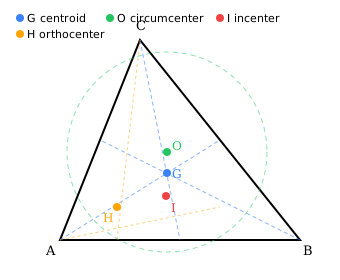
Beyond the basic metric properties of triangles, classical Euclidean geometry is rich with special points associated to each triangle — centres defined by different geometric concurrence conditions. These concurrence results are theorems, not tautologies: it is genuinely remarkable that three seemingly different lines through a triangle always meet at a single point.
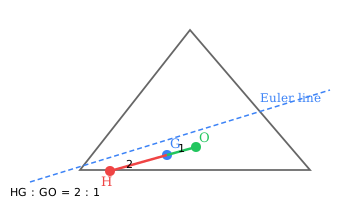
The Euler line is a striking example of how the basic metric structure of a triangle coerces several independently defined points into a single line. The incentre, defined by angle bisectors rather than side bisectors, does not generally lie on the Euler line — it satisfies a different set of metric conditions.
Centroid: \(g = \frac{1}{3}(u+v+w) = \frac{1}{3}(5,3) = (5/3, 1)\).
Circumcentre: We need the point equidistant from all three vertices. The perpendicular bisector of \([u,v]\) is the vertical line \(x = 2\). The perpendicular bisector of \([u,w]\) passes through the midpoint \((1/2, 3/2)\) and is perpendicular to \(w - u = (1,3)\), so it has equation \(1(x-1/2) + 3(y-3/2) = 0\), i.e., \(x + 3y = 5\). Setting \(x=2\): \(2 + 3y = 5\), \(y = 1\). So \(o = (2,1)\).
Check: \(|o-u|^2 = 4+1=5\), \(|o-v|^2 = 4+1=5\), \(|o-w|^2 = 1+4=5\). ✓
Orthocentre: Using \(h = 3g - 2o = (5,-3) - (4,2) = (1,-2).\)
Wait — let us verify directly. The altitude from \(u=(0,0)\) is perpendicular to \(vw = w-v = (-3,3)\), so its direction is \((1,1)\): parametrically \((t,t)\). The altitude from \(v=(4,0)\) is perpendicular to \(uw = w-u = (1,3)\), so its direction is \((3,-1)\): parametrically \((4+3s, -s)\). Setting equal: \(t = 4+3s\) and \(t = -s\), so \(-s = 4+3s\), \(-4s = 4\), \(s = -1\), giving the point \((1, 1)\).
Hmm, let us recompute \(h\): \(3g - 2o = 3(5/3, 1) - 2(2,1) = (5,3) - (4,2) = (1,1)\). So \(h = (1,1)\). ✓
Incentre: Side lengths: \(a = |w-v| = |(-3,3)| = 3\sqrt{2}\), \(b = |u-w| = |(-1,-3)| = \sqrt{10}\), \(c = |v-u| = |(4,0)| = 4\). The incentre is
\[ i = \frac{a\cdot u + b\cdot v + c\cdot w}{a+b+c} = \frac{3\sqrt{2}(0,0) + \sqrt{10}(4,0) + 4(1,3)}{3\sqrt{2}+\sqrt{10}+4}. \]Numerically: \(3\sqrt{2} \approx 4.24\), \(\sqrt{10} \approx 3.16\), denominator \(\approx 11.4\).
\[ i \approx \frac{(0,0) + (12.65, 0) + (4, 12)}{11.4} = \frac{(16.65, 12)}{11.4} \approx (1.46, 1.05). \]The Euler line passes through \(o = (2,1)\), \(g = (5/3, 1)\), \(h = (1,1)\). Note all have \(y=1\)! The Euler line is the horizontal line \(y=1\). The incentre at \((1.46, 1.05)\) does not lie on this line (its \(y\)-coordinate is slightly different). ✓
1.5 Isometries of Euclidean Space
An isometry is a distance-preserving bijection. Understanding isometries is the unifying theme of the entire course — each geometry is characterized by its group of isometries. This is Klein’s Erlangen Program (1872): a geometry is a set together with its symmetry group, and geometric properties are precisely those invariant under that group.
Orthogonal matrices are precisely those that preserve the dot product: \((A\mathbf{u})\cdot(A\mathbf{v}) = \mathbf{u}^T A^T A \mathbf{v} = \mathbf{u}\cdot\mathbf{v}\). Equivalently, their columns form an orthonormal basis. This connects algebraically to the geometric notion of distance preservation.
The following theorem is the algebraic backbone of the classification: every isometry is rigid, affine, and built from an orthogonal linear part and a translation.
This is where the Polarization Identity pays off: knowing that \(L\) preserves lengths allows us to recover that it preserves dot products, and dot products determine the linear structure completely. The determinant of the orthogonal part \(A\) is \(\pm 1\), giving rise to a natural dichotomy.
Isometries in \(\mathbb{R}^2\)
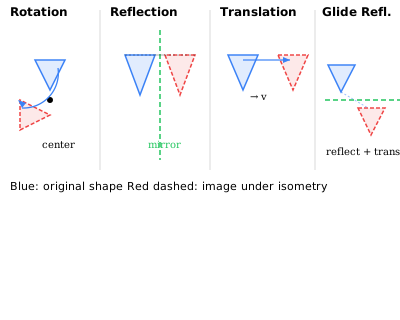
The isometries of the plane fall into five types, classified by whether they fix points, preserve orientation, and by how they compose from reflections.
- Identity: \(I(x) = x\).
- Translation: \(T_u(x) = x + u\).
- Rotation about \(p\) by \(\theta\): \(R_{p,\theta}(x) = p + R_\theta(x-p)\) where \(R_\theta = \begin{pmatrix}\cos\theta & -\sin\theta \\ \sin\theta & \cos\theta\end{pmatrix}\).
- Reflection in line \(L\) through \(p\) perpendicular to \(u\): \(F_L(x) = x - \frac{2(x-p)\cdot u}{|u|^2}u\).
- Glide reflection: \(G_{u,L} = T_u \circ F_L = F_L \circ T_u\) when \(L\) is parallel to \(u\).
Translations and rotations preserve orientation; reflections and glide reflections reverse it.
The next theorem reveals that reflections are in some sense the “atoms” of planar isometries — every isometry is a product of reflections. Understanding how reflections compose gives us all the others.
- If \(L = M\) then \(F_M F_L = I\).
- If \(L \parallel M\) then \(F_M F_L = T_{2u}\) where \(u\) is the vector from \(L\) orthogonally to \(M\).
- If \(L \cap M = \{p\}\) then \(F_M F_L = R_{p, 2\theta}\) where \(\theta\) is the angle from \(L\) counterclockwise to \(M\).
The composition \(F_M \circ F_L\) is a rotation about the origin by \(2 \cdot \pi/6 = \pi/3\). We can verify: reflecting \((1,0)\) in \(L\) gives \((1,0)\); reflecting \((1,0)\) in \(M\) (at angle \(\pi/6\)) gives \((\cos(2\pi/6), \sin(2\pi/6)) = (1/2, \sqrt{3}/2)\). Indeed, rotating \((1,0)\) by \(\pi/3\) counterclockwise gives \((\cos\pi/3, \sin\pi/3) = (1/2, \sqrt{3}/2)\). ✓
Similarly, if \(L\) is the \(y\)-axis (\(x=0\)) and \(M\) is the vertical line \(x=d\), then \(F_M \circ F_L\) is a translation by \((2d, 0)\).
Isometries in \(\mathbb{R}^3\)
In \(\mathbb{R}^3\) the full list expands:
The new entry in dimension three compared to dimension two is the twist (also called a screw motion): a simultaneous rotation about an axis and translation along that same axis. This has no two-dimensional counterpart, illustrating how the classification of isometries is genuinely sensitive to the dimension.
Chapter 2: Spherical Geometry
Motivation: Why Study Spherical Geometry?
Before diving into the mathematics, it is worth asking: why does spherical geometry matter? The answer is not merely academic.
The Earth is (approximately) a sphere. Navigation on its surface is a problem in spherical geometry: the shortest path between two cities is not a straight line on a flat map, but a great-circle arc. Pilots flying from Toronto to London follow a route that appears curved on a Mercator map but is actually the shortest path on the sphere — and computing this path requires spherical trigonometry.
Astronomers map the positions of stars on the celestial sphere, projecting the sky onto \(S^2\). The ancient problem of calculating stellar positions and predicting eclipses drove the development of spherical trigonometry long before the concept of non-Euclidean geometry was formulated. The laws of sines and cosines on the sphere were known to medieval Islamic mathematicians, including al-Battani and Nasir al-Din al-Tusi.
Geodesy — the science of measuring the Earth’s shape — requires spherical geometry. GPS relies on it. And from the mathematical perspective, \(S^2\) is the simplest example of a space with constant positive curvature, providing the perfect testing ground for ideas that generalize to all Riemannian manifolds.
2.1 The Sphere and Spherical Distance
Spherical geometry lives on the unit sphere \(S^2\), where “straight lines” become great circles and angles sum to more than \(\pi\) in a triangle. This is the simplest model of a non-Euclidean geometry with positive curvature.
Having developed the full toolkit of Euclidean geometry, we now ask: what happens when we replace the flat plane \(\mathbb{R}^2\) with a curved surface? The sphere \(S^2 \subset \mathbb{R}^3\) is the most natural first candidate, and we already have all the tools — dot products, cross products, projections — to work with it.
Points \(\pm\mathbf{u}\) are called antipodal. For \(\mathbf{u}, \mathbf{v} \in S^2\), the spherical distance is
\[ d_S(\mathbf{u},\mathbf{v}) = \theta(\mathbf{u},\mathbf{v}) = \cos^{-1}(\mathbf{u}\cdot\mathbf{v}). \]The spherical distance between two points is simply the angle between the corresponding unit vectors — it measures how far apart they are along the surface of the sphere, not through the ambient space. The maximum possible spherical distance is \(\pi\), achieved by antipodal points.
(1) North pole to equator: The north pole is \(\mathbf{n} = (0,0,1)\) and a point on the equator is \(\mathbf{e} = (1,0,0)\). Then \(\mathbf{n}\cdot\mathbf{e} = 0\), so \(d_S(\mathbf{n},\mathbf{e}) = \cos^{-1}(0) = \pi/2\). This makes sense: the equator is exactly a quarter of the way around the globe from the pole.
(2) Two cities as angles: Consider two points on the equator at longitudes \(0°\) and \(60°\):
\[ \mathbf{u} = (1,0,0), \quad \mathbf{v} = (\cos 60°, \sin 60°, 0) = (1/2, \sqrt{3}/2, 0). \]Then \(\mathbf{u}\cdot\mathbf{v} = 1/2\), so \(d_S(\mathbf{u},\mathbf{v}) = \cos^{-1}(1/2) = \pi/3\). On a sphere of radius \(R = 6371\) km (Earth), the actual distance would be \(R\cdot\pi/3 \approx 6671\) km.
(3) Antipodal points: \(\mathbf{n} = (0,0,1)\), \(\mathbf{s} = (0,0,-1)\). Then \(\mathbf{n}\cdot\mathbf{s} = -1\), so \(d_S = \cos^{-1}(-1) = \pi\). Antipodal points are as far apart as possible.
This tells us the two distances are monotonically related — one can be recovered from the other — but they are not proportional. Spherical distance is not simply Euclidean distance in disguise. For small angles, \(d_E \approx d_S\) (the sphere looks flat locally), but for large angles they diverge significantly.
This is Archimedes’ hat-box theorem: the sphere and the enclosing cylinder have the same lateral area. The elegant cancellation in the integrand — the sphere bows outward exactly as the cap shrinks — is what makes the area formula so clean. Archimedes was so proud of this result that he reportedly requested a sphere inscribed in a cylinder be carved on his tombstone.
2.2 Spherical Circles and Lines
For \(r = \pi/4\): \(L_S = 2\pi\sin(\pi/4) = 2\pi/\sqrt{2} \approx 4.44\), while \(L_E = 2\pi(\pi/4) \approx 4.93\). The spherical circle is shorter.
For \(r = \pi/2\) (the equator): \(L_S = 2\pi\sin(\pi/2) = 2\pi\). This matches the Euclidean formula \(L_E = 2\pi\cdot 1 = 2\pi\) only because the equator happens to be a great circle. But the “radius” in the spherical sense is \(\pi/2\), while the Euclidean circumference formula \(2\pi r\) would give \(\pi^2 \approx 9.87\). The discrepancy shows that spherical circles are smaller than Euclidean circles of the same radius.
Area comparison:
\[ A_S = 2\pi(1-\cos r) \approx \pi r^2 - \frac{\pi r^4}{12} + \cdots \]The leading term \(\pi r^2\) matches the Euclidean formula, with negative corrections due to positive curvature. For the hemisphere (\(r = \pi/2\)): \(A_S = 2\pi(1-0) = 2\pi\), which is half of \(4\pi\) as expected.
Note the contrast with Euclidean geometry: the circumference is \(2\pi\sin r \leq 2\pi r\), reflecting the positive curvature of the sphere. The ratio \(\frac{L_S}{L_E} = \frac{\sin r}{r}\) goes to 1 as \(r \to 0\) (local flatness) and goes to 0 as \(r \to \pi\) (the “circle” at distance \(\pi\) from a point is a single antipodal point, with zero circumference).
Now that we have a notion of distance on \(S^2\), we can ask: what plays the role of straight lines? In Euclidean geometry, lines are geodesics — shortest-distance curves. On the sphere, the shortest paths between two points run along great circles.
Two lines are orthogonal when their poles are orthogonal.
- Given \(\mathbf{u}, \mathbf{v} \in S^2\) with \(\mathbf{v} \neq \pm\mathbf{u}\), there is a unique line through \(\mathbf{u}\) and \(\mathbf{v}\), namely \(L_\mathbf{w}\) with \(\mathbf{w} = \pm\frac{\mathbf{u}\times\mathbf{v}}{|\mathbf{u}\times\mathbf{v}|}\).
- Any two distinct lines in \(S^2\) intersect in exactly two antipodal points.
- Given \(\mathbf{u} \in S^2\) and a line \(L\) with \(L \neq L_\mathbf{u}\), there is a unique line through \(\mathbf{u}\) perpendicular to \(L\).
- Given two distinct lines, there is a unique line perpendicular to both.
Part (2) is a key departure from Euclidean geometry: there are no parallel lines on the sphere. Every pair of great circles meets, just as every pair of longitudes meets at the poles. The “parallel postulate” fails on \(S^2\) — but in the opposite direction from hyperbolic geometry. In Euclidean geometry, through a point off a line there is exactly one parallel; on the sphere there are none; in the hyperbolic plane there are infinitely many.
2.3 Oriented Angles on \(S^2\)
To measure angles between curves on the sphere, we need to work in the tangent space at each point — the natural home for directional information. The tangent space is what makes differential geometry possible: it is the infinitesimal Euclidean world attached to each point of the curved sphere.
The tangent space \(T_\mathbf{u}\) is simply the plane in \(\mathbb{R}^3\) perpendicular to \(\mathbf{u}\) through the origin — it inherits the full inner product structure from \(\mathbb{R}^3\), which lets us measure angles between tangent vectors using the same formula as in \(\mathbb{R}^2\). Crucially, even though the sphere is curved, the angle between two geodesics at a point is well-defined and Euclidean, measured in the flat tangent plane.
The tangent vector formula is just the normalized version of the component of \(\mathbf{v}\) perpendicular to \(\mathbf{u}\) — geometrically, it is the direction you would initially travel along the great circle from \(\mathbf{u}\) toward \(\mathbf{v}\). This is the “initial heading” on a great-circle route.
2.4 Spherical Triangles
With a notion of line segments and angles on \(S^2\), we can now define and study triangles. Spherical triangle geometry is both richer and more symmetric than its Euclidean counterpart. The key novelty is that AAA congruence holds — knowing the angles determines the triangle completely. In Euclidean geometry, similar triangles can be scaled; on the sphere, scale is locked to angle.
These are three mutually orthogonal unit vectors, so each pair has dot product 0. Thus:
\[ a = b = c = d_S(\mathbf{u},\mathbf{v}) = \cos^{-1}(0) = \pi/2. \]This is an equilateral spherical triangle with all sides equal to \(\pi/2\). To find the angles, use the First Law of Cosines:
\[ \cos\alpha = \frac{\cos a - \cos b\cos c}{\sin b\sin c} = \frac{\cos(\pi/2) - \cos(\pi/2)\cos(\pi/2)}{\sin(\pi/2)\sin(\pi/2)} = \frac{0 - 0}{1} = 0, \]so \(\alpha = \pi/2\). By symmetry \(\beta = \gamma = \pi/2\) as well.
The angle sum is \(\alpha + \beta + \gamma = 3\pi/2\), and the area (by Girard’s theorem) is \(3\pi/2 - \pi = \pi/2\). Note the total sphere area is \(4\pi\), and this triangle covers \(1/8\) of the sphere — which makes geometric sense since the three coordinate planes divide the sphere into 8 octants.
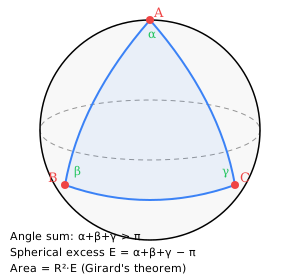
This quantity \(\alpha + \beta + \gamma - \pi > 0\) is the spherical excess of the triangle.
Let \(T = [\mathbf{u},\mathbf{v},\mathbf{w}]\) be the triangle with area \(A\), and let \(T' = [-\mathbf{u},-\mathbf{v},-\mathbf{w}]\) be the antipodal triangle (also with area \(A\)).
Let \(W_\alpha\) be the double wedge (lune + antipodal lune) whose boundary is the great circle through \(\mathbf{v}\) and \(\mathbf{w}\) and which contains \(\mathbf{u}\). Its area is \(4\alpha\). Similarly define \(W_\beta\) (area \(4\beta\)) and \(W_\gamma\) (area \(4\gamma\)).
The three double wedges together cover every point of \(S^2\): the triangle \(T\) and its antipode \(T'\) each get covered three times, and every other point gets covered once. Since the total sphere area is \(4\pi\):
\[ 4\alpha + 4\beta + 4\gamma = 4\pi + 4A + 4A \cdot 0 \implies \text{wait...} \]More carefully: \(W_\alpha \cup W_\beta \cup W_\gamma = S^2\) and the overlaps are \(T, T'\), and the six pairs of arc regions. Counting with multiplicity: the sphere plus twice the triangle plus twice the antipodal triangle equals the sum of the three double-wedge areas:
\[ 4\pi + 2A + 2A = 4\alpha + 4\beta + 4\gamma, \]wait, each overlap (triangle) is covered three times instead of once, so we add \(2A\) for \(T\) and \(2A\) for \(T'\):
\[ 4\alpha + 4\beta + 4\gamma = 4\pi + 4A \implies A = \alpha + \beta + \gamma - \pi. \]This is one of the most beautiful theorems in geometry: the area of a spherical triangle is completely determined by its angle sum, with no reference to side lengths. Girard’s theorem was proved by Albert Girard in 1629, though the result was likely known to Thomas Harriot independently around the same time. It was later generalized to all curved surfaces by Gauss and Bonnet.
The next construction introduces a remarkable symmetry unique to spherical geometry: the polar triangle, which swaps the roles of sides and angles.
- The polar triangle of the polar triangle is the original: \([\mathbf{u}'', \mathbf{v}'', \mathbf{w}''] = [\mathbf{u},\mathbf{v},\mathbf{w}]\).
- The polar triangle is also positively oriented.
- The side lengths of the polar triangle are \(a' = \pi - \alpha\), \(b' = \pi - \beta\), \(c' = \pi - \gamma\).
- The angles of the polar triangle are \(\alpha' = \pi - a\), \(\beta' = \pi - b\), \(\gamma' = \pi - c\).
The polar triangle is a duality: sides and angles exchange roles up to supplementation. This allows us to derive the Second Law of Cosines from the First — apply the First Law to the polar triangle and use the substitutions \(a \mapsto \pi - \alpha'\), etc.
The Second Law is derived by applying the First Law to the polar triangle using the duality \(a \leftrightarrow \pi - \alpha'\), etc. The Second Law has no Euclidean analogue — it is purely spherical. Its existence reflects the AAA congruence property: you can solve for side lengths from angles.
Let \(b = \pi/3\), \(c = \pi/4\), \(\alpha = \pi/2\) (the angle between sides \(b\) and \(c\) at vertex \(\mathbf{u}\)).
Using the spherical law of cosines (solving for side \(a\)):
\[ \cos a = \cos b\cos c + \sin b\sin c\cos\alpha \]\[ = \cos(\pi/3)\cos(\pi/4) + \sin(\pi/3)\sin(\pi/4)\cos(\pi/2) \]\[ = \frac{1}{2}\cdot\frac{\sqrt{2}}{2} + \frac{\sqrt{3}}{2}\cdot\frac{\sqrt{2}}{2}\cdot 0 = \frac{\sqrt{2}}{4}. \]So \(a = \cos^{-1}(\sqrt{2}/4) \approx \cos^{-1}(0.354) \approx 1.21\) radians \(\approx 69.3°\).
Euclidean check: By the Euclidean law of cosines, \(a^2 = b^2 + c^2 - 2bc\cos\alpha = (\pi/3)^2 + (\pi/4)^2 - 0 \approx 1.09 + 0.62 = 1.71\), so \(a \approx 1.31\). The spherical value (1.21) is smaller than the Euclidean value (1.31), consistent with positive curvature compressing distances.
The AAA congruence corollary captures one of the most striking differences between spherical and Euclidean geometry: there is no concept of similar-but-not-congruent triangles on the sphere. Two spherical triangles with the same angles are necessarily the same size. This is because the sphere has a preferred scale — its radius — and angles encode scale information that is lost in flat space.
Comparison: Euclidean vs. Spherical Triangle Laws
| Property | Euclidean | Spherical |
|---|---|---|
| Angle sum | \(\alpha+\beta+\gamma = \pi\) | \(\alpha+\beta+\gamma > \pi\) |
| Area | depends on base and height | \(= \alpha+\beta+\gamma-\pi\) (Girard) |
| Sine Law | \(\frac{\sin\alpha}{a} = \frac{\sin\beta}{b}\) | \(\frac{\sin\alpha}{\sin a} = \frac{\sin\beta}{\sin b}\) |
| Cosine Law | \(\cos\alpha = \frac{b^2+c^2-a^2}{2bc}\) | \(\cos\alpha = \frac{\cos a - \cos b\cos c}{\sin b\sin c}\) |
| AAA congruence | No (only similarity) | Yes |
| Parallel lines | Exactly one through any external point | None |
2.5 Isometries on \(S^2\)
Just as isometries of \(\mathbb{R}^n\) were characterized as maps of the form \(A\mathbf{x} + \mathbf{b}\), isometries of \(S^2\) have a clean algebraic description — and the ambient \(\mathbb{R}^3\) makes it transparent. The key insight is that an isometry of \(S^2\) must preserve lengths of vectors (since spherical distance equals angle between unit vectors), and any linear length-preserving map is orthogonal.
- The antipodal map \(N: S^2 \to S^2\) is given by \(N(\mathbf{x}) = -\mathbf{x}\), corresponding to the matrix \(-I\).
- The reflection \(F_\mathbf{u}: S^2 \to S^2\) in the line \(L_\mathbf{u}\) is the restriction of the orthogonal reflection \(F_\mathbf{u}(\mathbf{x}) = \mathbf{x} - 2(\mathbf{x}\cdot\mathbf{u})\mathbf{u} = (I - 2\mathbf{u}\mathbf{u}^T)\mathbf{x}\).
- The rotation \(R_{\mathbf{u},\theta}: S^2 \to S^2\) rotates about \(\mathbf{u}\) by angle \(\theta\).
The composite of two reflections in lines meeting at \(\mathbf{u}\) is a rotation about \(\mathbf{u}\) by twice the angle between the lines.
This mirrors the Euclidean Theorem 1.83: the composition law for reflections has the same form on \(S^2\) as in \(\mathbb{R}^2\). This is not a coincidence — it reflects the local flatness of the sphere (at any point, the geometry looks Euclidean to first order). The group-theoretic structure of reflections and rotations is the same everywhere.
2.6 Projections of \(S^2\)
Several important projections map parts of \(S^2\) to flat regions. Each has distinctive properties. No single projection can faithfully represent all properties of the sphere on a flat map — there is always some distortion. This is a theorem (Gauss’s Theorema Egregium, 1827): you cannot flatten a sphere without distortion. The choice of projection depends on which property one wishes to preserve: area, angle, or straightness of geodesics.
Orthogonal Projection: The map \(\phi: H \to D\) from the upper hemisphere \(H\) to the unit disc \(D\) given by \(\phi(x,y,z) = (x,y)\). The inverse is \(\psi(u,v) = (u, v, \sqrt{1-u^2-v^2})\).
Lambert Cylindrical Equal-Area Projection: The map \(\phi: S \to R\) (where \(S = S^2 \setminus \{\pm(0,0,1)\}\) and \(R\) is the rectangle \([0,2\pi)\times[-1,1]\)) given by projecting radially outward from the \(z\)-axis to the cylinder \(x^2+y^2=1\), then unrolling. The formula is \(\phi\!\left(\sqrt{1-z^2}\cos\theta, \sqrt{1-z^2}\sin\theta, z\right) = (\theta, z)\).
This is precisely Archimedes’ hat-box theorem in the language of projections: the Lambert projection compresses latitude and expands longitude in a way that exactly cancels, preserving area.
Gnomonic Projection: The map \(\phi: H \to \mathbb{R}^2\) (where \(H\) is the open upper hemisphere) given by projecting radially from the origin to the plane \(z = 1\):
\[ \phi(x,y,z) = \left(\frac{x}{z}, \frac{y}{z}\right). \]This is why the gnomonic projection is used in navigation charts where straight-line paths represent great-circle routes. A ship navigator could draw a straight line from departure to destination on a gnomonic chart and read off the great-circle heading. The cost: angles and areas are severely distorted.
Stereographic Projection: The map \(\phi: S^2 \setminus \{(0,0,1)\} \to \mathbb{R}^2\) given by projecting through the north pole \((0,0,1)\) to the equatorial plane \(z=0\):
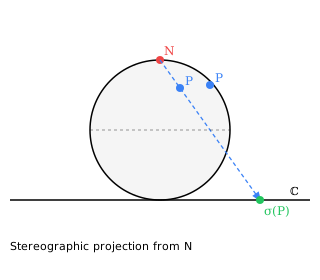
Project the point \(P = (0, 0, -1)\) (south pole): \(\phi(0,0,-1) = (0/(1-(-1)), 0/(1-(-1))) = (0,0)\). The south pole maps to the origin.
Project \(P = (0, \sin\phi, \cos\phi)\) (a point at colatitude \(\phi\) on the \(yz\)-great circle):
\[ \phi(P) = \left(\frac{0}{1-\cos\phi}, \frac{\sin\phi}{1-\cos\phi}\right) = \left(0, \cot(\phi/2)\right). \]For \(\phi = \pi/2\) (the equator, south part): \(\phi(P) = (0, \cot(\pi/4)) = (0, 1)\). For \(\phi = \pi/3\): \(\phi(P) = (0, \cot(\pi/6)) = (0, \sqrt{3}) \approx (0, 1.73)\). For \(\phi \to 0\) (approaching north pole): \(\cot(\phi/2) \to \infty\). Confirmed: north pole maps to infinity.
The conformality of stereographic projection means it is angle-faithful but not area-faithful. It will reappear in the Poincaré disc model: the circle inversion that defines hyperbolic reflections is a close relative of stereographic projection, and shares the same conformality property.
Chapter 3: Projective Geometry
Historical Motivation: Perspective and Infinity
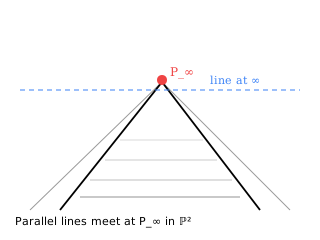
Projective geometry has its roots in the Italian Renaissance. Artists like Brunelleschi (c. 1415) and Alberti (1435) developed rules for drawing in perspective: parallel lines converge to a point on the horizon, and the horizon itself is a “line at infinity.” The mathematician Gérard Desargues (1591–1661) was the first to treat these vanishing points as actual geometric objects, creating projective geometry as a rigorous discipline.
The key insight is that two parallel lines in the Euclidean plane should be thought of as meeting at a “point at infinity” in the direction of the lines. Different families of parallel lines meet at different points at infinity, and all points at infinity together form the “line at infinity.” Adding these ideal points gives the projective plane \(\mathbb{P}^2\), in which any two distinct lines meet in exactly one point — no exceptions.
This simplification is not merely aesthetic. Many theorems of classical geometry become cleaner in the projective setting: Desargues’ theorem, Pascal’s theorem, and Pappus’ theorem all have simpler statements and proofs in \(\mathbb{P}^2\) than in \(\mathbb{R}^2\).
3.1 The Projective Plane
We can identify \(\mathbb{P}^2\) with the set of antipodal pairs \(\{\pm\mathbf{x}\}\) in \(S^2\). A projective point is a pair of antipodal spherical points — this “folding” of the sphere onto the projective plane is what makes the isometry group \(SO(3)\) (rather than \(O(3)\)).
The projective point \([1,2,3]\) in \(\mathbb{P}^2\) represents the line through the origin and \((1,2,3)\) in \(\mathbb{R}^3\). We have \([1,2,3] = [2,4,6] = [-1,-2,-3]\) as projective points.
The projective line \(L_{(0,0,1)}\) with pole \((0,0,1)\) consists of all lines in \(\mathbb{R}^3\) lying in the \(xy\)-plane \(z=0\): \(\{[x,y,0] : (x,y)\neq(0,0)\}\). In the affine chart \(\phi_3([x,y,z]) = (x/z, y/z)\), this line is the “line at infinity” — you cannot reach it by setting \(z \neq 0\).
A point in the affine chart \(U_3 = \{[x,y,z] : z\neq 0\}\) can be written as \([u,v,1]\) via the identification \((u,v) \mapsto [u,v,1]\). The “ordinary” points of \(\mathbb{R}^2\) correspond to \(U_3\), and the line at infinity \(L_{(0,0,1)}\) consists of the “new” projective points added.
- Any two distinct points in \(\mathbb{P}^2\) determine a unique projective line.
- Any two distinct projective lines meet in a unique point (no parallel lines in \(\mathbb{P}^2\)!).
- Given a point and a line not polar to it, there is a unique perpendicular line through the point.
- Given two distinct lines, there is a unique line perpendicular to both.
The key contrast with Euclidean geometry: in \(\mathbb{P}^2\), any two distinct lines always meet. There are no parallels. This is because “parallel” Euclidean lines meet at their common point at infinity.
The isometry group of \(\mathbb{P}^2\) is strictly smaller than that of \(S^2\) (\(SO(3)\) versus \(O(3)\)), because orientation-reversing maps of \(S^2\) — such as reflections — do not descend to well-defined isometries of \(\mathbb{P}^2\). This is because the antipodal identification \(\mathbf{x} \sim -\mathbf{x}\) interacts badly with orientation reversal.
3.2 Homogeneous Coordinates and Zero Sets
To do algebra in \(\mathbb{P}^2\), we use homogeneous coordinates, which package the equivalence class \([\mathbf{x}]\) into a coordinate triple well-suited for polynomial equations. The key point is that polynomial equations in homogeneous coordinates are well-defined on \(\mathbb{P}^2\) if and only if the polynomial is homogeneous.
We can view \(\mathbb{P}^2 = U_k \cup L_k\) where \(L_k = \mathbb{P}^2 \setminus U_k\) is the “line at infinity” for the copy \(U_k \cong \mathbb{R}^2\).
Homogeneous polynomials are necessary because the coordinates of a projective point are only defined up to scaling: replacing \((x,y,z)\) by \((tx,ty,tz)\) changes \(F\) by \(t^n\), which vanishes if and only if \(F\) vanishes. So the zero set is consistent across representatives. A non-homogeneous polynomial like \(x + y + z^2 = 0\) would be inconsistent: replacing \((x,y,z)\) by \((2x,2y,2z)\) gives \(2x + 2y + 4z^2 = 0\), a different equation.
3.3 Conic Sections
The projective plane is the natural home for conic sections, where the classical distinction between ellipse, parabola, and hyperbola dissolves: all non-degenerate conics are projectively equivalent, the differences arising only from how the conic meets the line at infinity.
An ellipse meets the line at infinity in no real points (it is “bounded”). A parabola is tangent to the line at infinity at one point. A hyperbola meets the line at infinity in two distinct real points (its asymptotic directions). From the projective perspective, these are all the same curve — we just view them from different affine charts.
A conic section is the intersection of a double cone with a plane.
- The cone with vertex \((0,0,-h)\), axis \(\frac{1}{\sqrt{2}}(0,1,1)\), half-angle \(\pi/4\) meets the \(xy\)-plane in the parabola \(y = \frac{1}{2h}x^2\).
- The cone with vertex \((0,0,h)\), axis \((1,0,0)\), half-angle \(\phi\) meets the \(xy\)-plane in the hyperbola \(\frac{x^2}{h^2\cot^2\phi} - \frac{y^2}{h^2} = 1\).
- With appropriate cone, meets the \(xy\)-plane in an ellipse.
3.4 Classical Theorems
The projective plane is the right setting for several remarkable classical theorems about incidence — theorems concerning when points are collinear or lines are concurrent. These theorems are purely projective: they do not refer to distance or angle, only to the incidence structure of points and lines.
Let \(u = [1,0,0]\), \(v = [0,1,0]\), \(w = [0,0,1]\), and take the perspective center \(p = [1,1,1]\).
Place \(u' = [2,1,1]\), \(v' = [1,2,1]\), \(w' = [1,1,2]\).
Check that lines \(uu'\), \(vv'\), \(ww'\) pass through \(p = [1,1,1]\):
- \(uu'\): the line through \([1,0,0]\) and \([2,1,1]\) contains \([1,0,0] + [1,1,1] = [2,1,1]\). And \([1,1,1]\) itself lies on this line since \([1,1,1] = [2,1,1] - [1,0,0]\) (as projective combinations). ✓
By Desargues’ theorem, the points \(a = (vw)\cap(v'w')\), \(b = (wu)\cap(w'u')\), \(c = (uv)\cap(u'v')\) should be collinear. We can verify this computationally using cross products in homogeneous coordinates.
Pappus’ theorem (Pappus of Alexandria, c. 340 AD) is one of the oldest projective theorems. It predates projective geometry as a formal theory by over a millennium — Pappus proved it as a fact about hexagons inscribed in pairs of lines, without the projective language. In the projective plane, it is equivalent to commutativity of the underlying field.
Then \(a, b, c\) are collinear (they lie on the “Pascal line”).
Take the unit circle \(x^2+y^2=1\) and six points:
\[ u_1 = (1,0),\; u_2 = (0,1),\; u_3 = (-1,0),\; u_4 = (0,-1),\; u_5 = (1/\sqrt{2}, 1/\sqrt{2}),\; u_6 = (-1/\sqrt{2}, 1/\sqrt{2}). \]The line through \(u_1 = (1,0)\) and \(u_2 = (0,1)\) has equation \(x + y = 1\). The line through \(u_4 = (0,-1)\) and \(u_5 = (1/\sqrt{2}, 1/\sqrt{2})\) has equation \(y = (1+1/\sqrt{2})x - 1\). Their intersection point \(a\) is computed by substituting.
Pascal’s theorem guarantees that the three such intersection points \(a\), \(b\), \(c\) are collinear, regardless of which six points on the circle we chose.
When the conic degenerates to a pair of lines, Pascal’s Theorem reduces to Pappus’ Theorem.
Comparison: Euclidean vs. Projective Geometry
| Property | Euclidean | Projective |
|---|---|---|
| Parallel lines | May or may not intersect | Always intersect (at a point at infinity) |
| Distinct lines in a plane | 0 or 1 intersection points | Always exactly 1 |
| Distance | Defined | Not defined (no metric) |
| Angles | Defined | Not defined |
| Circles vs. ellipses vs. hyperbolas | All different | Projectively equivalent |
| Desargues’ theorem | Holds (with exceptions) | Holds universally |
Chapter 4: Hyperbolic Geometry
Historical Narrative: Two Thousand Years of a Failed Proof
The story of hyperbolic geometry is one of the most dramatic in mathematics. Euclid’s five postulates had stood as the foundation of geometry since around 300 BC. The fifth postulate — the parallel postulate — was always the odd one out: it is more complex than the other four, and generations of mathematicians suspected it was actually a theorem derivable from the others.
For two millennia, mathematicians tried to prove the parallel postulate from the first four. Proclus (5th century AD), al-Haytham (11th century), Saccheri (1733), Lambert (1766), Legendre (early 19th century) — all attempted the proof, and all failed. Saccheri and Lambert actually derived many consequences of the negation of the parallel postulate, without realizing they were building a new geometry.
The breakthrough came simultaneously and independently around 1830, from three mathematicians. János Bolyai (1802–1860), a Hungarian officer’s son, published his discovery of hyperbolic geometry in 1832 as an appendix to his father’s book. His father sent it to Carl Friedrich Gauss — who replied that he had discovered the same thing decades earlier but never published, fearing the “clamor of the Boeotians” (ridicule from contemporaries). Nikolai Lobachevsky (1792–1856), a Russian mathematician, had published similar results as early as 1829. Gauss had the ideas but lacked the courage to publish; Bolyai and Lobachevsky had the courage.
The existence of hyperbolic geometry was a philosophical earthquake. It showed that the parallel postulate is independent of the other four — a logically consistent geometry exists in which it fails. Euclid’s geometry is not “the” geometry; it is a geometry. This opened the door to Riemann’s generalization (1854), which is the foundation of Einstein’s general relativity.
The first concrete model of hyperbolic geometry was constructed by Eugenio Beltrami in 1868. Henri Poincaré gave the disc model in 1882, and Felix Klein gave another model the same year. The model we study in this course — the Poincaré disc — is perhaps the most beautiful, and is the inspiration for M.C. Escher’s famous “Circle Limit” series of drawings.
4.1 Reflections in Circles
Hyperbolic geometry is built on the notion of reflection in a circle (circle inversion), which plays the role that reflection in a line plays in Euclidean geometry.
After surveying the positively curved world of the sphere and the “flat” projective plane, we now turn to the third major geometry: the hyperbolic plane, which has constant negative curvature. The construction is more subtle — we cannot simply take a surface embedded in \(\mathbb{R}^3\) as we did with \(S^2\). Instead, we will define the geometry analytically on the unit disc, and the key to understanding its isometries is circle inversion.
- The reflection in a line \(L\) through \(a\) perpendicular to \(\mathbf{u}\) is \[ F_L(\mathbf{x}) = \mathbf{x} - \frac{2(\mathbf{x}-a)\cdot\mathbf{u}}{|\mathbf{u}|^2}\mathbf{u}. \]
- The reflection (inversion) in a circle \(C\) centred at \(a\) of radius \(r\) is the map \(F_C: \mathbb{R}^2\setminus\{a\} \to \mathbb{R}^2\setminus\{a\}\) given by \[ F_C(\mathbf{x}) = a + \frac{r^2}{|\mathbf{x}-a|^2}(\mathbf{x}-a). \]
Geometrically, circle inversion sends points inside \(C\) to points outside \(C\) and vice versa, fixing points on \(C\) itself. Points close to the center \(a\) map to points far away, and points far from \(a\) map to points close to \(a\). The center itself has no image (it maps to “infinity”), which is why the domain excludes \(a\).
Let \(C\) be the circle centred at the origin with radius \(r = 2\). Invert the point \(\mathbf{x} = (1, 0)\):
\[ F_C(\mathbf{x}) = \frac{r^2}{|\mathbf{x}|^2}\mathbf{x} = \frac{4}{1}(1,0) = (4,0). \]Invert the point \(\mathbf{x} = (4, 0)\):
\[ F_C((4,0)) = \frac{4}{16}(4,0) = (1,0). \]Confirmed: inversion is its own inverse. ✓
Invert \(\mathbf{x} = (1,1)\): \(|\mathbf{x}|^2 = 2\),
\[ F_C((1,1)) = \frac{4}{2}(1,1) = (2,2). \]Check \(F_C((2,2)) = \frac{4}{8}(2,2) = (1,1)\). ✓
Invert a point on \(C\): \(\mathbf{x} = (2, 0)\),
\[ F_C((2,0)) = \frac{4}{4}(2,0) = (2,0). \]Points on the circle are fixed. ✓
- Any line through \(a\) is mapped to itself.
- A line not through \(a\) is mapped to a circle passing through \(a\).
- A circle through \(a\) is mapped to a line not through \(a\).
- A circle not through \(a\) is mapped to a circle (not through \(a\)).
This theorem is central: it tells us that circle inversion preserves the family of “generalized circles” (circles and lines, treating lines as circles of infinite radius). This is exactly the family that will serve as hyperbolic lines, so inversions will automatically map hyperbolic lines to hyperbolic lines.
confirming that \(F_C\) is conformal with scaling factor \(\frac{r^2}{s^2+t^2} = \frac{r^2}{|\mathbf{x}-a|^2}\).
Conformality is a crucial property. It means circle inversion preserves angles between curves (though it reverses orientation). This is why the Poincaré disc model is conformal: hyperbolic angles equal Euclidean angles, making it visually interpretable.
4.2 The Poincaré Disc Model
We now have all the ingredients to define the hyperbolic plane. The idea is to take the Euclidean open unit disc and equip it with a new metric that stretches distances near the boundary — so that the boundary circle is “infinitely far away” and the disc becomes a model of infinite negatively curved space.
Imagine living inside this disc as a hyperbolic creature. You cannot reach the boundary — it is infinitely far away. If you walk outward at constant hyperbolic speed, you slow down (from a Euclidean perspective) and never reach the edge. The grid of equal-spacing hyperbolic squares, when drawn in Euclidean coordinates, looks like Escher’s “Circle Limit” drawings: fish or angels that shrink toward the boundary but are all “the same size” to the hyperbolic observer.
The boundary \(S^1 = \{|\mathbf{x}| = 1\}\) consists of points at infinity (or asymptotic points). Hyperbolic length and area are measured by the infinitesimal rescaling:
\[ d_H L = \frac{2}{1-|\mathbf{x}|^2}\,d_E L, \qquad d_H A = \frac{4}{(1-|\mathbf{x}|^2)^2}\,d_E A. \]The hyperbolic length of a curve \(\mathbf{x} = \alpha(t)\), \(a \leq t \leq b\) is
\[ L = \int_a^b \frac{2|\alpha'(t)|}{1 - |\alpha(t)|^2}\,dt. \]Hyperbolic angles are the same as Euclidean angles.
The metric blows up at the boundary \(S^1\), meaning points near the boundary are “infinitely far away” in the hyperbolic metric. The disc looks finite to Euclidean eyes but is infinite to a hyperbolic observer.
The choice of conformal factor \(\frac{2}{1-|\mathbf{x}|^2}\) is not arbitrary: it is the unique factor (up to scaling) that makes the resulting geometry have constant curvature \(-1\). The Gaussian curvature of this metric is:
\[ K = -\frac{1}{2}\Delta \log\left(\frac{2}{1-|\mathbf{x}|^2}\right)^2 = -1. \]The conformality of the model — hyperbolic angles equal Euclidean angles — is what gives the Poincaré disc its aesthetic appeal in Escher’s famous “Circle Limit” drawings.
- of the form \(L = M \cap \mathbb{H}^2\) where \(M\) is a Euclidean line through the origin, or
- of the form \(L = C \cap \mathbb{H}^2\) where \(C\) is a Euclidean circle meeting \(S^1\) orthogonally.
A circle \(C\) centred at \(a\) of radius \(r\) meets \(S^1\) orthogonally if and only if \(r^2 = |a|^2 - 1\) (so \(|a| > 1\)).
In both cases a hyperbolic line is an arc of a generalized circle that meets the boundary \(S^1\) at right angles — the orthogonality condition is what makes circle inversions in these circles preserve the disc.
so the scaling exactly compensates for the change in the hyperbolic metric factor.
- Two hyperbolic lines that meet in \(\mathbb{H}^2\) are called intersecting.
- Two hyperbolic lines that share an ideal endpoint in \(S^1\) are called asymptotic (or critically parallel).
- Two hyperbolic lines with no shared point in \(\mathbb{H}^2 \cup S^1\) are called parallel (or ultraparallel).
The three-way classification of line pairs is a hallmark of hyperbolic geometry. Given a line \(L\) and a point \(p \notin L\), there are infinitely many lines through \(p\) that do not intersect \(L\) — they divide into two families of asymptotic lines bordering a continuous band of ultraparallel lines. This is the negation of Euclid’s parallel postulate.
4.3 Geodesics and Distance
Equality holds iff \(\theta' = 0\) and \(r' \geq 0\), i.e., \(C\) is the straight line segment. For general \(\mathbf{u}, \mathbf{v}\), apply an isometry \(F_L\) to move \(\mathbf{u}\) to \(\mathbf{0}\).
The proof has the same structure as the classical Euclidean proof that straight lines are shortest: reduce to a straight radial path by discarding angular components, then integrate. The key difference is the metric weight \(\frac{2}{1-r^2}\), which makes the calculation purely one-dimensional.
From Example 4.11, the distance from \(\mathbf{0}\) to \(\mathbf{u}\) is:
\[ d_H(\mathbf{0}, \mathbf{u}) = \ln\frac{1+|\mathbf{u}|}{1-|\mathbf{u}|}. \](1) Distance from \(\mathbf{0}\) to \((0.5, 0)\):
\[ d_H(\mathbf{0}, (0.5,0)) = \ln\frac{1+0.5}{1-0.5} = \ln\frac{1.5}{0.5} = \ln 3 \approx 1.099. \]The Euclidean distance is \(0.5\), much shorter. Near the center, hyperbolic and Euclidean distances are similar; far from the center, they diverge.
(2) Distance from \(\mathbf{0}\) to \((0.9, 0)\):
\[ d_H(\mathbf{0}, (0.9,0)) = \ln\frac{1.9}{0.1} = \ln 19 \approx 2.944. \]Euclidean distance: \(0.9\). The ratio \(d_H/d_E \approx 3.27\) — the hyperbolic distance has stretched significantly.
(3) Distance from \(\mathbf{0}\) to \((0.99, 0)\):
\[ d_H = \ln\frac{1.99}{0.01} = \ln 199 \approx 5.29. \]The boundary at \(|\mathbf{x}|=1\) would require \(d_H = \ln\infty = \infty\). The boundary is infinitely far away.
(4) Using the general formula for \(d_H((0.3,0), (0.6,0))\):
\[ d_H = \cosh^{-1}\!\left(1 + \frac{2|0.6-0.3|^2}{(1-0.09)(1-0.36)}\right) = \cosh^{-1}\!\left(1 + \frac{2\cdot0.09}{0.91\cdot0.64}\right) = \cosh^{-1}\!\left(1 + \frac{0.18}{0.5824}\right) \approx \cosh^{-1}(1.309) \approx 0.791. \]The appearance of \(\cosh^{-1}\) in the distance formula, where \(\cos^{-1}\) appeared in the spherical formula, is not a coincidence: it reflects the fact that spherical and hyperbolic geometry are related by replacing trigonometric functions with their hyperbolic counterparts, corresponding to curvatures \(+1\) and \(-1\) respectively.
These formulas grow exponentially in \(r\), reflecting the negative curvature of \(\mathbb{H}^2\). For large \(r\), \(L \approx \pi e^r\) — circles grow much faster in hyperbolic space than in Euclidean space. This exponential growth is why negatively curved spaces have so much “room”: many more points are far from any given point than in flat space, which is the geometric reason hyperbolic groups tend to have exponential word growth.
Compare the three geometries:
| Geometry | Curvature | Circumference | Area of disc |
|---|---|---|---|
| Euclidean | \(0\) | \(2\pi r\) | \(\pi r^2\) |
| Spherical | \(+1\) | \(2\pi\sin r\) | \(2\pi(1-\cos r)\) |
| Hyperbolic | \(-1\) | \(2\pi\sinh r\) | \(2\pi(\cosh r - 1)\) |
The Euclidean formulas emerge as the \(r \to 0\) limit in all cases, reflecting local flatness: \(\sin r \approx r\), \(\sinh r \approx r\), \(1-\cos r \approx r^2/2\), \(\cosh r - 1 \approx r^2/2\).
4.4 Angles and Triangles in Hyperbolic Geometry
Hyperbolic triangles have interior angle sum strictly less than \(\pi\), and the deficit \(\pi - (\alpha + \beta + \gamma)\) equals the area — exactly analogous to the spherical excess.
- A horocycle is a Euclidean circle tangent to \(S^1\) from inside (intersects \(S^1\) at exactly one point).
- A hypercycle is a Euclidean circle intersecting \(S^1\) at two distinct points, intersected with \(\mathbb{H}^2\).
Horocycles and hypercycles are the hyperbolic analogues of circles and lines in the Euclidean sense: a horocycle is orthogonal to all hyperbolic lines through its “centre at infinity,” while a hypercycle is the locus of points at constant distance from a given hyperbolic line.
- (Sine Law) \(\displaystyle\frac{\sinh a}{\sin\alpha} = \frac{\sinh b}{\sin\beta} = \frac{\sinh c}{\sin\gamma}\).
- (First Law of Cosines) \(\displaystyle\cos\alpha = \frac{\cosh b\cosh c - \cosh a}{\sinh b\sinh c}.\)
- (Second Law of Cosines) \(\displaystyle\cosh a = \frac{\cos\alpha + \cos\beta\cos\gamma}{\sin\beta\sin\gamma}\).
The hyperbolic laws are obtained from the spherical laws by replacing \(\cos a\) with \(\cosh a\) and \(\sin a\) with \(\sinh a\). This substitution \(a \mapsto ia\) (where \(i = \sqrt{-1}\) gives \(\cos(ia) = \cosh a\), \(\sin(ia) = i\sinh a\)) reflects the fact that curvature changes sign: imagining the sphere with purely imaginary radius gives the hyperbolic plane.
Place a right-angled hyperbolic triangle with \(\gamma = \pi/2\) and legs \(a = b = 1\). We want to find the hypotenuse \(c\) and the angles \(\alpha = \beta\) (by symmetry).
By the First Law of Cosines with \(\gamma = \pi/2\):
\[ \cos(\pi/2) = \frac{\cosh a\cosh b - \cosh c}{\sinh a\sinh b} \implies 0 = \cosh^2(1) - \cosh c \]\[ \cosh c = \cosh^2(1) \approx (1.5431)^2 \approx 2.381. \]\[ c = \cosh^{-1}(2.381) \approx 1.526. \]For angle \(\alpha\):
\[ \cos\alpha = \frac{\cosh b\cosh c - \cosh a}{\sinh b\sinh c} = \frac{\cosh(1)\cdot 2.381 - \cosh(1)}{\sinh(1)\cdot\sinh(1.526)}. \]\[ \approx \frac{1.5431 \cdot 2.381 - 1.5431}{1.1752 \cdot 2.109} = \frac{3.674 - 1.543}{2.479} = \frac{2.131}{2.479} \approx 0.860. \]\[ \alpha = \cos^{-1}(0.860) \approx 0.540 \text{ rad} \approx 30.9°. \]Angle sum: \(\alpha + \beta + \gamma \approx 0.540 + 0.540 + \pi/2 \approx 2.651 < \pi \approx 3.14\). ✓
Area \(= \pi - (\alpha+\beta+\gamma) \approx 3.14 - 2.65 = 0.49\) square hyperbolic units.
Compare: In Euclidean geometry, a right isoceles triangle with legs 1 has hypotenuse \(\sqrt{2} \approx 1.414\) and base angles \(\pi/4 = 45°\). The hyperbolic hypotenuse (\(1.526 > \sqrt{2}\)) is longer, and the base angles (\(30.9° < 45°\)) are smaller, consistent with negative curvature defect.
Comparing the three geometries:
| Geometry | Curvature | Angle Sum | Sine Law | First Cosine |
|---|---|---|---|---|
| Euclidean | \(0\) | \(= \pi\) | \(\frac{\sin\alpha}{a} = \frac{\sin\beta}{b}\) | \(a^2 = b^2+c^2-2bc\cos\alpha\) |
| Spherical | \(+1\) | \(> \pi\) | \(\frac{\sin a}{\sin\alpha} = \frac{\sin b}{\sin\beta}\) | \(\cos\alpha = \frac{\cos a - \cos b\cos c}{\sin b\sin c}\) |
| Hyperbolic | \(-1\) | \(< \pi\) | \(\frac{\sinh a}{\sin\alpha} = \frac{\sinh b}{\sin\beta}\) | \(\cos\alpha = \frac{\cosh b\cosh c - \cosh a}{\sinh b\sinh c}\) |
The table reveals a beautiful pattern: the hyperbolic laws are obtained from the spherical laws by replacing \(\cos a\) with \(\cosh a\) and \(\sin a\) with \(\sinh a\). This is the “dictionary” between the two non-Euclidean geometries, reflecting that one has curvature \(+1\) and the other \(-1\).
For asymptotic vertices, the interior angle is \(0\).
(1) An ideal triangle (all three vertices on \(S^1\), all angles \(= 0\)) has area \(= \pi - 0 = \pi\). This is the maximum possible area for a hyperbolic triangle.
Compare: In spherical geometry, the maximum triangle (covering a hemisphere, angles \(\pi/2, \pi/2, \pi/2\)) has area \(\pi/2 + \pi/2 + \pi/2 - \pi = \pi/2\). And the maximum possible area in Euclidean geometry is infinite.
(2) An equilateral hyperbolic triangle with all angles \(\alpha = \pi/6\) has area \(A = \pi - 3\pi/6 = \pi - \pi/2 = \pi/2\).
(3) For a very small triangle (angles near \(\pi/3\) each), area \(\approx \pi - 3\pi/3 = 0\). Small hyperbolic triangles look Euclidean.
The Gauss-Bonnet table:
\[ \begin{array}{c|c|c} \text{Geometry} & \text{Area formula} & \text{Example: equilateral, sides } r \\ \hline \text{Euclidean} & \tfrac{\sqrt{3}}{4}r^2 & \text{grows as } r^2 \\ \text{Spherical } (K=+1) & \alpha+\beta+\gamma-\pi & \text{bounded by } 4\pi \\ \text{Hyperbolic } (K=-1) & \pi-(\alpha+\beta+\gamma) & \text{bounded by } \pi \\ \end{array} \]This is the hyperbolic analogue of Girard’s theorem. The area equals the angle defect \(\pi - (\alpha+\beta+\gamma) > 0\), since in hyperbolic geometry \(\alpha + \beta + \gamma < \pi\). Both the spherical and hyperbolic triangle area formulas are instances of the Gauss-Bonnet theorem, which states that for a geodesic triangle on a surface of curvature \(K\):
\[ \text{Area} = \frac{1}{K}\left(\alpha + \beta + \gamma - \pi\right) \quad (K \neq 0). \]For \(K = +1\) this gives spherical excess; for \(K = -1\) this gives hyperbolic defect (with a sign flip).
4.5 Isometries of the Hyperbolic Plane
Having classified the isometries of Euclidean space and \(S^2\), we now turn to the isometries of \(\mathbb{H}^2\). The structure is richer than in the other geometries, reflecting the more complex topology of the hyperbolic plane.
- a rotation (elliptic isometry) \(R_{p,\theta}\) when \(L \cap M = \{p\} \subset \mathbb{H}^2\), rotating by \(\theta = 2\angle(L,M)\);
- a horolation (parabolic isometry) when \(L\) and \(M\) are asymptotic at \(p \in S^1\);
- a translation (hyperbolic isometry) along the common perpendicular \(N\) when \(L\) and \(M\) are ultraparallel.
The three types of orientation-preserving isometries correspond to the three types of Möbius transformations (elliptic, parabolic, hyperbolic). Explicitly, the orientation-preserving isometries of the Poincaré disc are the Möbius transformations that preserve \(\mathbb{H}^2\):
\[ f(z) = e^{i\theta}\frac{z - a}{1 - \bar{a}z}, \quad |a| < 1, \quad \theta \in \mathbb{R}. \]These are classified by their fixed points:
- Elliptic (rotation): One fixed point inside \(\mathbb{H}^2\), one outside.
- Parabolic (horolation): Exactly one fixed point, on \(S^1\).
- Hyperbolic (translation): Two distinct fixed points on \(S^1\).
Rotation by \(\pi/3\) about the origin:
\[ f(z) = e^{i\pi/3}z = \frac{1+i\sqrt{3}}{2}z. \]Fixed point: \(z = 0\) (inside the disc). This is an elliptic isometry. Every point orbits around the origin in a hyperbolic circle.
Horolation fixing the point \(1 \in S^1\):
\[ f(z) = \frac{(2+it)z - it}{itz + (2-it)}, \quad t \in \mathbb{R}. \]For \(t = 1\): \(f(z) = \frac{(2+i)z-i}{iz+(2-i)}\). Fixed point: only \(z=1\). Horocycles (Euclidean circles tangent to \(S^1\) at \(1\)) are preserved.
Translation along the real axis:
\[ f(z) = \frac{z + r}{rz + 1}, \quad 0 < r < 1. \]Fixed points: \(z = \pm 1\) (on \(S^1\)). This translates along the real diameter by a hyperbolic distance of \(2\tanh^{-1}(r)\).
The perpendicular bisector passes through the hyperbolic midpoint of \([\mathbf{u},\mathbf{v}]\) and meets that segment at a right angle.
4.6 Other Models of Hyperbolic Geometry
The Poincaré disc is one of several equivalent models. Each model of the hyperbolic plane emphasizes a different aspect of its geometry. Just as no single map projection faithfully represents the sphere, no single model of \(\mathbb{H}^2\) simultaneously preserves angles, distances, and the appearance of geodesics as straight lines. The choice of model is a matter of which properties are most useful for the task at hand.
Poincaré Upper Half-Plane Model: Let \(\mathbb{U}^2 = \{(x,y) \mid y > 0\}\). Let \(C = C_E((0,1), \sqrt{2})\) and \(L\) be the \(x\)-axis; then \(S = F_L \circ F_C\) maps \(\mathbb{H}^2\) to \(\mathbb{U}^2\). In \(\mathbb{U}^2\), the metric is \(ds = \frac{d_E s}{y}\). Geodesics are vertical lines and upper semicircles with centres on the \(x\)-axis. Angles are Euclidean.
Minkowski (Hyperboloid) Model: Define the Minkowski quadratic form \(Q(x,y,t) = x^2 + y^2 - t^2\) on \(\mathbb{R}^3\). The model is the upper sheet of the hyperboloid:
\[ \mathbb{M}^2 = \left\{ (x,y,t) \in \mathbb{R}^3 \mid x^2 + y^2 - t^2 = -1,\; t > 0 \right\}. \]A stereographic-like projection from \((0,0,-1)\) maps \(\mathbb{M}^2\) to \(\mathbb{H}^2\). Geodesics in \(\mathbb{M}^2\) are intersections with planes through the origin.
The Minkowski model makes explicit the parallel with spherical geometry: just as \(S^2\) is the set of unit vectors for the Euclidean inner product \(\langle\mathbf{x},\mathbf{y}\rangle = x_1y_1+x_2y_2+x_3y_3\), the hyperboloid \(\mathbb{M}^2\) is the set of “unit vectors” for the Minkowski inner product \(\langle (x,y,t), (x',y',t') \rangle = xx' + yy' - tt'\). The sign change in the time coordinate is precisely what switches from positive to negative curvature.
Klein Model: The unit disc \(\mathbb{K}^2 = \{(x,y) \mid x^2+y^2 < 1\}\) with a different metric defined so that the gnomic projection from \(\mathbb{M}^2\) is an isometry. In the Klein model, geodesics are Euclidean straight-line segments, but angles are not the same as Euclidean angles.
Comparison of Models
| Property | Poincaré Disc | Upper Half-Plane | Hyperboloid | Klein |
|---|---|---|---|---|
| Domain | Open unit disc | Upper half-plane \(y>0\) | Upper hyperboloid in \(\mathbb{R}^{2,1}\) | Open unit disc |
| Metric | \(\frac{2}{1-r^2}ds_E\) | \(\frac{1}{y}ds_E\) | Minkowski restriction | Different from Poincaré |
| Geodesics | Arcs orthog. to \(S^1\) | Vertical lines, semicircles | Plane sections through origin | Straight Euclidean segments |
| Angles | Same as Euclidean | Same as Euclidean | Must be computed from Minkowski metric | Different from Euclidean |
| Isometries | Möbius transformations preserving disc | Möbius transformations \(az+b/cz+d\), \(ad-bc>0\) | Lorentz group \(SO^+(2,1)\) | Projective transformations |
| Conformal? | Yes | Yes | No (in Euclidean sense) | No |
The three disc/plane models (Poincaré disc, upper half-plane, Klein) are conformally, isometrically, or projectively equivalent to each other, each highlighting different geometric properties. The Poincaré disc and upper half-plane are conformal (angle-preserving); the Klein model has straight-line geodesics. All satisfy the same abstract axioms of hyperbolic geometry, including the negation of Euclid’s parallel postulate: through any point not on a given line, there are infinitely many lines parallel to (not intersecting) the given line.
Summary and Comparison of the Three Geometries
The three geometries of this course are distinguished by a single number: the curvature \(K\).
| Property | Euclidean (\(K=0\)) | Spherical (\(K=+1\)) | Hyperbolic (\(K=-1\)) |
|---|---|---|---|
| Parallel postulate | Exactly one parallel | No parallels | Infinitely many parallels |
| Angle sum of triangle | \(= \pi\) | \(> \pi\) | \(< \pi\) |
| Triangle area | Independent of angles | \(= \alpha+\beta+\gamma-\pi\) | \(= \pi-(\alpha+\beta+\gamma)\) |
| AAA congruence | No (similarity) | Yes | Yes |
| Circle circumference | \(2\pi r\) | \(2\pi\sin r\) | \(2\pi\sinh r\) |
| Growth rate | Polynomial | Bounded | Exponential |
| Isometry group | \(\mathrm{Isom}(\mathbb{R}^2)\) | \(O(3)\) | \(\mathrm{PSL}(2,\mathbb{R})\) |
| Geodesics | Lines | Great circles | Arcs orthogonal to boundary |
| Models | \(\mathbb{R}^2\) itself | \(S^2 \subset \mathbb{R}^3\) | Poincaré disc, UHP, Klein, hyperboloid |
The discovery that multiple consistent geometries exist — with different curvatures, different parallel postulates, different triangle angle sums — transformed mathematics and physics. Riemann’s 1854 generalization (“On the Hypotheses Which Lie at the Foundations of Geometry”) introduced the concept of a Riemannian manifold: any space with a locally Euclidean metric. Einstein’s general relativity (1915) uses this framework, modeling spacetime as a 4-dimensional Riemannian (actually pseudo-Riemannian) manifold whose curvature is determined by the distribution of mass-energy. The universe itself is a non-Euclidean geometry, and the question of its curvature (positive, zero, or negative) is an open problem in cosmology.
Appendix A: Additional Worked Examples and Deeper Theory
This appendix provides extended worked examples, more detailed proofs, and deeper connections between the four geometries covered in the course. It is organized to follow the chapter structure.
A.1 Further Euclidean Examples
A.1.1 The Gram-Schmidt Process
The Gram-Schmidt process converts any basis into an orthonormal one. It is the computational realization of the direct sum decomposition \(\mathbb{R}^n = U \oplus U^\perp\), applied iteratively. The process is foundational in numerical linear algebra (QR decomposition) and functional analysis (orthogonal polynomials).
Then \(\{\mathbf{u}_1, \ldots, \mathbf{u}_k\}\) is an orthogonal basis for \(\mathrm{Span}\{\mathbf{v}_1, \ldots, \mathbf{v}_k\}\). Normalizing gives an orthonormal basis \(\hat{\mathbf{u}}_j = \mathbf{u}_j / |\mathbf{u}_j|\).
Step 1: \(\mathbf{u}_1 = \mathbf{v}_1 = (1,1,0)\), \(|\mathbf{u}_1|^2 = 2\).
Step 2:
\[ \mathbf{u}_2 = \mathbf{v}_2 - \frac{\mathbf{v}_2\cdot\mathbf{u}_1}{|\mathbf{u}_1|^2}\mathbf{u}_1 = (1,0,1) - \frac{1}{2}(1,1,0) = \left(\frac{1}{2}, -\frac{1}{2}, 1\right). \]Check: \(\mathbf{u}_2 \cdot \mathbf{u}_1 = 1/2 - 1/2 + 0 = 0\). ✓
Step 3: \(|\mathbf{u}_2|^2 = 1/4 + 1/4 + 1 = 3/2\).
\[ \mathbf{u}_3 = \mathbf{v}_3 - \frac{\mathbf{v}_3\cdot\mathbf{u}_1}{|\mathbf{u}_1|^2}\mathbf{u}_1 - \frac{\mathbf{v}_3\cdot\mathbf{u}_2}{|\mathbf{u}_2|^2}\mathbf{u}_2. \]\[ \mathbf{v}_3\cdot\mathbf{u}_1 = 0+1+0 = 1, \quad \mathbf{v}_3\cdot\mathbf{u}_2 = 0 - 1/2 + 1 = 1/2. \]\[ \mathbf{u}_3 = (0,1,1) - \frac{1}{2}(1,1,0) - \frac{1/2}{3/2}\left(\frac{1}{2},-\frac{1}{2},1\right) = (0,1,1) - \left(\frac{1}{2},\frac{1}{2},0\right) - \frac{1}{3}\left(\frac{1}{2},-\frac{1}{2},1\right). \]\[ = (0,1,1) - \left(\frac{1}{2}+\frac{1}{6}, \frac{1}{2}-\frac{1}{6}, \frac{1}{3}\right) = \left(-\frac{2}{3}, \frac{2}{3}, \frac{2}{3}\right). \]Check: \(\mathbf{u}_3\cdot\mathbf{u}_1 = -2/3+2/3+0 = 0\) ✓, \(\mathbf{u}_3\cdot\mathbf{u}_2 = -1/3-1/3+2/3 = 0\) ✓.
The orthonormal basis is \(\hat{\mathbf{u}}_1 = \frac{1}{\sqrt{2}}(1,1,0)\), \(\hat{\mathbf{u}}_2 = \sqrt{2/3}(1/2,-1/2,1)\), \(\hat{\mathbf{u}}_3 = \frac{1}{\sqrt{3}}(-1,1,1)\).
A.1.2 Composition of Isometries — A Detailed Example
Let \(L_1\) be the line through the origin at angle \(0\) (the \(x\)-axis) and \(L_2\) be the line through the origin at angle \(\pi/8\). Their intersection is the origin \(p = (0,0)\), and the angle from \(L_1\) to \(L_2\) counterclockwise is \(\pi/8\).
By Theorem 1.83(3), the composite \(F_{L_2} \circ F_{L_1}\) is the rotation \(R_{(0,0), 2 \cdot \pi/8} = R_{(0,0), \pi/4}\).
Let us verify with \(\mathbf{x} = (1,0)\):
- \(F_{L_1}(1,0) = (1,0)\) (the \(x\)-axis is fixed by reflection in itself).
- \(F_{L_2}(1,0)\): reflecting \((1,0)\) in the line at angle \(\pi/8\). Using the formula \(F_{L}(\mathbf{x}) = 2(\mathbf{x}\cdot\hat\mathbf{n})\hat\mathbf{n} - \mathbf{x}\) where \(\hat\mathbf{n} = (\cos\pi/8, \sin\pi/8)\):
This is indeed the rotation of \((1,0)\) by \(\pi/4\). ✓
A.1.3 The Circumradius and Inradius Formulas
The circumradius and inradius of a Euclidean triangle can be expressed in terms of the side lengths, providing a clean example of how metric data determines the full geometry.
A.2 Deeper Spherical Geometry
A.2.1 The Spherical Excess and Area — A Direct Computational Approach
Girard’s theorem gives area \(= \alpha+\beta+\gamma-\pi\) abstractly. Let us verify it directly for the octant triangle of Example 2.16a.
The triangle \([\mathbf{u},\mathbf{v},\mathbf{w}]\) with \(\mathbf{u}=(1,0,0)\), \(\mathbf{v}=(0,1,0)\), \(\mathbf{w}=(0,0,1)\) is one-eighth of the sphere. By symmetry (the three coordinate planes divide \(S^2\) into 8 equal octants), its area is \(\frac{4\pi}{8} = \frac{\pi}{2}\).
By Girard’s theorem: \(A = \alpha+\beta+\gamma-\pi = \pi/2+\pi/2+\pi/2-\pi = \pi/2\). ✓
Now let us compute the area of the equilateral triangle from Example 2.23a with \(b=c=\pi/3\) and \(\alpha = \pi/2\). We found \(a = \cos^{-1}(\sqrt{2}/4)\). By the First Law of Cosines applied to find \(\beta = \gamma\):
\[ \cos\beta = \frac{\cos b - \cos a \cos c}{\sin a \sin c} = \frac{\cos(\pi/3) - \cos(a)\cos(\pi/4)}{\sin(a)\sin(\pi/4)}. \]With \(\cos a = \sqrt{2}/4 \approx 0.354\), \(\sin a = \sqrt{1-2/16} = \sqrt{14/16} = \sqrt{14}/4\):
\[ \cos\beta = \frac{1/2 - (\sqrt{2}/4)(\sqrt{2}/2)}{(\sqrt{14}/4)(\sqrt{2}/2)} = \frac{1/2 - 1/4}{\sqrt{28}/8} = \frac{1/4}{\sqrt{28}/8} = \frac{2}{\sqrt{28}} = \frac{1}{\sqrt{7}} \approx 0.378. \]\[ \beta = \cos^{-1}(1/\sqrt{7}) \approx 67.8° \approx 1.183 \text{ rad}. \]Area \(= \alpha+\beta+\gamma-\pi \approx \pi/2 + 1.183 + 1.183 - \pi \approx 1.571 + 2.366 - 3.14 \approx 0.80\) steradians.
A.2.2 Sterographic Projection is Conformal — A Detailed Proof
The conformality of stereographic projection is one of its most important properties. Let us flesh out the proof with explicit calculations.
Let \(P = (x,y,z) \in S^2\) with \(z \neq 1\). Let \(\mathbf{v}_1, \mathbf{v}_2 \in T_P S^2\) be two tangent vectors. The differential of \(\phi\) is the \(2\times 3\) matrix:
\[ d\phi_P = \frac{1}{1-z}\begin{pmatrix} 1 & 0 & x/(1-z) \\ 0 & 1 & y/(1-z) \end{pmatrix}. \]For \(\mathbf{v} = (v_1, v_2, v_3) \in T_P S^2\) (so \(xv_1+yv_2+zv_3 = 0\)):
\[ d\phi_P(\mathbf{v}) = \frac{1}{1-z}\left(v_1 + \frac{xv_3}{1-z}, v_2 + \frac{yv_3}{1-z}\right). \]Computing \(|d\phi_P(\mathbf{v})|^2\) and using the constraint \(xv_1+yv_2 = -zv_3\), one finds after calculation:
\[ |d\phi_P(\mathbf{v})|^2 = \frac{|\mathbf{v}|^2}{(1-z)^2}. \]Since this holds for all tangent vectors, \(d\phi_P\) scales all tangent vectors by the same factor \(\frac{1}{1-z}\). A linear map that scales all vectors by the same factor preserves angles. Hence \(\phi\) is conformal. The scaling factor is \(\frac{1}{1-z} = \frac{1}{2}\left(1+\frac{1}{r^2+1}\right)\) where \(r^2 = u^2+v^2\) in the plane coordinates.
A.2.3 The Spherical Triangle Inequality — A Geometric Interpretation
The spherical triangle inequality \(d_S(\mathbf{u},\mathbf{w}) \leq d_S(\mathbf{u},\mathbf{v}) + d_S(\mathbf{v},\mathbf{w})\) says that the “straight” path (along the great circle) is shorter than any detour through a third point. This is obvious in Euclidean geometry but requires proof on the sphere.
Note the caveat: if \(d_S(\mathbf{u},\mathbf{w}) = \pi\) (antipodal points), the “shorter geodesic arc” is not unique — any great circle through \(\mathbf{u}\) and \(\mathbf{w}\) works, and \(\mathbf{v}\) can be any point on any of them.
A.3 Projective Duality and Coordinates
A.3.1 Duality in \(\mathbb{P}^2\)
The projective plane has a remarkable self-duality: the roles of points and lines can be exchanged. This is not a coincidence but reflects the symmetry of the axioms.
In homogeneous coordinates, the duality is simply:
- A point \([a:b:c]\) corresponds to the line \(\{ax+by+cz=0\}\).
- A line \(\{px+qy+rz=0\}\) corresponds to the point \([p:q:r]\).
For example, Desargues’ theorem is self-dual: swapping points and lines gives the same statement back. Pascal’s theorem and Brianchon’s theorem are dual to each other: Pascal’s theorem about a hexagon inscribed in a conic becomes Brianchon’s theorem about a hexagon circumscribed about a conic.
Pascal’s theorem: If a hexagon is inscribed in a conic, the three pairs of opposite sides meet in collinear points (on the Pascal line).
Brianchon’s theorem (dual): If a hexagon is circumscribed about a conic, the three main diagonals (connecting opposite vertices) are concurrent (at the Brianchon point).
These are the same theorem, viewed through the duality of \(\mathbb{P}^2\).
A.3.2 Cross-Ratio — The Fundamental Projective Invariant
Unlike Euclidean geometry (which has distances and angles), projective geometry has no metric. But it does have a projective invariant: the cross-ratio of four collinear points.
The cross-ratio is the unique projective invariant of four points in \(\mathbb{P}^1\) up to projective equivalence. It plays a role in projective geometry analogous to distance in Euclidean geometry — except it requires four points rather than two.
where \(z^*, w^*\) are the ideal endpoints (intersections with the real line) of the unique hyperbolic line through \(z\) and \(w\), and the cross-ratio is taken of the four points \(z, w, z^*, w^*\) on \(\mathbb{P}^1\). This shows that hyperbolic distance is essentially a projective concept — another manifestation of the deep unity between the geometries.
A.4 Deeper Hyperbolic Geometry
A.4.1 The Möbius Group and Hyperbolic Isometries
The orientation-preserving isometries of the Poincaré disc \(\mathbb{H}^2\) form a group isomorphic to \(\mathrm{PSL}(2,\mathbb{R}) = \mathrm{SL}(2,\mathbb{R})/\{\pm I\}\). This group acts on the upper half-plane by Möbius transformations:
\[ z \mapsto \frac{az+b}{cz+d}, \quad a,b,c,d \in \mathbb{R},\quad ad-bc = 1. \]with \(a,b,c,d \in \mathbb{R}\) and \(ad-bc > 0\). The full isometry group also includes orientation-reversing isometries \(z \mapsto \frac{a\bar{z}+b}{c\bar{z}+d}\).
(1) Horizontal translation by \(t\): \(z \mapsto z + t = \frac{1\cdot z + t}{0\cdot z + 1}\). Here \(a=1, b=t, c=0, d=1\), \(ad-bc = 1\). This is a parabolic isometry fixing \(\infty\).
(2) Dilation by \(\lambda > 0\): \(z \mapsto \lambda z = \frac{\sqrt\lambda \cdot z + 0}{0\cdot z + 1/\sqrt\lambda}\). This is a hyperbolic isometry fixing \(0\) and \(\infty\).
(3) Rotation about \(i\): The map \(z \mapsto \frac{z\cos\theta - \sin\theta}{z\sin\theta + \cos\theta}\) is an elliptic isometry fixing \(i\). When \(\theta = \pi/2\): \(z \mapsto -1/z\), which maps \(i\) to \(i\). ✓
(4) Geodesic from \(0\) to \(\infty\): The positive imaginary axis. Dilation maps this to itself: \(\lambda \cdot iy = i(\lambda y)\). The hyperbolic length from \(i\) to \(i\lambda\) is:
\[ \int_1^\lambda \frac{dy}{y} = \ln\lambda. \]So hyperbolic distance from \(i\) to \(\lambda i\) is \(|\ln\lambda|\).
A.4.2 Tessellations and the Hyperbolic Plane
One of the most beautiful applications of hyperbolic geometry is the theory of tessellations (tilings). In Euclidean geometry, only three regular tessellations exist: by equilateral triangles, squares, and regular hexagons. In the hyperbolic plane, there are infinitely many regular tessellations.
- Euclidean: A \(\{p,q\}\) tessellation exists iff \(\frac{1}{p}+\frac{1}{q} = \frac{1}{2}\). The solutions are \(\{3,6\}\), \(\{4,4\}\), \(\{6,3\}\).
- Spherical: A \(\{p,q\}\) tessellation exists iff \(\frac{1}{p}+\frac{1}{q} > \frac{1}{2}\). These correspond to the Platonic solids.
- Hyperbolic: A \(\{p,q\}\) tessellation exists iff \(\frac{1}{p}+\frac{1}{q} < \frac{1}{2}\). There are infinitely many such \((p,q)\).
where \(A\) is the area. For the tessellation to work, we need \(q\alpha = 2\pi\), i.e., \(\alpha = 2\pi/q\). Substituting:
\[ K \cdot A = (p-2)(2\pi/q) - (p-2)\pi = (p-2)\pi\left(\frac{2}{q}-1\right) = (p-2)\pi\cdot\frac{2-q}{q}. \]For \(K = 0\): \((p-2)(2-q) = 0\), so \(p=2\) (degenerate) or \(q=2\) (degenerate) or… actually this requires \(\frac{1}{p}+\frac{1}{q} = \frac{1}{2}\). For \(K > 0\): \(A > 0\) requires \(\frac{2-q}{q} > 0\), so \(q < 2\)… let me reconsider.
The angle at each vertex of a regular \(p\)-gon is \(\alpha_p\). For the tessellation we need \(q \cdot \alpha_p = 2\pi\). In Euclidean space, \(\alpha_p = (1-2/p)\pi\). So \(q(1-2/p)\pi = 2\pi\), giving \(\frac{1}{p}+\frac{1}{q} = \frac{1}{2}\).
In hyperbolic geometry, a regular \(p\)-gon can have any interior angle \(\alpha \in (0, (1-2/p)\pi)\) by choosing its size appropriately (larger polygon = smaller angles). We need \(q\alpha = 2\pi\), i.e., \(\alpha = 2\pi/q\). This is achievable as long as \(2\pi/q < (1-2/p)\pi\), i.e., \(\frac{2}{q} < 1-\frac{2}{p}\), i.e., \(\frac{1}{p}+\frac{1}{q} < \frac{1}{2}\). ✓
The \(\{7,3\}\) tessellation: regular heptagons (7-sided polygons), 3 meeting at each vertex. Each heptagon has interior angle \(2\pi/3\) (instead of the Euclidean value \((1-2/7)\pi = 5\pi/7\)). This requires a hyperbolic heptagon, which is smaller than expected from the Euclidean formula.
The \(\{4,5\}\) tessellation: squares with 5 meeting at each vertex. Each square has interior angle \(2\pi/5 = 72°\) instead of the Euclidean \(90°\). Escher’s “Circle Limit I” uses a variation of the \(\{6,4\}\) tessellation.
The \(\{3,7\}\) tessellation: equilateral triangles with 7 at each vertex. Each triangle has angle \(2\pi/7 \approx 51.4°\), so angle sum \(\approx 154.3° < 180°\), and area \(= \pi - 3\cdot 2\pi/7 = \pi/7\).
A.4.3 Hyperbolic Area of Ideal Polygons
An ideal polygon in \(\mathbb{H}^2\) has all vertices on \(S^1\). Ideal triangles have area \(\pi\) (all angles \(= 0\)). More generally:
This formula mirrors the Euclidean formula for the angle sum of a polygon: an Euclidean \(n\)-gon has angle sum \((n-2)\pi\), but an ideal hyperbolic \(n\)-gon has area \((n-2)\pi\). In some sense, the angle-sum deficit has “become” the area.
A.4.4 Hyperbolic Trigonometry — Small Angle Limits
The hyperbolic trig laws should reduce to the Euclidean laws for small triangles. Let us verify this explicitly.
This is exactly the Euclidean law of cosines! Similarly, the hyperbolic sine law becomes the Euclidean sine law, and the angle sum approaches \(\pi\) (since the area \(\pi-(\alpha+\beta+\gamma) \approx 0\) for small triangles).
This is the manifestation of the fact that any smooth Riemannian manifold looks Euclidean at small scales — the curvature is a second-order effect. Formally, for a triangle of “size” \(\epsilon\), the angle sum deficit is \(\pi - (\alpha+\beta+\gamma) = K \cdot \text{Area} + O(\epsilon^4)\), where \(K\) is the curvature. For \(K=-1\) (hyperbolic) and Area \(\approx \frac{\sqrt{3}}{4}\epsilon^2\) (small equilateral triangle of side \(\epsilon\)), the deficit is approximately \(\frac{\sqrt{3}}{4}\epsilon^2\), which is indeed small.
A.5 Connections Between the Geometries
A.5.1 The Projective Model of Hyperbolic Geometry (Klein Disc)
The Klein model makes explicit the connection between hyperbolic and projective geometry. Geodesics in the Klein model are Euclidean line segments — so the Klein model is a “projective” model of hyperbolic space.
where \(A, B\) are the intersections of the Euclidean line \(PQ\) with the unit circle \(S^1\), and the cross-ratio is taken of the four collinear points. Geodesics are Euclidean line segments.
This definition makes clear why the cross-ratio is fundamental to hyperbolic geometry: the hyperbolic distance is literally a cross-ratio. The Poincaré disc model and Klein model are related by:
\[ (x,y)_{\text{Klein}} = \frac{2(x,y)_{\text{Poincaré}}}{1+|(x,y)_{\text{Poincaré}}|^2}. \]Consider the geodesic along the \(x\)-axis in the Klein model. It extends from \(A = (-1,0)\) to \(B = (1,0)\). For points \(P = (p,0)\) and \(Q = (q,0)\):
\[ (A,B;P,Q) = \frac{(P-A)(Q-B)}{(P-B)(Q-A)} = \frac{(p+1)(q-1)}{(p-1)(q+1)}. \]Taking \(P = (0,0)\) (origin) and \(Q = (r,0)\) for small \(r > 0\):
\[ d_K(O,Q) = \frac{1}{2}\log\frac{(0+1)(r-1)}{(0-1)(r+1)} = \frac{1}{2}\log\frac{-(r-1)}{-(r+1)} = \frac{1}{2}\log\frac{1-r}{1+r}\cdot(-1)^2 \]Wait, let’s be careful with the cross-ratio order. Using \((A,B;P,Q) = \frac{(P-A)(Q-B)}{(Q-A)(P-B)}\):
\[ = \frac{(p-(-1))(q-1)}{(q-(-1))(p-1)} = \frac{(p+1)(q-1)}{(q+1)(p-1)}. \]For \(p=0\), \(q=r\): \(\frac{(1)(r-1)}{(r+1)(-1)} = \frac{r-1}{-(r+1)} = \frac{1-r}{1+r}\) (for \(0 < r < 1\), this is between 0 and 1).
\[ d_K = \frac{1}{2}\left|\log\frac{1-r}{1+r}\right| = \frac{1}{2}\log\frac{1+r}{1-r} = \tanh^{-1}(r). \]This matches the Poincaré distance formula: \(d_H(0,r) = \log\frac{1+r}{1-r} = 2\tanh^{-1}(r)\). The Klein model gives half the Poincaré distance, which is a normalization convention.
A.5.2 Flat Geometry as a Limit
All three geometries are related: Euclidean geometry is the \(K \to 0\) limit of both spherical (\(K = +1/R^2\) for radius \(R \to \infty\)) and hyperbolic (\(K = -1/R^2\) for \(R \to \infty\)) geometries.
On a sphere of radius \(R\), the spherical distance between two points at angle \(\theta\) apart is \(R\theta\), and the area formula becomes \(R^2(\alpha+\beta+\gamma-\pi)\). As \(R \to \infty\), the sphere “flattens” to the Euclidean plane, and the area formula gives \(\infty \cdot 0 = 0\) (consistent with the Euclidean formula where area is not determined by angles).
Similarly, in the hyperbolic plane with curvature \(-1/R^2\), scaling all distances by \(R\) and letting \(R \to \infty\) gives the Euclidean plane.
This is the Gauss-Bonnet formula for triangles. For \(K > 0\) (sphere), the angle sum exceeds \(\pi\); for \(K < 0\) (hyperbolic), it is less than \(\pi\); for \(K = 0\) (Euclidean), it equals \(\pi\) exactly. The formula shows that the curvature can be measured from within the geometry itself, without reference to any embedding in a higher-dimensional space. This is Gauss’s Theorema Egregium: curvature is an intrinsic property.
A.5.3 Beltrami’s Pseudosphere
Before Poincaré’s disc model, Beltrami (1868) showed that a surface in \(\mathbb{R}^3\) called the pseudosphere has constant negative curvature \(-1\). The pseudosphere is the surface of revolution generated by a tractrix.
The pseudosphere has a cusp (singular point) at the point of rotation on the \(x\)-axis, so it only models a portion of the hyperbolic plane — a doubly asymptotic strip. Nevertheless, it provides valuable intuition: the surface curves “saddle-like” at every point, with positive curvature in one direction and negative in the other (though the Gaussian curvature, the product of the principal curvatures, is \(-1\)).
A.6 The Parallel Postulate — Five Equivalent Forms
Euclid’s fifth postulate has many equivalent formulations. Understanding these equivalences illuminates why the parallel postulate is special and why its negation leads to a valid geometry.
- (Euclid V) If a line crosses two others making interior angles summing to less than \(\pi\) on one side, the two lines meet on that side.
- (Playfair) Through any point not on a line, there is exactly one line parallel to the given line.
- (Angle Sum) The sum of interior angles in any triangle is \(\pi\).
- (Pythagoras) In a right triangle, \(a^2 + b^2 = c^2\).
- (Similar Triangles) There exist non-congruent similar triangles.
- (Rectangle Existence) There exists a rectangle (a quadrilateral with four right angles).
The equivalence of (1)–(6) is proved by assuming each and deriving the others, using only the first four postulates. This reveals that the “parallel world” of geometry is highly interconnected: seemingly unrelated facts (the existence of similar triangles, the Pythagorean theorem, the angle sum) are all secretly equivalent to the parallel postulate.
In both spherical and hyperbolic geometry, all six of these statements fail (in different directions):
| Statement | Euclidean | Spherical | Hyperbolic |
|---|---|---|---|
| One parallel through external point | Exactly one | None | Infinitely many |
| Angle sum | \(= \pi\) | \(> \pi\) | \(< \pi\) |
| Pythagoras | \(a^2+b^2=c^2\) | \(\cos c = \cos a\cos b\) | \(\cosh c = \cosh a\cosh b\) |
| Similar non-congruent triangles | Exist | Don’t exist | Don’t exist |
| Rectangles | Exist | Don’t exist | Don’t exist |
A.7 Connections to Modern Mathematics
A.7.1 Hyperbolic Geometry and Complex Analysis
The upper half-plane model \(\mathbb{U}^2\) is closely connected to complex analysis. The Möbius transformations that preserve \(\mathbb{U}^2\) form the group \(\mathrm{PSL}(2,\mathbb{R})\), which is one of the most important groups in mathematics:
- As the isometry group of \(\mathbb{U}^2\), it gives the symmetries of hyperbolic geometry.
- As a subgroup of \(\mathrm{PSL}(2,\mathbb{C})\) (the full Möbius group), it appears in the theory of Riemann surfaces.
- Quotients \(\mathbb{U}^2/\Gamma\) for discrete subgroups \(\Gamma \subset \mathrm{PSL}(2,\mathbb{R})\) give Riemann surfaces of genus \(\geq 2\) — this is the uniformization theorem.
- The classical theory of modular forms (which underlies many deep results in number theory, including Fermat’s Last Theorem) uses the action of \(\mathrm{SL}(2,\mathbb{Z}) \subset \mathrm{SL}(2,\mathbb{R})\) on \(\mathbb{U}^2\).
A.7.2 Riemannian Geometry and the Sectional Curvature
The three constant-curvature geometries are special cases of Riemannian geometry:
- A Riemannian manifold \((M, g)\) is a smooth manifold with a smoothly varying inner product \(g\) on each tangent space.
- The Gaussian curvature \(K\) (for surfaces) generalizes to the Riemann curvature tensor for higher dimensions.
- Space forms are Riemannian manifolds of constant sectional curvature: \(S^n\) (\(K=1\)), \(\mathbb{R}^n\) (\(K=0\)), and hyperbolic space \(\mathbb{H}^n\) (\(K=-1\)).
The discovery of hyperbolic geometry made Riemannian geometry possible: once mathematicians realized that the parallel postulate could fail, Riemann (1854) was free to imagine arbitrary smooth variations of curvature, leading to the modern framework used in general relativity.
A.7.3 Thurston’s Geometrization Conjecture
William Thurston (1978) proposed a classification of three-dimensional manifolds into eight geometric types, including the three constant-curvature geometries in 3D. Grigori Perelman proved Thurston’s conjecture (and the Poincaré Conjecture) in 2003. The vast majority of three-dimensional manifolds (in a precise sense) admit a hyperbolic metric — hyperbolic geometry is, in a sense, the “generic” three-dimensional geometry.
This shows that the hyperbolic plane, which began as a mathematical curiosity (a geometry in which the parallel postulate fails), is actually the most common type of three-dimensional geometry. Far from being an exotic exception, hyperbolic geometry is the rule.
A.8 Exercises and Problems
The following problems test the material from all four chapters.
Chapter 1 Problems
Let \(\mathbf{u} = (3,4,0)\) and \(\mathbf{v} = (0,4,3)\). Compute: (a) \(\mathbf{u}\cdot\mathbf{v}\), (b) \(|\mathbf{u}|\) and \(|\mathbf{v}|\), (c) the angle between \(\mathbf{u}\) and \(\mathbf{v}\), (d) \(\mathbf{u}\times\mathbf{v}\), (e) \(\mathrm{Proj}_\mathbf{v}(\mathbf{u})\).
For the triangle with vertices \(A=(0,0)\), \(B=(6,0)\), \(C=(2,4)\): (a) find all four classical centers, (b) verify the Euler line relation, (c) find the circumradius and inradius.
Describe the isometry of \(\mathbb{R}^2\) given by \(S(x,y) = (y,-x) + (1,0)\): (a) what type is it? (b) find its fixed points (if any), (c) find its axis (if any).
Show that the composition of reflections in three concurrent lines is a reflection.
Chapter 2 Problems
Let \(\mathbf{p} = (\sin\phi\cos\lambda, \sin\phi\sin\lambda, \cos\phi)\) represent a point at colatitude \(\phi\) and longitude \(\lambda\) on \(S^2\). (a) Find the spherical distance from \(\mathbf{p}\) to the north pole. (b) Find the spherical distance from \((1,0,0)\) to \((0,1/\sqrt{2}, 1/\sqrt{2})\).
A spherical triangle has angles \(\alpha = \pi/2\), \(\beta = \pi/3\), \(\gamma = \pi/4\). (a) Find all three side lengths using the Second Law of Cosines. (b) Compute the area. (c) Compute the side lengths of the polar triangle.
For the stereographic projection \(\phi: S^2\setminus\{N\} \to \mathbb{R}^2\), prove that great circles not passing through \(N\) map to circles in \(\mathbb{R}^2\).
Chapter 3 Problems
In \(\mathbb{P}^2\), find the intersection of the projective lines \(\{x+2y-z=0\}\) and \(\{2x-y+3z=0\}\).
Let \(C\) be the conic \(\{x^2+y^2-z^2=0\}\) in \(\mathbb{P}^2\). (a) Is this a non-degenerate conic? (b) What curve does it become in the affine chart \(\phi_3\)? (c) What are the “points at infinity” of this curve?
Verify Desargues’ theorem for specific numerical coordinates of your choice.
Chapter 4 Problems
In the Poincaré disc model: (a) Find the hyperbolic distance \(d_H((0.4,0),(0,0.4))\). (b) Find the hyperbolic length of the geodesic arc from \((0.5,0)\) to \((0,0.5)\). (c) Show that the hyperbolic midpoint of the segment from \(0\) to \(r \in (0,1)\) on the real axis is at \(r/(1+\sqrt{1-r^2})\).
For a hyperbolic triangle with all angles equal to \(\pi/4\): (a) find the side lengths using the Second Law of Cosines, (b) find the area, (c) verify using the First Law.
Show that in the upper half-plane model, the geodesic from \(i\) to \(1+i\) is a semicircle of radius \(\sqrt{2}/2\) centered at \(1/2\) on the real axis.
(Challenge) Prove that the Poincaré disc model has constant Gaussian curvature \(-1\) by computing the curvature of the metric \(ds^2 = \frac{4(dx^2+dy^2)}{(1-x^2-y^2)^2}\).
Appendix B: Proof Details and Extended Calculations
B.1 The Law of Cosines — All Three Geometries
It is instructive to see all three cosine laws derived in parallel, highlighting the structural unity.
B.1.1 Euclidean Law of Cosines
Place the triangle with \(u = (0,0)\), \(v = (c,0)\), \(w = (b\cos\alpha, b\sin\alpha)\). Then:
\[ a^2 = |w-v|^2 = (b\cos\alpha - c)^2 + (b\sin\alpha)^2 = b^2 - 2bc\cos\alpha + c^2. \]Rearranging: \(\cos\alpha = \frac{b^2+c^2-a^2}{2bc}\).
B.1.2 Spherical Law of Cosines — Full Derivation
The tangent vector from \(\mathbf{u}\) toward \(\mathbf{v}\) is:
\[ \hat{\mathbf{t}}_{uv} = \frac{\mathbf{v} - (\mathbf{u}\cdot\mathbf{v})\mathbf{u}}{|\mathbf{u}\times\mathbf{v}|} = \frac{\mathbf{v} - \cos(c)\mathbf{u}}{\sin(c)}. \]Similarly, \(\hat{\mathbf{t}}_{uw} = \frac{\mathbf{w} - \cos(b)\mathbf{u}}{\sin(b)}\).
The angle \(\alpha\) at \(\mathbf{u}\) satisfies:
\[ \cos\alpha = \hat{\mathbf{t}}_{uv} \cdot \hat{\mathbf{t}}_{uw} = \frac{(\mathbf{v} - \cos c\,\mathbf{u})\cdot(\mathbf{w} - \cos b\,\mathbf{u})}{\sin b\sin c}. \]Expanding: \((\mathbf{v}-\cos c\,\mathbf{u})\cdot(\mathbf{w}-\cos b\,\mathbf{u}) = \mathbf{v}\cdot\mathbf{w} - \cos b\,(\mathbf{v}\cdot\mathbf{u}) - \cos c\,(\mathbf{u}\cdot\mathbf{w}) + \cos b\cos c\,|\mathbf{u}|^2\).
Using \(\mathbf{v}\cdot\mathbf{w} = \cos a\), \(\mathbf{v}\cdot\mathbf{u} = \cos c\), \(\mathbf{u}\cdot\mathbf{w} = \cos b\), \(|\mathbf{u}|^2=1\):
\[ = \cos a - \cos b\cos c - \cos c\cos b + \cos b\cos c = \cos a - \cos b\cos c. \]Therefore:
\[ \cos\alpha = \frac{\cos a - \cos b\cos c}{\sin b\sin c}. \quad\square \]B.1.3 Hyperbolic Law of Cosines — Derivation via Upper Half-Plane
In the upper half-plane, the geodesic from \(i\) along the imaginary axis reaches the point \(e^c i\) (since \(d_H(i,e^c i) = \int_1^{e^c} \frac{dy}{y} = c\)). Place \(\mathbf{w}\) on a geodesic making angle \(\alpha\) with the imaginary axis.
The hyperbolic distance formula \(d_H(z,w) = \cosh^{-1}\!\left(1 + \frac{|z-w|^2}{2\,\mathrm{Im}(z)\,\mathrm{Im}(w)}\right)\) gives:
\[ \cosh a = 1 + \frac{|\mathbf{v}-\mathbf{w}|^2}{2\,\mathrm{Im}(\mathbf{v})\,\mathrm{Im}(\mathbf{w})}. \]After computing \(\mathbf{w}\) explicitly (using the angle \(\alpha\) and distance \(b\) from \(\mathbf{u}=i\)) and substituting, one finds:
\[ \cosh a = \cosh b\cosh c - \sinh b\sinh c\cos\alpha. \]Rearranging: \(\cos\alpha = \frac{\cosh b\cosh c - \cosh a}{\sinh b\sinh c}\). \(\square\)
B.2 The Gauss-Bonnet Theorem — General Statement
The area formulas for spherical and hyperbolic triangles are both special cases of the Gauss-Bonnet theorem, one of the most important results in differential geometry.
where \(K\) is the Gaussian curvature and \(\chi(M)\) is the Euler characteristic of \(M\).
For \(S^2\): \(K \equiv +1\), \(\chi(S^2) = 2\).
\[ \iint_{S^2} 1\, dA = \text{Area}(S^2) = 4\pi = 2\pi\cdot 2. \checkmark \]For a torus \(T^2\): \(\chi(T^2) = 0\), so \(\iint_{T^2} K\, dA = 0\). The torus has positive and negative curvature regions that cancel out.
For a surface of genus \(g\): \(\chi = 2-2g\), so \(\iint K\, dA = 4\pi(1-g)\). For \(g \geq 2\), this is negative, consistent with the surface having hyperbolic geometry (by the uniformization theorem).
The Gauss-Bonnet theorem for a geodesic triangle is the version we proved in the course:
\[ \iint_T K\, dA = (\alpha+\beta+\gamma) - \pi, \]which gives the spherical excess for \(K=+1\) and the hyperbolic defect for \(K=-1\).
B.3 Spherical Trigonometry — The Napier Rules for Right Triangles
For spherical right triangles (with \(\gamma = \pi/2\)), there is an elegant mnemonic called Napier’s Rules (John Napier, 1614) for remembering all the relationships between the five parts \(a, b, c-\pi/2, \pi/2-\alpha, \pi/2-\beta\) (the “co-parts”).
- The cosine of any part equals the product of the sines of the two opposite parts.
- The cosine of any part equals the product of the cosines of the two adjacent parts.
For a spherical right triangle with \(\gamma = \pi/2\), \(c = \pi/3\), \(\alpha = \pi/4\). Find \(b\), \(\beta\), and \(a\).
Napier’s circle (in order): \(a,\; b,\; \pi/2-\alpha = \pi/4,\; c = \pi/3,\; \pi/2-\beta\).
Rule (cosine = product of sines of opposite):
\[ \cos(\pi/4) = \sin b\sin(\pi/3) \implies \frac{\sqrt{2}}{2} = \sin b \cdot \frac{\sqrt{3}}{2} \implies \sin b = \frac{\sqrt{2}}{\sqrt{3}} = \sqrt{2/3}. \]\[ b = \arcsin(\sqrt{2/3}) \approx 0.9553 \text{ rad} \approx 54.7°. \]Rule (cosine = product of cosines of adjacent):
\[ \cos c = \cos a\cos b \implies \cos(\pi/3) = \cos a\cos b. \]\[ \frac{1}{2} = \cos a \cdot \sqrt{1-2/3} = \cos a\cdot\frac{1}{\sqrt{3}} \implies \cos a = \frac{\sqrt{3}}{2} \implies a = \frac{\pi}{6}. \]For \(\beta\): \(\cos(\pi/2-\beta) = \sin\beta\). From \(\sin\beta\sin(\pi/4) = \cos b\):
\[ \sin\beta = \frac{\cos b}{\sin(\pi/4)} = \frac{\sqrt{1/3}}{\sqrt{2}/2} = \frac{2}{\sqrt{6}} = \sqrt{2/3}. \]So \(\beta = \arcsin(\sqrt{2/3}) = b\). This makes sense by the symmetry \(a = \pi/6\), \(b \approx 54.7°\), \(\alpha = \pi/4\).
Check with Girard: Area \(= \alpha + \beta + \gamma - \pi = \pi/4 + \arcsin(\sqrt{2/3}) + \pi/2 - \pi = \arcsin(\sqrt{2/3}) - \pi/4 \approx 0.9553 - 0.785 \approx 0.17\) steradians.
B.4 Circle Inversion — Deeper Properties
B.4.1 The Image of a Circle Under Inversion
If \(|OQ|^2 \neq \rho^2\) (i.e., \(O\) is not on \(D\)), then \(F_C(D)\) is the circle with:
\[ \text{Centre}: O + \frac{r^2(Q-O)}{|Q-O|^2 - \rho^2}, \qquad \text{Radius}: \frac{r^2\rho}{||Q-O|^2 - \rho^2|}. \]Let \(C\) be the unit circle (inversion in \(C\), centred at origin, radius 1). Let \(D\) be the circle centred at \(Q = (3,0)\) with radius \(\rho = 1\).
\(|OQ|^2 - \rho^2 = 9 - 1 = 8\).
Image centre: \(O + \frac{1\cdot(3,0)}{8} = (3/8, 0)\). Image radius: \(\frac{1\cdot 1}{8} = 1/8\).
So the circle of radius 1 centred at \((3,0)\) inverts to the circle of radius \(1/8\) centred at \((3/8, 0)\). Note: the image circle is much smaller and closer to the origin — consistent with inversion moving far objects close and shrinking them.
B.4.2 Why Circle Inversions Preserve \(\mathbb{H}^2\)
Let us give a complete proof that inversion in an orthogonal circle preserves the unit disc.
Let \(C\) have centre \(a = (a_1,0)\) (WLOG on the real axis by rotation) and radius \(r = \sqrt{a_1^2-1}\) (orthogonality condition). For \(\mathbf{x} = (x_1,x_2)\) with \(|\mathbf{x}| < 1\), let \(\mathbf{y} = F_C(\mathbf{x}) = a + \frac{r^2}{|\mathbf{x}-a|^2}(\mathbf{x}-a)\).
We compute \(|\mathbf{y}|^2\):
\[ \mathbf{y} - a = \frac{r^2}{|\mathbf{x}-a|^2}(\mathbf{x}-a), \]\[ |\mathbf{y}|^2 = |a|^2 + 2a\cdot(\mathbf{y}-a) + |\mathbf{y}-a|^2 = a_1^2 + 2a_1\cdot\frac{r^2(x_1-a_1)}{|\mathbf{x}-a|^2} + \frac{r^4}{|\mathbf{x}-a|^2}. \]Using \(r^2 = a_1^2 - 1\) and expanding \(|\mathbf{x}-a|^2 = x_1^2 - 2a_1 x_1 + a_1^2 + x_2^2\):
After expanding and simplifying (using \(|\mathbf{x}|^2 = x_1^2+x_2^2\)):
\[ |\mathbf{y}|^2 = \frac{(a_1^2-1)|\mathbf{x}|^2 - 2a_1|\mathbf{x}|^2 + a_1^2 + 2a_1 x_1 - 2a_1^2 x_1 + a_1^2(a_1^2-1) + \cdots}{|\mathbf{x}-a|^4} \cdot |\mathbf{x}-a|^2. \]The key identity is: \(|\mathbf{y}|^2 - 1 = \frac{(a_1^2-1)(|\mathbf{x}|^2-1)}{|\mathbf{x}-a|^2}\) (this requires careful algebra using \(r^2 = a_1^2-1\)).
Since \(|\mathbf{x}| < 1\), we have \(|\mathbf{x}|^2 - 1 < 0\), and since \(|a|=a_1 > 1\) (so \(a_1^2-1 > 0\)), the right side is negative, giving \(|\mathbf{y}|^2 < 1\). Thus \(\mathbf{y} \in \mathbb{H}^2\). \(\square\)
B.5 The Upper Half-Plane — Geodesics and Distances
B.5.1 Finding the Geodesic Through Two Points
In the upper half-plane \(\mathbb{U}^2 = \{z = x+iy : y > 0\}\), geodesics are either:
- Vertical lines \(\{x = c\}\), or
- Upper semicircles with centres on the real axis.
Since the real parts differ (\(x_1 = 1 \neq x_2 = 3\)), the geodesic is a semicircle. Its centre is at some point \((m, 0)\) on the real axis equidistant from \(z_1\) and \(z_2\):
\[ |z_1 - m|^2 = |z_2 - m|^2 \]\[ (1-m)^2 + 1 = (3-m)^2 + 4 \]\[ 1 - 2m + m^2 + 1 = 9 - 6m + m^2 + 4 \]\[ 2 - 2m = 13 - 6m \]\[ 4m = 11 \implies m = 11/4. \]The radius is \(R = |z_1 - 11/4| = |(1-11/4)^2+1^2|^{1/2} = |(-7/4)^2+1|^{1/2} = \sqrt{49/16+1} = \sqrt{65/16} = \sqrt{65}/4\).
The geodesic is the upper semicircle centred at \((11/4, 0)\) with radius \(\sqrt{65}/4\).
For \(z_1 = i\) and \(z_2 = 2i\) (both on the imaginary axis):
\[ d_H(i, 2i) = \int_1^2 \frac{dy}{y} = \ln 2 \approx 0.693. \]For \(z_1 = i\) and \(z_2 = 1+i\) (not on the same vertical line), use the formula:
\[ d_H(z_1,z_2) = \cosh^{-1}\left(1 + \frac{|z_1-z_2|^2}{2\,\mathrm{Im}(z_1)\mathrm{Im}(z_2)}\right) = \cosh^{-1}\left(1 + \frac{1}{2}\right) = \cosh^{-1}(3/2). \]\[ \cosh^{-1}(3/2) = \ln\left(\frac{3}{2}+\sqrt{\frac{9}{4}-1}\right) = \ln\left(\frac{3}{2}+\frac{\sqrt{5}}{2}\right) = \ln\left(\frac{3+\sqrt{5}}{2}\right) \approx \ln(2.618) \approx 0.962. \]B.5.2 The Horoball and Fundamental Domain
In the upper half-plane, horocycles based at \(\infty\) are horizontal lines \(\{y = c\}\). The region \(\{y > c\}\) is a horoball — a “ball” centered at the ideal point \(\infty\).
The fundamental domain \(\mathcal{F}\) is the hyperbolic analogue of a parallelogram fundamental domain for a lattice in Euclidean space. The quotient \(\mathbb{U}^2/\Gamma\) is the modular surface, which has finite hyperbolic area \(\pi/3\) — computed by integrating \(dx\,dy/y^2\) over \(\mathcal{F}\).
B.6 Curvature Computations
B.6.1 Gaussian Curvature of the Sphere
The sphere \(S^2\) of radius 1 in \(\mathbb{R}^3\) can be parametrized by:
\[ \mathbf{r}(\phi,\lambda) = (\sin\phi\cos\lambda, \sin\phi\sin\lambda, \cos\phi), \quad \phi \in (0,\pi), \lambda \in (0,2\pi). \]The first fundamental form (metric tensor) has components:
\[ E = |\mathbf{r}_\phi|^2 = 1, \quad F = \mathbf{r}_\phi\cdot\mathbf{r}_\lambda = 0, \quad G = |\mathbf{r}_\lambda|^2 = \sin^2\phi. \]The second fundamental form has components \(e = -1\), \(f = 0\), \(g = -\sin^2\phi\).
The Gaussian curvature is:
\[ K = \frac{eg-f^2}{EG-F^2} = \frac{(-1)(-\sin^2\phi) - 0}{1\cdot\sin^2\phi - 0} = \frac{\sin^2\phi}{\sin^2\phi} = 1. \]So the sphere has constant Gaussian curvature \(K = 1\). For a sphere of radius \(R\), the curvature would be \(K = 1/R^2\).
B.6.2 Gaussian Curvature of the Poincaré Disc
For the Poincaré metric \(g = \frac{4}{(1-r^2)^2}(dx^2+dy^2)\) where \(r^2 = x^2+y^2\), the conformal factor is \(\lambda = \frac{2}{1-r^2}\), so \(g = \lambda^2(dx^2+dy^2)\).
The Gaussian curvature of a conformally flat metric \(g = e^{2f}(dx^2+dy^2)\) is:
\[ K = -e^{-2f}\Delta f, \]where \(\Delta\) is the Euclidean Laplacian.
Here \(e^{2f} = \frac{4}{(1-r^2)^2}\), so \(2f = \log 4 - 2\log(1-r^2)\), \(f = \log 2 - \log(1-r^2)\).
\[ \frac{\partial f}{\partial x} = \frac{2x}{1-r^2}, \quad \frac{\partial^2 f}{\partial x^2} = \frac{2(1-r^2) + 4x^2}{(1-r^2)^2} = \frac{2+2y^2-2x^2+4x^2}{(1-r^2)^2}. \]By symmetry in \(x\) and \(y\):
\[ \Delta f = \frac{\partial^2 f}{\partial x^2}+\frac{\partial^2 f}{\partial y^2} = \frac{4(1+r^2)}{(1-r^2)^2} \cdot \frac{1}{1}. \]Actually, let’s compute more carefully:
\[ \frac{\partial^2 f}{\partial x^2} = \frac{2(1-r^2) - 2x(-2x)}{(1-r^2)^2} = \frac{2-2r^2+4x^2}{(1-r^2)^2}. \]\[ \Delta f = \frac{2-2r^2+4x^2}{(1-r^2)^2}+\frac{2-2r^2+4y^2}{(1-r^2)^2} = \frac{4-4r^2+4r^2}{(1-r^2)^2} = \frac{4}{(1-r^2)^2}. \]\[ K = -e^{-2f}\Delta f = -\frac{(1-r^2)^2}{4}\cdot\frac{4}{(1-r^2)^2} = -1. \]Confirmed: the Poincaré disc has Gaussian curvature \(K = -1\) everywhere. ✓
B.7 Geometric Proofs of Pythagorean Theorems
All three geometries have a “Pythagorean theorem” for right triangles:
| Geometry | Statement |
|---|---|
| Euclidean | \(a^2 = b^2 + c^2\) |
| Spherical | \(\cos a = \cos b\cos c\) |
| Hyperbolic | \(\cosh a = \cosh b\cosh c\) |
All three reduce to the Euclidean case for small triangles:
- Spherical: \(\cos a \approx 1-a^2/2\), so \(1-a^2/2 \approx (1-b^2/2)(1-c^2/2) \approx 1-b^2/2-c^2/2\), giving \(a^2 = b^2+c^2\).
- Hyperbolic: \(\cosh a \approx 1+a^2/2\), giving the same computation.
so \(a > b\) (the hypotenuse is longer than either leg), just as in Euclidean geometry. But the spherical hypotenuse is shorter than the Euclidean one: \(\cos a = \cos b\cos c > \cos\sqrt{b^2+c^2}\) (since \(\cos\) is concave on \([0,\pi]\)… actually let us not claim this without verification).
For the hyperbolic Pythagorean theorem, \(\cosh a = \cosh b\cosh c > \cosh b > 1\), so \(a > b\) again. The hyperbolic hypotenuse is longer than the Euclidean one: \(\cosh a = \cosh b\cosh c\), and using \(\cosh x > 1+x^2/2\): \(\cosh a \approx 1+a^2/2\) and \(\cosh b\cosh c \approx (1+b^2/2)(1+c^2/2) \approx 1+(b^2+c^2)/2\), so \(a^2 \approx b^2+c^2\), with the correction being positive (since \(\cosh b\cosh c > 1+(b^2+c^2)/2\)). So the hyperbolic hypotenuse is longer than the Euclidean one.
B.8 Topology and Geometry
B.8.1 The Euler Characteristic and Curvature
The Gauss-Bonnet theorem \(\iint_M K\,dA = 2\pi\chi(M)\) connects the local differential geometry (curvature \(K\)) to the global topology (Euler characteristic \(\chi\)). This is one of the deepest theorems in mathematics, and the non-Euclidean geometries are central examples.
| Surface | Euler Characteristic \(\chi\) | Curvature | Total curvature \(= 2\pi\chi\) |
|---|---|---|---|
| \(S^2\) (sphere) | \(2\) | \(+1\) | \(4\pi\) |
| \(T^2\) (torus) | \(0\) | varies (averages to \(0\)) | \(0\) |
| \(\Sigma_g\) (genus \(g\)) | \(2-2g\) | \(-1\) (hyperbolic) | \(4\pi(1-g)\) |
For a genus-2 surface \(\Sigma_2\), \(\chi = -2\), and a hyperbolic metric gives total curvature \(-4\pi\). Since \(K = -1\), the area must be \(4\pi\). This is the only possible area for a hyperbolic genus-2 surface — area is determined by topology!
B.8.2 Geometry and Topology in Three Dimensions
Thurston’s geometrization theorem (proved by Perelman, 2003) classifies closed orientable 3-manifolds: every such manifold can be cut along tori and spheres into pieces, each admitting one of eight model geometries. The eight geometries are:
- \(S^3\) (spherical)
- \(\mathbb{R}^3\) (Euclidean)
- \(\mathbb{H}^3\) (hyperbolic)
- \(S^2 \times \mathbb{R}\)
- \(\mathbb{H}^2 \times \mathbb{R}\)
- \(\widetilde{SL}(2,\mathbb{R})\) (twisted hyperbolic)
- Nil (Heisenberg group)
- Sol
Hyperbolic geometry (type 3) is by far the most common: among all 3-manifolds, “most” (in a rigorous sense) are hyperbolic. The other seven geometries occur only in special cases.
B.9 Historical Timeline
Here is a brief timeline of the development of the geometries covered in this course:
Ancient and Medieval:
- c. 300 BC: Euclid writes the Elements, giving axioms for geometry.
- c. 200 BC: Archimedes proves the hat-box theorem (area of sphere).
- c. 200 BC: Apollonius systematically studies conic sections.
- c. 340 AD: Pappus proves his hexagon theorem.
- c. 1000 AD: al-Haytham attempts to prove the parallel postulate.
- c. 1250 AD: Nasir al-Din al-Tusi develops spherical trigonometry.
Renaissance and Early Modern:
- 1415–1435: Brunelleschi and Alberti develop perspective drawing rules.
- 1591–1661: Gérard Desargues discovers his triangle theorem (c. 1640).
- 1629: Albert Girard proves the spherical excess formula.
- 1733: Saccheri systematically investigates the negation of the parallel postulate.
- 1748: Euler systematically studies polyhedra and surfaces.
- 1766: Lambert investigates the hypotheses about the angle-sum and comes close to hyperbolic geometry.
19th Century (the revolution):
- 1822: Gauss proves the Theorema Egregium (curvature is intrinsic).
- 1829: Lobachevsky publishes hyperbolic geometry.
- 1832: Bolyai publishes hyperbolic geometry (as an appendix to his father’s book).
- 1854: Riemann gives his habilitation lecture, introducing Riemannian geometry.
- 1858: Möbius and others develop projective geometry systematically.
- 1868: Beltrami constructs the first model of hyperbolic geometry (pseudosphere, disc model).
- 1872: Klein announces the Erlangen Program.
- 1882: Poincaré gives the disc and upper half-plane models of hyperbolic geometry.
20th Century:
- 1915: Einstein’s general relativity uses Riemannian (pseudo-Riemannian) geometry.
- 1970s: Thurston develops the geometry of 3-manifolds.
- 2003: Perelman proves Thurston’s geometrization conjecture and the Poincaré conjecture.
The arc from Euclid’s parallel postulate to Perelman’s proof is over 2300 years, making this one of the longest-running stories in mathematics. At its heart is a question that seems simple but is profoundly deep: what is the geometry of space?
Appendix C: Formulas Reference Sheet
This appendix collects all the key formulas from the course in one place for quick reference.
C.1 Euclidean Geometry Formulas
Dot Product and Angle:
\[ \mathbf{u}\cdot\mathbf{v} = \sum u_i v_i, \qquad \cos\theta = \frac{\mathbf{u}\cdot\mathbf{v}}{|\mathbf{u}||\mathbf{v}|}, \qquad |\mathbf{u}| = \sqrt{\mathbf{u}\cdot\mathbf{u}}. \]Cross Product:
\[ \mathbf{u}\times\mathbf{v} = (u_2v_3-u_3v_2, u_3v_1-u_1v_3, u_1v_2-u_2v_1), \qquad |\mathbf{u}\times\mathbf{v}| = |\mathbf{u}||\mathbf{v}|\sin\theta. \]Projection:
\[ \mathrm{Proj}_\mathbf{u}(\mathbf{x}) = \frac{\mathbf{x}\cdot\mathbf{u}}{|\mathbf{u}|^2}\mathbf{u}, \qquad \mathrm{Proj}_U(\mathbf{x}) = \sum_{i=1}^k (\mathbf{x}\cdot\hat\mathbf{u}_i)\hat\mathbf{u}_i \text{ (orthonormal basis)}. \]Euclidean Triangle Laws:
\[ \text{Angle sum: } \alpha+\beta+\gamma = \pi, \qquad \frac{\sin\alpha}{a} = \frac{\sin\beta}{b} = \frac{\sin\gamma}{c}. \]\[ \cos\alpha = \frac{b^2+c^2-a^2}{2bc}, \qquad \text{Area} = \frac{1}{2}ab\sin\gamma = \sqrt{s(s-a)(s-b)(s-c)}. \]Circumradius and Inradius:
\[ R = \frac{abc}{4\text{Area}}, \qquad r = \frac{\text{Area}}{s}, \qquad s = \frac{a+b+c}{2}. \]Triangle Centers:
\[ g = \frac{u+v+w}{3}, \qquad h = 3g-2o, \qquad i = \frac{a\cdot u + b\cdot v + c\cdot w}{a+b+c}. \]Isometries: Every isometry \(S: \mathbb{R}^n \to \mathbb{R}^n\) has the form \(S(\mathbf{x}) = A\mathbf{x}+\mathbf{b}\) with \(A \in O_n(\mathbb{R})\), \(\mathbf{b} \in \mathbb{R}^n\).
C.2 Spherical Geometry Formulas
Sphere and Distances:
\[ S^2 = \{\mathbf{u} \in \mathbb{R}^3 : |\mathbf{u}|=1\}, \qquad d_S(\mathbf{u},\mathbf{v}) = \cos^{-1}(\mathbf{u}\cdot\mathbf{v}) \in [0,\pi]. \]Great Circles:
\[ L_\mathbf{u} = \{\mathbf{x} \in S^2 : \mathbf{x}\cdot\mathbf{u}=0\}, \qquad \text{pole of } L \text{ through } \mathbf{u},\mathbf{v}: \mathbf{w} = \pm\frac{\mathbf{u}\times\mathbf{v}}{|\mathbf{u}\times\mathbf{v}|}. \]Tangent Vector:
\[ \vec{\mathbf{u}\mathbf{v}} = \frac{\mathbf{v}-(\mathbf{u}\cdot\mathbf{v})\mathbf{u}}{|\mathbf{u}\times\mathbf{v}|}, \qquad \cos(\angle vuw) = \vec{\mathbf{u}\mathbf{v}}\cdot\vec{\mathbf{u}\mathbf{w}}. \]Spherical Triangle Laws:
\[ \text{Angle sum: } \alpha+\beta+\gamma > \pi, \qquad \text{Area} = \alpha+\beta+\gamma-\pi \text{ (Girard)}. \]\[ \frac{\sin a}{\sin\alpha} = \frac{\sin b}{\sin\beta} = \frac{\sin c}{\sin\gamma} \quad \text{(Sine Law)}. \]\[ \cos\alpha = \frac{\cos a - \cos b\cos c}{\sin b\sin c} \quad \text{(First Cosine Law)}. \]\[ \cos a = \frac{\cos\alpha + \cos\beta\cos\gamma}{\sin\beta\sin\gamma} \quad \text{(Second Cosine Law)}. \]Polar Triangle: \(a' = \pi-\alpha\), \(b' = \pi-\beta\), \(c' = \pi-\gamma\), \(\alpha' = \pi-a\), \(\beta' = \pi-b\), \(\gamma' = \pi-c\).
Circle Formulas:
\[ L(C(\mathbf{u},r)) = 2\pi\sin r, \qquad A(D(\mathbf{u},r)) = 2\pi(1-\cos r). \]Stereographic Projection \(\phi: S^2\setminus\{N\} \to \mathbb{R}^2\):
\[ \phi(x,y,z) = \left(\frac{x}{1-z},\frac{y}{1-z}\right), \qquad \psi(u,v) = \left(\frac{2u}{u^2+v^2+1}, \frac{2v}{u^2+v^2+1}, \frac{u^2+v^2-1}{u^2+v^2+1}\right). \]Scaling factor: \(\frac{2}{u^2+v^2+1}\) (conformal).
Isometries: \(\text{Isom}(S^2) \cong O_3(\mathbb{R})\); orientation-preserving isometries: \(SO_3(\mathbb{R})\).
C.3 Projective Geometry Formulas
Projective Plane:
\[ \mathbb{P}^2 = \{\text{lines through origin in } \mathbb{R}^3\}, \qquad d_P([x],[y]) = \cos^{-1}\frac{|\mathbf{x}\cdot\mathbf{y}|}{|\mathbf{x}||\mathbf{y}|}. \]Gnomonic Charts:
\[ \phi_3([x:y:z]) = (x/z, y/z), \qquad \phi_3^{-1}(u,v) = [u:v:1]. \]Homogeneous Polynomial: \(F(tx,ty,tz) = t^n F(x,y,z)\), zero set \(Z(F) \subseteq \mathbb{P}^2\) well-defined.
Homogenization: \(F(x,y,z) = z^n f(x/z, y/z)\).
Key Theorems:
- Desargues: perspective triangles have collinear “opposite side intersections.”
- Pappus: hexagon on two lines has collinear “cross-diagonal intersections.”
- Pascal: hexagon on a conic has collinear “opposite side intersections.”
Isometries: \(\text{Isom}(\mathbb{P}^2) \cong SO_3(\mathbb{R})\).
C.4 Hyperbolic Geometry Formulas
Poincaré Disc:
\[ \mathbb{H}^2 = \{(x,y) : x^2+y^2 < 1\}, \qquad ds_H = \frac{2\,ds_E}{1-r^2}, \qquad dA_H = \frac{4\,dA_E}{(1-r^2)^2}. \]Hyperbolic Lines: Diameters of \(\mathbb{H}^2\) or arcs of circles orthogonal to \(S^1\) (orthogonality: \(r^2 = |a|^2-1\) for center \(a\), radius \(r\)).
Distances:
\[ d_H(\mathbf{0},\mathbf{u}) = \ln\frac{1+|\mathbf{u}|}{1-|\mathbf{u}|}, \qquad d_H(\mathbf{u},\mathbf{v}) = \cosh^{-1}\!\left(1+\frac{2|\mathbf{u}-\mathbf{v}|^2}{(1-|\mathbf{u}|^2)(1-|\mathbf{v}|^2)}\right). \]Circle Formulas:
\[ L = 2\pi\sinh r, \qquad A = 2\pi(\cosh r-1). \]Hyperbolic Triangle Laws:
\[ \text{Angle sum: } \alpha+\beta+\gamma < \pi, \qquad \text{Area} = \pi-(\alpha+\beta+\gamma) \text{ (Gauss-Bonnet)}. \]\[ \frac{\sinh a}{\sin\alpha} = \frac{\sinh b}{\sin\beta} = \frac{\sinh c}{\sin\gamma} \quad \text{(Sine Law)}. \]\[ \cos\alpha = \frac{\cosh b\cosh c - \cosh a}{\sinh b\sinh c} \quad \text{(First Cosine Law)}. \]\[ \cosh a = \frac{\cos\alpha+\cos\beta\cos\gamma}{\sin\beta\sin\gamma} \quad \text{(Second Cosine Law)}. \]Hyperbolic Right Triangle (Pythagorean):
\[ \cosh c = \cosh a\cosh b \quad (\gamma = \pi/2). \]Circle Inversion:
\[ F_C(\mathbf{x}) = a + \frac{r^2}{|\mathbf{x}-a|^2}(\mathbf{x}-a), \qquad \text{scaling factor: } \frac{r^2}{|\mathbf{x}-a|^2}. \]Möbius Transformations (Orientation-Preserving Isometries):
\[ f(z) = e^{i\theta}\frac{z-a}{1-\bar{a}z}, \quad |a|<1, \theta \in \mathbb{R}. \]- Elliptic (rotation): one fixed point inside \(\mathbb{H}^2\).
- Parabolic (horolation): one fixed point on \(S^1\).
- Hyperbolic (translation): two fixed points on \(S^1\).
Upper Half-Plane Model \(\mathbb{U}^2 = \{z : \mathrm{Im}(z)>0\}\):
\[ ds = \frac{|dz|}{\mathrm{Im}(z)}, \qquad d_H(z,w) = \cosh^{-1}\!\left(1+\frac{|z-w|^2}{2\,\mathrm{Im}(z)\,\mathrm{Im}(w)}\right). \]Geodesics: vertical lines and upper semicircles with centers on the real axis. Isometries: \(z \mapsto \frac{az+b}{cz+d}\), \(a,b,c,d \in \mathbb{R}\), \(ad-bc > 0\).
Klein Model: Geodesics are Euclidean segments; distance is \(\frac{1}{2}\log\)(cross-ratio).
Hyperboloid Model:
\[ \mathbb{M}^2 = \{(x,y,t) : x^2+y^2-t^2=-1, t>0\}, \qquad \langle\mathbf{u},\mathbf{v}\rangle_{\mathrm{Mink}} = u_1v_1+u_2v_2-u_3v_3. \]C.5 The Dictionary Between Geometries
The “hyperbolic dictionary” converts spherical formulas to hyperbolic formulas:
| Spherical | Hyperbolic |
|---|---|
| \(\cos a\) | \(\cosh a\) |
| \(\sin a\) | \(\sinh a\) |
| \(\tan a\) | \(\tanh a\) |
| \(K = +1\) | \(K = -1\) |
| Area \(= \alpha+\beta+\gamma-\pi\) | Area \(= \pi-(\alpha+\beta+\gamma)\) |
| \(\cos a = \cos b\cos c\) (right) | \(\cosh a = \cosh b\cosh c\) (right) |
| \(d_S = \cos^{-1}(\mathbf{u}\cdot\mathbf{v})\) | \(d_H = \cosh^{-1}(-\langle\mathbf{u},\mathbf{v}\rangle_{\text{Mink}})\) |
The formal substitution \(a \mapsto ia\) (imaginary radius) converts spherical formulas to hyperbolic ones, since \(\cos(ia) = \cosh a\) and \(\sin(ia) = i\sinh a\). This reflects the fact that the sphere \(S^2\) and the hyperboloid \(\mathbb{M}^2\) are both “unit spheres,” but for the Euclidean and Minkowski inner products respectively.
The parallel postulate is the dividing line:
- Euclidean geometry: exactly one parallel through any external point.
- Spherical geometry: no parallels (every two lines meet).
- Hyperbolic geometry: infinitely many parallels (the “Lobachevsky fan”).
All three have consistent axiom systems, consistent models, and rich theorems. The “right” geometry for physical space is an empirical question — and the answer, according to general relativity, is that spacetime is a pseudo-Riemannian manifold of varying curvature, locally approximated by the flat Minkowski geometry of special relativity.
The tools we have developed — dot products, cross products, projections, isometries, circle inversions, Möbius transformations — are not just for geometry. They appear throughout mathematics: in quantum mechanics (Hilbert spaces), complex analysis (Möbius transformations), coding theory (orthogonal matrices), computer graphics (quaternions and rotations), and number theory (modular forms and hyperbolic surfaces).
Non-Euclidean geometry is not a curiosity. It is the foundation of modern geometry and mathematical physics.
