PMATH 365: Differential Geometry
Stephen New
Estimated study time: 1 hr 42 min
Table of contents
This course develops the classical theory of curves and surfaces, leading to the Gauss-Bonnet theorem, then generalizes this geometry to submanifolds of \(\mathbb{R}^n\) using the language of differential forms and tensor algebras.
Chapter 1: Curves
The study of curves is the natural entry point into differential geometry: curves are one-dimensional, so the local geometry is governed by a single parameter, and yet they already exhibit rich structure — bending, twisting, and winding — that foreshadows everything to come. The central philosophy of the subject appears immediately: we want to identify properties that are genuinely geometric, meaning they do not depend on how we choose to parametrize the curve.
Curves in \(\mathbb{R}^n\)
A parametrized curve in \(\mathbb{R}^n\) is a continuous map \(\alpha : I \subseteq \mathbb{R} \to \mathbb{R}^n\) where \(I\) is a nonempty interval. Writing \(\alpha(t) = (x_1(t), x_2(t), \ldots, x_n(t))\), we say \(\alpha\) is \(C^k\) when all derivatives up to order \(k\) exist and are continuous, smooth or \(C^\infty\) when it is \(C^k\) for all \(k\), and regular when it is \(C^1\) with \(\alpha'(t) \neq 0\) for all \(t \in I\). Unless otherwise stated, all curves are assumed smooth and regular.
The tangent vector \(\alpha'(a)\) exists at any point where \(\alpha\) is differentiable, and regularity guarantees this tangent vector is always nonzero. A curve that fails regularity may cross itself or have corners: the curve \(\alpha(t) = (t, |t|)\) has no derivative at \(t=0\), the curve \(\beta(t) = (t^3, t^2)\) has \(\beta'(0) = 0\), and the curve \(\gamma(t) = (t, t^2 \sin(1/t))\) for \(t \neq 0\) with \(\gamma(0)=0\) is differentiable but not \(C^1\).
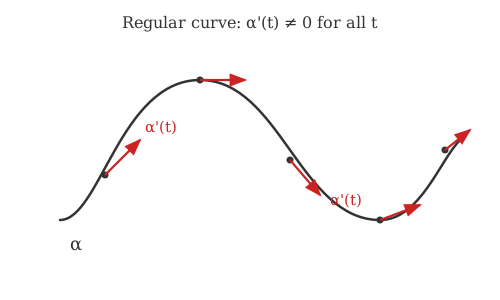
Regularity is a mild and very useful condition: it prevents cusps and ensures the curve has a well-defined tangent line at every point. The following theorem shows that regularity also forces the curve to be locally injective — it cannot immediately fold back on itself.
Theorem 1.3 (Local Injectivity): Every regular curve in \(\mathbb{R}^n\) is locally injective.
Proof. Let \(a \in I\). Since \(\alpha'(a) \neq 0\), some coordinate function satisfies \(x_k'(a) \neq 0\), say \(x_k'(a) > 0\). By continuity of \(x_k'\), there exists \(\delta > 0\) such that \(x_k'(t) > 0\) for \(|t-a| < \delta\). Thus \(x_k\) is strictly increasing on \((a-\delta, a+\delta)\), making \(\alpha\) injective there. \(\square\)
Regularity is not necessary for global injectivity (the three non-regular examples above are all globally injective). Conversely, regular curves can fail to be globally injective: the alpha curve \(\alpha(t) = (t^2-1, t(t^2-1))\) crosses itself at the origin.
Now that we understand smoothness and regularity, we turn to the most basic measurement we can make about a curve: its length. The natural definition comes from approximating the curve by inscribed polygonal paths and taking a supremum.
\[ L = L_\alpha[a,b] = \sup \left\{ \sum_{j=1}^p |\alpha(t_j) - \alpha(t_{j-1})| \,\Big|\, a = t_0 < t_1 < \cdots < t_p = b \right\}. \]For regular curves, this supremum is always finite and equals the familiar integral formula. This is a non-trivial fact: it says the polygonal approximations do converge, and they converge to the integral of the speed.
\[ L = L_\alpha[a,b] = \int_a^b |\alpha'(t)|\, dt. \]Proof. The proof proceeds by showing the supremum of the piecewise linear sums \(L(\alpha, P)\) and the Riemann sums \(S(\alpha, P)\) for \(\int |\alpha'|\) both approximate the same limit. Given \(\epsilon > 0\), by uniform continuity of each \(x_k'\) and Riemann integrability of \(|\alpha'|\), one finds a partition \(P\) fine enough that \(L - L(\alpha,P) < \epsilon/3\), \(|\int |\alpha'| - S(\alpha,P)| < \epsilon/3\), and \(|L(\alpha,P) - S(\alpha,P)| < \epsilon/3\), yielding \(|L - \int |\alpha'|| < \epsilon\). \(\square\)
Length is a geometric property: it does not depend on how we parametrize the curve. Different parametrizations of the same geometric path give the same length, as long as we integrate the speed correctly. This leads to the idea of choosing a canonical parametrization — one where the speed is identically 1.
A reparametrization of \(\alpha\) is a curve \(\beta(s) = \alpha(t(s))\) where \(s : I \to J\) is a homeomorphism. When \(s'(t) \neq 0\) for all \(t\), the reparametrization is regular; it preserves direction when \(s'(t) > 0\) and reverses direction when \(s'(t) < 0\). We say \(\beta\) is parametrized by arclength when \(|\beta'(s)| = 1\) for all \(s\).
Theorem 1.11: Every regular curve can be reparametrized by arclength using a regular direction-preserving change of coordinates.
Proof. Fix \(a \in I\) and define \(s(t) = \int_a^t |\alpha'(r)|\, dr\). Then \(s'(t) = |\alpha'(t)| > 0\), so \(s\) is regular and strictly increasing. Its inverse satisfies \(t'(s) = 1/|\alpha'(t)|\), and the reparametrized curve \(\beta(s) = \alpha(t(s))\) has \(|\beta'(s)| = |\alpha'(t(s))| \cdot t'(s) = 1\). \(\square\)
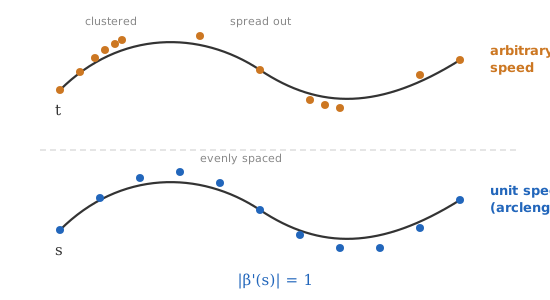
Arclength parametrization is the “natural speed” — the parameter literally measures distance traveled along the curve. With this canonical choice available, we can define geometric quantities free of any speed-dependence.
Curves in \(\mathbb{R}^2\)
In the plane, a unit-speed curve has a distinguished orthonormal frame at each point — the tangent and the perpendicular normal — and we can measure how rapidly the curve turns. This turning rate, the signed curvature, is the single invariant that completely classifies plane curves up to rigid motion.
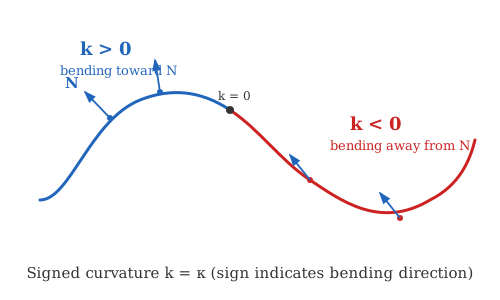
\[ T(s) = T_\beta(s) = \beta'(s), \qquad N(s) = N_\beta(s) = T(s)^\times. \]\[ \beta''(s) = k(s) N(s). \]The scalar curvature is \(\kappa(s) = |k(s)| = |\beta''(s)|\). For an arbitrary regular curve \(\alpha : I \to \mathbb{R}^2\), one first reparametrizes by arclength and then defines \(T, N, k, \kappa\) in terms of the reparametrized curve.
The sign of \(k\) encodes the direction of turning: positive curvature means the curve bends to the left (toward \(N\)), and negative curvature means it bends to the right. The magnitude \(\kappa\) measures how tightly the curve bends — a circle of radius \(r\) has constant curvature \(\kappa = 1/r\).
The osculating circle of \(\beta\) at \(s_0\) is the circle through \(\beta(s_0)\) with center \(\beta(s_0) + \frac{1}{k(s_0)} N(s_0)\) (when \(k(s_0) \neq 0\) and radius \(1/|k(s_0)|\). It is the best-fit circle to the curve at that point.
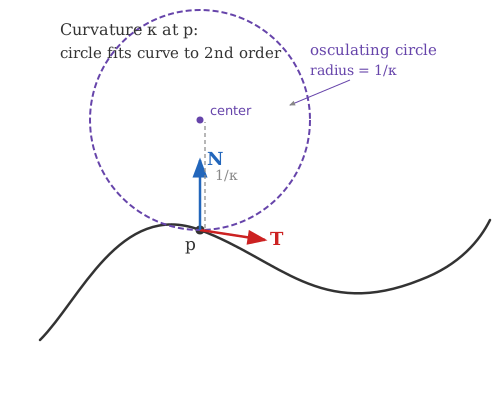
The osculating circle captures the second-order behavior of the curve: it agrees with the curve to second order in the arclength parameter. A straight line has no osculating circle (or one of infinite radius), while a curve with very high curvature has a small, tightly fitting osculating circle.
\[ \beta'(s) = (\cos\theta(s),\ \sin\theta(s)). \]In this case \(\theta'(s) = k(s)\).
This theorem is the key link between signed curvature and the global behavior of a closed curve: by integrating \(k\) around the curve we measure the total angle through which the tangent rotates.
\[ n(\alpha) = \frac{1}{2\pi}\int_0^L k(s)\, ds = \frac{\theta(L) - \theta(0)}{2\pi}, \]the total turning of the tangent vector divided by \(2\pi\).
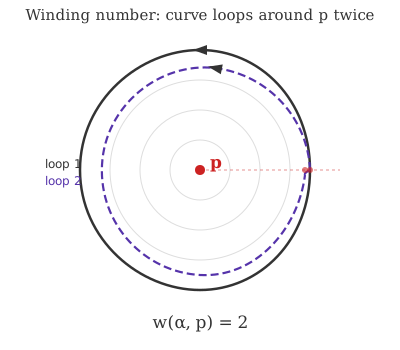
Theorem 1.19 (Turning Number Theorem): For a smooth closed regular curve in \(\mathbb{R}^2\) that does not self-intersect, the turning number is \(\pm 1\).
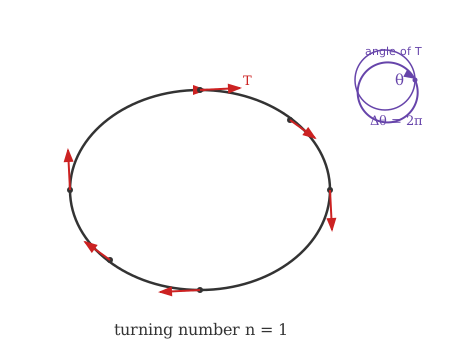
The turning number theorem is a beautiful early example of a topological constraint imposed on geometry: no matter how wildly a simple closed curve is drawn, the tangent always winds exactly once. The sign depends on the orientation of traversal.
Theorem 1.20 (Fundamental Theorem for Plane Curves): Given a smooth function \(k : J \to \mathbb{R}\) and a point \(p \in \mathbb{R}^2\), a unit vector \(A \in \mathbb{R}^2\), and \(s_0 \in J\), there exists a unique smooth regular curve \(\beta : J \to \mathbb{R}^2\) parametrized by arclength with \(\beta(s_0)=p\), \(\beta'(s_0)=A\), and signed curvature \(k_\beta = k\).
Proof sketch. By the Polar Coordinates Theorem, define \(\theta(s) = \theta_0 + \int_{s_0}^s k(r)\,dr\) where \(\theta_0\) is chosen so that \(A = (\cos\theta_0, \sin\theta_0)\), then set \(\beta(s) = p + \int_{s_0}^s (\cos\theta(r), \sin\theta(r))\,dr\).
This fundamental theorem is the plane-curve analogue of the basic existence-uniqueness theorem for ODEs: specifying the initial position, initial direction, and curvature function completely pins down the curve. It tells us that signed curvature is a complete invariant for plane curves — two unit-speed plane curves with the same curvature function and matching initial data are congruent.
Curves in \(\mathbb{R}^3\)
Moving from the plane to space introduces a new degree of freedom: a space curve can not only bend (as measured by curvature) but also twist out of any fixed plane. To capture this, we need a richer moving frame — the Frenet-Serret frame — and a second scalar invariant called torsion.
For a smooth regular curve \(\beta : J \to \mathbb{R}^3\) parametrized by arclength, the unit tangent vector is \(T = \beta'\). Since \(|T| = 1\), we have \(T' \perp T\). When \(T'(s) \neq 0\), the principal normal vector is \(P = T'/|T'|\) and the curvature is \(\kappa = |T'| = |\beta''|\). The binormal vector is \(B = T \times P\), giving a positively oriented orthonormal frame \(\{T, P, B\}\) at each point.
\[ T' = \kappa P, \qquad P' = -\kappa T + \tau B, \qquad B' = -\tau P. \]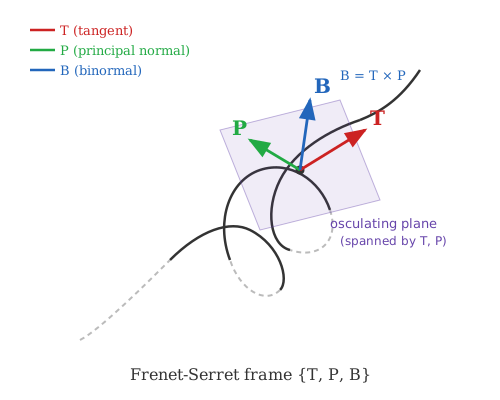
The curvature \(\kappa\) measures the rate at which the curve bends away from a straight line, while the torsion \(\tau\) measures how the curve twists out of the osculating plane spanned by \(T\) and \(P\). A curve lies in a plane if and only if \(\tau \equiv 0\).
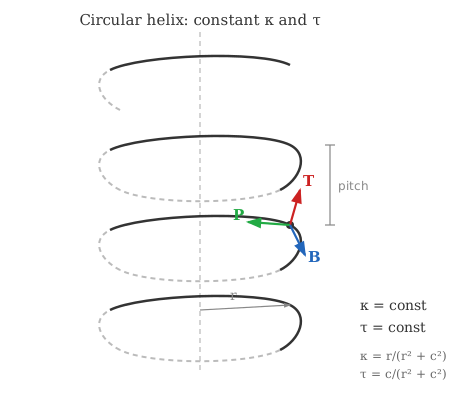
The Frenet-Serret formulas express the derivatives of the frame in terms of the frame itself. Geometrically: \(T' = \kappa P\) says the tangent turns toward the principal normal at rate \(\kappa\); \(B' = -\tau P\) says the binormal rotates toward the principal normal at rate \(\tau\), measuring how the osculating plane tilts. A helix, for instance, has constant positive curvature and constant nonzero torsion, capturing its uniform spiral character.
Theorem 1.27 (Fundamental Theorem for Space Curves): Given smooth functions \(\kappa, \tau : J \to \mathbb{R}\) with \(\kappa(s) > 0\) for all \(s\), a point \(p \in \mathbb{R}^3\), and a positively oriented orthonormal basis \(\{A, B, C\}\) of \(\mathbb{R}^3\), there exists a unique smooth curve \(\beta : J \to \mathbb{R}^3\) parametrized by arclength such that \(\beta(s_0) = p\), \((T(s_0), P(s_0), B(s_0)) = (A, B, C)\), and the curvature and torsion of \(\beta\) are \(\kappa\) and \(\tau\).
Proof sketch. The Frenet-Serret equations form a system of ODEs \(\frac{d}{ds}(T,P,B) = (T,P,B) M\) for a skew-symmetric matrix \(M\) depending on \(\kappa\) and \(\tau\). Existence and uniqueness of solutions with prescribed initial conditions follows from the standard ODE theorem. One then verifies the solution maintains the orthonormality of the frame.
Just as for plane curves, the pair \((\kappa, \tau)\) is a complete set of invariants for space curves: two unit-speed space curves with \(\kappa > 0\) and the same curvature and torsion functions are congruent via a rigid motion. This closes the local theory of curves and prepares us to turn to the richer and more challenging world of surfaces.
Chapter 2: Surfaces
Having understood curves, we now step up one dimension. A surface in \(\mathbb{R}^3\) is a two-dimensional geometric object, locally parametrized by two variables. The central question is the same as for curves: what are the intrinsic geometric invariants of a surface? The answer here is deeper and more surprising — Gauss’s Theorema Egregium tells us that Gaussian curvature is intrinsic even though it seems to depend on how the surface sits in space.
Surfaces in \(\mathbb{R}^n\)
A (local parametrized) surface in \(\mathbb{R}^n\) is a continuous map \(\sigma : U \subseteq \mathbb{R}^2 \to \mathbb{R}^n\) where \(U\) is an open set. The surface is regular when \(\sigma\) is \(C^1\) and its derivative (Jacobian) matrix \(D\sigma = (\sigma_u, \sigma_v)\) has rank 2, meaning the column vectors \(\sigma_u = \partial\sigma/\partial u\) and \(\sigma_v = \partial\sigma/\partial v\) are linearly independent at every point. The tangent plane to \(\sigma\) at \((a,b)\) is the plane through \(\sigma(a,b)\) parallel to \(\sigma_u(a,b)\) and \(\sigma_v(a,b)\).
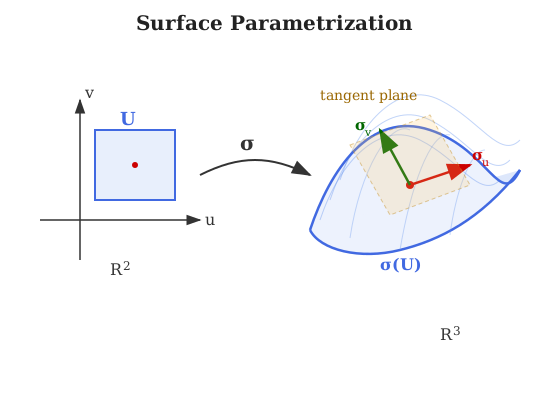
Standard examples include:
- The graph of \(f: U \to \mathbb{R}\) via \(\sigma(u,v) = (u,v,f(u,v))\), always regular since \(D\sigma\) has rank 2.
- The sphere \(\rho(\phi,\theta) = r(\sin\phi\cos\theta, \sin\phi\sin\theta, \cos\phi)\), regular when \(\sin\phi \neq 0\).
- The torus \(\sigma(\theta,\phi) = ((R+r\cos\phi)\cos\theta, (R+r\cos\phi)\sin\theta, r\sin\phi)\), regular everywhere for \(0 < r < R\).
To measure lengths and angles on the surface — to do intrinsic geometry — we pull back the ambient Euclidean metric through the parametrization. This gives the first fundamental form, which encodes all measurements that can be made by a flat creature living on the surface.
\[ g = g_\sigma = D\sigma^T D\sigma = \begin{pmatrix} \sigma_u \cdot \sigma_u & \sigma_u \cdot \sigma_v \\ \sigma_u \cdot \sigma_v & \sigma_v \cdot \sigma_v \end{pmatrix}. \]Traditionally one writes \(E = g_{11} = \sigma_u \cdot \sigma_u\), \(F = g_{12} = \sigma_u \cdot \sigma_v\), \(G = g_{22} = \sigma_v \cdot \sigma_v\). This is positive-definite (since \(\sigma_u\) and \(\sigma_v\) are linearly independent), so it defines an inner product \(\langle X, Y \rangle = Y^T g X\) on \(\mathbb{R}^2\).
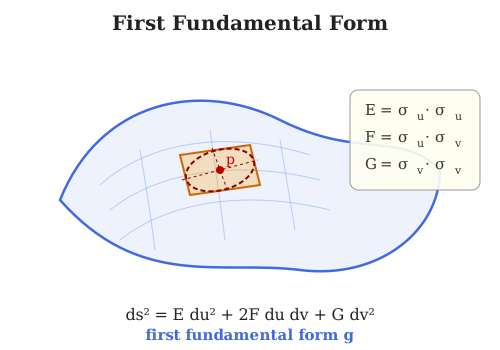
and the angle between two curves on the surface through a point \(p\) is computed using the inner product \(\langle X, Y \rangle = Y^T g(p) X\).
\[ A_\sigma(R) = \iint_R \sqrt{\det g(u,v)}\, du\, dv. \]More generally, for a continuous function \(f : U \to \mathbb{R}\), we write \(dA = \sqrt{\det g}\, du\, dv\) and define \(\iint_R f\, dA = \iint_R f(u,v)\sqrt{\det g}\,du\,dv\).
Theorem 2.12 (Change of Coordinates): Under a smooth regular change of coordinates \(\phi: U \to V\) with inverse \(\psi = \phi^{-1}\), the surface \(\rho = \sigma \circ \psi\) satisfies \(g_\rho(q) = D\psi(q)^T g_\sigma(p) D\psi(q)\) and \(A_\rho(\phi(R)) = A_\sigma(R)\). That is, area is intrinsic and independent of the parametrization chosen.
Surfaces in \(\mathbb{R}^3\)
When a surface sits in \(\mathbb{R}^3\), we gain access to the unit normal vector, which allows us to measure how the surface bends in the ambient space. The second fundamental form captures this extrinsic bending, leading to the notions of principal, mean, and Gaussian curvature.
\[ n = n_\sigma = \frac{\sigma_u \times \sigma_v}{|\sigma_u \times \sigma_v|} : U \to S^2 \subseteq \mathbb{R}^3. \]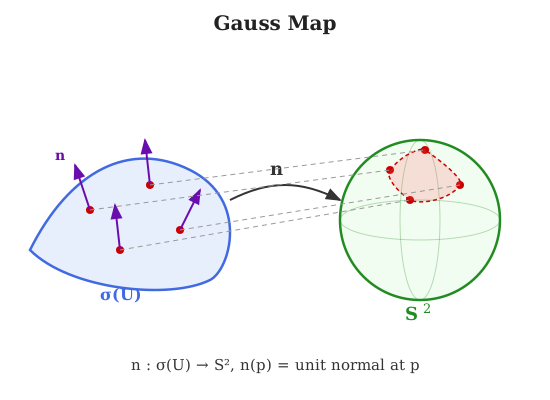
Given a point \(p \in U\) and a nonzero vector \(A \in \mathbb{R}^2\), the (directional) curvature \(k_\sigma(p)(A)\) is defined by taking any regular curve \(\alpha\) with \(\alpha(0)=p\), \(\alpha'(0)=A\), letting \(\gamma = \sigma \circ \alpha\) and reparametrizing by arclength to get \(\delta\), then setting \(k_\sigma(p)(A) = \delta''(0) \cdot N(0)\) where \(N(s) = n(\alpha(t(s)))\).
\[ k_\sigma(p)(A) = \frac{A^T h(p) A}{A^T g(p) A} \]where \(g = D\sigma^T D\sigma\) is the first fundamental form and \(h = -Dn^T D\sigma\) is the second fundamental form.
The formula \(A^T h A / A^T g A\) is a generalized Rayleigh quotient. Its maximum and minimum over all directions \(A\) are the eigenvalues of the matrix \(g^{-1}h\), and the extremizing directions are the principal directions of curvature — the directions in which the surface bends most and least steeply.
\[ h = \begin{pmatrix} \sigma_{uu} \cdot n & \sigma_{uv} \cdot n \\ \sigma_{uv} \cdot n & \sigma_{vv} \cdot n \end{pmatrix} \]using the identities \(\sigma_{uu} \cdot n = -\sigma_u \cdot n_u\) etc. (obtained by differentiating \(\sigma_u \cdot n = 0\). Traditionally one writes \(L = h_{11}\), \(M = h_{12}\), \(N = h_{22}\).
Proof of Theorem 2.14. Since \(\delta'\) lies in the tangent plane, \(\delta' \cdot N = 0\). Differentiating: \(\delta'' \cdot N = -\delta' \cdot N'\). Computing \(\delta' = D\sigma(\alpha') / |D\sigma\alpha'|\) and \(N' = Dn(\alpha')/|D\sigma\alpha'|\), one obtains \(k = -(\delta' \cdot N') = -(A^T Dn^T D\sigma A)/(A^T D\sigma^T D\sigma A) = A^T h A / A^T g A\). \(\square\)
The directional curvature depends only on the direction of \(A\), so \(k_\sigma(p)\) defines a function on the projective line \(\mathbb{P}^1(\mathbb{R})\) of directions. Under a positive change of coordinates, the unit normal is preserved (\(n_\rho = n_\sigma\), the second fundamental form transforms as \(h_\rho(q) = D\psi(q)^T h_\sigma(p) D\psi(q)\), and the directional curvature is invariant.
Theorem 2.18 (Principal Curvature Directions): For \(p \in U\), the directional curvature \(k_\sigma(p)(A)\) attains its maximum \(k_1\) and minimum \(k_2\) in two directions orthogonal with respect to \(g(p)\). These extreme values are the principal curvatures, the eigenvalues of \(g(p)^{-1} h(p)\), occurring in the principal directions (eigenvectors). The principal curvatures are the roots of \(\det(h(p) - k\ g(p)) = 0\).
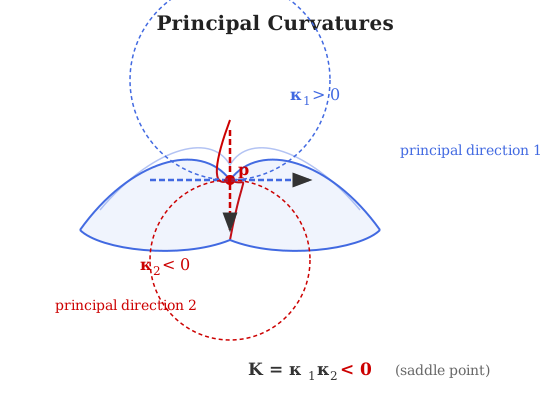
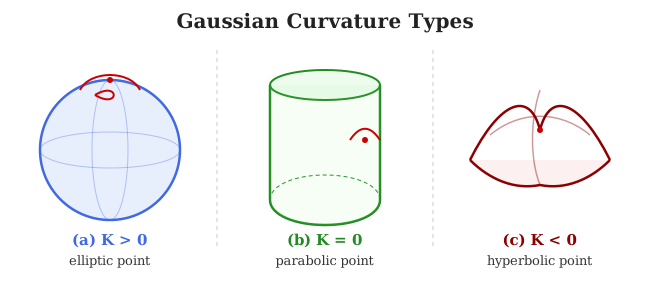
Mean curvature \(H\) measures the average bending in all directions; minimal surfaces (soap films) satisfy \(H = 0\). Gaussian curvature \(K\) is the product of the principal curvatures and is positive when the surface curves the same way in all directions (like a sphere or ellipsoid), zero when it is flat in at least one direction (like a cylinder or cone), and negative when it saddles (like a hyperbolic paraboloid). The Gaussian curvature turns out to have a much deeper significance, which we will reveal with the Theorema Egregium.
\[ \begin{pmatrix} \sigma_{uu} \\ \sigma_{uv} \\ \sigma_{vv} \\ n_u \\ n_v \end{pmatrix} = \begin{pmatrix} \Gamma^1_{11} & \Gamma^2_{11} & h_{11} \\ \Gamma^1_{12} & \Gamma^2_{12} & h_{12} \\ \Gamma^1_{22} & \Gamma^2_{22} & h_{22} \\ b^1_1 & b^2_1 & 0 \\ b^1_2 & b^2_2 & 0 \end{pmatrix} \begin{pmatrix} \sigma_u \\ \sigma_v \\ n \end{pmatrix} \]\[ \begin{pmatrix} \Gamma^1_{11} & \Gamma^1_{12} & \Gamma^1_{22} \\ \Gamma^2_{11} & \Gamma^2_{12} & \Gamma^2_{22} \end{pmatrix} = \tfrac{1}{2} g^{-1} \begin{pmatrix} (g_{11})_u & (g_{11})_v & 2(g_{12})_v - (g_{22})_u \\ 2(g_{12})_u - (g_{11})_v & (g_{22})_u & (g_{22})_v \end{pmatrix}. \]The proof determines all entries by taking dot products with \(\sigma_u\), \(\sigma_v\), and \(n\), using e.g. \(\sigma_{uu} \cdot \sigma_u = \frac{1}{2}(g_{11})_u\) (from differentiating \(g_{11} = \sigma_u \cdot \sigma_u\).
The Gauss-Weingarten equations express every second partial derivative of the surface in terms of the moving frame \(\{\sigma_u, \sigma_v, n\}\). Crucially, the coefficients \(\Gamma^k_{ij}\) depend only on \(g\) and its first derivatives — not on the embedding. These will play the role of “correction terms” when we differentiate vector fields on the surface, and they are the building blocks of the intrinsic geometry.
\[ (h_{11})_v - (h_{12})_u = h_{11}\Gamma^1_{12} + h_{12}(\Gamma^2_{12} - \Gamma^1_{11}) - h_{22}\Gamma^2_{11}, \]\[ (h_{12})_v - (h_{22})_u = h_{11}\Gamma^1_{22} + h_{12}(\Gamma^2_{22} - \Gamma^1_{12}) - h_{22}\Gamma^2_{12}, \]\[ g_{11} K = (\Gamma^2_{11})_v - (\Gamma^2_{12})_u + \Gamma^2_{11}\Gamma^2_{22} + \Gamma^1_{11}\Gamma^2_{12} - \Gamma^1_{12}\Gamma^2_{11} - (\Gamma^2_{12})^2, \]and two further equations for \(g_{12} K\) and \(g_{22} K\).
These compatibility equations arise from requiring \(\sigma_{uuv} = \sigma_{uvu}\) and \(\sigma_{vvu} = \sigma_{vuv}\), then expanding using the Gauss-Weingarten equations and equating coefficients of \(\sigma_u\), \(\sigma_v\), and \(n\).
The Gauss equations are remarkable: although \(K = \det h / \det g\) involves the second fundamental form \(h\) (which encodes the extrinsic embedding), the right-hand side of the Gauss equations involves only \(g\) and its derivatives. This is not a coincidence; it is the precise content of the Theorema Egregium.
Theorem 2.23 (Theorema Egregium): For a smooth regular surface in \(\mathbb{R}^3\), the Gaussian curvature \(K = \det h / \det g\) can be expressed entirely in terms of the first fundamental form \(g\) and its derivatives. In particular, \(K\) is an intrinsic property: it is preserved under isometries (maps that preserve the Riemannian metric).
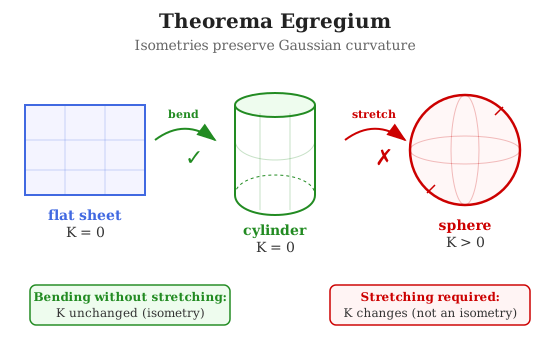
This is Gauss’s “remarkable theorem”: even though \(K\) is defined using \(h\) (which depends on the embedding in \(\mathbb{R}^3\), it turns out to depend only on the intrinsic geometry. As a consequence, a flat rectangle and a cylinder (which is obtained by bending a rectangle without stretching) have the same Gaussian curvature \(K=0\) at every point, while the mean curvature changes (\(H=0\) vs. \(H = 1/(2r)\).
Theorem 2.24 (Bonnet’s Theorem / Fundamental Theorem for Surfaces): Given a connected open set \(U \subseteq \mathbb{R}^2\), smooth functions \(g_{11}, g_{12}, g_{22}, h_{11}, h_{12}, h_{22} : U \to \mathbb{R}\) with \(g_{11} > 0\) and \(g_{11}g_{22} - g_{12}^2 > 0\), satisfying all the Gauss-Codazzi equations, and given initial data \(p \in \mathbb{R}^3\) and orthogonal unit vectors \(A, B \in \mathbb{R}^3\), there exists a unique smooth surface \(\sigma : U \to \mathbb{R}^3\) with these fundamental forms satisfying \(\sigma(0)=p\), \(\sigma_u(0) \in \operatorname{Span}\{A\}\), \(\sigma_v(0) \in \operatorname{Span}\{A,B\}\). Bonnet’s theorem says a surface is determined up to rigid motion by its two fundamental forms, provided the Gauss-Codazzi compatibility conditions hold.
Bonnet’s theorem is the surface analogue of the fundamental theorem for curves: just as a space curve is determined up to rigid motion by its curvature and torsion functions, a surface is determined up to rigid motion by \(g\) and \(h\) — provided the Gauss-Codazzi equations are satisfied, which are precisely the integrability conditions guaranteeing the Gauss-Weingarten system has a solution.
Chapter 3: Geodesic Curvature and the Gauss-Bonnet Theorem
With the local theory of surfaces in hand, we now develop the tools needed to prove one of the most beautiful theorems in all of mathematics: the Gauss-Bonnet theorem. The strategy is to define geodesic curvature (the intrinsic bending of a curve on a surface), identify geodesics as the “straightest possible” paths, and then use Green’s theorem to assemble local curvature information into global topological information.
Geodesic Curvature and Geodesics
Let \(\sigma : U \subseteq \mathbb{R}^2 \to \mathbb{R}^3\) be a smooth regular surface, let \(\alpha : I \to U\) be a smooth regular curve, and let \(\gamma(t) = \sigma(\alpha(t))\). Reparametrize \(\gamma\) by arclength to get \(\beta(s) = \alpha(t(s))\) and \(\delta(s) = \gamma(t(s))\). Set \(T(s) = \delta'(s)\), \(N(s) = n(\beta(s))\), and \(M(s) = N(s) \times T(s)\). Then \(\{T, M, N\}\) is a positive oriented orthonormal basis for \(\mathbb{R}^3\) with \(T\) and \(M\) spanning the tangent plane.
\[ \delta'' = (\delta'' \cdot N) N + (\delta'' \cdot M) M. \]\[ k_g = k_g(s) = k_g(\beta)(s) = \delta''(s) \cdot M(s). \]For the original curve \(\alpha\) we set \(k_g(\alpha)(t) = k_g(\beta)(s(t))\).
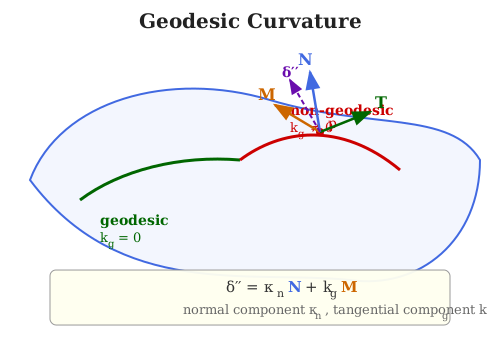
Geodesic curvature measures how much the curve bends within the surface itself, independently of how the surface is curved in space. A geodesic — the surface analogue of a straight line — has zero geodesic curvature: it bends only as much as the surface forces it to.
\[ k_g = \sqrt{\det g} \left[ \left(v'' + \Gamma^2_{11}(u')^2 + 2\Gamma^2_{12} u'v' + \Gamma^2_{22}(v')^2\right) u' - \left(u'' + \Gamma^1_{11}(u')^2 + 2\Gamma^1_{12} u'v' + \Gamma^1_{22}(v')^2\right) v' \right]. \]Since this formula involves only \(g\) and its derivatives (via the Christoffel symbols), \(k_g\) is intrinsic — it can be computed from the Riemannian metric alone without knowing how the surface sits in \(\mathbb{R}^3\).
Proof. Using \(\delta'\) and \(\delta''\) from the Gauss-Weingarten equations and the formula \(k_g = \det(\delta', \delta'', N)\), one notes that \(\det(\sigma_u, \sigma_v, n) = \sqrt{\det g}\). The normal component \(n(\cdot)\) drops out, yielding the intrinsic formula. \(\square\)
Geodesics via the Calculus of Variations
\[ E_\delta[a,b] = \int_a^b |\delta'(s)|^2\, ds = \int_a^b \beta'(s)^T g(\beta(s)) \beta'(s)\, ds. \]By the Cauchy-Schwarz inequality, \(L^2 \leq (b-a) E\), with equality when \(|\delta'|\) is constant. So minimizing arclength among arclength-parametrized curves is equivalent to minimizing energy.
Minimizing the energy functional is the right approach because the energy functional is smoother to work with analytically. The Euler-Lagrange equations for the energy give a clean second-order ODE system — the geodesic equations — whose solutions exist and are unique by the standard ODE existence theorem.
\[ \frac{\partial L}{\partial u} - \frac{d}{ds}\frac{\partial L}{\partial u'} = 0, \qquad \frac{\partial L}{\partial v} - \frac{d}{ds}\frac{\partial L}{\partial v'} = 0. \]\[ u'' + \Gamma^1_{11}(u')^2 + 2\Gamma^1_{12} u'v' + \Gamma^1_{22}(v')^2 = 0, \]\[ v'' + \Gamma^2_{11}(u')^2 + 2\Gamma^2_{12} u'v' + \Gamma^2_{22}(v')^2 = 0. \]Definition 3.4: A geodesic on \(\sigma\) is a smooth regular curve \(\beta : I \to U\), parametrized by arclength with respect to \(g\), satisfying the geodesic equations.
Theorem 3.5: For a smooth regular curve \(\beta\) on \(\sigma\) with \(\delta = \sigma \circ \beta\):
- \(\delta''(s) \parallel N(s)\) for all \(s\) if and only if \(\beta\) satisfies the geodesic equations, in which case \(|\delta'|\) is constant.
- When \(|\delta'(s)| = 1\), \(\beta\) is a geodesic if and only if \(k_g \equiv 0\).
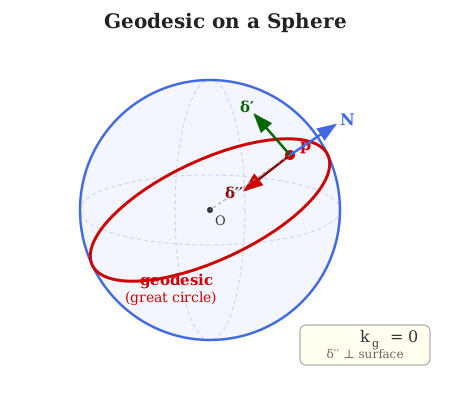
In other words, a geodesic is a curve for which the acceleration \(\delta''\) is always normal to the surface — there is no tangential acceleration, so the curve “travels as straight as possible” on the surface.
Corollary 3.6: Given a point \(p \in U\) and a unit vector \(A \in \mathbb{R}^2\), there exists a unique geodesic \(\beta : I \to U\) with \(\beta(0) = p\) and \(\beta'(0)/|\beta'(0)| = A\), defined on the maximal interval \(I\) for which \(\beta(s) \in U\). This follows directly from the existence and uniqueness theorem for ODEs applied to the geodesic equations.
Orthogonal Coordinates
Working with arbitrary coordinates makes many formulas cumbersome. A key simplification comes from choosing coordinates in which the coordinate lines are perpendicular — orthogonal coordinates — so that the metric takes diagonal form. Such coordinates always exist locally, and in them the formulas for Gaussian curvature and geodesic curvature become much more transparent.
Theorem 3.7 (Orthogonal Coordinates): For every point \(p \in U\) there exists a neighborhood \(U_p \subseteq U\) of \(p\) and a smooth regular change of coordinates \(\phi : U_p \to V_p\) such that the reparametrized surface \(\rho = \sigma \circ \phi^{-1}\) has diagonal first fundamental form \(g_\rho(s,t) = \operatorname{diag}(g_{11}, g_{22})\) everywhere in \(V_p\).
When the coordinates are orthogonal (i.e., \(g_{12} = F = 0\), geometric quantities simplify greatly. In fact, Gauss proved a stronger result: isothermal coordinates exist locally around any point, where \(g_\rho\) is a scalar multiple of the identity.
\[ K = \frac{-1}{2\sqrt{g_{11}g_{22}}} \left[ \frac{\partial}{\partial u}\frac{(g_{22})_u}{\sqrt{g_{11}g_{22}}} + \frac{\partial}{\partial v}\frac{(g_{11})_v}{\sqrt{g_{11}g_{22}}} \right]. \]This formula makes the intrinsic nature of \(K\) transparent: the right-hand side depends only on the metric coefficients \(g_{11}\) and \(g_{22}\) and their derivatives, with no reference to the second fundamental form.
\[ k_1 = k_g^{v=b} = -\frac{(g_{11})_v}{2\sqrt{g_{11}g_{22}}}, \qquad k_2 = k_g^{u=a} = \frac{(g_{22})_u}{2\sqrt{g_{22}g_{11}}}. \]\[ \delta'(s) = \cos\theta(s)\,\frac{\sigma_u(\beta(s))}{|\sigma_u(\beta(s))|} + \sin\theta(s)\,\frac{\sigma_v(\beta(s))}{|\sigma_v(\beta(s))|} \]for a smooth function \(\theta(s)\) (unique up to \(2\pi\). This \(\theta\) measures the angle from the \(\sigma_u\)-direction to the tangent vector in the tangent plane.
Theorem 3.13 (Geodesic Curvature in Orthogonal Coordinates): With notation as above:
- Writing \(\beta(s) = (u(s), v(s))\), we have \(\cos\theta = \sqrt{g_{11}}\, u'\) and \(\sin\theta = \sqrt{g_{22}}\, v'\).
- The geodesic curvature satisfies \[ k_g = \theta' + k_1 \cos\theta + k_2 \sin\theta. \]
This elegant formula decomposes the geodesic curvature into the rate of change of the angle (\(\theta'\) plus the curvature contributions from the coordinate lines.
Green’s Theorem
Before proving the Gauss-Bonnet formula, we need a version of Green’s theorem adapted to curved coordinate systems. The following theorem gives the change-of-variables form that will feed directly into the Gauss-Bonnet argument.
\[ \iint_R \left(\frac{\partial Q}{\partial u} - \frac{\partial P}{\partial v}\right) du\, dv = \sum_{j=1}^3 \int_0^1 F(\alpha_j(t)) \cdot \alpha_j'(t)\, dt. \]Proof. Set \(G(x,y) = D\psi(x,y)^T F(\psi(x,y))\). By the change of variables formula, \(\iint_R (Q_u - P_v)\,du\,dv = \iint_\Delta (M_x - L_y)\,dx\,dy\) where \((L,M) = G\). The latter equals \(\sum_j \int_0^1 G(\delta_j) \cdot \delta_j'\,dt\) by direct computation on the triangle \(\Delta\) using iterated integrals, and each boundary integral for \(G\) matches the corresponding one for \(F\) under the change of coordinates. \(\square\)
The Gauss-Bonnet Formula
We now have all the ingredients to prove the local Gauss-Bonnet formula for a geodesic triangle. The key insight is that the Gaussian curvature integral over a triangular region and the geodesic curvature integrals along its edges together exactly account for the total angular turning around the boundary — with the discrepancy from \(2\pi\) being absorbed by the exterior angles at the vertices.
\[ \int_\alpha k_g\,dL = \int_a^b k_g(\alpha)(t)\,|\gamma'(t)|\,dt, \qquad \iint_R K\,dA = \iint_R K_\sigma(u,v)\sqrt{\det g}\,du\,dv. \]These are invariant under changes of parametrization (with appropriate sign adjustments).
\[ \iint_R K\,dA + \sum_{j=1}^3 \int_{\alpha_j} k_g\,dL = \sum_{j=1}^3 \Delta\theta_j. \]Proof. Using Theorem 3.13, each geodesic curvature integral decomposes as \(\int k_g\,dL = \Delta\theta_j + \int_0^1 F(\alpha_j) \cdot \alpha_j'\,dt\) where \(F = (P,Q)\) with \(P = -(g_{11})_v/(2\sqrt{g_{11}g_{22}})\) and \(Q = (g_{22})_u/(2\sqrt{g_{11}g_{22}})\). By Green’s Theorem, \(\sum_j \int F \cdot \alpha_j'\,dt = \iint_R (Q_u - P_v)\,du\,dv = -\iint_R K\,dA\) by Theorem 3.10. \(\square\)
\[ \iint_R K\,dA + \sum_{j=1}^3 \int_{\alpha_j} k_g\,dL + \sum_{j=1}^3 \epsilon_j = 2\pi. \]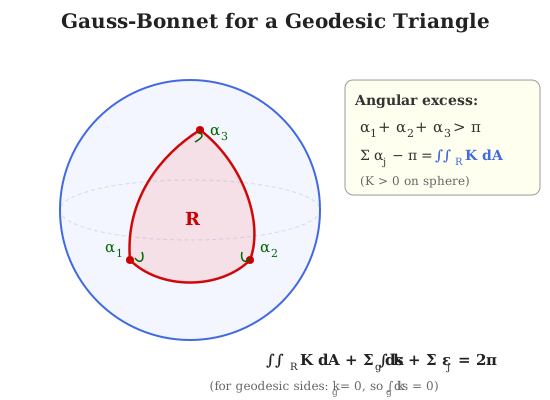
The formula in Note 3.18 generalizes the elementary angle-sum theorem for triangles: a flat triangle (\(K = 0\)) with geodesic sides (\(k_g = 0\)) has exterior angles summing to \(2\pi\), i.e., interior angles summing to \(\pi\). On a positively curved surface like a sphere, the integral \(\iint K\,dA > 0\) so the angle sum exceeds \(\pi\) — a spherical triangle has angle sum greater than \(\pi\), with the excess equal to the area (up to a normalization constant).
\[ \iint_\Delta K_\sigma\, dA + \sum_{j=1}^3 \int_{\alpha_j} k_g\, dL + \sum_{j=1}^3 \epsilon_j = 2\pi. \]This formula holds without assuming orthogonal coordinates, because every point has a neighborhood with orthogonal coordinates (Theorem 3.7), and one can subdivide \(\Delta\) into small triangles each contained in such a neighborhood, apply Theorem 3.17 to each, and add — with interior boundary terms canceling.
Global Gauss-Bonnet Theorem
The local Gauss-Bonnet formula holds for a single triangular patch. The global theorem assembles these local pieces by triangulating a closed surface: when we sum the formula over all triangles, the geodesic curvature integrals along shared edges cancel, the external angle sums at vertices contribute \(2\pi V\) in total, and what remains is a purely topological quantity — the Euler characteristic.
Definition 3.22: A smooth regular global surface (or smooth regular 2-dimensional submanifold) in \(\mathbb{R}^n\) is a set \(S \subseteq \mathbb{R}^n\) covered by smooth regular homeomorphisms \(\sigma : U_\sigma \to S \cap W_\sigma\) (the coordinate charts) such that whenever two charts overlap, the transition map is smooth and regular. The collection of charts is an atlas for \(S\).
\[ \chi = V - E + F \]where \(V\), \(E\), \(F\) are the numbers of vertices, edges, and faces of the triangulation.
\[ \iint_S K\, dA = \sum_{i=1}^n \iint_\Delta K_{\sigma_i}\, dA = 2\pi\chi. \]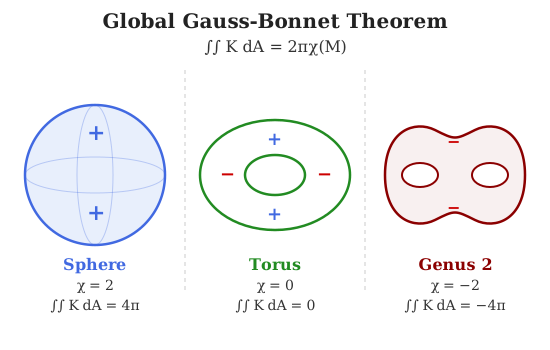
Proof. Apply the Gauss-Bonnet Formula to each triangle. When edges are joined in pairs, the geodesic curvature integrals cancel (by the change-of-coordinates theorem for \(k_g\). Let \(\epsilon_{i,j}\) and \(\phi_{i,j} = \pi - \epsilon_{i,j}\) be the external and internal angles of triangle \(i\) at vertex \(j\). Since \(F=n\), \(E = 3n/2\), and the sum of internal angles at each vertex is \(2\pi\), one obtains \(\sum K\,dA = 2\pi n - \sum_{i,j} \epsilon_{i,j} = 2\pi F - 2\pi E + 2\pi V = 2\pi\chi\). \(\square\)
Remark 3.25: Since \(K_S(p) = K_\sigma(u,v)\) when \(\sigma(u,v)=p\) (and this is independent of the chart chosen), the total curvature \(\iint_S K\,dA\) is well-defined and independent of triangulation. In particular, the Euler characteristic \(\chi(S)\) is a topological invariant. For a sphere, \(\chi = 2\) and \(\iint K\,dA = 4\pi\); for a torus, \(\chi = 0\) and \(\iint K\,dA = 0\). The Gauss-Bonnet theorem is remarkable because it relates a purely geometric quantity (total curvature, involving second derivatives of the surface) to a purely topological one (the Euler characteristic, which counts vertices minus edges plus faces in any triangulation).
Chapter 4: Submanifolds of \(\mathbb{R}^n\)
Having thoroughly developed the geometry of surfaces in \(\mathbb{R}^3\), we now generalize. The theory of submanifolds of \(\mathbb{R}^n\) is the natural setting that encompasses both curves and surfaces as special cases and extends the same ideas to higher dimensions. The key analytical tools — the inverse function theorem and its corollaries — guarantee that the local theory of submanifolds reduces to that of open subsets of Euclidean space.
Smooth Maps and Regularity
A smooth map \(f : U \subseteq \mathbb{R}^m \to \mathbb{R}^n\) (where \(U\) is open) is called regular (or an immersion) when its Jacobian matrix \(Df\) is injective at every point, i.e., the columns of \(Df(u)\) are linearly independent for all \(u \in U\). This extends the regularity conditions used for curves (\(m=1\) and surfaces (\(m=2\) to maps of any dimension.
Submanifolds
Definition 4.2–4.3: A set \(M \subseteq \mathbb{R}^n\) is an \(m\)-dimensional smooth regular submanifold when, near every point \(p \in M\), it is locally equal to the graph of a smooth function of \(m\) of the \(n\) coordinates in terms of the remaining \(n-m\).
Graphs of smooth functions, open sets in \(\mathbb{R}^m\), and the unit sphere \(S^{n-1} = \{x \in \mathbb{R}^n : |x| = 1\}\) are all examples of submanifolds.
The Inverse Function Theorem
The inverse function theorem is the engine that drives the entire theory of smooth manifolds. It tells us that an invertible first-order approximation (the Jacobian) implies the existence of a local smooth inverse, thereby allowing us to treat smooth submanifolds like open subsets of Euclidean space in small enough neighborhoods.
Theorem 4.6 (Inverse Function Theorem): Let \(f : U \subseteq \mathbb{R}^n \to \mathbb{R}^n\) with \(U\) open and \(a \in U\). If \(f\) is \(C^1\) and \(Df(a)\) is invertible, then there exists an open set \(U_0 \subseteq U\) with \(a \in U_0\) such that \(V_0 = f(U_0)\) is open, \(f : U_0 \to V_0\) is bijective, and \(g = f^{-1} : V_0 \to U_0\) is \(C^1\) with \(Dg(f(a)) = Df(a)^{-1}\). If \(f\) is \(C^k\) (or \(C^\infty\) then so is \(f^{-1}\).
(A complete proof appears in Appendix 1. The idea is a contraction mapping argument in Banach space.)
The Implicit and Parametric Function Theorems
From the inverse function theorem, one derives two fundamental tools for describing submanifolds: the implicit function theorem (describing them as level sets of smooth maps) and the parametric function theorem (describing them via smooth parametrizations). Together, these two perspectives — equations and coordinates — are complementary and underlie all of the local theory.
Theorem 4.7 (Implicit Function Theorem): Let \(f : U \subseteq \mathbb{R}^n \to \mathbb{R}^\ell\) be \(C^1\) with \(Df(p)\) of rank \(\ell\). Setting \(c = f(p)\), the level set \(f^{-1}(c)\) is locally the graph of a \(C^1\) function near \(p\).
Proof. Reorder variables so that the last \(\ell\) columns of \(Df(p)\) form an invertible \(\ell \times \ell\) matrix. Write \(f(x,y)\) with \(x \in \mathbb{R}^{n-\ell}\) and \(y \in \mathbb{R}^\ell\) with \(\partial z/\partial y\) invertible. Define \(F(x,y) = (x, f(x,y))\); then \(DF(p)\) is invertible, so the IFT applies. The inverse \(G(w,z) = (w, g(w,z))\) satisfies \(f^{-1}(c) = \{(x, g(x,c))\}\) locally. \(\square\)
Corollary 4.8 (Implicit Description of Submanifolds): If \(f : U \to \mathbb{R}^\ell\) is smooth with \(\operatorname{rank} Df(x) = \ell\) for all \(x \in U\), then \(f^{-1}(c)\) is a smooth \((n-\ell)\)-dimensional submanifold for every \(c\) in the range. For example, \(S^{n-1} = f^{-1}(1)\) for \(f(x) = |x|^2\), which has \(Df(x) = 2x^T\) of rank 1 everywhere on \(S^{n-1}\).
Theorem 4.10 (Parametric Function Theorem): Let \(\sigma : U \subseteq \mathbb{R}^m \to \mathbb{R}^n\) be \(C^1\) with \(D\sigma(a)\) of rank \(m\). Then there is an open \(U_0 \subseteq U\) with \(a \in U_0\) such that \(\sigma(U_0)\) equals the graph of a \(C^1\) function and \(\sigma : U_0 \to \sigma(U_0)\) is a homeomorphism.
Corollary 4.11 (Parametric Description): An \(m\)-dimensional smooth regular submanifold \(M \subseteq \mathbb{R}^n\) is a set covered by smooth regular homeomorphisms \(\sigma : U \to V \subseteq M\) (with \(U \subseteq \mathbb{R}^m\) open). The collection of all such maps is an atlas for \(M\), and each map is a coordinate chart. When two charts overlap, the transition map \(\rho^{-1}\sigma\) is a smooth regular change of coordinates (Theorem 4.15).
An important subtlety: the homeomorphism condition on \(\sigma\) is essential. The alpha curve \(\alpha(t) = (t^2-1, t(t^2-1))\) is regular and locally injective but not a homeomorphism onto its image near the self-intersection, and the image is not a manifold.
Smooth Maps Between Manifolds
Let \(M \subseteq \mathbb{R}^k\) and \(N \subseteq \mathbb{R}^\ell\) be smooth submanifolds. A map \(f : M \to N\) is smooth when \(\rho^{-1} f \sigma\) is smooth for every chart \(\sigma\) on \(M\) and every chart \(\rho\) on \(N\). A diffeomorphism is a bijective smooth map with smooth inverse. The dimension of a submanifold is well-defined (since if two charts overlap, the transition map must be square, forcing \(m = \ell\). Composites of smooth maps are smooth.
Tangent Spaces and Vector Fields
Now that we have a coordinate-free notion of a submanifold, we can develop calculus on it. The tangent space at a point is the correct linear approximation to the manifold, and it is the domain in which directional derivatives and vector fields live. The following definition captures this intrinsically, without privileging any particular chart.
\[ T_p M = \operatorname{Range} D\sigma(a). \]This is an \(m\)-dimensional subspace of \(\mathbb{R}^n\), and \(D\sigma(a)\) is an isomorphism from \(\mathbb{R}^m\) to \(T_p M\).
For example, \(T_p S^{n-1} = \{p\}^\perp = \ker(p^T)\), the hyperplane perpendicular to \(p\).
\[ X_p(f) = \frac{d}{dt}\Big|_{t=0} f(\gamma(t)) \]for any smooth \(\gamma\) with \(\gamma(0) = p\), \(\gamma'(0) = X_p\). In local coordinates \(\sigma\), \(X_p(f) = D(f \circ \sigma)(a) \cdot A\) where \(D\sigma(a) A = X_p\).
A vector field on \(M\) is a smooth assignment \(p \mapsto X_p \in T_p M\); in local coordinates \(\sigma\), it corresponds to a smooth map \(A_\sigma : U_\sigma \to \mathbb{R}^m\) with \(X(\sigma(u)) = D\sigma(u) A_\sigma(u)\).
\[ f_* X_p = \frac{d}{dt}\Big|_{t=0} f(\gamma(t)) \in T_{f(p)} N. \]In local coordinates, \(f_* X_p = D(f \circ \sigma)(a) A_\sigma\).
The Riemannian Metric on Manifolds
Just as we pulled back the ambient Euclidean metric to get the first fundamental form of a surface, we can equip any smooth submanifold of \(\mathbb{R}^n\) with an induced Riemannian metric. This metric is the fundamental data for doing intrinsic geometry on the manifold, and it is consistent across all coordinate charts by construction.
Definition 4.45: For a chart \(\sigma : U_\sigma \to M\), the Riemannian metric is \(g_\sigma(u) = D\sigma(u)^T D\sigma(u)\), giving an inner product on \(T_u U_\sigma = \mathbb{R}^m\). This is consistent across charts: if \(\rho = \sigma \circ \psi\) then \(g_\rho = D\psi^T g_\sigma D\psi\). The length of a curve on \(M\) and integrals of functions over \(M\) are computed using this metric, and are independent of the chart chosen.
Chapter 5: Integration of Differential Forms
We have so far been using integrals in a somewhat ad hoc manner — integrating functions along curves, over surfaces, and so on. Differential forms provide the correct, coordinate-free framework for all of these integration operations, and the exterior derivative unifies the gradient, curl, and divergence into a single operator \(d\). The payoff is Stokes’ theorem in its fully general form, of which all classical integral theorems are special cases.
Line Integrals and Flux Integrals
\[ \int_\alpha F \cdot dL = \int_a^b F(\alpha(t)) \cdot \alpha'(t)\, dt. \]\[ \int_\alpha F \cdot dN = \int_a^b F(\alpha(t)) \cdot \alpha'(t)^\times\, dt \]where \(v^\times = (-v_2, v_1)\). These are the basic examples of integrating a 1-form along a curve.
Differential Forms
\[ \omega = \sum_{I} a_I(u)\, du_I \]where the sum is over increasing multi-indices \(I = (i_1 < i_2 < \cdots < i_k)\), and \(du_I = du_{i_1} \wedge \cdots \wedge du_{i_k}\). A smooth 0-form is just a smooth function.
The antisymmetry of \(k\)-forms — they change sign under transposition of any two arguments — is what makes them the right objects to integrate over oriented domains: when you reverse orientation, the sign of the integral flips.
\[ \int_\sigma \omega = \int_R \omega(\sigma(u))\big(D\sigma(u) e_1, \ldots, D\sigma(u) e_k\big)\, du_1 \cdots du_k. \]The Wedge Product and Exterior Derivative
\[ \alpha \wedge \beta = (-1)^{jk} \beta \wedge \alpha. \]\[ d\omega = \sum_I da_I \wedge du_I = \sum_I \sum_j \frac{\partial a_I}{\partial u_j} du_j \wedge du_I. \]The key property is \(d^2 = 0\) (i.e., \(d(d\omega) = 0\) for any smooth form).
The identity \(d^2 = 0\) is the algebraic shadow of the commutativity of mixed partial derivatives. It encodes all the classical identities: \(\operatorname{curl}(\operatorname{grad} f) = 0\) and \(\operatorname{div}(\operatorname{curl} F) = 0\) are both instances of \(d^2 = 0\) in \(\mathbb{R}^3\).
The classical vector calculus operations are special cases of \(d\) in \(\mathbb{R}^3\): the gradient of a function is \(d\) on 0-forms, the curl corresponds to \(d\) on 1-forms, and the divergence corresponds to \(d\) on 2-forms.
Stokes-Type Theorems
The following classical theorems are all special cases of a single unified theorem:
Conservative Field Theorem: \(\int_\alpha dF = F(\alpha(b)) - F(\alpha(a))\) for smooth \(F\) and curve \(\alpha\).
\[ \iint_R \left(\frac{\partial Q}{\partial x} - \frac{\partial P}{\partial y}\right) dA = \oint_{\partial R} P\,dx + Q\,dy. \]\[ \iiint_W \operatorname{div} F\, dV = \oiint_{\partial W} F \cdot dA. \]Stokes’ Theorem: For a surface \(\Sigma\) in \(\mathbb{R}^3\) with boundary curve \(\partial\Sigma\): \( \iint_\Sigma \(\nabla \times F) \cdot dA = \oint_{\partial \Sigma} F \cdot dL. \)
Simplices, Chains, and the Boundary Operator
To state the general Stokes’ theorem, we need a systematic way to describe the domains of integration and their boundaries. Simplices and chains provide this combinatorial bookkeeping, with the boundary operator \(\partial\) satisfying \(\partial^2 = 0\) — a purely combinatorial identity that is dual to the analytic identity \(d^2 = 0\). This duality is the heart of de Rham cohomology.
\[ \partial \sigma = \sum_{j=0}^k (-1)^j \sigma \circ F_j \]where \(F_j\) maps \(\Delta^{k-1}\) to the \(j^{\text{th}}\) face of \(\Delta^k\). The key identity is \(\partial^2 = 0\).
\[ \int_\sigma d\omega = \int_{\partial \sigma} \omega. \]Proof sketch. By linearity, one reduces to the case \(\omega = a\, du_1 \wedge \cdots \wedge \widehat{du_j} \wedge \cdots \wedge du_k\). Applying the fundamental theorem of calculus in the \(j\)-th variable and summing with signs gives the result, with boundary face integrals accounting for the sign pattern via the Cauchy-Binet formula.
Pullback
\[ (f^*\beta)_u(v_1, \ldots, v_k) = \beta_{f(u)}(Df(u)v_1, \ldots, Df(u)v_k). \]In coordinates, if \(\beta = \sum_I b_I dy_I\) then \(f^*\beta = \sum_I (b_I \circ f) d(f_{i_1}) \wedge \cdots \wedge d(f_{i_k})\). Pullback is natural: \(f^*(d\omega) = d(f^*\omega)\) and \(f^*(\alpha \wedge \beta) = f^*\alpha \wedge f^*\beta\).
Pullback is the operation that makes differential forms coordinate-independent: when you change coordinates, forms transform via pullback, and the naturality \(f^* \circ d = d \circ f^*\) means the exterior derivative does not depend on which coordinates you use to compute it.
\[ \int_{f \circ \sigma} \omega = \int_\sigma f^*\omega, \qquad \int_\sigma f^*\omega = \int_{f_*\sigma} \omega. \]Stokes’ Theorem on Submanifolds
\[ \int_M d\omega = \int_{\partial M} \omega. \]This unifies all the classical theorems: they are all instances of “the integral of the exterior derivative equals the integral on the boundary.”
Chapter 6: Tensor Algebras and Differential Forms
Chapter 5 developed differential forms in a concrete, coordinate-based way. This final chapter provides the coordinate-free algebraic foundation: tensor algebras, exterior algebras, and the abstract cotangent bundle. This perspective makes the coordinate-independence of differential forms manifest and sets up the machinery used in modern differential geometry and mathematical physics.
Dual Spaces and Multilinear Maps
For a finite-dimensional vector space \(U\) over a field \(F\), the dual space is \(U^* = \operatorname{Hom}(U, F)\), the space of linear functions \(f : U \to F\). If \(\{e_i\}\) is a basis for \(U\), the dual basis \(\{e_i^*\}\) is defined by \(e_i^*(e_j) = \delta_{ij}\). We have \(\dim U^* = \dim U\) and the natural isomorphism \(U \cong (U^*)^*\).
More generally, a multilinear map (or tensor) of type \((k)\) on \(U\) is a map \(T : U^k \to F\) that is linear in each argument separately. The space of all such tensors is written \(T^k(U) = (U^*)^{\otimes k}\).
Tensor, Symmetric, and Exterior Algebras
Definition: For vector spaces \(U_1, \ldots, U_k\), the tensor product \(U_1 \otimes \cdots \otimes U_k\) is the vector space generated by symbols \(u_1 \otimes \cdots \otimes u_k\) subject to multilinearity relations. The tensor algebra is \(TU = \bigoplus_{k=0}^\infty T^k U\) with product given by tensor product.
The space of symmetric \(k\)-forms \(S^k U\) consists of tensors symmetric under permutation of arguments, and the space of alternating \(k\)-forms (or \(k\)-covectors) is \(\Lambda^k U\), consisting of tensors that change sign under any transposition of two arguments. The exterior (wedge) product makes \(\Lambda U = \bigoplus_{k=0}^\infty \Lambda^k U\) into the exterior algebra.
When \(\{e_1, \ldots, e_n\}\) is a basis for \(U\):
- \(T^k U\) has basis \(\{e_{i_1}^* \otimes \cdots \otimes e_{i_k}^*\}\), dimension \(n^k\).
- \(S^k U\) has dimension \(\binom{n+k-1}{k}\).
- \(\Lambda^k U\) has basis \(\{e_{i_1}^* \wedge \cdots \wedge e_{i_k}^* : i_1 < i_2 < \cdots < i_k\}\), dimension \(\binom{n}{k}\).
The dimension formula \(\dim \Lambda^k U = \binom{n}{k}\) has a familiar consequence: \(\Lambda^n U\) is one-dimensional, spanned by \(e_1^* \wedge \cdots \wedge e_n^*\). A \(k\)-covector is zero if any two of its arguments are equal, so an \(n\)-covector on \(\mathbb{R}^n\) is essentially a determinant — which is precisely why integration of \(n\)-forms recovers the usual change-of-variables formula.
The Cotangent Space and Coordinate Bases
For a smooth submanifold \(M \subseteq \mathbb{R}^n\) with chart \(\sigma : U \to M\) and \(\sigma(a) = p\), the cotangent space at \(p\) is the dual space \(T_p^* M = (T_p M)^*\).
The standard coordinates \((u_1, \ldots, u_m)\) on \(U\) provide:
- Coordinate tangent vectors \(\partial/\partial u_i|_p = D\sigma(a) e_i \in T_p M\) (a basis for \(T_p M\).
- Coordinate 1-forms \(du_i|_p \in T_p^* M\) (the dual basis), defined by \(du_i(\partial/\partial u_j) = \delta_{ij}\).
Under a change of coordinates \(\phi\), the tangent vectors transform covariantly (\(\partial/\partial u_i = \sum_j (\partial v_j/\partial u_i) \partial/\partial v_j\) and the 1-forms transform contravariantly (\(du_i = \sum_j (\partial u_i/\partial v_j) dv_j\).
For a multi-index \(I = (i_1 < \cdots < i_k)\), the forms \(du_I = du_{i_1} \wedge \cdots \wedge du_{i_k}\) form a basis for \(\Lambda^k T_p^* M\).
Smooth Differential Forms on Manifolds
A smooth \(k\)-form on \(M\) is a smooth assignment \(p \mapsto \omega_p \in \Lambda^k T_p^* M\). In local coordinates \(\sigma\), this has the form \(\omega = \sum_I a_I(u) du_I\) for smooth coefficient functions \(a_I\). This definition is consistent with and equivalent to the one in Chapter 5.
Pullback in the Algebraic Framework
\[ (f^*\omega)_p(v_1, \ldots, v_k) = \omega_{f(p)}(f_* v_1, \ldots, f_* v_k). \]This is compatible with the exterior derivative: \(f^*(d\omega) = d(f^*\omega)\). The definitions of smooth \(k\)-forms and their exterior derivatives given in this chapter via the algebraic framework are consistent with the definitions given in Chapter 5 via coordinate formulas. The algebraic approach makes the coordinate-independence manifest.
Appendix 1: Review of Differentiation
This appendix collects the analytic foundations that underlie the entire course. The definition of differentiability used here — through the linear approximation error — is the right one for functions between Euclidean spaces of arbitrary dimension, and the inverse function theorem, whose proof occupies most of the appendix, is the key result that makes the local theory of submanifolds work.
Differentiability
\[ \lim_{h \to 0} \frac{|f(a+h) - f(a) - Ah|}{|h|} = 0. \]\[ |Ah| \leq \\|A\\| \cdot |h| \quad \text{where} \quad \\|A\\|^2 \leq n \sum_{i,j} A_{ij}^2. \]\[ D(g \circ f)(a) = Dg(f(a)) \cdot Df(a). \]The directional derivative of \(f\) at \(a\) in direction \(v\) is \(D_v f(a) = Df(a) v\). If \(f\) is \(C^1\) (all partial derivatives exist and are continuous) then \(f\) is differentiable.
Mean Value Theorem: If \(f : U \to \mathbb{R}^n\) is differentiable on the line segment \([a, a+h] \subseteq U\), then \(|f(a+h) - f(a)| \leq \sup_{0 \leq t \leq 1} \\|Df(a+th)\\| \cdot |h|\).
Corollary (Vanishing Derivative): If \(U\) is connected and \(Df \equiv 0\), then \(f\) is constant.
The Inverse Function Theorem: Full Proof
The proof of the inverse function theorem proceeds by constructing the local inverse as the fixed point of a contraction mapping. The key estimate is that if \(Df(a)\) is invertible and \(Df\) is continuous, then \(Df(x)\) is invertible and controlled in a small enough ball around \(a\), making a certain auxiliary map contractive.
Theorem A1.6 (Inverse Function Theorem): Let \(f : U \subseteq \mathbb{R}^n \to \mathbb{R}^n\) be \(C^1\) with \(Df(a)\) invertible.
The proof proceeds via eight claims:
Claim 1. There exists \(r > 0\) such that \(Df(x)\) is invertible for all \(x \in B(a,r)\) and \(\\|Df(x)^{-1}\\| \leq 2\\|Df(a)^{-1}\\|\). (By continuity of \(Df\).)
Claim 2. For the map \(g(x) = x - Df(a)^{-1}(f(x) - y)\), we have \(\\|Dg(x)\\| \leq 1/2\) for \(x \in B(a,r)\).
Claim 3. \(g\) is a contraction: \(|g(x_1) - g(x_2)| \leq \frac{1}{2}|x_1 - x_2|\) for \(x_1, x_2 \in B(a,r)\).
Claim 4. For each \(y \in B(f(a), \delta)\) (for suitable \(\delta\), the equation \(f(x) = y\) has a unique solution \(x \in B(a,r)\), obtained as the fixed point of the contraction \(g\).
Claim 5. Setting \(h = f^{-1}: B(f(a),\delta) \to B(a,r)\), the map \(h\) is continuous.
Claim 6. \(h\) is differentiable with \(Dh(y) = Df(h(y))^{-1}\).
Claims 7–8. \(h\) is \(C^1\), and if \(f\) is \(C^k\) then \(h\) is \(C^k\) (by induction using the formula \(Dh(y) = Df(h(y))^{-1}\) and the cofactor formula for matrix inverses).
The Parametric and Implicit Function Theorems
Parametric Function Theorem (Appendix version): Same as Theorem 4.10. When \(D\sigma(a)\) has rank \(m\), the top \(m \times m\) submatrix of \(D\sigma(a)\) (after reordering) is invertible. Apply the IFT to the first \(m\) components to invert locally, then express the remaining components as a function of the first \(m\).
Implicit Function Theorem (Appendix version): Same as Theorem 4.7. Reduce to the Parametric Function Theorem by showing the level set is locally the graph of a smooth function via the IFT.
Appendix 2: The Generalized Cross Product
The cross product in \(\mathbb{R}^3\) is familiar from multivariable calculus: it produces a vector orthogonal to two given vectors, with magnitude equal to the area of the parallelogram they span. This appendix develops the correct generalization to \(\mathbb{R}^n\): given \(n-1\) vectors in \(\mathbb{R}^n\), there is a unique (up to sign) vector orthogonal to all of them, whose magnitude equals the volume of the parallelotope they span.
Parallelotopes and Volume
\[ P(u_1, \ldots, u_k) = \left\{ \sum_{i=1}^k t_i u_i : 0 \leq t_i \leq 1 \right\}. \]\[ V(u_1, \ldots, u_k) = V(u_1, \ldots, u_{k-1}) \cdot |\operatorname{Proj}_{U^\perp} u_k| \]where \(U = \operatorname{Span}\{u_1, \ldots, u_{k-1}\}\).
\[ V(u_1, \ldots, u_k) = \sqrt{\det(A^T A)}. \]\[ \det(B^T B) = \det\begin{pmatrix} A^T A & 0 \\ 0 & |w|^2 \end{pmatrix} = \det(A^T A) \cdot |w|^2. \]Taking square roots: \(\sqrt{\det(B^T B)} = \sqrt{\det(A^T A)} \cdot |w| = V(u_1,\ldots,u_{k-1}) \cdot |w| = V(u_1,\ldots,u_k)\). \(\square\)
In the special case \(k = n\), \(\det(A^T A) = (\det A)^2\), so \(V = |\det A|\). For a simplex \([a_0, \ldots, a_k]\) with \(u_i = a_i - a_0\), the volume is \(\frac{1}{k!} V(u_1, \ldots, u_k) = \frac{1}{k!}\sqrt{\det(A^T A)}\).
The formula \(V = \sqrt{\det(A^T A)}\) is exactly what appears in the area element \(dA = \sqrt{\det g}\, du\, dv\) for surfaces, since \(g = D\sigma^T D\sigma\) and \(\sqrt{\det g} = V(\sigma_u, \sigma_v)\). This is not a coincidence: area on a surface is the volume of infinitesimal parallelograms spanned by the partial derivatives.
The Generalized Cross Product
\[ X(A)_j = (-1)^{n+j} \det A(j) \]\[ u \times v = (u_2 v_3 - u_3 v_2,\; u_3 v_1 - u_1 v_3,\; u_1 v_2 - u_2 v_1). \]Since the determinant is \((n-1)\)-linear and alternating, the cross product is also \((n-1)\)-linear and alternating.
Theorem A2.9 (Properties of the Cross Product): For \(u_1, \ldots, u_{n-1}, v_1, \ldots, v_{n-1}, w \in \mathbb{R}^n\) and \(A = (u_1, \ldots, u_{n-1}), B = (v_1, \ldots, v_{n-1}) \in M_{n \times (n-1)}\):
- Dot product formula: \(X(u_1, \ldots, u_{n-1}) \cdot w = \det(u_1, \ldots, u_{n-1}, w)\).
- Orthogonality: \(X(u_1, \ldots, u_{n-1}) \cdot u_k = 0\) for each \(1 \leq k < n\).
- Zero iff dependent: \(X(u_1, \ldots, u_{n-1}) = 0\) iff \(\{u_1, \ldots, u_{n-1}\}\) is linearly dependent.
- Positive orientation: When \(w = X(u_1, \ldots, u_{n-1}) \neq 0\), the \(n\)-tuple \((u_1, \ldots, u_{n-1}, w)\) is a positively oriented basis for \(\mathbb{R}^n\).
- Volume formula: \(|X(u_1, \ldots, u_{n-1})| = V(u_1, \ldots, u_{n-1})\).
- Generalized Binet formula: \(X(u_1,\ldots,u_{n-1}) \cdot X(v_1,\ldots,v_{n-1}) = \det(B^T A)\).
- Iterated cross product: \[ X\big(u_1,\ldots,u_{n-2}, X(v_1,\ldots,v_{n-1})\big) = \sum_{i=1}^{n-1} (-1)^{n+i} \det\big((B^T A)^{(i)}\big) v_i \] where \((B^T A)^{(i)}\) denotes \(B^T A\) with the \(i\)-th row removed.
by cofactor expansion along the last column. Property 2 follows since \(\det\) with a repeated column is zero.
\[ (x \cdot y)^2 = \det(A,y)\det(B,x) = \det\begin{pmatrix} B^T A & B^T y \\ x^T A & x^T y \end{pmatrix} = \det\begin{pmatrix} B^T A & 0 \\ 0 & x \cdot y \end{pmatrix} = (x \cdot y) \det(B^T A). \]When \(x \cdot y \neq 0\), divide to get \(x \cdot y = \det(B^T A)\). When \(x \cdot y = 0\), one shows directly that \(\det(B^T A) = 0\) as well (either \(x=0\) or \(y=0\) gives rank deficiency, or \(y \in \operatorname{Col}(A)\cap \operatorname{Null}(B^T)\) gives a nonzero vector in the kernel of \(B^T A\). Alternatively, both sides are polynomials in the entries of the vectors and unique factorization completes the argument.
Change of Variables Formula
\[ P^T X(PA) = (\det P) X(A). \]Proof. The \(i\)-th entry of \(P^T X(PA)\) is \(v_i^T X(PA) = \det(PA, v_i)\) where \(v_i\) is the \(i\)-th column of \(P\). Expanding via cofactors and using the cofactor identity \(\operatorname{Cof}(P) P = \det(P) I\), one shows that the \(i\)-th entry equals \((\det P) X(A)_i\). Both sides are polynomials in the entries, so the identity extends by continuity to all \(P\) (including non-invertible ones). Replacing \(P\) by \(P^T\) yields the equivalent form \(P X(P^T A) = (\det P) X(A)\).
This change of variables formula is used in the proof of Property 7 above: one expresses \(X(A,y)\) in terms of the basis \(\{v_1,\ldots,v_{n-1},y\}\) using the matrix \(P = (B, y)\) (whose determinant is \(|y|^2\) by Property 1) and then applies the change of variables formula.