These are comprehensive lecture notes for PMATH 465/665: Smooth Manifolds, as taught by Dr. Spiro Karigiannis at the University of Waterloo in Fall 2020. The course follows John M. Lee’s Introduction to Smooth Manifolds (2nd edition, Springer GTM 218), with supplementary material drawn from Boothby’s An Introduction to Differentiable Manifolds and Riemannian Geometry. Dr. Karigiannis also taught a companion course on Riemannian geometry in Fall 2013, and the present notes incorporate several organizational ideas and examples from that earlier iteration. The goal of this course is to develop the foundational theory of smooth manifolds — the natural setting for modern differential geometry, geometric analysis, and mathematical physics — beginning with topological manifolds and smooth structures, proceeding through the calculus of smooth maps, and culminating in the theory of tangent vectors, the tangent bundle, and vector fields with their Lie-algebraic structure.
Chapter 1: Topological Manifolds and Smooth Structures
1.1 Topological Manifolds
The starting point for the theory of smooth manifolds is the purely topological notion of a space that “locally looks like Euclidean space.” The idea is simple and powerful: while a manifold may have complicated global topology (the sphere, the torus, projective space), every sufficiently small piece of it is indistinguishable from an open subset of \(\mathbb{R}^n\). This local Euclidean character is what allows us to do calculus on manifolds, by transferring problems to \(\mathbb{R}^n\) via coordinate charts. Before we can discuss smoothness, however, we must pin down the correct topological hypotheses.
Definition 1.1 (Topological Manifold). A
topological \(n\)-manifold is a topological space \(M\) satisfying the following three properties:
- \(M\) is Hausdorff: for every pair of distinct points \(p, q \in M\), there exist disjoint open sets \(U \ni p\) and \(V \ni q\).
- \(M\) is second countable: there exists a countable basis for the topology of \(M\).
- \(M\) is locally Euclidean of dimension \(n\): every point \(p \in M\) has a neighbourhood \(U\) that is homeomorphic to an open subset of \(\mathbb{R}^n\).
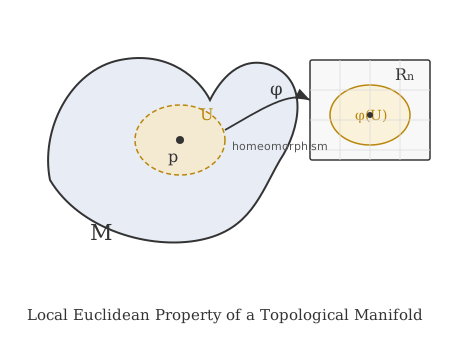
Each of these three conditions plays an essential role and deserves comment.
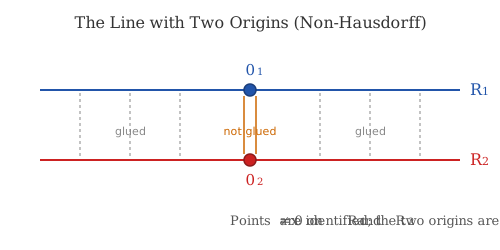
The Hausdorff condition excludes pathological examples such as the “line with two origins,” obtained by taking two copies of \(\mathbb{R}\) and identifying all points except the origin. The resulting space is locally Euclidean and second countable, but the two origins cannot be separated by disjoint open sets. Without the Hausdorff condition, many basic results of analysis and geometry would fail.
Second countability ensures that the topology of \(M\) is not too large. It guarantees the existence of partitions of unity (which we discuss in Chapter 2), the embeddability of \(M\) into Euclidean space (by the Whitney embedding theorem), and the existence of Riemannian metrics. It also implies that \(M\) is paracompact and has at most countably many connected components.
The locally Euclidean condition is the heart of the definition. The integer \(n\) is called the dimension of \(M\). By the theorem on invariance of domain (a deep result in algebraic topology), if a nonempty topological space is locally homeomorphic to both \(\mathbb{R}^m\) and \(\mathbb{R}^n\), then \(m = n\), so the dimension is well-defined on each connected component.
1.2 Coordinate Charts and Atlases
The homeomorphisms witnessing the locally Euclidean property are the fundamental tools that allow us to transfer calculus from \(\mathbb{R}^n\) to a manifold. We formalize them as follows.
Definition 1.2 (Coordinate Chart). Let \(M\) be a topological \(n\)-manifold. A coordinate chart (or simply a chart) on \(M\) is a pair \((U, \varphi)\) where \(U \subseteq M\) is open and \(\varphi \colon U \to \hat{U} \subseteq \mathbb{R}^n\) is a homeomorphism onto an open subset \(\hat{U}\) of \(\mathbb{R}^n\). The set \(U\) is called a coordinate domain (or coordinate neighbourhood), and the component functions \(x^1, \ldots, x^n\) of \(\varphi = (x^1, \ldots, x^n)\) are called local coordinates on \(U\).
Given a point \(p \in U\), the coordinates of \(p\) are the \(n\) real numbers \((x^1(p), \ldots, x^n(p)) \in \mathbb{R}^n\). A chart \((U, \varphi)\) is said to be centred at \(p\) if \(\varphi(p) = 0\).
When two charts overlap, we need to understand how their coordinate systems are related. This leads to the notion of transition maps.
Definition 1.3 (Transition Map). If \((U, \varphi)\) and \((V, \psi)\) are two charts on \(M\) with \(U \cap V \neq \emptyset\), the transition map from \(\varphi\) to \(\psi\) is the map
\[
\psi \circ \varphi^{-1} \colon \varphi(U \cap V) \to \psi(U \cap V).
\]
This is a homeomorphism between open subsets of \(\mathbb{R}^n\).
Transition maps are the key to defining smoothness on manifolds. Since \(\psi \circ \varphi^{-1}\) is a map between open subsets of \(\mathbb{R}^n\), it makes sense to ask whether it is smooth (\(C^\infty\)) in the ordinary multivariable calculus sense.
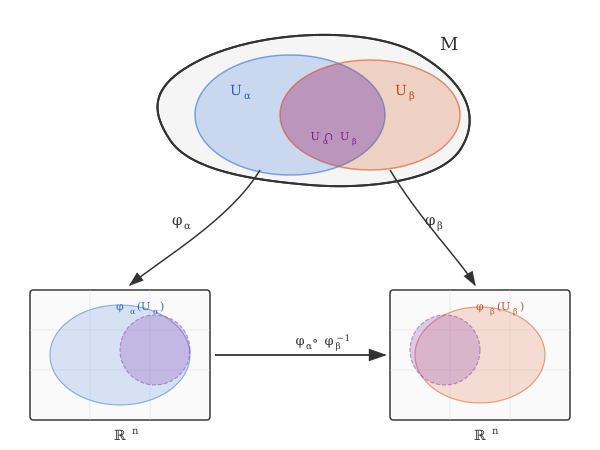
Definition 1.4 (Smoothly Compatible Charts). Two charts \((U, \varphi)\) and \((V, \psi)\) on a topological manifold \(M\) are smoothly compatible if either \(U \cap V = \emptyset\) or the transition map \(\psi \circ \varphi^{-1}\) and its inverse \(\varphi \circ \psi^{-1}\) are both smooth (i.e., \(C^\infty\)) maps between open subsets of \(\mathbb{R}^n\).
Definition 1.5 (Smooth Atlas). A
smooth atlas on a topological \(n\)-manifold \(M\) is a collection \(\mathcal{A} = \{(U_\alpha, \varphi_\alpha)\}_{\alpha \in A}\) of charts such that:
- The coordinate domains cover \(M\): \(\bigcup_{\alpha \in A} U_\alpha = M\).
- Any two charts in \(\mathcal{A}\) are smoothly compatible.
1.3 Smooth Structures and Smooth Manifolds
A smooth atlas provides enough structure to do calculus, but there is an aesthetic and technical issue: many different atlases can give rise to the “same” smooth structure. Two atlases \(\mathcal{A}\) and \(\mathcal{B}\) on \(M\) are said to be compatible if their union \(\mathcal{A} \cup \mathcal{B}\) is again a smooth atlas. Compatibility is an equivalence relation on the set of all smooth atlases on \(M\). Rather than working with equivalence classes, it is more convenient to single out a canonical representative.
Definition 1.6 (Smooth Structure). A smooth structure on a topological manifold \(M\) is a smooth atlas \(\mathcal{A}\) that is maximal: if \((U, \varphi)\) is any chart that is smoothly compatible with every chart in \(\mathcal{A}\), then \((U, \varphi) \in \mathcal{A}\).
Every smooth atlas \(\mathcal{A}\) is contained in a unique maximal atlas — simply take the collection of all charts on \(M\) that are smoothly compatible with every chart in \(\mathcal{A}\). Thus, specifying a smooth structure is equivalent to specifying any smooth atlas; the maximal atlas it generates is the smooth structure.
Definition 1.7 (Smooth Manifold). A smooth \(n\)-manifold is a pair \((M, \mathcal{A})\) where \(M\) is a topological \(n\)-manifold and \(\mathcal{A}\) is a smooth structure on \(M\). When the smooth structure is understood from context, we simply say that \(M\) is a smooth manifold.
In practice, one almost never works with the full maximal atlas. Instead, one specifies a small atlas (often just two or three charts) and declares that the smooth structure is the one generated by that atlas. The key point is that the maximal atlas exists and is unique, so there is no ambiguity.
1.4 Examples of Smooth Manifolds
We now present the most important examples of smooth manifolds. These examples will serve as a testing ground for all the theory that follows.
Example 1.8 (Euclidean space \(\mathbb{R}^n\)). The space \(\mathbb{R}^n\) with its standard topology is a topological \(n\)-manifold. The single chart \((\mathbb{R}^n, \mathrm{id}_{\mathbb{R}^n})\) constitutes a smooth atlas (there are no nontrivial transition maps to check). The smooth structure generated by this atlas is the standard smooth structure on \(\mathbb{R}^n\). More generally, any open subset \(U \subseteq \mathbb{R}^n\) inherits a smooth structure from a single chart \((U, \mathrm{id}_U)\).
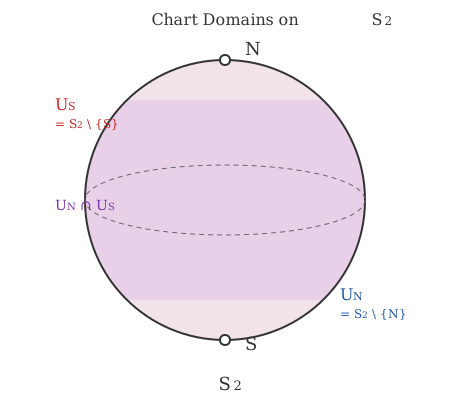
Example 1.9 (The \(n\)-sphere \(S^n\)). The unit sphere
\[
S^n = \{x \in \mathbb{R}^{n+1} : |x|^2 = (x^1)^2 + \cdots + (x^{n+1})^2 = 1\}
\]
is a topological \(n\)-manifold in the subspace topology inherited from \(\mathbb{R}^{n+1}\). It is Hausdorff and second countable because \(\mathbb{R}^{n+1}\) is. To show it is locally Euclidean and to exhibit a smooth atlas, we use
stereographic projection.
\[
U_N = S^n \setminus \{N\}, \qquad U_S = S^n \setminus \{S\}.
\]
\[
\sigma_N(x^1, \ldots, x^{n+1}) = \frac{1}{1 - x^{n+1}}(x^1, \ldots, x^n).
\]
Geometrically, \(\sigma_N(x)\) is the point where the line from \(N\) through \(x\) meets the equatorial hyperplane \(\{x^{n+1} = 0\}\).
\[
\sigma_S(x^1, \ldots, x^{n+1}) = \frac{1}{1 + x^{n+1}}(x^1, \ldots, x^n).
\]
Both maps are homeomorphisms onto \(\mathbb{R}^n\), so \(\{(U_N, \sigma_N), (U_S, \sigma_S)\}\) is an atlas for \(S^n\).
The transition map for the stereographic atlas is a central computation that we carry out in full detail, since it illustrates the general technique and will be useful later.
Proposition 1.10 (Transition Map for Stereographic Projection). On the overlap \(U_N \cap U_S = S^n \setminus \{N, S\}\), the transition map \(\sigma_S \circ \sigma_N^{-1} \colon \mathbb{R}^n \setminus \{0\} \to \mathbb{R}^n \setminus \{0\}\) is given by
\[
\sigma_S \circ \sigma_N^{-1}(u) = \frac{u}{|u|^2},
\]
which is the inversion in the unit sphere in \(\mathbb{R}^n\).
Proof. We first compute \(\sigma_N^{-1}\). Given \(u = (u^1, \ldots, u^n) \in \mathbb{R}^n\), we need to find \(x = (x^1, \ldots, x^{n+1}) \in S^n \setminus \{N\}\) such that
\[
u^i = \frac{x^i}{1 - x^{n+1}}, \qquad i = 1, \ldots, n.
\]
So \(x^i = u^i(1 - x^{n+1})\). From the constraint \(|x|^2 = 1\), we get
\[
\sum_{i=1}^n (u^i)^2 (1 - x^{n+1})^2 + (x^{n+1})^2 = 1.
\]
Setting \(|u|^2 = \sum (u^i)^2\) and \(t = x^{n+1}\), this gives \(|u|^2(1-t)^2 + t^2 = 1\). Expanding:
\[
|u|^2 - 2|u|^2 t + |u|^2 t^2 + t^2 = 1,
\]
\[
(|u|^2 + 1)t^2 - 2|u|^2 t + (|u|^2 - 1) = 0.
\]
Using the quadratic formula (or factoring):
\[
t = \frac{2|u|^2 \pm \sqrt{4|u|^4 - 4(|u|^2+1)(|u|^2-1)}}{2(|u|^2+1)} = \frac{2|u|^2 \pm 2}{2(|u|^2+1)}.
\]
The solution \(t = 1\) corresponds to the north pole, which we exclude. So
\[
x^{n+1} = t = \frac{|u|^2 - 1}{|u|^2 + 1}, \qquad 1 - t = \frac{2}{|u|^2 + 1},
\]
and therefore
\[
x^i = u^i \cdot \frac{2}{|u|^2 + 1}.
\]
The inverse is thus
\[
\sigma_N^{-1}(u) = \frac{1}{|u|^2 + 1}\left(2u^1, \ldots, 2u^n, |u|^2 - 1\right).
\]
Now we apply \(\sigma_S\):
\[
\sigma_S(\sigma_N^{-1}(u)) = \frac{1}{1 + x^{n+1}}(x^1, \ldots, x^n) = \frac{1}{1 + \frac{|u|^2 - 1}{|u|^2 + 1}} \cdot \frac{2u}{|u|^2 + 1}.
\]
We have
\[
1 + \frac{|u|^2 - 1}{|u|^2 + 1} = \frac{|u|^2 + 1 + |u|^2 - 1}{|u|^2 + 1} = \frac{2|u|^2}{|u|^2 + 1}.
\]
Therefore
\[
\sigma_S \circ \sigma_N^{-1}(u) = \frac{|u|^2 + 1}{2|u|^2} \cdot \frac{2u}{|u|^2 + 1} = \frac{u}{|u|^2}.
\]
This is a smooth map on \(\mathbb{R}^n \setminus \{0\}\), and it is its own inverse (applying the formula twice gives back \(u\)). Hence both transition maps are smooth, and the stereographic atlas defines a smooth structure on \(S^n\). \(\blacksquare\)
Example 1.11 (Real Projective Space \(\mathbb{R}P^n\)). The
real projective space \(\mathbb{R}P^n\) is the set of all one-dimensional linear subspaces (lines through the origin) of \(\mathbb{R}^{n+1}\). Equivalently, it is the quotient space
\[
\mathbb{R}P^n = ({\mathbb{R}^{n+1} \setminus \{0\}})/{\sim},
\]
where \(x \sim y\) if and only if \(x = \lambda y\) for some \(\lambda \in \mathbb{R} \setminus \{0\}\). The equivalence class of a point \((x^0, x^1, \ldots, x^n)\) is denoted \([x^0 : x^1 : \cdots : x^n]\) and called
homogeneous coordinates.
\[
\varphi_i([x^0 : \cdots : x^n]) = \left(\frac{x^0}{x^i}, \ldots, \widehat{\frac{x^i}{x^i}}, \ldots, \frac{x^n}{x^i}\right),
\]
where the hat means that the \(i\)-th entry is omitted. The sets \(U_0, \ldots, U_n\) cover \(\mathbb{R}P^n\), each \(\varphi_i\) is a homeomorphism, and the transition maps are smooth rational functions. Thus \(\mathbb{R}P^n\) is a smooth \(n\)-manifold. Note that \(\mathbb{R}P^n\) is compact (it is the continuous image of \(S^n\) under the quotient map).
Example 1.12 (Product Manifolds). If \(M\) is a smooth \(m\)-manifold and \(N\) is a smooth \(n\)-manifold, their product \(M \times N\) is naturally a smooth \((m+n)\)-manifold. The product topology makes \(M \times N\) Hausdorff and second countable. If \(\{(U_\alpha, \varphi_\alpha)\}\) is an atlas for \(M\) and \(\{(V_\beta, \psi_\beta)\}\) is an atlas for \(N\), then
\[
\{(U_\alpha \times V_\beta,\; \varphi_\alpha \times \psi_\beta)\}
\]
is a smooth atlas for \(M \times N\), where \((\varphi_\alpha \times \psi_\beta)(p, q) = (\varphi_\alpha(p), \psi_\beta(q))\). The transition maps are products of the individual transition maps and hence smooth.
Example 1.13 (Tori). The \(n\)-torus is the product manifold
\[
T^n = \underbrace{S^1 \times S^1 \times \cdots \times S^1}_{n \text{ copies}}.
\]
It is a compact smooth \(n\)-manifold. The \(2\)-torus \(T^2 = S^1 \times S^1\) is the familiar "doughnut" surface that can be embedded in \(\mathbb{R}^3\).
The next class of examples is among the most important in all of mathematics and physics.
Example 1.14 (Lie Groups as Manifolds). A
Lie group is a smooth manifold \(G\) that is simultaneously a group, with the property that the multiplication map \(\mu \colon G \times G \to G\), \((g,h) \mapsto gh\), and the inversion map \(\iota \colon G \to G\), \(g \mapsto g^{-1}\), are both smooth. Every Lie group is, in particular, a smooth manifold.
Important examples include:
- \(\mathrm{GL}(n, \mathbb{R})\): the general linear group of invertible \(n \times n\) real matrices. This is an open subset of \(\mathbb{R}^{n^2}\) (where the determinant is nonzero), hence a smooth manifold of dimension \(n^2\).
- \(\mathrm{GL}(n, \mathbb{C})\): the general linear group of invertible \(n \times n\) complex matrices, a smooth manifold of dimension \(2n^2\).
- \(\mathrm{O}(n)\): the orthogonal group \(\{A \in \mathrm{GL}(n, \mathbb{R}) : A^T A = I\}\), a smooth manifold of dimension \(n(n-1)/2\).
- \(\mathrm{SO}(n) = \{A \in \mathrm{O}(n) : \det A = 1\}\): the special orthogonal group, the connected component of the identity in \(\mathrm{O}(n)\).
- \(\mathrm{U}(n)\): the unitary group \(\{A \in \mathrm{GL}(n, \mathbb{C}) : A^* A = I\}\), dimension \(n^2\).
- \(\mathrm{SU}(n) = \{A \in \mathrm{U}(n) : \det A = 1\}\): the special unitary group, dimension \(n^2 - 1\).
We will return to Lie groups in Chapter 4, where their interplay with Lie algebras becomes central.
1.5 Exotic Smooth Structures
A natural question arises: can a given topological manifold admit more than one smooth structure? The answer, surprisingly, is yes, and this phenomenon has deep implications.
1.6 Manifolds with Boundary
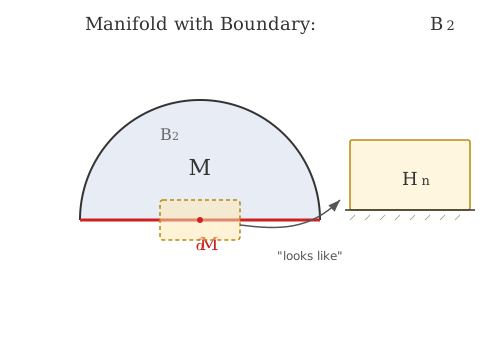
For many applications — particularly in integration theory and Stokes’ theorem — it is necessary to consider manifolds that have edges. The model for such spaces is the upper half-space.
Definition 1.15 (Upper Half-Space). The upper half-space of \(\mathbb{R}^n\) is
\[
\mathbb{H}^n = \{(x^1, \ldots, x^n) \in \mathbb{R}^n : x^n \geq 0\}.
\]
Its boundary is \(\partial \mathbb{H}^n = \{x \in \mathbb{R}^n : x^n = 0\} \cong \mathbb{R}^{n-1}\), and its interior is \(\mathrm{Int}(\mathbb{H}^n) = \{x \in \mathbb{R}^n : x^n > 0\}\).
Definition 1.16 (Smooth Manifold with Boundary). A
topological \(n\)-manifold with boundary is a Hausdorff, second countable topological space \(M\) in which every point has a neighbourhood homeomorphic to an open subset of either \(\mathbb{R}^n\) or \(\mathbb{H}^n\). A point \(p \in M\) is a
boundary point if it is mapped to \(\partial \mathbb{H}^n\) under some (hence every) chart, and an
interior point otherwise. The set of all boundary points is denoted \(\partial M\).
A smooth structure on \(M\) is defined exactly as before, using charts taking values in open subsets of \(\mathbb{H}^n\) and requiring smooth compatibility. A manifold with boundary together with a smooth structure is a smooth manifold with boundary.
Proposition 1.17. If \(M\) is a smooth \(n\)-manifold with boundary, then \(\partial M\) is a smooth \((n-1)\)-manifold (without boundary), and \(\mathrm{Int}(M) = M \setminus \partial M\) is a smooth \(n\)-manifold without boundary.
Example 1.18. The closed unit ball \(\overline{B}^n = \{x \in \mathbb{R}^n : |x| \leq 1\}\) is a smooth \(n\)-manifold with boundary \(\partial \overline{B}^n = S^{n-1}\). The half-space \(\mathbb{H}^n\) itself is a smooth manifold with boundary \(\partial \mathbb{H}^n \cong \mathbb{R}^{n-1}\).
Chapter 2: Smooth Maps and Partitions of Unity
2.1 Smooth Functions on Manifolds
Having established the notion of a smooth manifold, we now develop the theory of smooth maps between manifolds. The key idea is simple: a map between manifolds is smooth if and only if its local coordinate representations (obtained via charts) are smooth maps between open subsets of Euclidean space. This is precisely why we needed the transition maps to be smooth — it ensures that the notion of smoothness does not depend on the choice of charts.
Definition 2.1 (Smooth Function). Let \(M\) be a smooth \(n\)-manifold. A function \(f \colon M \to \mathbb{R}\) is smooth (or \(C^\infty\)) if for every point \(p \in M\) and every smooth chart \((U, \varphi)\) with \(p \in U\), the composite
\[
f \circ \varphi^{-1} \colon \varphi(U) \to \mathbb{R}
\]
is a smooth function on the open set \(\varphi(U) \subseteq \mathbb{R}^n\).
\[
f \circ \psi^{-1} = (f \circ \varphi^{-1}) \circ (\varphi \circ \psi^{-1}),
\]
and this is a composition of smooth maps (since \(\varphi \circ \psi^{-1}\) is a smooth transition map).
Definition 2.2. The set of all smooth functions \(f \colon M \to \mathbb{R}\) is denoted \(C^\infty(M)\). It is a commutative \(\mathbb{R}\)-algebra under pointwise addition, scalar multiplication, and pointwise multiplication.
The algebra \(C^\infty(M)\) is a fundamental invariant of the smooth manifold \(M\). In fact, two smooth manifolds \(M\) and \(N\) are diffeomorphic if and only if \(C^\infty(M)\) and \(C^\infty(N)\) are isomorphic as \(\mathbb{R}\)-algebras (this is a consequence of Milnor’s exercise; see Lee, Problem 2-2).
2.2 Smooth Maps Between Manifolds
We now extend the notion of smoothness from functions to maps between manifolds.
Definition 2.3 (Smooth Map). Let \(M\) and \(N\) be smooth manifolds of dimensions \(m\) and \(n\), respectively. A continuous map \(F \colon M \to N\) is smooth if for every \(p \in M\), there exist charts \((U, \varphi)\) for \(M\) with \(p \in U\) and \((V, \psi)\) for \(N\) with \(F(p) \in V\) such that \(F(U) \subseteq V\) and the coordinate representation
\[
\hat{F} = \psi \circ F \circ \varphi^{-1} \colon \varphi(U) \to \psi(V)
\]
is a smooth map between open subsets of Euclidean spaces.
Again, the smoothness of transition maps ensures that if this condition holds for one pair of charts, it holds for every pair. The set of smooth maps from \(M\) to \(N\) is denoted \(C^\infty(M, N)\).
Proposition 2.4 (Composition of Smooth Maps). If \(F \colon M \to N\) and \(G \colon N \to P\) are smooth maps between smooth manifolds, then the composition \(G \circ F \colon M \to P\) is smooth. The identity map \(\mathrm{id}_M \colon M \to M\) is smooth.
Proof. Let \(p \in M\) and choose charts \((U, \varphi)\) around \(p\), \((V, \psi)\) around \(F(p)\), and \((W, \theta)\) around \(G(F(p))\) with \(F(U) \subseteq V\) and \(G(V) \subseteq W\). Then
\[
\theta \circ (G \circ F) \circ \varphi^{-1} = (\theta \circ G \circ \psi^{-1}) \circ (\psi \circ F \circ \varphi^{-1})
\]
is a composition of smooth maps between open subsets of Euclidean spaces, hence smooth. The identity map is smooth because its coordinate representation in any chart is the identity. \(\blacksquare\)
Thus smooth manifolds and smooth maps form a category, the smooth category, often denoted \(\mathbf{Man}^\infty\) or \(\mathbf{Diff}\). The isomorphisms in this category are diffeomorphisms.
Definition 2.5 (Diffeomorphism). A smooth map \(F \colon M \to N\) is a diffeomorphism if it is a bijection and its inverse \(F^{-1} \colon N \to M\) is also smooth. Two smooth manifolds are diffeomorphic if there exists a diffeomorphism between them.
Diffeomorphism is the natural notion of equivalence in the smooth category. The central question of differential topology is to classify smooth manifolds up to diffeomorphism.
2.3 Bump Functions and Cutoff Functions
Before discussing partitions of unity, we need to establish the existence of smooth functions with special localization properties. These are possible because, unlike analytic functions, smooth functions can have compact support.
Definition 2.6 (Support). The support of a function \(f \colon M \to \mathbb{R}\) is
\[
\mathrm{supp}(f) = \overline{\{p \in M : f(p) \neq 0\}},
\]
the closure of the set where \(f\) is nonzero.
The fundamental building block is the following function on \(\mathbb{R}\).
Lemma 2.7. The function \(h \colon \mathbb{R} \to \mathbb{R}\) defined by
\[
h(t) = \begin{cases} e^{-1/t} & \text{if } t > 0, \\ 0 & \text{if } t \leq 0, \end{cases}
\]
is smooth on all of \(\mathbb{R}\).
Proof. The function is clearly smooth on \((-\infty, 0)\) and on \((0, \infty)\). At \(t = 0\), smoothness requires that all right-hand derivatives equal zero. One shows by induction that for \(t > 0\), the \(k\)-th derivative of \(h\) has the form \(p_k(1/t) \cdot e^{-1/t}\) where \(p_k\) is a polynomial. Since \(e^{-1/t}\) decays faster than any polynomial in \(1/t\) as \(t \to 0^+\), we have \(h^{(k)}(t) \to 0\) as \(t \to 0^+\) for all \(k\), which matches the value of the \(k\)-th derivative of the constant function \(0\) from the left. \(\blacksquare\)
From this, we can construct smooth functions with prescribed support.
Proposition 2.8 (Smooth Bump Function). For any \(p \in M\) and any open neighbourhood \(U\) of \(p\), there exists a smooth function \(\psi \colon M \to [0,1]\) such that \(\psi(p) = 1\) and \(\mathrm{supp}(\psi) \subseteq U\). Such a function is called a bump function supported in \(U\).
Proof (Sketch). Using the function \(h\) from Lemma 2.7, one constructs a smooth function \(H \colon \mathbb{R}^n \to [0,1]\) that equals \(1\) on the ball \(\overline{B}_r(0)\) and equals \(0\) outside \(\overline{B}_R(0)\) for any \(0 < r < R\). Transporting this to \(M\) via a coordinate chart centred at \(p\) and extending by zero outside the coordinate domain gives the desired bump function. \(\blacksquare\)
Proposition 2.9 (Smooth Cutoff Function). For any closed set \(A \subseteq M\) and any open set \(U \supseteq A\), there exists a smooth function \(f \colon M \to [0,1]\) such that \(f \equiv 1\) on \(A\) and \(\mathrm{supp}(f) \subseteq U\).
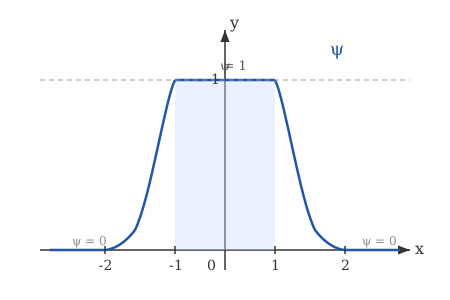
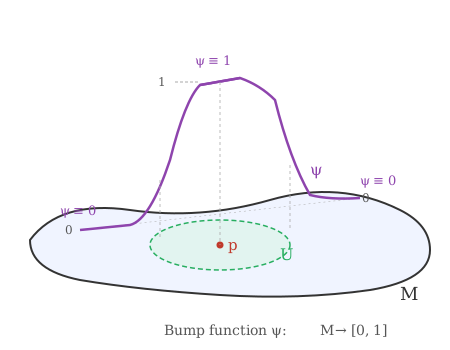
Bump functions and cutoff functions are essential tools for transferring local constructions to global ones. They will be used repeatedly throughout the course, most immediately in the construction of partitions of unity.
2.4 Partitions of Unity
Partitions of unity are the primary technical tool for passing from local to global constructions on manifolds. Many objects — Riemannian metrics, differential forms, connections — are easy to define locally in coordinates, but assembling them into a globally defined, smooth object requires a way to “glue” using smooth weights. This is precisely what partitions of unity provide.
Definition 2.10 (Partition of Unity). Let \(M\) be a smooth manifold and \(\{U_\alpha\}_{\alpha \in A}\) an open cover of \(M\). A
partition of unity subordinate to \(\{U_\alpha\}\) is a collection of smooth functions \(\{\psi_\alpha \colon M \to [0,1]\}_{\alpha \in A}\) such that:
- \(\mathrm{supp}(\psi_\alpha) \subseteq U_\alpha\) for each \(\alpha\).
- The collection \(\{\mathrm{supp}(\psi_\alpha)\}\) is locally finite: every point of \(M\) has a neighbourhood that intersects only finitely many of the supports.
- \(\sum_{\alpha \in A} \psi_\alpha(p) = 1\) for every \(p \in M\). (This sum is well-defined because of local finiteness.)
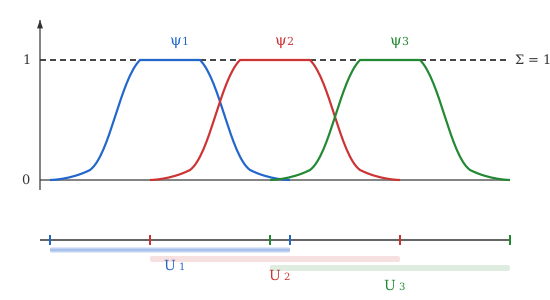
The existence of partitions of unity on smooth manifolds is one of the most important facts in the subject, and it is here that the Hausdorff and second countable conditions in the definition of a manifold earn their keep.
Theorem 2.11 (Existence of Partitions of Unity). Let \(M\) be a smooth manifold and \(\{U_\alpha\}_{\alpha \in A}\) any open cover of \(M\). Then there exists a partition of unity subordinate to \(\{U_\alpha\}\).
Proof (Sketch of Key Ideas). The proof proceeds in several steps.
Step 1: Paracompactness. Since \(M\) is second countable and locally compact Hausdorff, it is paracompact: every open cover has a locally finite refinement. In fact, \(M\) admits a countable, locally finite refinement by precompact open sets (sets whose closures are compact).
Step 2: Subordinate bump functions. For each set in the locally finite refinement, we use bump functions (Proposition 2.8) to construct a smooth function supported in that set. More precisely, for each element \(V_i\) of the refinement (with \(V_i \subseteq U_{\alpha(i)}\) for some \(\alpha(i)\)), we can find a smooth function \(\rho_i \geq 0\) with \(\mathrm{supp}(\rho_i) \subseteq V_i\) and \(\rho_i > 0\) on some neighbourhood of a carefully chosen compact subset.
Step 3: Normalization. The function \(\rho = \sum_i \rho_i\) is well-defined and smooth (by local finiteness) and everywhere positive (since every point of \(M\) is in the support of some \(\rho_i\)). Setting \(\psi_\alpha = \sum_{i : \alpha(i) = \alpha} \rho_i / \rho\) gives the desired partition of unity. \(\blacksquare\)
2.5 Applications of Partitions of Unity
Partitions of unity have numerous applications. We mention several of the most important.
Proposition 2.12 (Extension of Smooth Functions). Let \(A \subseteq M\) be a closed subset and \(U \supseteq A\) an open neighbourhood. If \(f \colon U \to \mathbb{R}\) is a smooth function, there exists a smooth function \(\tilde{f} \colon M \to \mathbb{R}\) that agrees with \(f\) on a neighbourhood of \(A\).
Proof. Let \(\psi\) be a smooth cutoff function with \(\psi \equiv 1\) on a neighbourhood of \(A\) and \(\mathrm{supp}(\psi) \subseteq U\) (Proposition 2.9). Define \(\tilde{f} = \psi \cdot f\) on \(U\) and \(\tilde{f} = 0\) on \(M \setminus \mathrm{supp}(\psi)\). On the overlap \(U \setminus \mathrm{supp}(\psi)\), both definitions give zero, so \(\tilde{f}\) is well-defined and smooth on all of \(M\). \(\blacksquare\)
Proposition 2.13 (Existence of Riemannian Metrics). Every smooth manifold admits a Riemannian metric.
Proof (Sketch). In each coordinate chart \((U_\alpha, \varphi_\alpha)\), the Euclidean inner product on \(\mathbb{R}^n\) pulls back to a local Riemannian metric \(g_\alpha\) on \(U_\alpha\). Let \(\{\psi_\alpha\}\) be a partition of unity subordinate to \(\{U_\alpha\}\). Then \(g = \sum_\alpha \psi_\alpha \, g_\alpha\) is a globally defined Riemannian metric on \(M\). (The sum is locally finite and each term is a smooth, nonnegative-definite symmetric \(2\)-tensor; the result is positive-definite because at each point at least one \(\psi_\alpha > 0\).) \(\blacksquare\)
Another important application is the embedding of manifolds into Euclidean space.
Theorem 2.14 (Whitney Embedding Theorem, weak version). Every smooth \(n\)-manifold can be smoothly embedded in \(\mathbb{R}^{2n+1}\) as a closed submanifold.
The proof of the full Whitney embedding theorem is beyond our scope, but partitions of unity are an essential ingredient.
Chapter 3: Tangent Vectors and the Tangent Bundle
3.1 Motivation: What Is a Tangent Vector?
If \(M\) is a smooth submanifold of \(\mathbb{R}^N\), we have an intuitive picture of tangent vectors: they are velocity vectors of curves lying in \(M\), or equivalently, arrows in the ambient space that are “tangent” to \(M\) at a point. However, for abstract smooth manifolds not given as subsets of any Euclidean space, we need an intrinsic definition that does not rely on an ambient space. There are several equivalent approaches:
- Geometric: tangent vectors as equivalence classes of curves.
- Algebraic: tangent vectors as derivations on germs of smooth functions.
- Physicist’s: tangent vectors as gadgets that transform by the Jacobian matrix under coordinate changes.
We follow Lee’s approach and adopt the algebraic definition, then show it is equivalent to the others. The key insight is that a tangent vector should be determined by how it acts on smooth functions — that is, by the directional derivatives it computes.
3.2 Derivations and the Tangent Space
Definition 3.1 (Derivation at a Point). Let \(M\) be a smooth manifold and \(p \in M\). A derivation at \(p\) is a linear map \(v \colon C^\infty(M) \to \mathbb{R}\) satisfying the Leibniz rule (product rule):
\[
v(fg) = f(p) \, v(g) + g(p) \, v(f)
\]
for all \(f, g \in C^\infty(M)\).
Definition 3.2 (Tangent Space). The tangent space to \(M\) at \(p\), denoted \(T_pM\), is the set of all derivations at \(p\). It is a real vector space under the operations
\[
(v + w)(f) = v(f) + w(f), \qquad (\lambda v)(f) = \lambda \, v(f).
\]
Elements of \(T_pM\) are called tangent vectors at \(p\).
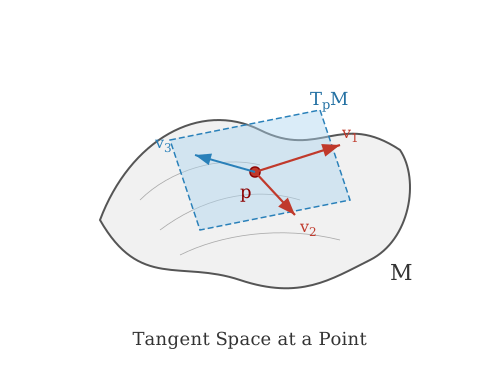
Before computing the dimension of the tangent space, we establish some useful consequences of the Leibniz rule.
Lemma 3.3 (Properties of Derivations). Let \(v \in T_pM\).
- If \(c \in \mathbb{R}\) is a constant function, then \(v(c) = 0\).
- If \(f(p) = g(p) = 0\), then \(v(fg) = 0\).
- If \(f \equiv g\) on some neighbourhood of \(p\), then \(v(f) = v(g)\).
Proof. (1) We have \(v(1) = v(1 \cdot 1) = 1 \cdot v(1) + 1 \cdot v(1) = 2v(1)\), so \(v(1) = 0\). By linearity, \(v(c) = c \cdot v(1) = 0\).
(2) This follows directly from the Leibniz rule: \(v(fg) = f(p) v(g) + g(p) v(f) = 0\).
(3) We need bump functions for this. Let \(\psi\) be a bump function with \(\psi \equiv 1\) near \(p\) and \(\mathrm{supp}(\psi)\) contained in the neighbourhood where \(f = g\). Then \(\psi f = \psi g\) everywhere on \(M\), so \(v(\psi f) = v(\psi g)\). But \(v(\psi f) = \psi(p) v(f) + f(p) v(\psi) = v(f) + f(p) v(\psi)\), and similarly \(v(\psi g) = v(g) + g(p) v(\psi)\). Since \(f(p) = g(p)\), we conclude \(v(f) = v(g)\). \(\blacksquare\)
Property (3) shows that derivations are local: the value of \(v(f)\) depends only on the germ of \(f\) at \(p\). This is what one expects of a “directional derivative.”
3.3 Coordinate Bases and the Dimension of \(T_pM\)
Let \((U, \varphi)\) be a smooth chart around \(p\) with local coordinates \(x^1, \ldots, x^n\). For each \(i = 1, \ldots, n\), we define a derivation at \(p\) by
\[
\left.\frac{\partial}{\partial x^i}\right|_p (f) = \frac{\partial (f \circ \varphi^{-1})}{\partial r^i}\bigg|_{\varphi(p)},
\]
where \(r^1, \ldots, r^n\) are the standard coordinates on \(\mathbb{R}^n\). In other words, \(\frac{\partial}{\partial x^i}\big|_p\) computes the \(i\)-th partial derivative of the coordinate representation of \(f\). One checks directly that this satisfies the Leibniz rule and is thus an element of \(T_pM\).
Theorem 3.4 (Dimension of the Tangent Space). Let \(M\) be a smooth \(n\)-manifold, \(p \in M\), and \((U, \varphi) = (U, x^1, \ldots, x^n)\) a smooth chart containing \(p\). Then the tangent vectors
\[
\left.\frac{\partial}{\partial x^1}\right|_p, \ldots, \left.\frac{\partial}{\partial x^n}\right|_p
\]
form a basis for \(T_pM\). In particular, \(\dim T_pM = n = \dim M\).
Proof. Without loss of generality (by composing with a translation), we may assume the chart is centred at \(p\), so \(\varphi(p) = 0\). Let \(\hat{f} = f \circ \varphi^{-1}\).
Linear independence. We have \(\frac{\partial}{\partial x^i}\big|_p(x^j) = \frac{\partial r^j}{\partial r^i}\big|_0 = \delta^j_i\). If \(\sum_i a^i \frac{\partial}{\partial x^i}\big|_p = 0\), then applying this to \(x^j\) gives \(a^j = 0\) for each \(j\).
Spanning. Let \(v \in T_pM\) be any derivation. Set \(v^i = v(x^i)\). We claim that \(v = \sum_i v^i \frac{\partial}{\partial x^i}\big|_p\).
\[
\hat{f}(x) = \hat{f}(0) + \sum_{i=1}^n x^i \, g_i(x),
\]
where \(g_i\) are smooth functions satisfying \(g_i(0) = \frac{\partial \hat{f}}{\partial r^i}(0)\). (One obtains this from \(\hat{f}(x) - \hat{f}(0) = \int_0^1 \frac{d}{dt}\hat{f}(tx)\,dt = \sum_i x^i \int_0^1 \frac{\partial \hat{f}}{\partial r^i}(tx)\,dt\).)
\[
v(f) = v(f(p)) + \sum_i v(x^i \cdot (g_i \circ \varphi)) = 0 + \sum_i \left[x^i(p)\, v(g_i \circ \varphi) + (g_i \circ \varphi)(p)\, v(x^i)\right].
\]\[
v(f) = \sum_i v^i \frac{\partial}{\partial x^i}\bigg|_p(f).
\]
Since this holds for every \(f\), we have \(v = \sum_i v^i \frac{\partial}{\partial x^i}\big|_p\). \(\blacksquare\)
3.4 The Pushforward (Differential)
One of the most important operations in differential geometry is the pushforward (or differential) of a smooth map. Given a smooth map \(F \colon M \to N\), we want to associate to it a linear map on tangent spaces that captures the “linear approximation” of \(F\) at each point. In \(\mathbb{R}^n\), this role is played by the Jacobian matrix; the pushforward generalizes this to manifolds.
Definition 3.5 (Pushforward / Differential). Let \(F \colon M \to N\) be a smooth map and \(p \in M\). The pushforward (or differential) of \(F\) at \(p\) is the linear map
\[
F_{*,p} \colon T_pM \to T_{F(p)}N
\]
(also written \(dF_p\), \(DF_p\), or \((F_*)_p\)) defined by
\[
(F_{*,p}(v))(g) = v(g \circ F)
\]
for all \(v \in T_pM\) and \(g \in C^\infty(N)\).
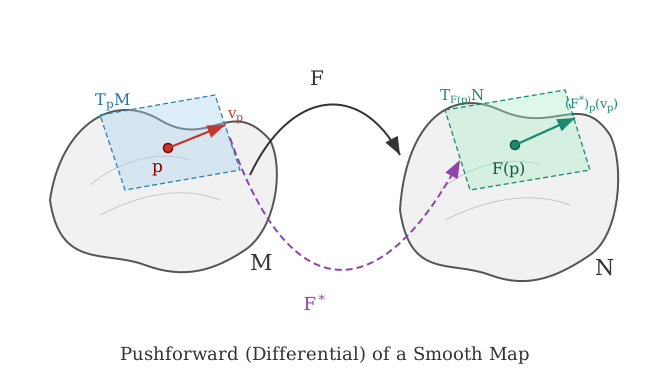
\[
F_{*,p}(v)(g_1 g_2) = v((g_1 g_2) \circ F) = v((g_1 \circ F)(g_2 \circ F)),
\]\[
= (g_1 \circ F)(p) \, v(g_2 \circ F) + (g_2 \circ F)(p) \, v(g_1 \circ F) = g_1(F(p)) \, F_{*,p}(v)(g_2) + g_2(F(p)) \, F_{*,p}(v)(g_1).
\]
So \(F_{*,p}(v) \in T_{F(p)}N\).
3.5 Pushforward in Local Coordinates
The power of the pushforward becomes concrete when we compute it in coordinates. The result is exactly the Jacobian matrix, confirming that the pushforward is the correct generalization of the total derivative.
Proposition 3.6 (Pushforward in Coordinates). Let \(F \colon M \to N\) be smooth, \(p \in M\), \((U, \varphi) = (U, x^1, \ldots, x^m)\) a chart around \(p\), and \((V, \psi) = (V, y^1, \ldots, y^n)\) a chart around \(F(p)\). Write the coordinate representation of \(F\) as
\[
\hat{F} = \psi \circ F \circ \varphi^{-1} \colon \varphi(U) \to \psi(V), \qquad \hat{F}(x) = (\hat{F}^1(x), \ldots, \hat{F}^n(x)).
\]
Then
\[
F_{*,p}\left(\frac{\partial}{\partial x^i}\bigg|_p\right) = \sum_{j=1}^n \frac{\partial \hat{F}^j}{\partial x^i}(\varphi(p)) \, \frac{\partial}{\partial y^j}\bigg|_{F(p)}.
\]
In other words, the matrix of \(F_{*,p}\) with respect to the coordinate bases is the Jacobian matrix of \(\hat{F}\) at \(\varphi(p)\).
Proof. For any \(g \in C^\infty(N)\), we compute
\[
F_{*,p}\left(\frac{\partial}{\partial x^i}\bigg|_p\right)(g) = \frac{\partial}{\partial x^i}\bigg|_p(g \circ F) = \frac{\partial (g \circ F \circ \varphi^{-1})}{\partial r^i}\bigg|_{\varphi(p)}.
\]
Now \(g \circ F \circ \varphi^{-1} = (g \circ \psi^{-1}) \circ (\psi \circ F \circ \varphi^{-1}) = \hat{g} \circ \hat{F}\). By the chain rule in \(\mathbb{R}^n\):
\[
\frac{\partial (\hat{g} \circ \hat{F})}{\partial r^i}\bigg|_{\varphi(p)} = \sum_{j=1}^n \frac{\partial \hat{g}}{\partial r^j}\bigg|_{\hat{F}(\varphi(p))} \cdot \frac{\partial \hat{F}^j}{\partial r^i}\bigg|_{\varphi(p)} = \sum_j \frac{\partial \hat{F}^j}{\partial x^i}(\varphi(p)) \cdot \frac{\partial}{\partial y^j}\bigg|_{F(p)}(g).
\]
Since this holds for all \(g\), the result follows. \(\blacksquare\)
3.6 The Chain Rule and Functoriality
The chain rule from multivariable calculus generalizes beautifully to manifolds.
Theorem 3.7 (Chain Rule for Pushforwards). If \(F \colon M \to N\) and \(G \colon N \to P\) are smooth maps, then for every \(p \in M\),
\[
(G \circ F)_{*,p} = G_{*,F(p)} \circ F_{*,p}.
\]
Moreover, \((\mathrm{id}_M)_{*,p} = \mathrm{id}_{T_pM}\).
Proof. For any \(v \in T_pM\) and \(h \in C^\infty(P)\):
\[
(G \circ F)_{*,p}(v)(h) = v(h \circ G \circ F) = F_{*,p}(v)(h \circ G) = G_{*,F(p)}(F_{*,p}(v))(h).
\]
The identity statement is immediate: \((\mathrm{id}_M)_{*,p}(v)(f) = v(f \circ \mathrm{id}_M) = v(f)\). \(\blacksquare\)
Corollary 3.8. If \(F \colon M \to N\) is a diffeomorphism, then \(F_{*,p} \colon T_pM \to T_{F(p)}N\) is a linear isomorphism for every \(p \in M\), with \((F_{*,p})^{-1} = (F^{-1})_{*,F(p)}\).
Proof. From the chain rule: \(F_{*,p} \circ (F^{-1})_{*,F(p)} = (F \circ F^{-1})_{*,F(p)} = (\mathrm{id}_N)_{*,F(p)} = \mathrm{id}_{T_{F(p)}N}\), and similarly \((F^{-1})_{*,F(p)} \circ F_{*,p} = \mathrm{id}_{T_pM}\). \(\blacksquare\)
In categorical language, the tangent space construction is a functor from the category of smooth manifolds (with smooth maps) to the category of vector spaces (with linear maps): it sends each manifold to a family of vector spaces and each smooth map to a family of linear maps, respecting composition and identities.
3.7 Change of Coordinates for Tangent Vectors
The coordinate basis vectors \(\frac{\partial}{\partial x^i}\big|_p\) depend on the choice of chart. When we change from one chart to another, the basis vectors transform by the Jacobian of the transition map. This gives the classical “transformation law” for tangent vectors.
Proposition 3.9 (Change of Coordinates). Let \((U, x^1, \ldots, x^n)\) and \((V, y^1, \ldots, y^n)\) be two charts around \(p \in M\). Then
\[
\frac{\partial}{\partial x^i}\bigg|_p = \sum_{j=1}^n \frac{\partial y^j}{\partial x^i}(p) \, \frac{\partial}{\partial y^j}\bigg|_p,
\]
where \(\frac{\partial y^j}{\partial x^i}(p)\) denotes the \((j,i)\)-entry of the Jacobian matrix of the transition map \(\psi \circ \varphi^{-1}\) evaluated at \(\varphi(p)\).
\[
w^j = \sum_i \frac{\partial y^j}{\partial x^i}(p) \, v^i.
\]
Proof. This is a special case of Proposition 3.6 applied to the identity map \(\mathrm{id}_M\), with \(F = \mathrm{id}_M\), using charts \((U, \varphi)\) in the domain and \((V, \psi)\) in the codomain. The coordinate representation is the transition map \(\hat{F} = \psi \circ \varphi^{-1}\). \(\blacksquare\)
3.8 Tangent Vectors as Velocity Vectors of Curves
We now connect the algebraic definition of tangent vectors to the geometric picture of velocity vectors.
Definition 3.10 (Smooth Curve and Velocity Vector). A smooth curve in \(M\) is a smooth map \(\gamma \colon I \to M\), where \(I \subseteq \mathbb{R}\) is an open interval. If \(t_0 \in I\), the velocity vector of \(\gamma\) at \(t_0\) is the tangent vector
\[
\gamma'(t_0) = \gamma_{*,t_0}\left(\frac{d}{dt}\bigg|_{t_0}\right) \in T_{\gamma(t_0)}M.
\]
Explicitly, \(\gamma'(t_0)\) acts on a smooth function \(f\) by
\[
\gamma'(t_0)(f) = \frac{d}{dt}\bigg|_{t_0}(f \circ \gamma) = (f \circ \gamma)'(t_0).
\]
\[
\gamma'(t_0) = \sum_{i=1}^n \dot{\gamma}^i(t_0) \, \frac{\partial}{\partial x^i}\bigg|_{\gamma(t_0)},
\]
where \(\dot{\gamma}^i(t_0) = \frac{d\gamma^i}{dt}(t_0)\). This is exactly what one would expect from the chain rule.
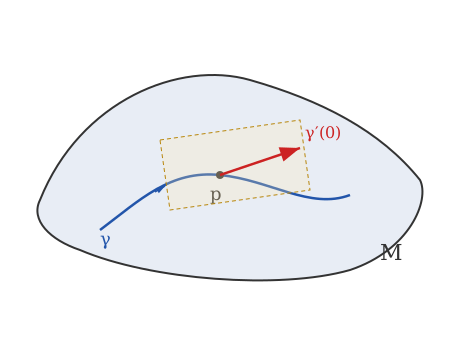
The next result shows that the geometric and algebraic definitions of tangent vectors are equivalent.
Proposition 3.11 (Every Tangent Vector is a Velocity Vector). For every \(v \in T_pM\), there exists a smooth curve \(\gamma \colon (-\varepsilon, \varepsilon) \to M\) with \(\gamma(0) = p\) and \(\gamma'(0) = v\).
Proof. Let \((U, \varphi) = (U, x^1, \ldots, x^n)\) be a chart centred at \(p\) and write \(v = \sum_i v^i \frac{\partial}{\partial x^i}\big|_p\). Define \(\gamma\) in coordinates by \(\varphi(\gamma(t)) = (v^1 t, \ldots, v^n t)\) for \(t\) sufficiently small. Then \(\gamma(0) = p\) (since \(\varphi(p) = 0\)) and \(\gamma'(0) = \sum_i v^i \frac{\partial}{\partial x^i}\big|_p = v\). \(\blacksquare\)
3.9 The Tangent Bundle
Having constructed the tangent space \(T_pM\) at each point, we now assemble all these vector spaces into a single smooth manifold: the tangent bundle.
Definition 3.12 (Tangent Bundle). The tangent bundle of a smooth \(n\)-manifold \(M\) is the disjoint union
\[
TM = \bigsqcup_{p \in M} T_pM = \{(p, v) : p \in M, \, v \in T_pM\}.
\]
The natural projection is the map \(\pi \colon TM \to M\) defined by \(\pi(p, v) = p\).
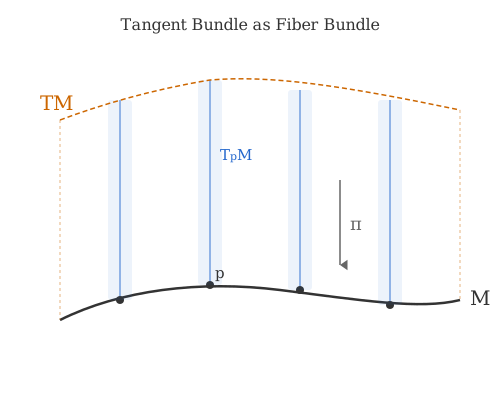
The tangent bundle \(TM\) carries a natural topology and smooth structure making it a smooth \(2n\)-dimensional manifold. The construction proceeds as follows.
Theorem 3.13 (Smooth Structure on the Tangent Bundle). Let \(M\) be a smooth \(n\)-manifold. Then \(TM\) admits a unique topology and smooth structure making it a smooth \(2n\)-manifold with the following properties:
- The projection \(\pi \colon TM \to M\) is a smooth surjection.
- For each smooth chart \((U, \varphi) = (U, x^1, \ldots, x^n)\) on \(M\), the map \(\tilde{\varphi} \colon \pi^{-1}(U) \to \varphi(U) \times \mathbb{R}^n\) defined by
\[
\tilde{\varphi}\left(p,\, v^i \frac{\partial}{\partial x^i}\bigg|_p\right) = (x^1(p), \ldots, x^n(p), v^1, \ldots, v^n)
\]
is a diffeomorphism onto an open subset of \(\mathbb{R}^{2n}\).
Proof (Construction). For each chart \((U_\alpha, \varphi_\alpha)\) on \(M\), define \(\tilde{\varphi}_\alpha \colon \pi^{-1}(U_\alpha) \to \varphi_\alpha(U_\alpha) \times \mathbb{R}^n\) as in the statement. The sets \(\pi^{-1}(U_\alpha)\) cover \(TM\), and each \(\tilde{\varphi}_\alpha\) is a bijection onto an open subset of \(\mathbb{R}^{2n}\).
\[
\tilde{\varphi}_\beta \circ \tilde{\varphi}_\alpha^{-1}(x, v) = \left(\tau(x),\; J_\tau(x) \cdot v\right),
\]
where \(\tau = \varphi_\beta \circ \varphi_\alpha^{-1}\) is the transition map on \(M\) and \(J_\tau(x)\) is its Jacobian matrix. This is smooth (since \(\tau\) is a diffeomorphism and the Jacobian depends smoothly on \(x\)), so the charts \(\{(\pi^{-1}(U_\alpha), \tilde{\varphi}_\alpha)\}\) form a smooth atlas on \(TM\).
We topologize \(TM\) by declaring \(W \subseteq TM\) to be open if \(\tilde{\varphi}_\alpha(W \cap \pi^{-1}(U_\alpha))\) is open in \(\mathbb{R}^{2n}\) for every \(\alpha\). This makes \(TM\) Hausdorff and second countable (because \(M\) is), and the maps \(\tilde{\varphi}_\alpha\) become homeomorphisms. \(\blacksquare\)
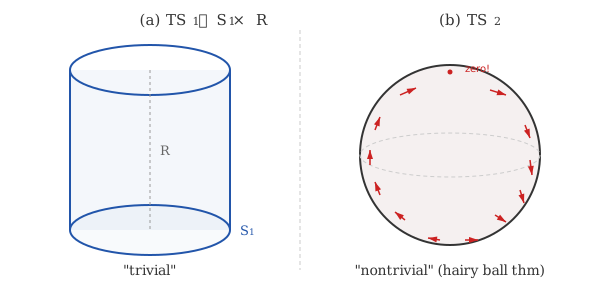
Example 3.14. The tangent bundle of \(\mathbb{R}^n\) is \(T\mathbb{R}^n \cong \mathbb{R}^n \times \mathbb{R}^n \cong \mathbb{R}^{2n}\). The tangent bundle of \(S^1\) is \(TS^1 \cong S^1 \times \mathbb{R}\) (the circle is "parallelizable"). In contrast, \(TS^2\) is not trivial — this is the content of the hairy ball theorem, which states that there is no nowhere-vanishing continuous tangent vector field on \(S^2\).
Chapter 4: Vector Fields on Manifolds
4.1 Sections of the Tangent Bundle
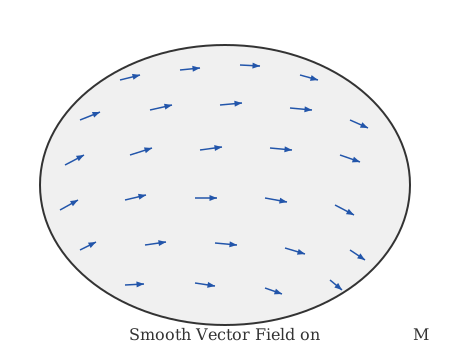
Chapter 3 established the tangent bundle \(\pi \colon TM \to M\) as a smooth \(2n\)-manifold fibred over \(M\). We now study the global objects that live on this bundle: vector fields. Informally, a vector field is a rule that assigns to each point of \(M\) a tangent vector at that point, varying smoothly from point to point. Such objects are fundamental to differential geometry and physics — they describe flows, infinitesimal symmetries, and dynamical systems.
Definition 4.1 (Vector Field). A vector field on a smooth manifold \(M\) is a section of the tangent bundle: a smooth map \(X \colon M \to TM\) such that \(\pi \circ X = \mathrm{id}_M\). Equivalently, \(X\) assigns to each \(p \in M\) a tangent vector \(X_p \in T_pM\), and the assignment \(p \mapsto X_p\) is smooth.
\[
X = \sum_{i=1}^n X^i \frac{\partial}{\partial x^i},
\]
where the component functions \(X^i \colon U \to \mathbb{R}\) are given by \(X^i(p) = (X_p)(x^i)\). The vector field \(X\) is smooth if and only if all component functions \(X^i\) are smooth in every coordinate chart.
Definition 4.2 (Space of Smooth Vector Fields). The set of all smooth vector fields on \(M\) is denoted \(\Gamma(TM)\) or \(\mathfrak{X}(M)\). It is a real vector space under pointwise addition:
\[
(X + Y)_p = X_p + Y_p, \qquad (\lambda X)_p = \lambda X_p.
\]
Moreover, \(\Gamma(TM)\) is a module over \(C^\infty(M)\): for any \(f \in C^\infty(M)\) and \(X \in \Gamma(TM)\), the product \(fX\) defined by \((fX)_p = f(p) X_p\) is again a smooth vector field. The module axioms are easily verified.
4.2 Vector Fields as Derivations of \(C^\infty(M)\)
Each tangent vector \(v \in T_pM\) acts as a derivation on \(C^\infty(M)\) at the point \(p\). When we let \(p\) vary, a vector field \(X\) defines a derivation of the entire algebra \(C^\infty(M)\).
Definition 4.3 (Vector Field as Derivation). A smooth vector field \(X \in \Gamma(TM)\) acts on smooth functions by
\[
(Xf)(p) = X_p(f) \quad \text{for all } f \in C^\infty(M), \, p \in M.
\]
The resulting function \(Xf \colon M \to \mathbb{R}\) is smooth (one checks this in coordinates), so \(X\) defines a map \(X \colon C^\infty(M) \to C^\infty(M)\) satisfying:
- \(\mathbb{R}\)-linearity: \(X(af + bg) = a\,Xf + b\,Xg\) for all \(a, b \in \mathbb{R}\).
- Leibniz rule: \(X(fg) = f \cdot Xg + g \cdot Xf\).
A map \(C^\infty(M) \to C^\infty(M)\) satisfying these two properties is called a
derivation of \(C^\infty(M)\).
\[
Xf = \sum_{i=1}^n X^i \frac{\partial f}{\partial x^i},
\]
which is a first-order linear partial differential operator.
Proposition 4.4. The map \(\Gamma(TM) \to \mathrm{Der}(C^\infty(M))\) sending \(X\) to the derivation \(f \mapsto Xf\) is an isomorphism of \(C^\infty(M)\)-modules. That is, every derivation of \(C^\infty(M)\) arises from a unique smooth vector field.
Proof (Sketch). Injectivity is clear: if \(Xf = 0\) for all \(f\), then \(X_p(f) = 0\) for all \(p\) and all \(f\), so \(X_p = 0\) for all \(p\). For surjectivity, given a derivation \(D \colon C^\infty(M) \to C^\infty(M)\), one shows using bump functions that \(D\) is local (i.e., \((Df)(p)\) depends only on \(f\) near \(p\)) and hence defines a derivation \(D_p\) at each point \(p\), yielding a vector field. Smoothness follows from the fact that the component functions \(D(x^i)\) are smooth. \(\blacksquare\)
When we have a smooth map \(F \colon M \to N\), we generally cannot “push forward” a vector field on \(M\) to a vector field on \(N\), because \(F\) may not be surjective (there may be points of \(N\) not in the image) or not injective (distinct points may map to the same point, giving ambiguous values). Instead, we have the weaker notion of \(F\)-relatedness.
Definition 4.5 (\(F\)-Related Vector Fields). Let \(F \colon M \to N\) be a smooth map. A vector field \(X \in \Gamma(TM)\) and a vector field \(Y \in \Gamma(TN)\) are \(F\)-related if
\[
F_{*,p}(X_p) = Y_{F(p)} \qquad \text{for all } p \in M.
\]
Equivalently, \(F_* \circ X = Y \circ F\) as maps \(M \to TN\).
Proposition 4.6 (Characterization of \(F\)-Relatedness). Let \(F \colon M \to N\) be smooth, \(X \in \Gamma(TM)\), and \(Y \in \Gamma(TN)\). Then \(X\) and \(Y\) are \(F\)-related if and only if
\[
X(g \circ F) = (Yg) \circ F \qquad \text{for all } g \in C^\infty(N).
\]
Proof. For any \(p \in M\) and \(g \in C^\infty(N)\):
\[
X(g \circ F)(p) = X_p(g \circ F) = (F_{*,p} X_p)(g),
\]
\[
((Yg) \circ F)(p) = (Yg)(F(p)) = Y_{F(p)}(g).
\]
These are equal for all \(g\) and \(p\) if and only if \(F_{*,p} X_p = Y_{F(p)}\) for all \(p\). \(\blacksquare\)
If \(F\) is a diffeomorphism, then for any \(X \in \Gamma(TM)\), there is a unique vector field \(F_*X \in \Gamma(TN)\) that is \(F\)-related to \(X\), called the pushforward of \(X\): it is defined by \((F_*X)_q = F_{*,F^{-1}(q)}(X_{F^{-1}(q)})\).
4.4 The Lie Bracket
We now come to one of the most important algebraic structures in differential geometry: the Lie bracket of vector fields. The Lie bracket measures the failure of two flows to commute and provides the tangent bundle with a rich algebraic structure that goes far beyond its mere vector space or module structure.
Given two vector fields \(X, Y \in \Gamma(TM)\), each acts as a derivation of \(C^\infty(M)\). The composition \(X \circ Y\) (meaning \(f \mapsto X(Yf)\)) is, in general, not a derivation because it involves second-order derivatives. However, the commutator \(XY - YX\) miraculously cancels the second-order terms and produces a derivation.
Definition 4.7 (Lie Bracket). The Lie bracket of two smooth vector fields \(X, Y \in \Gamma(TM)\) is the smooth vector field \([X, Y] \in \Gamma(TM)\) defined by
\[
[X, Y](f) = X(Yf) - Y(Xf) \qquad \text{for all } f \in C^\infty(M).
\]
![The Lie bracket as the failure of a parallelogram to close: flowing along X then Y versus Y then X yields a gap measured by [X,Y]](/pics/pmath465/lie-bracket-parallelogram.svg)
We must verify that \([X, Y]\) is indeed a derivation (and hence corresponds to a vector field by Proposition 4.4).
Proof that \([X, Y]\) is a derivation. Linearity is clear. For the Leibniz rule, let \(f, g \in C^\infty(M)\):
\[
X(Y(fg)) = X(f \cdot Yg + g \cdot Yf) = Xf \cdot Yg + f \cdot X(Yg) + Xg \cdot Yf + g \cdot X(Yf).
\]
Similarly,
\[
Y(X(fg)) = Yf \cdot Xg + f \cdot Y(Xg) + Yg \cdot Xf + g \cdot Y(Xf).
\]
Subtracting:
\[
[X,Y](fg) = f \cdot (X(Yg) - Y(Xg)) + g \cdot (X(Yf) - Y(Xf)) = f \cdot [X,Y]g + g \cdot [X,Y]f. \quad \blacksquare
\]
Now we compute the Lie bracket in local coordinates.
Proposition 4.8 (Coordinate Formula for the Lie Bracket). In local coordinates \((U, x^1, \ldots, x^n)\), if \(X = \sum_i X^i \frac{\partial}{\partial x^i}\) and \(Y = \sum_j Y^j \frac{\partial}{\partial x^j}\), then
\[
[X, Y] = \sum_{k=1}^n \left(\sum_{i=1}^n X^i \frac{\partial Y^k}{\partial x^i} - Y^i \frac{\partial X^k}{\partial x^i}\right) \frac{\partial}{\partial x^k}.
\]
Proof. We compute \([X, Y](f)\) for an arbitrary smooth function \(f\):
\[
X(Yf) = \sum_i X^i \frac{\partial}{\partial x^i}\left(\sum_j Y^j \frac{\partial f}{\partial x^j}\right) = \sum_{i,j} X^i \frac{\partial Y^j}{\partial x^i}\frac{\partial f}{\partial x^j} + \sum_{i,j} X^i Y^j \frac{\partial^2 f}{\partial x^i \partial x^j}.
\]
Similarly,
\[
Y(Xf) = \sum_{i,j} Y^i \frac{\partial X^j}{\partial x^i}\frac{\partial f}{\partial x^j} + \sum_{i,j} Y^i X^j \frac{\partial^2 f}{\partial x^i \partial x^j}.
\]
The second-order terms cancel (by equality of mixed partials), and we are left with
\[
[X,Y](f) = \sum_{i,j} \left(X^i \frac{\partial Y^j}{\partial x^i} - Y^i \frac{\partial X^j}{\partial x^i}\right) \frac{\partial f}{\partial x^j}.
\]
Relabelling the summation index \(j\) as \(k\) gives the stated formula. \(\blacksquare\)
4.5 Properties of the Lie Bracket
The Lie bracket satisfies three fundamental algebraic properties that make \(\Gamma(TM)\) into a Lie algebra.
Theorem 4.9 (Properties of the Lie Bracket). For all \(X, Y, Z \in \Gamma(TM)\) and \(a, b \in \mathbb{R}\):
- Bilinearity: \([aX + bY, Z] = a[X,Z] + b[Y,Z]\) and \([Z, aX+bY] = a[Z,X] + b[Z,Y]\).
- Skew-symmetry (antisymmetry): \([X, Y] = -[Y, X]\).
- Jacobi identity:
\[
[X, [Y, Z]] + [Y, [Z, X]] + [Z, [X, Y]] = 0.
\]
Proof. (1) and (2) are immediate from the definition \([X,Y]f = X(Yf) - Y(Xf)\).
\[
[X,[Y,Z]](f) = X([Y,Z]f) - [Y,Z](Xf) = X(Y(Zf)) - X(Z(Yf)) - Y(Z(Xf)) + Z(Y(Xf)).
\]\[
[Y,[Z,X]](f) = Y(Z(Xf)) - Y(X(Zf)) - Z(X(Yf)) + X(Z(Yf)),
\]\[
[Z,[X,Y]](f) = Z(X(Yf)) - Z(Y(Xf)) - X(Y(Zf)) + Y(X(Zf)).
\]
Adding all three expressions, every term cancels in pairs, giving \(0\). \(\blacksquare\)
A crucial property of the Lie bracket is its naturality with respect to smooth maps: the bracket is preserved by \(F\)-relatedness.
Theorem 4.10 (Lie Bracket Respects \(F\)-Relatedness). Let \(F \colon M \to N\) be a smooth map. If \(X_1, X_2 \in \Gamma(TM)\) are \(F\)-related to \(Y_1, Y_2 \in \Gamma(TN)\), respectively, then \([X_1, X_2]\) is \(F\)-related to \([Y_1, Y_2]\).
Proof. By Proposition 4.6, \(X_i\) is \(F\)-related to \(Y_i\) means \(X_i(g \circ F) = (Y_i g) \circ F\) for all \(g \in C^\infty(N)\). Then
\[
[X_1, X_2](g \circ F) = X_1(X_2(g \circ F)) - X_2(X_1(g \circ F))
\]
\[
= X_1((Y_2 g) \circ F) - X_2((Y_1 g) \circ F) = (Y_1(Y_2 g)) \circ F - (Y_2(Y_1 g)) \circ F = ([Y_1, Y_2]g) \circ F.
\]
By Proposition 4.6 again, \([X_1,X_2]\) is \(F\)-related to \([Y_1,Y_2]\). \(\blacksquare\)
Corollary 4.11. If \(F \colon M \to N\) is a diffeomorphism, then \(F_*[X,Y] = [F_*X, F_*Y]\) for all \(X, Y \in \Gamma(TM)\). That is, the pushforward by a diffeomorphism is a Lie algebra homomorphism.
4.7 Lie Groups and Lie Algebras
We now develop one of the most beautiful applications of vector fields: the Lie algebra of a Lie group. The interplay between the group structure and the manifold structure gives rise to a finite-dimensional Lie algebra that encodes much of the group’s structure.
Definition 4.12 (Lie Group). A Lie group is a smooth manifold \(G\) that is also a group, such that the multiplication map \(\mu \colon G \times G \to G\), \((g,h) \mapsto gh\), and the inversion map \(\iota \colon G \to G\), \(g \mapsto g^{-1}\), are smooth.
Definition 4.13 (Left Multiplication). For each \(g \in G\), the left multiplication (or left translation) by \(g\) is the map
\[
L_g \colon G \to G, \qquad L_g(h) = gh.
\]
Each \(L_g\) is a diffeomorphism with inverse \(L_{g^{-1}}\).
Since each \(L_g\) is a diffeomorphism, it induces an isomorphism \((L_g)_{*,h} \colon T_hG \to T_{gh}G\) at every point. This allows us to “translate” tangent vectors from one point to another, giving rise to a special class of vector fields.
Definition 4.14 (Left-Invariant Vector Field). A vector field \(X \in \Gamma(TG)\) is left-invariant if it is invariant under all left translations:
\[
(L_g)_* X = X \qquad \text{for all } g \in G.
\]
Equivalently, \((L_g)_{*,h}(X_h) = X_{gh}\) for all \(g, h \in G\).
The condition of left-invariance means that \(X\) is \(L_g\)-related to itself for every \(g\). This is an extremely rigid condition — it means the vector field is completely determined by its value at any single point.
Proposition 4.15. The map \(\mathrm{ev}_e \colon \{\text{left-invariant vector fields on } G\} \to T_eG\) defined by \(\mathrm{ev}_e(X) = X_e\) is a linear isomorphism. Its inverse sends \(v \in T_eG\) to the left-invariant vector field \(\tilde{v}\) defined by
\[
\tilde{v}_g = (L_g)_{*,e}(v) \qquad \text{for all } g \in G.
\]
Proof. The map \(\mathrm{ev}_e\) is clearly linear. It is injective because a left-invariant vector field is determined by its value at \(e\) (since \(X_g = (L_g)_{*,e}(X_e)\) for all \(g\)). It is surjective because, given \(v \in T_eG\), the formula \(\tilde{v}_g = (L_g)_{*,e}(v)\) defines a left-invariant vector field (one must check smoothness, which follows from smoothness of the multiplication map). \(\blacksquare\)
Definition 4.16 (Lie Algebra of a Lie Group). The Lie algebra of a Lie group \(G\), denoted \(\mathfrak{g}\), is the vector space of all left-invariant vector fields on \(G\), equipped with the Lie bracket.
By Proposition 4.15, \(\mathfrak{g} \cong T_eG\) as a vector space, so \(\dim \mathfrak{g} = \dim G\). The key point is that the Lie bracket of two left-invariant vector fields is again left-invariant, so the bracket operation restricts to \(\mathfrak{g}\).
Proposition 4.17. If \(X\) and \(Y\) are left-invariant vector fields on \(G\), then \([X, Y]\) is also left-invariant.
Proof. Since \(X\) is left-invariant, it is \(L_g\)-related to itself; similarly for \(Y\). By Theorem 4.10, \([X,Y]\) is \(L_g\)-related to \([X,Y]\), which means \((L_g)_*[X,Y] = [X,Y]\). Thus \([X,Y]\) is left-invariant. \(\blacksquare\)
Example 4.18 (Lie Algebras of Classical Groups).- For \(G = \mathrm{GL}(n, \mathbb{R})\), we have \(\mathfrak{gl}(n, \mathbb{R}) = M_{n \times n}(\mathbb{R})\) (all \(n \times n\) matrices), with bracket \([A, B] = AB - BA\).
- For \(G = \mathrm{O}(n)\), the Lie algebra is \(\mathfrak{o}(n) = \{A \in M_{n \times n}(\mathbb{R}) : A^T + A = 0\}\), the space of skew-symmetric matrices, with dimension \(n(n-1)/2\).
- For \(G = \mathrm{SO}(n)\), since \(\mathrm{SO}(n)\) is the identity component of \(\mathrm{O}(n)\), we have \(\mathfrak{so}(n) = \mathfrak{o}(n)\).
- For \(G = \mathrm{U}(n)\), we have \(\mathfrak{u}(n) = \{A \in M_{n \times n}(\mathbb{C}) : A^* + A = 0\}\), the space of skew-Hermitian matrices, with real dimension \(n^2\).
- For \(G = \mathrm{SU}(n)\), we have \(\mathfrak{su}(n) = \{A \in \mathfrak{u}(n) : \mathrm{tr}(A) = 0\}\), with dimension \(n^2 - 1\).
4.8 Lie Group Homomorphisms and Lie Algebra Homomorphisms
The correspondence between Lie groups and Lie algebras is functorial: smooth group homomorphisms induce Lie algebra homomorphisms.
Definition 4.19 (Lie Group Homomorphism). A Lie group homomorphism is a smooth map \(\Phi \colon G \to H\) between Lie groups that is also a group homomorphism: \(\Phi(g_1 g_2) = \Phi(g_1)\Phi(g_2)\) for all \(g_1, g_2 \in G\).
Definition 4.20 (Lie Algebra Homomorphism). A Lie algebra homomorphism is a linear map \(\phi \colon \mathfrak{g} \to \mathfrak{h}\) between Lie algebras satisfying \(\phi([X, Y]) = [\phi(X), \phi(Y)]\) for all \(X, Y \in \mathfrak{g}\).
Theorem 4.21 (Induced Lie Algebra Homomorphism). Let \(\Phi \colon G \to H\) be a Lie group homomorphism. Then the pushforward at the identity,
\[
\Phi_{*,e} \colon T_eG \to T_eH,
\]
is a Lie algebra homomorphism from \(\mathfrak{g}\) to \(\mathfrak{h}\) (under the identifications \(\mathfrak{g} \cong T_eG\) and \(\mathfrak{h} \cong T_eH\)). This homomorphism is often denoted \(\mathrm{Lie}(\Phi)\) or \(d\Phi_e\).
Proof. We must show that if \(X, Y\) are left-invariant vector fields on \(G\), then the left-invariant vector fields on \(H\) corresponding to \(\Phi_{*,e}(X_e)\) and \(\Phi_{*,e}(Y_e)\) have bracket equal to the left-invariant vector field corresponding to \(\Phi_{*,e}([X,Y]_e)\).
\[
\Phi_{*,gh} \circ (L_g)_{*,h} = (L_{\Phi(g)})_{*,\Phi(h)} \circ \Phi_{*,h}.
\]\[
(L_k)_{*,e}(\Phi_{*,e}(X_e)) = (L_{\Phi(g)})_{*,e}(\Phi_{*,e}(X_e)) = \Phi_{*,g}((L_g)_{*,e}(X_e)) = \Phi_{*,g}(X_g).
\]\[
\Phi_{*,e}([X,Y]_e) = [\tilde{X}, \tilde{Y}]_e.
\]
This is exactly the statement that \(\Phi_{*,e}\) preserves Lie brackets. \(\blacksquare\)
Example 4.22. The determinant map \(\det \colon \mathrm{GL}(n, \mathbb{R}) \to \mathbb{R}^* = \mathrm{GL}(1, \mathbb{R})\) is a Lie group homomorphism. Its induced Lie algebra homomorphism is the trace map \(\mathrm{tr} \colon \mathfrak{gl}(n, \mathbb{R}) \to \mathbb{R}\). Indeed, for any \(A \in \mathfrak{gl}(n, \mathbb{R})\), the curve \(\gamma(t) = I + tA\) has \(\gamma(0) = I\) and \(\gamma'(0) = A\), and \(\det(\gamma(t)) = 1 + t\,\mathrm{tr}(A) + O(t^2)\), so \(\frac{d}{dt}\big|_0 \det(\gamma(t)) = \mathrm{tr}(A)\). The kernel of \(\det\) is \(\mathrm{SL}(n, \mathbb{R})\), whose Lie algebra is \(\mathfrak{sl}(n, \mathbb{R}) = \ker(\mathrm{tr}) = \{A : \mathrm{tr}(A) = 0\}\).
Example 4.23. The inclusion \(\iota \colon \mathrm{SO}(n) \hookrightarrow \mathrm{GL}(n, \mathbb{R})\) is a Lie group homomorphism. Its induced Lie algebra homomorphism is the inclusion \(\mathfrak{so}(n) \hookrightarrow \mathfrak{gl}(n, \mathbb{R})\), identifying \(\mathfrak{so}(n)\) with the Lie subalgebra of skew-symmetric matrices.
This concludes our development of the foundational machinery of smooth manifolds through Chapter 4. We have built up from the topological definition of a manifold, through smooth structures and maps, to the tangent bundle and vector fields, arriving at the Lie bracket and the Lie algebra of a Lie group. These structures form the backbone upon which all further topics in the course — submanifolds, immersions and submersions, flows, differential forms, integration, and de Rham cohomology — will be built.
Chapter 5: Covectors and the Cotangent Bundle
5.1 Covectors and the Dual Space
Having developed the theory of tangent vectors and the tangent bundle in previous chapters, we now turn to the dual picture. In linear algebra, every vector space \( V \) has an associated dual space \( V^* \) consisting of all linear functionals on \( V \). When we apply this construction fibrewise to the tangent bundle of a smooth manifold, we obtain the cotangent bundle, whose sections are the covector fields or 1-forms. This dual perspective is not merely an abstract curiosity: covector fields arise naturally whenever we take the differential of a smooth function, and they are the objects that can be integrated along curves. The interplay between vectors and covectors is one of the central themes of differential geometry.
Let \( V \) be a finite-dimensional real vector space. Recall from linear algebra:
Definition 5.1 (Dual Space). The dual space of \( V \), denoted \( V^* \), is the vector space of all linear maps \( \omega \colon V \to \mathbb{R} \). Elements of \( V^* \) are called covectors, linear functionals, or linear forms on \( V \).
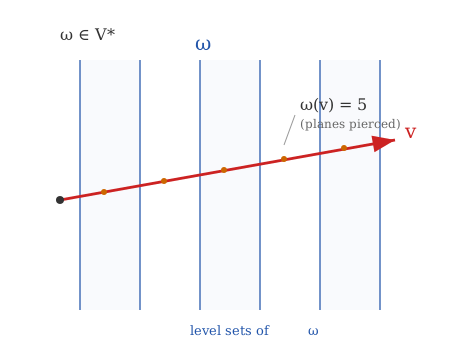
If \( V \) has dimension \( n \), then \( V^* \) also has dimension \( n \), though the two spaces are not canonically isomorphic (absent additional structure such as an inner product). Given a basis \( (e_1, \ldots, e_n) \) for \( V \), there is a uniquely determined dual basis \( (\varepsilon^1, \ldots, \varepsilon^n) \) for \( V^* \), characterised by the property
\[
\varepsilon^i(e_j) = \delta^i_j,
\]
where \( \delta^i_j \) is the Kronecker delta. Any covector \( \omega \in V^* \) can be expanded in the dual basis as \( \omega = \omega_i \, \varepsilon^i \) (using the Einstein summation convention), where \( \omega_i = \omega(e_i) \).
Now we bring this construction to manifolds. At each point \( p \) of a smooth manifold \( M \), the tangent space \( T_pM \) is a finite-dimensional real vector space, so we may form its dual.
Definition 5.2 (Cotangent Space). Let \( M \) be a smooth manifold and \( p \in M \). The cotangent space of \( M \) at \( p \) is the dual space
\[
T_p^*M = (T_pM)^*.
\]
Elements of \( T_p^*M \) are called tangent covectors at \( p \).
If \( (U, \varphi) \) is a smooth chart around \( p \) with coordinate functions \( (x^1, \ldots, x^n) \), then the coordinate vectors \( \left( \frac{\partial}{\partial x^1}\big|_p, \ldots, \frac{\partial}{\partial x^n}\big|_p \right) \) form a basis for \( T_pM \). The corresponding dual basis for \( T_p^*M \) is denoted \( (dx^1|_p, \ldots, dx^n|_p) \) and is characterised by
\[
dx^i|_p \left( \frac{\partial}{\partial x^j}\bigg|_p \right) = \delta^i_j.
\]
We shall see shortly that each \( dx^i|_p \) is in fact the differential of the coordinate function \( x^i \) at the point \( p \), which justifies the notation. Any covector \( \omega \in T_p^*M \) can be written as
\[
\omega = \omega_i \, dx^i|_p, \qquad \text{where } \omega_i = \omega\!\left( \frac{\partial}{\partial x^i}\bigg|_p \right).
\]
The components \( \omega_i \) carry a lower index, in contrast to the upper-indexed components \( v^i \) of a tangent vector \( v = v^i \frac{\partial}{\partial x^i}\big|_p \). This notational convention is deliberate and reflects the transformation laws: under a change of coordinates \( \tilde{x}^j = \tilde{x}^j(x^1, \ldots, x^n) \), the covector components transform covariantly:
\[
\tilde{\omega}_j = \frac{\partial x^i}{\partial \tilde{x}^j} \, \omega_i,
\]
whereas the tangent vector components transform contravariantly. The natural pairing \( \omega(v) = \omega_i v^i \) is coordinate-independent precisely because these two transformation laws compensate one another.
5.2 The Cotangent Bundle
Just as we assembled all tangent spaces into the tangent bundle \( TM \), we now assemble all cotangent spaces into a single object.
Definition 5.3 (Cotangent Bundle). The cotangent bundle of a smooth \( n \)-manifold \( M \) is the disjoint union
\[
T^*M = \bigsqcup_{p \in M} T_p^*M = \{ (p, \omega) : p \in M, \, \omega \in T_p^*M \}.
\]
It carries a natural projection \( \pi \colon T^*M \to M \) defined by \( \pi(p, \omega) = p \).
Proposition 5.4. If \( M \) is a smooth \( n \)-manifold, then \( T^*M \) has a natural structure as a smooth \( 2n \)-manifold, and the projection \( \pi \colon T^*M \to M \) is a smooth surjective map. Moreover, \( T^*M \) is a smooth vector bundle of rank \( n \) over \( M \).
The smooth structure is constructed exactly as for the tangent bundle. Given a smooth chart \( (U, \varphi) \) for \( M \) with coordinates \( (x^1, \ldots, x^n) \), we define a chart \( (\pi^{-1}(U), \tilde{\varphi}) \) for \( T^*M \) by
\[
\tilde{\varphi}(p, \omega_i \, dx^i|_p) = (x^1(p), \ldots, x^n(p), \omega_1, \ldots, \omega_n) \in \mathbb{R}^{2n}.
\]
The first \( n \) coordinates locate the base point \( p \) in \( M \), while the last \( n \) coordinates record the components of the covector in the dual basis. The transition functions between overlapping charts are smooth, yielding the desired smooth structure on \( T^*M \).
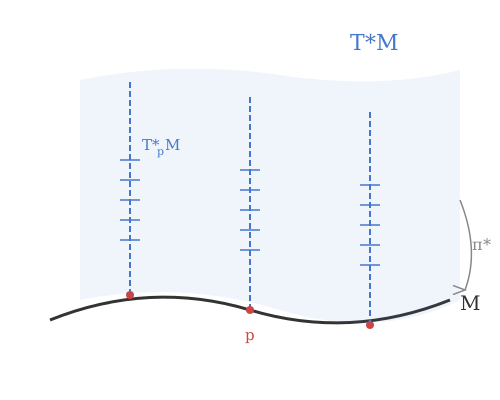
The cotangent bundle plays a fundamental role in Hamiltonian mechanics, where the phase space of a classical mechanical system is naturally \( T^*M \) rather than \( TM \). It also carries a canonical symplectic structure (the canonical 2-form), though we will not develop this in the present course.
Definition 5.5 (Covector Field / 1-Form). A covector field (or 1-form) on \( M \) is a smooth section of the cotangent bundle, i.e., a smooth map \( \omega \colon M \to T^*M \) such that \( \pi \circ \omega = \mathrm{id}_M \). The space of all smooth 1-forms on \( M \) is denoted
\[
\Omega^1(M) = \Gamma(T^*M).
\]
In local coordinates \( (x^1, \ldots, x^n) \) on an open set \( U \subseteq M \), a 1-form \( \omega \) can be written as
\[
\omega = \omega_i \, dx^i,
\]
where the component functions \( \omega_i \colon U \to \mathbb{R} \) are smooth. The space \( \Omega^1(M) \) is a module over the ring \( C^\infty(M) \): we can add 1-forms and multiply them by smooth functions pointwise.
Covector fields act on vector fields to produce smooth functions. If \( \omega \in \Omega^1(M) \) and \( X \in \mathfrak{X}(M) \), then the function \( \omega(X) \colon M \to \mathbb{R} \) defined by
\[
\omega(X)(p) = \omega_p(X_p)
\]
is smooth. In local coordinates, if \( X = X^j \frac{\partial}{\partial x^j} \), then
\[
\omega(X) = \omega_i \, X^i.
\]
This pairing \( \Omega^1(M) \times \mathfrak{X}(M) \to C^\infty(M) \) is \( C^\infty(M) \)-bilinear and is sometimes called the natural pairing or contraction.
5.4 The Differential of a Smooth Function
The most natural and important source of covector fields is the differential of a smooth function. This is a coordinate-free operation that generalises the classical gradient.
Definition 5.6 (Differential of a Function). Let \( f \in C^\infty(M) \). The differential of \( f \) is the 1-form \( df \in \Omega^1(M) \) defined by
\[
(df)_p(X_p) = X_p f
\]
for all \( p \in M \) and \( X_p \in T_pM \). Equivalently, for any smooth vector field \( X \in \mathfrak{X}(M) \),
\[
df(X) = Xf.
\]
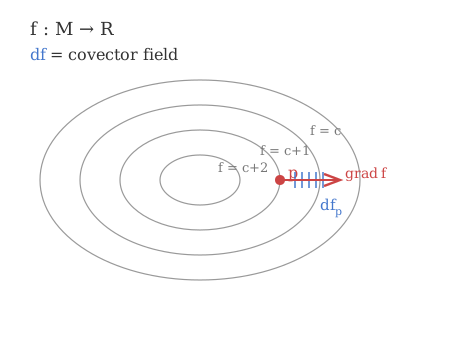
In words, \( df \) at a point \( p \) eats a tangent vector and returns the directional derivative of \( f \) in that direction. This is entirely coordinate-free. Let us now compute \( df \) in local coordinates.
Proposition 5.7 (Local Expression for \( df \)). Let \( (U, (x^1, \ldots, x^n)) \) be a smooth chart on \( M \). For any \( f \in C^\infty(M) \),
\[
df = \frac{\partial f}{\partial x^i} \, dx^i
\]
on \( U \).
Proof. We must show that both sides agree when applied to any basis vector field \( \frac{\partial}{\partial x^j} \). On one hand,
\[
df\!\left( \frac{\partial}{\partial x^j} \right) = \frac{\partial f}{\partial x^j}.
\]
On the other hand,
\[
\frac{\partial f}{\partial x^i} \, dx^i\!\left( \frac{\partial}{\partial x^j} \right) = \frac{\partial f}{\partial x^i} \, \delta^i_j = \frac{\partial f}{\partial x^j}. \qquad \square
\]
This proposition shows that the notation \( dx^i \) for the dual basis elements is consistent: \( dx^i \) is literally the differential of the coordinate function \( x^i \).
Example 5.8. Consider \( f \colon \mathbb{R}^3 \to \mathbb{R} \) given by \( f(x, y, z) = x^2 y + e^z \). Then
\[
df = 2xy \, dx + x^2 \, dy + e^z \, dz.
\]
Example 5.9. Let \( M = S^2 \) with the spherical coordinate chart \( (\theta, \phi) \) (where \( \theta \) is the polar angle and \( \phi \) is the azimuthal angle). If \( h \colon S^2 \to \mathbb{R} \) is the height function \( h = \cos \theta \), then
\[
dh = -\sin\theta \, d\theta.
\]
The vanishing of the \( d\phi \) component reflects the rotational symmetry of the height function about the vertical axis.
The differential satisfies the following algebraic properties, all immediate from the definition.
Proposition 5.10. The map \( d \colon C^\infty(M) \to \Omega^1(M) \) is \( \mathbb{R} \)-linear and satisfies the Leibniz rule (product rule):
\[
d(fg) = f \, dg + g \, df
\]
for all \( f, g \in C^\infty(M) \). Moreover, if \( c \in \mathbb{R} \) is a constant function, then \( dc = 0 \).
The differential \( d \colon C^\infty(M) \to \Omega^1(M) \) is a fundamental example of a derivation from the algebra \( C^\infty(M) \) to the module \( \Omega^1(M) \). Later, when we develop differential forms in full generality, we will extend \( d \) to the exterior derivative \( d \colon \Omega^k(M) \to \Omega^{k+1}(M) \).
One of the most important features distinguishing covectors from vectors is that covectors can be pulled back by smooth maps. Recall that a smooth map \( F \colon M \to N \) induces a pushforward \( F_{*,p} \colon T_pM \to T_{F(p)}N \) on tangent vectors. In general, there is no way to push forward a vector field from \( M \) to \( N \) unless \( F \) is a diffeomorphism. However, the dual operation — the pullback — goes in the opposite direction and is always well-defined for covectors.
Definition 5.11 (Pullback of a Covector). Let \( F \colon M \to N \) be a smooth map, and let \( p \in M \). The pullback (or codifferential) at \( p \) is the linear map
\[
F^* \colon T_{F(p)}^*N \to T_p^*M
\]
defined by
\[
(F^*\omega)(X_p) = \omega(F_{*,p} X_p)
\]
for all \( \omega \in T_{F(p)}^*N \) and \( X_p \in T_pM \).
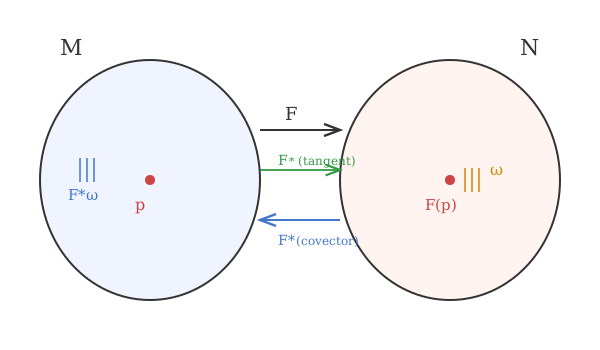
Note the directions carefully: the pushforward goes “forward” from \( T_pM \) to \( T_{F(p)}N \), while the pullback goes “backward” from \( T_{F(p)}^*N \) to \( T_p^*M \). This is the standard contravariance of the dual space construction in linear algebra.
The pointwise pullback extends to 1-forms: if \( \omega \) is a 1-form on \( N \), we define the pullback 1-form \( F^*\omega \) on \( M \) by
\[
(F^*\omega)_p = F^*(\omega_{F(p)}) \qquad \text{for all } p \in M.
\]
More explicitly, for any vector field \( X \in \mathfrak{X}(M) \),
\[
(F^*\omega)(X)(p) = \omega_{F(p)}(F_{*,p} X_p).
\]
The following proposition lists the key properties of pullback.
Proposition 5.13 (Properties of Pullback). Let \( F \colon M \to N \) be a smooth map. Then:
- \( F^* \colon \Omega^1(N) \to \Omega^1(M) \) is \( \mathbb{R} \)-linear.
- \( F^*(h\omega) = (h \circ F)(F^*\omega) \) for all \( h \in C^\infty(N) \), \( \omega \in \Omega^1(N) \).
- Naturality with respect to \( d \): \( F^*(dh) = d(h \circ F) \) for all \( h \in C^\infty(N) \).
- If \( G \colon N \to P \) is another smooth map, then \( (G \circ F)^* = F^* \circ G^* \).
- \( (\mathrm{id}_M)^* = \mathrm{id}_{\Omega^1(M)} \).
Proof. We prove property (3), the naturality with respect to \( d \), as it is the most important. For any \( p \in M \) and \( X_p \in T_pM \),
\[
(F^*(dh))_p(X_p) = (dh)_{F(p)}(F_{*,p}X_p) = (F_{*,p}X_p)(h) = X_p(h \circ F) = d(h \circ F)_p(X_p).
\]
Since this holds for all \( X_p \), we conclude \( F^*(dh) = d(h \circ F) \). The other properties are straightforward. \( \square \)
Property (3) is extremely useful in computations. It tells us that pulling back a differential is the same as first composing with \( F \) and then taking the differential. In particular, for coordinate functions \( y^j \) on \( N \) and a smooth map \( F \colon M \to N \) written in coordinates as \( y^j = F^j(x^1, \ldots, x^m) \):
\[
F^*(dy^j) = d(y^j \circ F) = dF^j = \frac{\partial F^j}{\partial x^i} \, dx^i.
\]
This gives a practical recipe for computing pullbacks of arbitrary 1-forms. If \( \omega = \omega_j \, dy^j \) on \( N \), then
\[
F^*\omega = (\omega_j \circ F) \frac{\partial F^j}{\partial x^i} \, dx^i.
\]
Example 5.14. Let \( F \colon \mathbb{R}^2 \to \mathbb{R}^3 \) be given by \( F(s,t) = (s^2, st, t^2) \), and let \( \omega = z \, dx + x \, dy - y \, dz \) be a 1-form on \( \mathbb{R}^3 \). We compute the pullback \( F^*\omega \). We have \( x = s^2, y = st, z = t^2 \), so:
\[
F^*(dx) = d(s^2) = 2s \, ds, \qquad F^*(dy) = d(st) = t \, ds + s \, dt, \qquad F^*(dz) = d(t^2) = 2t \, dt.
\]
Therefore,
\[
F^*\omega = t^2(2s \, ds) + s^2(t \, ds + s \, dt) - st(2t \, dt) = (2st^2 + s^2 t) \, ds + (s^3 - 2st^2) \, dt.
\]
5.6 Line Integrals of Covector Fields
One of the key motivations for studying covector fields is that they are the natural objects to integrate along curves. This should be contrasted with vector fields, which cannot be integrated along curves in a coordinate-independent way without additional structure (such as a Riemannian metric).
Definition 5.15 (Line Integral of a Covector Field). Let \( \omega \) be a smooth covector field on \( M \), and let \( \gamma \colon [a, b] \to M \) be a smooth curve. The line integral of \( \omega \) along \( \gamma \) is
\[
\int_\gamma \omega = \int_a^b \omega_{\gamma(t)}(\gamma'(t)) \, dt.
\]
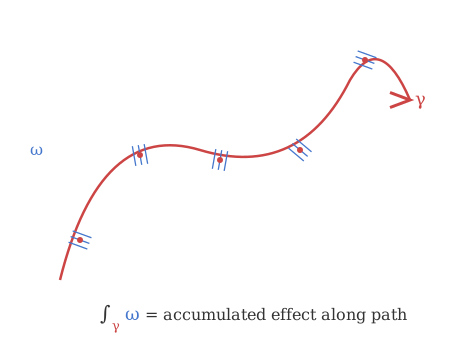
In local coordinates, if \( \omega = \omega_i \, dx^i \) and \( \gamma(t) = (x^1(t), \ldots, x^n(t)) \), then
\[
\int_\gamma \omega = \int_a^b \omega_i(\gamma(t)) \frac{dx^i}{dt} \, dt.
\]
This is a coordinate-independent quantity: one can verify directly that the integral does not depend on the choice of coordinates, because the transformation laws for covector components and tangent vector components cancel. This is precisely why 1-forms (not vector fields) are the correct objects to integrate along curves.
The line integral is also invariant under orientation-preserving reparametrisation of the curve, and reverses sign under orientation-reversing reparametrisation.
Theorem 5.16 (Fundamental Theorem for Line Integrals). If \( f \in C^\infty(M) \) and \( \gamma \colon [a,b] \to M \) is a smooth curve, then
\[
\int_\gamma df = f(\gamma(b)) - f(\gamma(a)).
\]
Proof. By the chain rule,
\[
\int_\gamma df = \int_a^b (df)_{\gamma(t)}(\gamma'(t)) \, dt = \int_a^b \frac{d}{dt}(f \circ \gamma)(t) \, dt = f(\gamma(b)) - f(\gamma(a)). \qquad \square
\]
This is the manifold generalisation of the fundamental theorem of calculus, and it tells us that the line integral of an exact 1-form depends only on the endpoints.
The fundamental theorem for line integrals motivates the following important notions.
Definition 5.17 (Exact and Closed 1-Forms). A 1-form \( \omega \in \Omega^1(M) \) is called:
- exact if \( \omega = df \) for some \( f \in C^\infty(M) \); the function \( f \) is called a potential for \( \omega \);
- closed if, in every smooth chart \( (U, (x^1, \ldots, x^n)) \), we have
\[
\frac{\partial \omega_i}{\partial x^j} = \frac{\partial \omega_j}{\partial x^i} \qquad \text{for all } i, j.
\]
Definition 5.18 (Conservative Covector Field). A covector field \( \omega \in \Omega^1(M) \) is conservative if for every pair of points \( p, q \in M \), the line integral \( \int_\gamma \omega \) has the same value for all piecewise smooth curves \( \gamma \) from \( p \) to \( q \). Equivalently, \( \omega \) is conservative if \( \oint_\gamma \omega = 0 \) for every piecewise smooth closed curve \( \gamma \).
These three properties are related as follows.
Theorem 5.19. Let \( \omega \) be a smooth covector field on a smooth manifold \( M \). Then:
- If \( \omega \) is exact, then \( \omega \) is conservative.
- If \( \omega \) is conservative, then \( \omega \) is exact.
- If \( \omega \) is exact, then \( \omega \) is closed.
Thus, exactness and conservativeness are equivalent, and both imply closedness.
Proof. Statement (1) follows directly from the fundamental theorem for line integrals. For (2), if \( \omega \) is conservative, we fix a point \( p_0 \in M \) and define \( f(p) = \int_\gamma \omega \) where \( \gamma \) is any piecewise smooth curve from \( p_0 \) to \( p \). (On each connected component, we choose a basepoint; if \( M \) is connected, one basepoint suffices.) The independence of path guarantees that \( f \) is well-defined. One then verifies that \( f \) is smooth and \( df = \omega \) by computing in local coordinates. Statement (3) follows from the equality of mixed partials: if \( \omega = df \), then
\[
\frac{\partial \omega_i}{\partial x^j} = \frac{\partial^2 f}{\partial x^j \partial x^i} = \frac{\partial^2 f}{\partial x^i \partial x^j} = \frac{\partial \omega_j}{\partial x^i}. \qquad \square
\]
The converse of (3) — “every closed 1-form is exact” — is not true in general. Whether it holds depends on the topology of \( M \).
Example 5.20. On \( \mathbb{R}^2 \setminus \{0\} \), the 1-form
\[
\omega = \frac{-y \, dx + x \, dy}{x^2 + y^2}
\]
is closed (as one can verify by direct computation) but not exact. Indeed, integrating \( \omega \) around the unit circle gives \( 2\pi \neq 0 \). On the other hand, locally (say on the upper half-plane), \( \omega = d(\arctan(y/x)) \), so \( \omega \) is locally exact. The obstruction to global exactness is the nontrivial first de Rham cohomology group \( H^1_{\mathrm{dR}}(\mathbb{R}^2 \setminus \{0\}) \cong \mathbb{R} \).
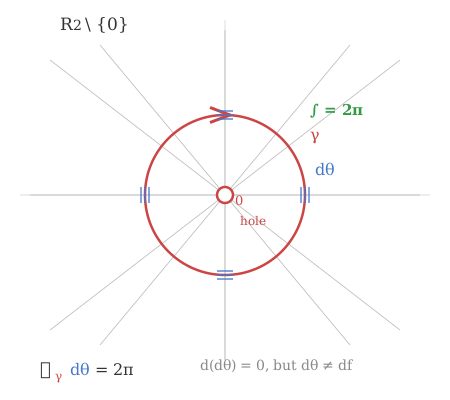
The quotient space \( H^1_{\mathrm{dR}}(M) = \ker d / \operatorname{im} d \) (closed 1-forms modulo exact 1-forms) is the first de Rham cohomology group of \( M \). It is a topological invariant that measures the extent to which closed forms can fail to be exact. The Poincare lemma asserts that on contractible domains (such as \( \mathbb{R}^n \) or any open ball), every closed form is exact. We will return to this in a later chapter.
Chapter 6: Submersions, Immersions, and Embeddings
6.1 Maps of Constant Rank
In multivariable calculus, the behaviour of a smooth map \( F \colon \mathbb{R}^m \to \mathbb{R}^n \) near a point is governed by the rank of its Jacobian matrix. The same principle carries over to smooth manifolds via the differential \( F_{*,p} \colon T_pM \to T_{F(p)}N \). In this chapter, we study the key classes of smooth maps — submersions, immersions, and embeddings — and develop the fundamental rank theorems that reveal their local structure. These results are indispensable tools for constructing new manifolds from old ones, particularly through the regular level set theorem.
Definition 6.1 (Rank of a Smooth Map). Let \( F \colon M \to N \) be a smooth map between smooth manifolds. The rank of \( F \) at \( p \in M \) is the rank of the linear map \( F_{*,p} \colon T_pM \to T_{F(p)}N \), that is,
\[
\operatorname{rank}_p F = \dim F_{*,p}(T_pM) = \operatorname{rank}(F_{*,p}).
\]
If \( \dim M = m \) and \( \dim N = n \), then \( 0 \le \operatorname{rank}_p F \le \min(m, n) \).
In local coordinates, the rank of \( F \) at \( p \) is just the rank of the Jacobian matrix \( \left( \frac{\partial F^j}{\partial x^i}(p) \right) \). The rank is a lower semicontinuous function of \( p \): if \( F \) has rank \( r \) at \( p \), then \( F \) has rank at least \( r \) at all nearby points.
Definition 6.2. A smooth map \( F \colon M \to N \) is said to have constant rank \( r \) if \( \operatorname{rank}_p F = r \) for every \( p \in M \). It is said to have constant rank on a subset \( S \subseteq M \) if the rank is the same at all points of \( S \).
We now define the three principal classes of smooth maps based on their rank.
6.2 Submersions
Definition 6.3 (Submersion). A smooth map \( F \colon M^m \to N^n \) is a submersion if \( F_{*,p} \) is surjective for every \( p \in M \). Equivalently, \( F \) has constant rank \( n = \dim N \) everywhere. (This requires \( m \ge n \).)
Submersions are the smooth analogues of “onto” linear maps. The defining condition — surjectivity of the differential everywhere — guarantees that the map locally looks like a projection. This is made precise by the following theorem.
Theorem 6.4 (Local Submersion Theorem / Canonical Form for Submersions). Let \( F \colon M^m \to N^n \) be a smooth submersion. For every \( p \in M \), there exist smooth charts \( (U, \varphi) \) centred at \( p \) and \( (V, \psi) \) centred at \( F(p) \) such that the coordinate representation of \( F \) is
\[
\hat{F}(x^1, \ldots, x^m) = (x^1, \ldots, x^n).
\]
That is, in suitable coordinates, a submersion is just a projection onto the first \( n \) coordinates.
Proof. This is a consequence of the inverse function theorem. After choosing initial charts and performing a linear change of coordinates on the domain, we may assume that the Jacobian matrix of \( \hat{F} \) at the origin has its first \( n \) rows forming a nonsingular \( n \times n \) block. Define \( \Phi \colon \mathbb{R}^m \to \mathbb{R}^m \) by
\[
\Phi(x^1, \ldots, x^m) = (\hat{F}^1(x), \ldots, \hat{F}^n(x), x^{n+1}, \ldots, x^m).
\]
The Jacobian of \( \Phi \) at the origin is nonsingular (it has the Jacobian of \( \hat{F} \) in its first \( n \) rows and the identity in the last \( m - n \) rows, with suitable structure), so by the inverse function theorem, \( \Phi \) is a local diffeomorphism. Replacing the chart on \( M \) by the composition with \( \Phi^{-1} \) gives the desired canonical form. \( \square \)
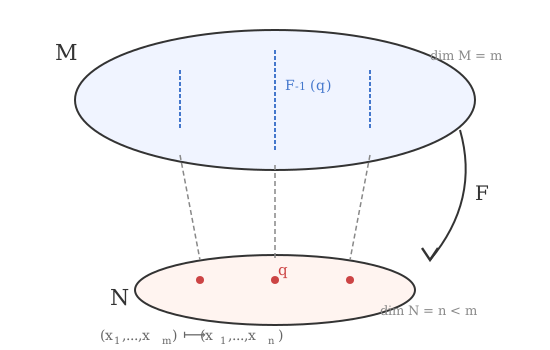
An important consequence of the local submersion theorem is:
Corollary 6.5. Every submersion is an open map. In particular, every surjective submersion is a quotient map.
Example 6.6. The projection \( \pi \colon \mathbb{R}^{m+n} \to \mathbb{R}^n \) given by \( \pi(x^1, \ldots, x^{m+n}) = (x^1, \ldots, x^n) \) is a submersion. More generally, the projection from any smooth vector bundle to its base is a smooth submersion.
Example 6.7. The determinant map \( \det \colon \mathrm{GL}(n, \mathbb{R}) \to \mathbb{R} \setminus \{0\} \) is a smooth submersion. To see this, consider the curve \( t \mapsto tA \) in \( \mathrm{GL}(n, \mathbb{R}) \) for a fixed \( A \), and compute \( \frac{d}{dt}\det(tA)\big|_{t=1} = n \det A \neq 0 \). (A more careful argument uses directional derivatives along rank-1 perturbations.)
6.3 Immersions
Definition 6.8 (Immersion). A smooth map \( F \colon M^m \to N^n \) is an immersion if \( F_{*,p} \) is injective for every \( p \in M \). Equivalently, \( F \) has constant rank \( m = \dim M \) everywhere. (This requires \( m \le n \).)
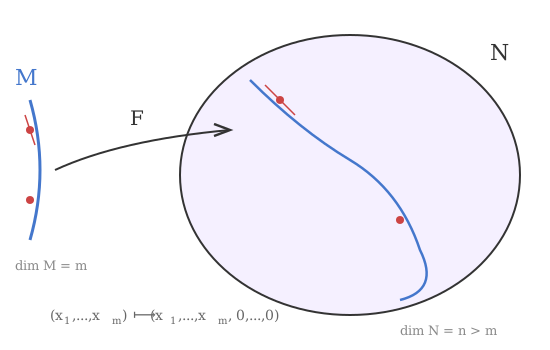
An immersion need not be injective as a map of sets — only the differential is required to be injective at every point. Immersions locally look like inclusions, as the following theorem makes precise.
Theorem 6.9 (Local Immersion Theorem / Canonical Form for Immersions). Let \( F \colon M^m \to N^n \) be a smooth immersion. For every \( p \in M \), there exist smooth charts \( (U, \varphi) \) centred at \( p \) and \( (V, \psi) \) centred at \( F(p) \) such that the coordinate representation of \( F \) is
\[
\hat{F}(x^1, \ldots, x^m) = (x^1, \ldots, x^m, 0, \ldots, 0).
\]
That is, in suitable coordinates, an immersion is just the inclusion \( \mathbb{R}^m \hookrightarrow \mathbb{R}^n \) as the first \( m \) coordinate axes.
Proof. By choosing coordinates appropriately, we may assume \( p = 0 \in \mathbb{R}^m \) and \( F(0) = 0 \in \mathbb{R}^n \), and that the first \( m \) rows of the Jacobian are linearly independent. Define \( \Psi \colon \mathbb{R}^m \times \mathbb{R}^{n-m} \to \mathbb{R}^n \) by
\[
\Psi(x^1, \ldots, x^m, x^{m+1}, \ldots, x^n) = \hat{F}(x^1, \ldots, x^m) + (0, \ldots, 0, x^{m+1}, \ldots, x^n).
\]
The Jacobian of \( \Psi \) at \( 0 \) is nonsingular, so \( \Psi \) is a local diffeomorphism by the inverse function theorem. Replacing the chart on \( N \) by the composition with \( \Psi^{-1} \) gives the desired canonical form. \( \square \)
Example 6.10. The figure-eight curve \( \gamma \colon (-\pi, \pi) \to \mathbb{R}^2 \) defined by \( \gamma(t) = (\sin 2t, \sin t) \) is an immersion (since \( \gamma'(t) \neq 0 \) for all \( t \)), but it is not injective as a map: the image crosses itself at the origin. Hence an immersion need not be an embedding.
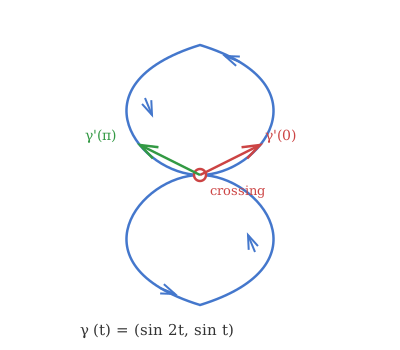
6.4 Smooth Embeddings
The notion of immersion is too weak for many purposes. For example, we want to define submanifolds as images of maps that are both immersions and well-behaved topologically. This leads to the notion of embedding.
Definition 6.11 (Smooth Embedding). A smooth map \( F \colon M \to N \) is a smooth embedding if it is an injective immersion that is also a homeomorphism onto its image \( F(M) \subseteq N \) (with the subspace topology inherited from \( N \)).
In other words, a smooth embedding is an immersion that is also a topological embedding. The condition of being a homeomorphism onto the image excludes self-intersections and also excludes curves that “accumulate on themselves” (such as an injective immersion of \( \mathbb{R} \) whose image is dense in the torus).
Example 6.13. The inclusion \( \iota \colon S^n \hookrightarrow \mathbb{R}^{n+1} \) is a smooth embedding. The sphere inherits its standard smooth structure from this embedding.
Example 6.14. Consider the map \( \gamma \colon \mathbb{R} \to \mathbb{T}^2 \) (where \( \mathbb{T}^2 = S^1 \times S^1 \) is the 2-torus) given by \( \gamma(t) = (e^{2\pi i t}, e^{2\pi i \alpha t}) \) for some irrational \( \alpha \). This is an injective immersion (since \( \gamma'(t) \neq 0 \) everywhere and injectivity follows from the irrationality of \( \alpha \)). However, the image is dense in \( \mathbb{T}^2 \), so \( \gamma \) is not a homeomorphism onto its image (its image in the subspace topology is not homeomorphic to \( \mathbb{R} \)). Thus \( \gamma \) is an injective immersion that is not an embedding.
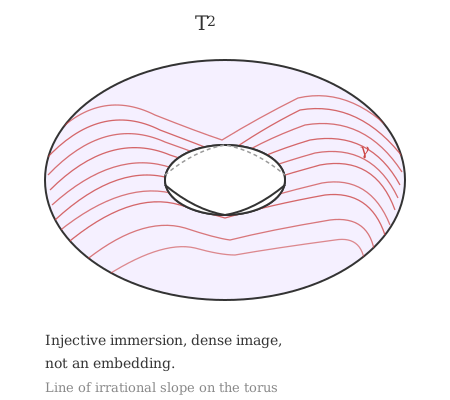
6.5 The Constant Rank Theorem
The local submersion and immersion theorems are special cases of a more general result.
Theorem 6.15 (Constant Rank Theorem). Let \( F \colon M^m \to N^n \) be a smooth map of constant rank \( r \) (i.e., \( \operatorname{rank}_p F = r \) for all \( p \in M \)). Then for each \( p \in M \), there exist smooth charts \( (U, \varphi) \) centred at \( p \) and \( (V, \psi) \) centred at \( F(p) \) in which \( F \) has the coordinate representation
\[
\hat{F}(x^1, \ldots, x^m) = (x^1, \ldots, x^r, 0, \ldots, 0).
\]
When \( r = n \), this reduces to the local submersion theorem; when \( r = m \), it reduces to the local immersion theorem. The constant rank theorem is a powerful tool, but its hypothesis — that the rank is constant on all of \( M \) — is quite restrictive. In practice, one often only needs the rank to be constant on a neighbourhood of a point, or one uses the following local version.
Corollary 6.16 (Local Constant Rank Theorem). If \( F \colon M \to N \) is a smooth map and \( \operatorname{rank}_p F = r \) at some point \( p \in M \), then there is a neighbourhood \( U \) of \( p \) on which \( F|_U \) has rank at least \( r \). If moreover \( \operatorname{rank}_q F = r \) for all \( q \) in some neighbourhood of \( p \), then the conclusion of the constant rank theorem holds at \( p \).
6.6 Level Sets and the Regular Level Set Theorem
One of the most important applications of the submersion theorem is to the study of level sets. Many naturally occurring manifolds — spheres, orthogonal groups, and more — arise as level sets of smooth maps.
Definition 6.17 (Regular Value, Critical Point). Let \( F \colon M \to N \) be a smooth map.
- A point \( p \in M \) is a regular point of \( F \) if \( F_{*,p} \) is surjective, and a critical point otherwise.
- A point \( c \in N \) is a regular value of \( F \) if every point in the preimage \( F^{-1}(c) \) is a regular point. (In particular, if \( F^{-1}(c) = \emptyset \), then \( c \) is a regular value vacuously.)
- A point \( c \in N \) is a critical value if it is not a regular value.
Theorem 6.18 (Regular Level Set Theorem / Preimage Theorem). Let \( F \colon M^m \to N^n \) be a smooth map, and let \( c \in N \) be a regular value of \( F \). Then the level set \( F^{-1}(c) \), if nonempty, is a properly embedded smooth submanifold of \( M \) of dimension \( m - n \).
Proof (sketch). Since \( c \) is a regular value, \( F_{*,p} \) is surjective at every \( p \in F^{-1}(c) \). Thus \( F \) is a submersion at every such \( p \). By the local submersion theorem, there are coordinates \( (x^1, \ldots, x^m) \) near \( p \) and \( (y^1, \ldots, y^n) \) near \( c \) in which \( F \) is the projection \( (x^1, \ldots, x^m) \mapsto (x^1, \ldots, x^n) \). The level set \( F^{-1}(c) \) in these coordinates is the set \( \{ x^1 = c^1, \ldots, x^n = c^n \} \), which is a coordinate slice of dimension \( m - n \). These coordinate slices provide charts making \( F^{-1}(c) \) into a smooth manifold. \( \square \)
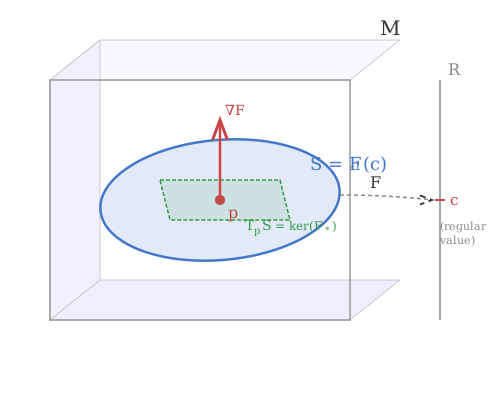
Moreover, the tangent space to the level set at any point \( p \in F^{-1}(c) \) is precisely the kernel of the differential:
Proposition 6.19. If \( c \) is a regular value of \( F \colon M \to N \) and \( S = F^{-1}(c) \), then for each \( p \in S \),
\[
T_p S = \ker F_{*,p} = \{ v \in T_pM : F_{*,p}(v) = 0 \}.
\]
This provides a practical way to compute tangent spaces to manifolds defined as level sets: one simply computes the kernel of the Jacobian.
Example 6.20 (\( S^n \) as a Regular Level Set). Define \( f \colon \mathbb{R}^{n+1} \to \mathbb{R} \) by \( f(x) = |x|^2 = (x^1)^2 + \cdots + (x^{n+1})^2 \). Then
\[
df_x = 2x^1 \, dx^1 + \cdots + 2x^{n+1} \, dx^{n+1} = 2x^i \, dx^i.
\]
At any point \( x \neq 0 \), the differential \( df_x \) is surjective (it is a nonzero linear map to \( \mathbb{R} \)), so every nonzero real number is a regular value. In particular, \( 1 \) is a regular value, and
\[
S^n = f^{-1}(1)
\]
is a smooth \( n \)-dimensional submanifold of \( \mathbb{R}^{n+1} \). The tangent space at \( p \in S^n \) is
\[
T_p S^n = \ker df_p = \{ v \in \mathbb{R}^{n+1} : \sum_{i=1}^{n+1} p^i v^i = 0 \} = p^\perp,
\]
the orthogonal complement of \( p \) in \( \mathbb{R}^{n+1} \).
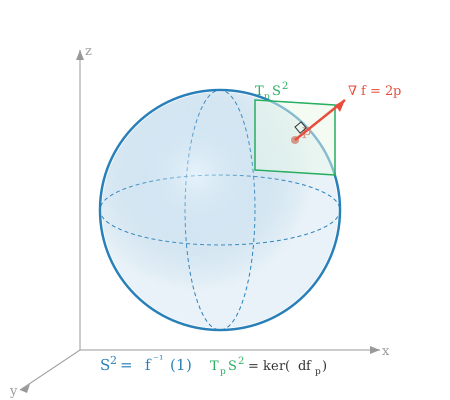
Example 6.21 (\( O(n) \) as a Regular Level Set). Define \( \Phi \colon M(n, \mathbb{R}) \to \operatorname{Sym}(n, \mathbb{R}) \) by \( \Phi(A) = A^T A \), where \( \operatorname{Sym}(n, \mathbb{R}) \) is the space of symmetric \( n \times n \) matrices (a vector space of dimension \( n(n+1)/2 \)). The orthogonal group is
\[
O(n) = \Phi^{-1}(I_n).
\]
One computes \( \Phi_{*,A}(B) = B^T A + A^T B \). When \( A \in O(n) \), this becomes \( \Phi_{*,A}(B) = B^T A + A^T B \). For any symmetric matrix \( S \), the matrix \( B = \frac{1}{2}AS \) satisfies \( \Phi_{*,A}(B) = S \), so \( \Phi_{*,A} \) is surjective. Hence \( I_n \) is a regular value, and \( O(n) \) is a smooth submanifold of \( M(n, \mathbb{R}) \cong \mathbb{R}^{n^2} \) of dimension
\[
\dim O(n) = n^2 - \frac{n(n+1)}{2} = \frac{n(n-1)}{2}.
\]
The tangent space at the identity is
\[
T_I O(n) = \ker \Phi_{*,I} = \{ B \in M(n, \mathbb{R}) : B^T + B = 0 \} = \mathfrak{o}(n),
\]
the space of skew-symmetric matrices.
Example 6.22 (\( SL(n, \mathbb{R}) \) as a Regular Level Set). The special linear group \( SL(n, \mathbb{R}) = \det^{-1}(1) \) is a regular level set of the determinant map \( \det \colon GL(n, \mathbb{R}) \to \mathbb{R} \setminus \{0\} \), which is a submersion (Example 6.7). Hence \( SL(n, \mathbb{R}) \) is a smooth submanifold of \( GL(n, \mathbb{R}) \) of dimension \( n^2 - 1 \), with tangent space at the identity equal to the space of traceless matrices.
The regular level set theorem, combined with Sard’s theorem (which states that the set of critical values has measure zero), tells us that “most” level sets of a smooth map are smooth submanifolds.
Chapter 7: Submanifolds
7.1 Embedded Submanifolds
The notion of submanifold gives a rigorous framework for studying lower-dimensional smooth objects sitting inside ambient manifolds. There are two important flavours of submanifold — embedded and immersed — reflecting the distinction between embeddings and immersions from the previous chapter. Embedded submanifolds are the more well-behaved class and suffice for most applications.
Definition 7.1 (Embedded Submanifold). Let \( M \) be a smooth manifold of dimension \( n \). A subset \( S \subseteq M \) is an embedded submanifold (or regular submanifold) of dimension \( k \) if for every point \( p \in S \), there exists a smooth chart \( (U, \varphi) \) for \( M \) centred at \( p \) such that
\[
\varphi(U \cap S) = \{ (x^1, \ldots, x^n) \in \varphi(U) : x^{k+1} = \cdots = x^n = 0 \}.
\]
Such a chart is called a slice chart (or adapted chart, or submanifold chart) for \( S \) in \( M \), and the set \( U \cap S \) is called a slice of \( U \). The number \( n - k \) is the codimension of \( S \) in \( M \).
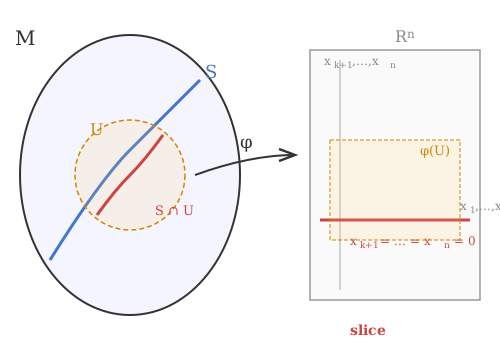
The idea behind the slice chart condition is simple: near any point of \( S \), we can find coordinates for \( M \) in which \( S \) is “flat” — it is carved out by setting the last \( n - k \) coordinates to zero. This is the strongest and most natural notion of submanifold.
Proposition 7.2. Every embedded submanifold \( S \subseteq M \) of dimension \( k \) is itself a smooth \( k \)-manifold in a natural way: the smooth structure on \( S \) is given by the atlas of slice charts \( \{ (U \cap S, \varphi|_{U \cap S}) \} \), where each chart maps into \( \mathbb{R}^k \) by projection onto the first \( k \) coordinates. Moreover, with this smooth structure, the inclusion map \( \iota \colon S \hookrightarrow M \) is a smooth embedding.
The topology on an embedded submanifold \( S \) is the subspace topology inherited from \( M \). This is an important point: an embedded submanifold is required to have the subspace topology, not some other topology that might make the inclusion continuous.
Proposition 7.3. Let \( S \subseteq M \) be an embedded submanifold. Then \( S \) is a closed subset of \( M \) if and only if the inclusion \( \iota \colon S \hookrightarrow M \) is a proper map.
Example 7.4. An open subset \( U \subseteq M \) is an embedded submanifold of dimension \( n = \dim M \) (a codimension-0 submanifold). The slice charts are simply the charts of \( M \) whose domains are contained in \( U \).
Example 7.5. By the regular level set theorem (Theorem 6.18), if \( F \colon M \to N \) is a smooth map and \( c \in N \) is a regular value, then \( F^{-1}(c) \) is an embedded submanifold. The sphere \( S^n \subset \mathbb{R}^{n+1} \) and the orthogonal group \( O(n) \subset M(n, \mathbb{R}) \) are examples obtained this way.
7.2 Slice Charts and Local Structure
The slice chart condition can be reformulated in several equivalent ways, each useful in different contexts.
Theorem 7.6 (Local Slice Criterion). Let \( S \subseteq M^n \) be a subset. The following are equivalent:
- \( S \) is a \( k \)-dimensional embedded submanifold of \( M \).
- For every \( p \in S \), there is a neighbourhood \( U \) of \( p \) in \( M \) and a smooth submersion \( \Phi \colon U \to \mathbb{R}^{n-k} \) such that \( U \cap S = \Phi^{-1}(0) \).
- For every \( p \in S \), there is a neighbourhood \( U \) of \( p \) in \( M \) and smooth functions \( \Phi^1, \ldots, \Phi^{n-k} \colon U \to \mathbb{R} \) such that \( U \cap S = \{ q \in U : \Phi^1(q) = \cdots = \Phi^{n-k}(q) = 0 \} \) and \( d\Phi^1|_p, \ldots, d\Phi^{n-k}|_p \) are linearly independent in \( T_p^*M \).
Condition (3) gives a very practical way to verify that a subset is an embedded submanifold: one exhibits defining functions whose differentials are independent. This is exactly the setup of the implicit function theorem.
7.3 Immersed Submanifolds
There is a more general notion of submanifold that arises from immersions rather than embeddings.
Definition 7.7 (Immersed Submanifold). An immersed submanifold of \( M \) is a subset \( S \subseteq M \) together with a topology on \( S \) (possibly different from the subspace topology) and a smooth structure making \( S \) into a smooth manifold, such that the inclusion \( \iota \colon S \hookrightarrow M \) is a smooth immersion.
Every embedded submanifold is an immersed submanifold (with the subspace topology), but the converse is false. The distinction is subtle but important: an immersed submanifold may have a topology that is finer than the subspace topology.
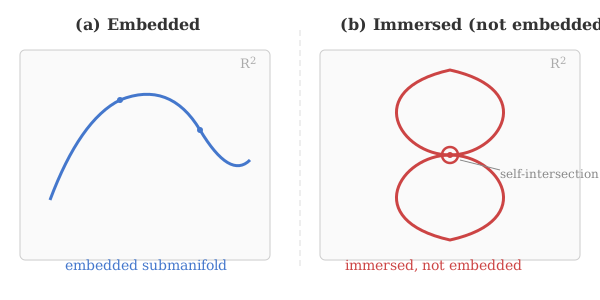
Example 7.8. The figure-eight curve in \( \mathbb{R}^2 \) (the image of the immersion from Example 6.10) is an immersed submanifold that is not an embedded submanifold: near the crossing point, no single chart for \( \mathbb{R}^2 \) can present the figure-eight as a flat slice.
Example 7.9. The dense curve on the torus from Example 6.14 is an immersed submanifold (diffeomorphic to \( \mathbb{R} \)), but it is not an embedded submanifold because its image is dense in \( \mathbb{T}^2 \), so it does not have the subspace topology.
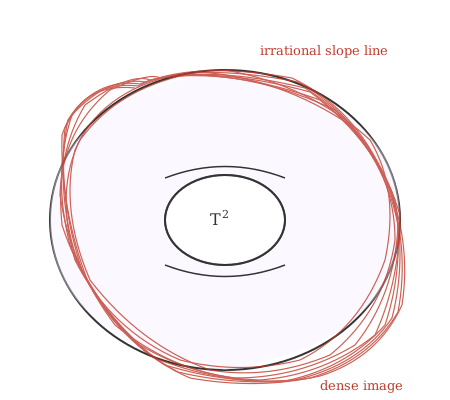
Despite these pathologies, immersed submanifolds arise naturally in several important contexts, particularly in the theory of Lie groups.
7.4 Tangent Space to a Submanifold
If \( S \subseteq M \) is an embedded (or immersed) submanifold and \( \iota \colon S \hookrightarrow M \) is the inclusion, then the differential \( \iota_{*,p} \colon T_pS \to T_pM \) is injective (since \( \iota \) is an immersion). We routinely identify \( T_pS \) with its image \( \iota_{*,p}(T_pS) \subseteq T_pM \), treating \( T_pS \) as a linear subspace of \( T_pM \).
Proposition 7.10. Let \( S \subseteq M \) be an embedded submanifold, and let \( (U, \varphi) \) be a slice chart for \( S \) centred at \( p \in S \), with coordinates \( (x^1, \ldots, x^n) \). Under the identification \( T_pS \subseteq T_pM \),
\[
T_pS = \operatorname{span}\left\{ \frac{\partial}{\partial x^1}\bigg|_p, \ldots, \frac{\partial}{\partial x^k}\bigg|_p \right\},
\]
where \( k = \dim S \). That is, \( T_pS \) is the subspace of \( T_pM \) spanned by the coordinate directions tangent to the slice.
When \( S = F^{-1}(c) \) is a regular level set, we have already seen (Proposition 6.19) that \( T_pS = \ker F_{*,p} \). These two descriptions are consistent: in a slice chart adapted to the level set, the tangent directions to \( S \) are precisely those annihilated by the differential of \( F \).
7.5 Restricting Maps to Submanifolds
A key practical question is: if \( F \colon M \to N \) is a smooth map and \( S \subseteq M \), \( T \subseteq N \) are submanifolds with \( F(S) \subseteq T \), is the restricted map \( F|_S \colon S \to T \) smooth?
Proposition 7.11. Let \( F \colon M \to N \) be a smooth map, and let \( S \subseteq M \) be an embedded or immersed submanifold with inclusion \( \iota_S \colon S \hookrightarrow M \). Then the restricted map \( F \circ \iota_S \colon S \to N \) is smooth.
This is immediate since the composition of smooth maps is smooth. The more subtle question is about restricting the codomain:
Theorem 7.12. Let \( F \colon M \to N \) be a smooth map, and let \( S \subseteq N \) be an embedded submanifold. If \( F(M) \subseteq S \), then \( F \colon M \to S \) is smooth (where \( S \) has its submanifold smooth structure).
Proof. Let \( p \in M \), and let \( (V, \psi) \) be a slice chart for \( S \) in \( N \) around \( F(p) \), with \( \psi = (y^1, \ldots, y^n) \) and \( S \cap V = \{ y^{k+1} = \cdots = y^n = 0 \} \). Since \( F(M) \subseteq S \), the last \( n - k \) components of \( \psi \circ F \) vanish identically, and the first \( k \) components give the coordinate representation of \( F \colon M \to S \). Since each component is smooth (being a component of the smooth map \( \psi \circ F \)), the map \( F \colon M \to S \) is smooth. \( \square \)
7.6 Lie Subgroups
The theory of submanifolds is particularly important in the context of Lie groups, where it provides a clean framework for studying subgroups.
Definition 7.14 (Lie Subgroup). A Lie subgroup of a Lie group \( G \) is a subgroup \( H \subseteq G \) that is also an immersed submanifold of \( G \), such that the group operations (multiplication and inversion) are smooth with respect to the smooth structure on \( H \).
If \( H \) is an embedded submanifold, it is called a closed Lie subgroup or regular Lie subgroup.
Theorem 7.15 (Closed Subgroup Theorem / Cartan's Theorem). Every closed subgroup of a Lie group is an embedded Lie subgroup. In particular, it is automatically a smooth submanifold, and the group operations are automatically smooth.
This theorem is remarkable because it requires no smoothness hypothesis: one starts with a purely algebraic and topological condition (closed subgroup) and obtains a smooth structure for free. We used this implicitly in Examples 6.21 and 6.22: both \( O(n) \) and \( SL(n, \mathbb{R}) \) are closed subgroups of \( GL(n, \mathbb{R}) \), so Cartan’s theorem guarantees they are Lie subgroups. (We verified this independently using the regular level set theorem.)
Example 7.16. The special orthogonal group \( SO(n) = O(n) \cap SL(n, \mathbb{R}) \) is a closed subgroup of \( GL(n, \mathbb{R}) \), hence a Lie subgroup. It is the connected component of the identity in \( O(n) \), and has dimension \( n(n-1)/2 \).
Example 7.17. The unitary group \( U(n) = \{ A \in GL(n, \mathbb{C}) : A^*A = I \} \) is a closed subgroup of \( GL(n, \mathbb{C}) \), hence a compact Lie group of real dimension \( n^2 \). Similarly, \( SU(n) = U(n) \cap SL(n, \mathbb{C}) \) has real dimension \( n^2 - 1 \).
Example 7.18. The irrational-slope line on the torus \( \mathbb{T}^2 \) from Example 6.14 is an immersed Lie subgroup (isomorphic to \( (\mathbb{R}, +) \)) that is dense, hence not closed and not an embedded submanifold. This shows that the hypothesis of closedness in Cartan's theorem is necessary.
Chapter 8: Tensors and Riemannian Metrics
8.1 Multilinear Algebra: Tensor Products
We now develop the algebraic machinery of tensors, which provides the natural framework for defining Riemannian metrics and many other geometric structures on manifolds. A tensor is, at its core, a multilinear map. The passage from linear algebra (vectors and covectors) to multilinear algebra (tensors) vastly expands the kinds of geometric objects we can work with.
Let \( V \) be a finite-dimensional real vector space with dual space \( V^* \).
Definition 8.1 (Tensor Product of Vector Spaces). If \( V_1, \ldots, V_r \) are finite-dimensional real vector spaces, their tensor product \( V_1 \otimes \cdots \otimes V_r \) is the vector space characterised (up to canonical isomorphism) by the universal property: there is a multilinear map
\[
\iota \colon V_1 \times \cdots \times V_r \to V_1 \otimes \cdots \otimes V_r
\]
such that for every multilinear map \( \alpha \colon V_1 \times \cdots \times V_r \to W \) into any vector space \( W \), there is a unique linear map \( \tilde{\alpha} \colon V_1 \otimes \cdots \otimes V_r \to W \) with \( \alpha = \tilde{\alpha} \circ \iota \).
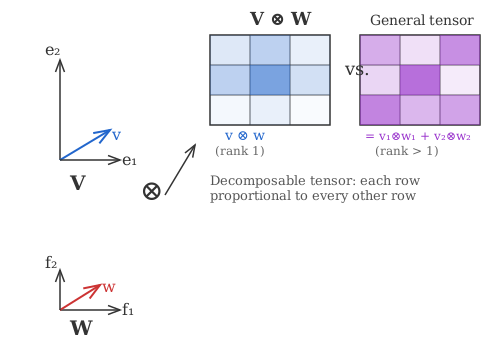
The image \( \iota(v_1, \ldots, v_r) \) is denoted \( v_1 \otimes \cdots \otimes v_r \) and is called a decomposable (or simple) tensor. Not every element of the tensor product is decomposable; a general element is a sum of decomposable tensors.
If \( (e_1, \ldots, e_n) \) is a basis for \( V \) and \( (f_1, \ldots, f_m) \) is a basis for \( W \), then \( \{ e_i \otimes f_j : 1 \le i \le n, \, 1 \le j \le m \} \) is a basis for \( V \otimes W \), so \( \dim(V \otimes W) = nm \). More generally, \( \dim(V_1 \otimes \cdots \otimes V_r) = \prod_i \dim V_i \).
8.2 Tensors on a Vector Space
In the context of tangent spaces, we form tensor products of copies of \( V = T_pM \) and its dual \( V^* = T_p^*M \).
Definition 8.2 (Mixed Tensors). A tensor of type \( (k, \ell) \) (or a \( (k, \ell) \)-tensor) on a vector space \( V \) is an element of
\[
T^{(k,\ell)}(V) = \underbrace{V^* \otimes \cdots \otimes V^*}_{k} \otimes \underbrace{V \otimes \cdots \otimes V}_{\ell}.
\]
Equivalently, a \( (k, \ell) \)-tensor is a multilinear map
\[
\sigma \colon \underbrace{V \times \cdots \times V}_{k} \times \underbrace{V^* \times \cdots \times V^*}_{\ell} \to \mathbb{R}.
\]
The number \( k \) is the covariant order (number of "covector slots") and \( \ell \) is the contravariant order (number of "vector slots"). The sum \( k + \ell \) is the total order of the tensor.
The space \( T^{(k,\ell)}(V) \) has dimension \( n^{k+\ell} \) where \( n = \dim V \). Given a basis \( (e_1, \ldots, e_n) \) for \( V \) with dual basis \( (\varepsilon^1, \ldots, \varepsilon^n) \) for \( V^* \), a general \( (k, \ell) \)-tensor can be written as
\[
\sigma = \sigma^{j_1 \cdots j_\ell}_{i_1 \cdots i_k} \, \varepsilon^{i_1} \otimes \cdots \otimes \varepsilon^{i_k} \otimes e_{j_1} \otimes \cdots \otimes e_{j_\ell},
\]
where the components are given by
\[
\sigma^{j_1 \cdots j_\ell}_{i_1 \cdots i_k} = \sigma(e_{i_1}, \ldots, e_{i_k}, \varepsilon^{j_1}, \ldots, \varepsilon^{j_\ell}).
\]
The Einstein summation convention (sum over repeated upper-lower index pairs) makes these expressions manageable. Upper indices correspond to contravariant (vector) slots, and lower indices correspond to covariant (covector) slots.
8.3 Tensor Bundles and Tensor Fields
We now globalise the construction by assembling tensors over all points of a manifold into a bundle.
Definition 8.4 (Tensor Bundle). Let \( M \) be a smooth \( n \)-manifold. The tensor bundle of type \( (k, \ell) \) is
\[
T^{(k,\ell)}M = \bigsqcup_{p \in M} T^{(k,\ell)}(T_pM) = \bigsqcup_{p \in M} \big( (T_p^*M)^{\otimes k} \otimes (T_pM)^{\otimes \ell} \big).
\]
It is a smooth vector bundle over \( M \) of rank \( n^{k+\ell} \), so \( T^{(k,\ell)}M \) is a smooth manifold of dimension \( n + n^{k+\ell} \).
Definition 8.5 (Tensor Field). A tensor field of type \( (k, \ell) \) on \( M \) is a smooth section of the tensor bundle \( T^{(k,\ell)}M \). The space of all smooth \( (k, \ell) \)-tensor fields on \( M \) is denoted
\[
\Gamma(T^{(k,\ell)}M) = \mathcal{T}^{k}_{\ell}(M).
\]
In local coordinates \( (x^1, \ldots, x^n) \) on an open set \( U \subseteq M \), a \( (k, \ell) \)-tensor field \( \sigma \) can be written as
\[
\sigma = \sigma^{j_1 \cdots j_\ell}_{i_1 \cdots i_k} \, dx^{i_1} \otimes \cdots \otimes dx^{i_k} \otimes \frac{\partial}{\partial x^{j_1}} \otimes \cdots \otimes \frac{\partial}{\partial x^{j_\ell}},
\]
where the component functions \( \sigma^{j_1 \cdots j_\ell}_{i_1 \cdots i_k} \colon U \to \mathbb{R} \) are smooth. The tensor product of two tensor fields is defined pointwise:
\[
(\sigma \otimes \tau)_p = \sigma_p \otimes \tau_p.
\]
This makes the collection of all tensor fields into a graded algebra over \( C^\infty(M) \).
Example 8.6. Some important special cases:
- \( \mathcal{T}^0_0(M) = C^\infty(M) \): smooth functions.
- \( \mathcal{T}^1_0(M) = \Omega^1(M) \): covector fields (1-forms).
- \( \mathcal{T}^0_1(M) = \mathfrak{X}(M) \): vector fields.
- \( \mathcal{T}^2_0(M) \): covariant 2-tensor fields (bilinear forms on vector fields). Riemannian metrics and Ricci curvature tensors live here.
- \( \mathcal{T}^1_1(M) \): mixed \( (1,1) \)-tensor fields, corresponding to smooth endomorphism fields \( \operatorname{End}(TM) \). Complex structures and almost complex structures are examples.
8.4 Symmetry and Alternation
Many of the most important tensors in geometry possess symmetry properties.
Definition 8.7 (Symmetric and Alternating Tensors). A covariant \( k \)-tensor \( \sigma \in T^{(k,0)}(V) \) is:
- symmetric if \( \sigma(v_1, \ldots, v_k) \) is unchanged under any permutation of its arguments;
- alternating (or skew-symmetric, or antisymmetric) if \( \sigma(v_1, \ldots, v_k) \) changes sign under any transposition of two arguments.
The space of symmetric covariant \( k \)-tensors is denoted \( \Sigma^k(V^*) \), and the space of alternating covariant \( k \)-tensors is denoted \( \Lambda^k(V^*) \).
There are natural projection operators:
Definition 8.8 (Symmetrisation and Alternation). For \( \sigma \in T^{(k,0)}(V) \), define:
- The symmetrisation: \( (\operatorname{Sym} \sigma)(v_1, \ldots, v_k) = \frac{1}{k!} \sum_{\pi \in S_k} \sigma(v_{\pi(1)}, \ldots, v_{\pi(k)}) \).
- The alternation: \( (\operatorname{Alt} \sigma)(v_1, \ldots, v_k) = \frac{1}{k!} \sum_{\pi \in S_k} (\operatorname{sgn} \pi) \, \sigma(v_{\pi(1)}, \ldots, v_{\pi(k)}) \).
These are projections: \( \operatorname{Sym}^2 = \operatorname{Sym} \) and \( \operatorname{Alt}^2 = \operatorname{Alt} \).
The alternating tensors \( \Lambda^k(V^*) \) are the building blocks of differential forms (the subject of a later chapter). For now, the symmetric tensors \( \Sigma^k(V^*) \) are more immediately relevant, as Riemannian metrics are symmetric \( (2,0) \)-tensor fields.
For a 2-tensor \( \sigma \in T^{(2,0)}(V) \), symmetry means \( \sigma(v, w) = \sigma(w, v) \) for all \( v, w \), and skew-symmetry means \( \sigma(v, w) = -\sigma(w, v) \). Every 2-tensor decomposes uniquely as a sum of a symmetric part and a skew-symmetric part:
\[
\sigma = \operatorname{Sym}(\sigma) + \operatorname{Alt}(\sigma), \qquad \text{where} \quad \operatorname{Sym}(\sigma)(v,w) = \tfrac{1}{2}(\sigma(v,w) + \sigma(w,v))
\]
and \( \operatorname{Alt}(\sigma)(v,w) = \tfrac{1}{2}(\sigma(v,w) - \sigma(w,v)) \).
8.5 Riemannian Metrics
We now arrive at one of the most important structures in differential geometry: the Riemannian metric. It is the structure that allows us to measure lengths, angles, areas, and volumes on a smooth manifold — concepts that the smooth structure alone does not provide.
Definition 8.9 (Riemannian Metric). A
Riemannian metric \( g \) on a smooth manifold \( M \) is a smooth symmetric covariant 2-tensor field that is
positive definite at each point. That is, \( g \in \mathcal{T}^2_0(M) \) such that:
- Symmetry: \( g_p(v, w) = g_p(w, v) \) for all \( p \in M \) and \( v, w \in T_pM \).
- Positive definiteness: \( g_p(v, v) > 0 \) for all \( p \in M \) and \( 0 \neq v \in T_pM \).
- Smoothness: for any smooth vector fields \( X, Y \in \mathfrak{X}(M) \), the function \( g(X, Y) \colon M \to \mathbb{R} \) is smooth.
A smooth manifold equipped with a Riemannian metric is called a
Riemannian manifold and is denoted \( (M, g) \).
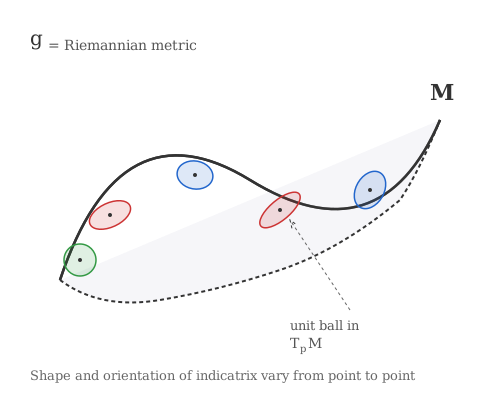
In other words, a Riemannian metric is a smoothly varying choice of inner product on each tangent space. At each point \( p \), the metric \( g_p \colon T_pM \times T_pM \to \mathbb{R} \) is an inner product, and this inner product varies smoothly from point to point.
In local coordinates \( (x^1, \ldots, x^n) \), the metric is expressed as
\[
g = g_{ij} \, dx^i \otimes dx^j,
\]
where the component functions are
\[
g_{ij} = g\!\left( \frac{\partial}{\partial x^i}, \frac{\partial}{\partial x^j} \right).
\]
The matrix \( (g_{ij}(p)) \) is a symmetric positive definite \( n \times n \) matrix at each point \( p \). The symmetry of \( g \) means \( g_{ij} = g_{ji} \), and the positive definiteness means the matrix \( (g_{ij}) \) has all positive eigenvalues.
8.6 Examples of Riemannian Metrics
Example 8.11 (Euclidean Metric). The standard inner product on \( \mathbb{R}^n \) defines a Riemannian metric
\[
\bar{g} = \delta_{ij} \, dx^i \otimes dx^j = (dx^1)^2 + \cdots + (dx^n)^2,
\]
where \( \delta_{ij} \) is the Kronecker delta. This is the Euclidean metric (or flat metric). In matrix form, \( (g_{ij}) = I_n \). The Euclidean metric is "flat" in the sense that its Riemann curvature tensor vanishes identically.
Example 8.12 (Round Metric on \( S^n \)). The round metric on the unit sphere \( S^n \subset \mathbb{R}^{n+1} \) is the metric induced by the Euclidean metric on \( \mathbb{R}^{n+1} \). If \( \iota \colon S^n \hookrightarrow \mathbb{R}^{n+1} \) is the inclusion, then
\[
g_{S^n} = \iota^* \bar{g}.
\]
In spherical coordinates \( (\theta^1, \ldots, \theta^n) \) on \( S^n \), the round metric for \( S^2 \) takes the familiar form
\[
g_{S^2} = d\theta^2 + \sin^2\theta \, d\phi^2.
\]
The round metric has constant sectional curvature \( +1 \).
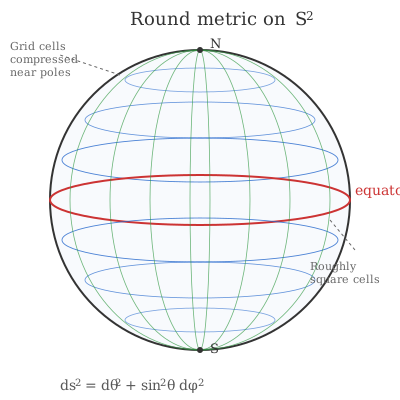
Example 8.13 (Hyperbolic Metric). On the upper half-space \( \mathbb{H}^n = \{ (x^1, \ldots, x^n) \in \mathbb{R}^n : x^n > 0 \} \), the hyperbolic metric is
\[
g = \frac{(dx^1)^2 + \cdots + (dx^n)^2}{(x^n)^2}.
\]
In matrix form, \( g_{ij} = \frac{\delta_{ij}}{(x^n)^2} \). This metric has constant sectional curvature \( -1 \) and is a model for hyperbolic geometry.
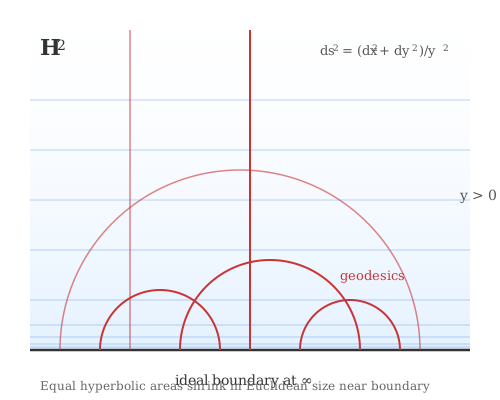
Example 8.14 (Pullback Metrics). More generally, if \( F \colon M \to (N, h) \) is a smooth immersion and \( (N, h) \) is a Riemannian manifold, then the pullback metric \( g = F^*h \) defined by
\[
g_p(v, w) = h_{F(p)}(F_{*,p}v, F_{*,p}w)
\]
is a Riemannian metric on \( M \). (Positive definiteness uses the injectivity of \( F_{*,p} \).) This is how the round metric on \( S^n \) is defined, and more generally how any submanifold of a Riemannian manifold inherits a Riemannian metric.
Example 8.15 (Product Metrics). If \( (M_1, g_1) \) and \( (M_2, g_2) \) are Riemannian manifolds, the product metric on \( M_1 \times M_2 \) is defined by
\[
g = \pi_1^* g_1 + \pi_2^* g_2,
\]
where \( \pi_i \colon M_1 \times M_2 \to M_i \) are the projections. In terms of the natural splitting \( T_{(p,q)}(M_1 \times M_2) \cong T_pM_1 \oplus T_qM_2 \), vectors from different factors are orthogonal. The flat torus \( \mathbb{T}^n = \mathbb{R}^n / \mathbb{Z}^n \) with its standard flat metric is a product of circles with the standard metric.
8.7 Existence of Riemannian Metrics
One might worry that Riemannian metrics are difficult to construct. The following theorem, which relies on partitions of unity, shows that every smooth manifold admits at least one Riemannian metric.
Theorem 8.16 (Existence of Riemannian Metrics). Every smooth manifold admits a Riemannian metric.
Proof. Let \( \{(U_\alpha, \varphi_\alpha)\}_{\alpha \in A} \) be a smooth atlas for \( M \), and let \( \{\rho_\alpha\}_{\alpha \in A} \) be a smooth partition of unity subordinate to the open cover \( \{U_\alpha\} \). On each chart domain \( U_\alpha \), define the local Riemannian metric
\[
g_\alpha = \delta_{ij} \, d(x_\alpha^i) \otimes d(x_\alpha^j),
\]
which is just the pullback of the Euclidean metric by the coordinate map \( \varphi_\alpha \). Now define
\[
g = \sum_{\alpha \in A} \rho_\alpha \, g_\alpha.
\]
This is a well-defined smooth symmetric covariant 2-tensor field on \( M \) (the sum is locally finite). It remains to check positive definiteness. For any \( p \in M \) and \( 0 \neq v \in T_pM \),
\[
g_p(v, v) = \sum_{\alpha} \rho_\alpha(p) \, (g_\alpha)_p(v, v).
\]
Each term is nonneg (since \( \rho_\alpha \ge 0 \) and each \( g_\alpha \) is positive definite), and at least one term is strictly positive (since \( \sum \rho_\alpha = 1 \) and \( (g_\alpha)_p(v,v) > 0 \) whenever \( p \in U_\alpha \) and \( v \neq 0 \)). Thus \( g_p(v,v) > 0 \). \( \square \)
8.8 The Musical Isomorphisms
A Riemannian metric establishes a canonical isomorphism between the tangent and cotangent spaces at each point, resolving the non-canonical nature of the identification between a vector space and its dual. These isomorphisms are called the musical isomorphisms because of the notational conventions used in index notation.
Definition 8.18 (Flat and Sharp). Let \( (M, g) \) be a Riemannian manifold. The flat map (or index-lowering map) is the bundle map
\[
\flat \colon TM \to T^*M
\]
defined at each point \( p \) by
\[
v^\flat(w) = g_p(v, w) \qquad \text{for all } v, w \in T_pM.
\]
The sharp map (or index-raising map) is the inverse
\[
\sharp \colon T^*M \to TM, \qquad \sharp = \flat^{-1}.
\]
That is, \( \omega^\sharp \) is the unique vector satisfying \( g(\omega^\sharp, w) = \omega(w) \) for all \( w \in T_pM \).
The flat map \( \flat \) is well-defined and invertible because \( g_p \) is a nondegenerate bilinear form (being positive definite). The name “flat” comes from the fact that in musical notation, the flat symbol \( \flat \) lowers the pitch — and here it “lowers an index” from upper (vector) to lower (covector) position. Similarly, the sharp \( \sharp \) “raises an index.”
In local coordinates, if \( v = v^i \frac{\partial}{\partial x^i} \), then
\[
v^\flat = g_{ij} v^i \, dx^j.
\]
That is, the components of \( v^\flat \) are \( (v^\flat)_j = g_{ij} v^i \): the metric “lowers the index.” Conversely, if \( \omega = \omega_j \, dx^j \), then
\[
\omega^\sharp = g^{ij} \omega_j \, \frac{\partial}{\partial x^i},
\]
where \( (g^{ij}) \) is the inverse matrix of \( (g_{ij}) \), i.e., \( g^{ik}g_{kj} = \delta^i_j \). The components of \( \omega^\sharp \) are \( (\omega^\sharp)^i = g^{ij}\omega_j \): the inverse metric “raises the index.”
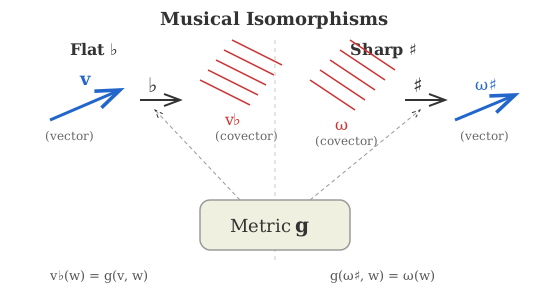
The musical isomorphisms extend to tensor fields by acting on individual indices, and they allow us to freely move indices up and down. This is a powerful computational tool in Riemannian geometry.
Proposition 8.19. The musical isomorphisms \( \flat \colon \mathfrak{X}(M) \to \Omega^1(M) \) and \( \sharp \colon \Omega^1(M) \to \mathfrak{X}(M) \) are \( C^\infty(M) \)-module isomorphisms.
8.9 The Gradient
The musical isomorphisms give us the correct definition of the gradient vector field on a Riemannian manifold.
Definition 8.20 (Gradient). Let \( (M, g) \) be a Riemannian manifold and \( f \in C^\infty(M) \). The gradient of \( f \) is the vector field
\[
\operatorname{grad} f = (df)^\sharp.
\]
Equivalently, \( \operatorname{grad} f \) is the unique smooth vector field satisfying
\[
g(\operatorname{grad} f, X) = df(X) = Xf \qquad \text{for all } X \in \mathfrak{X}(M).
\]
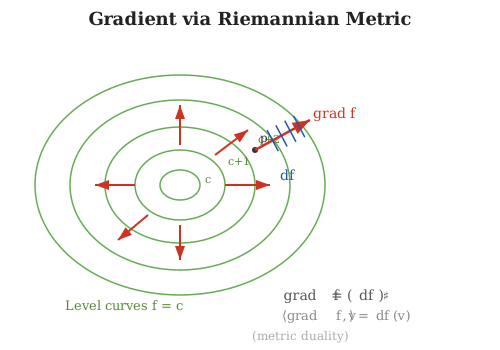
This definition makes it clear that the gradient depends on the choice of Riemannian metric, unlike the differential \( df \), which is purely a smooth-manifold concept. In Euclidean space \( (\mathbb{R}^n, \bar{g}) \), the gradient reduces to the classical gradient:
\[
\operatorname{grad} f = \frac{\partial f}{\partial x^i} \frac{\partial}{\partial x^i} = \nabla f,
\]
because \( g^{ij} = \delta^{ij} \). On a general Riemannian manifold, however, the components of the gradient involve the inverse metric:
\[
(\operatorname{grad} f)^i = g^{ij} \frac{\partial f}{\partial x^j}.
\]
Example 8.21. On \( S^2 \) with the round metric \( g = d\theta^2 + \sin^2\theta \, d\phi^2 \), the inverse metric matrix is
\[
(g^{ij}) = \begin{pmatrix} 1 & 0 \\ 0 & \csc^2\theta \end{pmatrix}.
\]
For the height function \( h = \cos\theta \), we have \( dh = -\sin\theta \, d\theta \), so
\[
\operatorname{grad} h = g^{11}(-\sin\theta) \frac{\partial}{\partial \theta} + g^{22}(0) \frac{\partial}{\partial \phi} = -\sin\theta \frac{\partial}{\partial \theta}.
\]
The gradient points "downhill" along lines of longitude, as expected.
Proposition 8.22 (Properties of the Gradient). Let \( (M, g) \) be a Riemannian manifold. Then:
- \( \operatorname{grad}(f + h) = \operatorname{grad} f + \operatorname{grad} h \).
- \( \operatorname{grad}(fh) = f \operatorname{grad} h + h \operatorname{grad} f \) (product rule).
- \( \operatorname{grad} f = 0 \) if and only if \( f \) is locally constant.
- At a point \( p \) where \( df_p \neq 0 \), the gradient \( \operatorname{grad} f|_p \) points in the direction of steepest ascent of \( f \), and \( |\operatorname{grad} f|_p| = \|df_p\|_{g^{-1}} \).
The Riemannian metric \( g \) on \( TM \) induces a corresponding inner product on \( T^*M \) (and more generally on all tensor bundles) via the musical isomorphisms.
Definition 8.23 (Induced Inner Product on Covectors). Let \( (M, g) \) be a Riemannian manifold. The induced inner product on covectors is the symmetric \( (0,2) \)-tensor field \( g^{-1} \) on \( T^*M \) defined by
\[
g^{-1}(\omega, \eta) = g(\omega^\sharp, \eta^\sharp)
\]
for all \( \omega, \eta \in T_p^*M \). In local coordinates,
\[
g^{-1}(\omega, \eta) = g^{ij} \omega_i \eta_j.
\]
This gives a pointwise inner product on \( T_p^*M \) that is positive definite (since \( g \) is). The norm of a covector is \( |\omega|_{g^{-1}} = \sqrt{g^{ij}\omega_i\omega_j} \). In particular,
\[
|\operatorname{grad} f|^2 = g(\operatorname{grad} f, \operatorname{grad} f) = g^{-1}(df, df) = g^{ij} \frac{\partial f}{\partial x^i} \frac{\partial f}{\partial x^j}.
\]
More generally, the metric induces inner products on all tensor bundles \( T^{(k,\ell)}M \) by contracting indices with \( g_{ij} \) and \( g^{ij} \). For example, on \( (2,0) \)-tensors:
\[
\langle \sigma, \tau \rangle = g^{i_1 j_1} g^{i_2 j_2} \sigma_{i_1 i_2} \tau_{j_1 j_2}.
\]
These inner products are essential for the \( L^2 \) theory of differential forms (Hodge theory), which we will encounter in later chapters.
8.11 Lengths of Curves and the Riemannian Distance
A Riemannian metric allows us to measure the lengths of tangent vectors, and thereby the lengths of curves.
Definition 8.24 (Length of a Curve). Let \( (M, g) \) be a Riemannian manifold and \( \gamma \colon [a, b] \to M \) a smooth (or piecewise smooth) curve. The length of \( \gamma \) is
\[
L(\gamma) = \int_a^b |\gamma'(t)|_g \, dt = \int_a^b \sqrt{g_{\gamma(t)}(\gamma'(t), \gamma'(t))} \, dt.
\]
In local coordinates, if \( \gamma(t) = (x^1(t), \ldots, x^n(t)) \), then
\[
L(\gamma) = \int_a^b \sqrt{g_{ij}(\gamma(t)) \frac{dx^i}{dt} \frac{dx^j}{dt}} \, dt.
\]
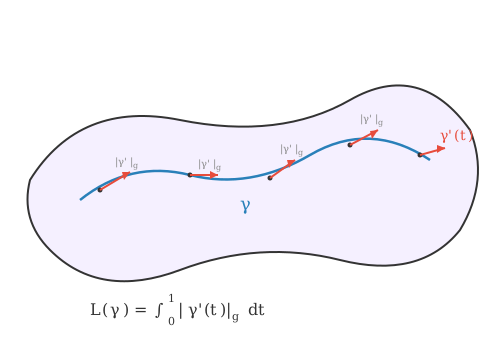
The length is independent of the parametrisation of the curve (as one can verify by the change-of-variables formula), which is geometrically natural.
Definition 8.25 (Riemannian Distance). On a connected Riemannian manifold \( (M, g) \), the Riemannian distance between two points \( p, q \in M \) is
\[
d_g(p, q) = \inf \{ L(\gamma) : \gamma \text{ is a piecewise smooth curve from } p \text{ to } q \}.
\]
Theorem 8.26. The Riemannian distance \( d_g \) is a metric (in the metric space sense) on \( M \), and the metric topology coincides with the manifold topology.
This is a deep and important result: it says that the Riemannian metric (a smooth tensor field) determines a metric space structure on \( M \), and that this metric space structure is compatible with the original topology. The curves that minimise length (locally) are called geodesics, and their study is a central topic in Riemannian geometry.
Under a change of coordinates \( x^i \mapsto \tilde{x}^j \), the metric components transform according to the standard covariant tensor transformation law:
\[
\tilde{g}_{k\ell} = \frac{\partial x^i}{\partial \tilde{x}^k} \frac{\partial x^j}{\partial \tilde{x}^\ell} \, g_{ij}.
\]
This can be written in matrix form as \( \tilde{G} = J^T G J \), where \( J = \left( \frac{\partial x^i}{\partial \tilde{x}^j} \right) \) is the Jacobian of the coordinate change and \( G = (g_{ij}) \). The positive definiteness of \( G \) is preserved since \( J \) is invertible.
Example 8.27 (Polar Coordinates). Consider \( \mathbb{R}^2 \) with the Euclidean metric \( g = dx^2 + dy^2 \). In polar coordinates \( (r, \theta) \), we have \( x = r\cos\theta \), \( y = r\sin\theta \), so
\[
dx = \cos\theta \, dr - r\sin\theta \, d\theta, \qquad dy = \sin\theta \, dr + r\cos\theta \, d\theta.
\]
Substituting:
\[
g = (\cos^2\theta + \sin^2\theta) \, dr^2 + (-r\sin\theta\cos\theta + r\sin\theta\cos\theta)(dr \, d\theta + d\theta \, dr) + r^2(\sin^2\theta + \cos^2\theta) \, d\theta^2,
\]
which simplifies to
\[
g = dr^2 + r^2 \, d\theta^2.
\]
The metric matrix is \( (g_{ij}) = \operatorname{diag}(1, r^2) \), and the inverse is \( (g^{ij}) = \operatorname{diag}(1, r^{-2}) \).
8.13 Isometries and Local Isometries
Definition 8.28 (Isometry). Let \( (M, g) \) and \( (N, h) \) be Riemannian manifolds. A diffeomorphism \( F \colon M \to N \) is an isometry if \( F^*h = g \), i.e.,
\[
h_{F(p)}(F_{*,p}v, F_{*,p}w) = g_p(v, w)
\]
for all \( p \in M \) and \( v, w \in T_pM \). More generally, a smooth map \( F \colon M \to N \) is a local isometry if every point \( p \in M \) has a neighbourhood \( U \) such that \( F|_U \colon U \to F(U) \) is an isometry onto its image.
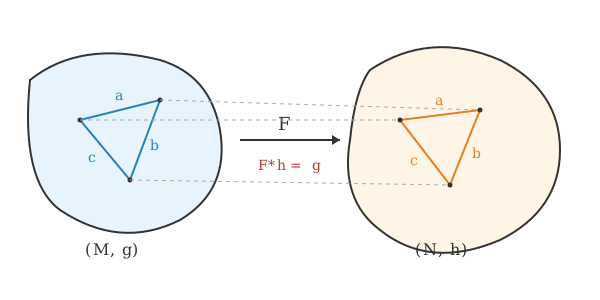
Isometries are the structure-preserving maps of Riemannian geometry. They preserve lengths, angles, areas, curvature, and all other Riemannian invariants. The set of all isometries from \( (M, g) \) to itself forms a group under composition, called the isometry group \( \operatorname{Isom}(M, g) \).
Example 8.29. The isometry group of Euclidean space \( (\mathbb{R}^n, \bar{g}) \) is the Euclidean group \( E(n) = O(n) \ltimes \mathbb{R}^n \), consisting of orthogonal transformations and translations. The isometry group of the round sphere \( (S^n, g_{S^n}) \) is the orthogonal group \( O(n+1) \).
This concludes our introduction to Riemannian metrics. The metric tensor \( g \) is the foundation upon which the entire edifice of Riemannian geometry is built. In subsequent chapters, we will use the metric to define connections, curvature, geodesics, and the Laplacian, revealing the deep interplay between geometry and analysis on manifolds.
9.1 The Algebra of Alternating Tensors
In our study of smooth manifolds, we have encountered tangent vectors, cotangent vectors, and general tensors. We now turn to a particularly important class of tensors — the alternating (or antisymmetric) tensors — which will form the algebraic backbone of the theory of differential forms. Differential forms are the natural objects to integrate on manifolds, and they encode geometric and topological information in a remarkably elegant way.
Let \( V \) be a finite-dimensional real vector space of dimension \( n \). Recall that a covariant \( k \)-tensor on \( V \) is a multilinear map \( \alpha \colon V^k \to \mathbb{R} \). We say that \( \alpha \) is alternating (or skew-symmetric) if it changes sign whenever two of its arguments are transposed.
Definition 9.1 (Alternating tensor). A covariant \( k \)-tensor \( \alpha \in T^k(V^*) \) is called alternating if for every permutation \( \sigma \in S_k \) and all vectors \( v_1, \ldots, v_k \in V \),
\[
\alpha(v_{\sigma(1)}, \ldots, v_{\sigma(k)}) = (\operatorname{sgn} \sigma) \, \alpha(v_1, \ldots, v_k).
\]
The vector space of alternating \( k \)-tensors on \( V \) is denoted \( \Lambda^k(V^*) \).
By convention, \( \Lambda^0(V^*) = \mathbb{R} \) and \( \Lambda^1(V^*) = V^* \). Since an alternating \( k \)-tensor must vanish whenever two of its arguments are equal (set \( v_i = v_j \) and use the sign change), it follows that \( \Lambda^k(V^*) = 0 \) for \( k > n = \dim V \). The space \( \Lambda^k(V^*) \) has dimension \( \binom{n}{k} \).
\[
\{ \varepsilon^{i_1} \wedge \cdots \wedge \varepsilon^{i_k} : 1 \le i_1 < i_2 < \cdots < i_k \le n \}.
\]
We will define the wedge product momentarily.
\[
(\operatorname{Alt}\, \alpha)(v_1, \ldots, v_k) = \frac{1}{k!} \sum_{\sigma \in S_k} (\operatorname{sgn}\, \sigma)\, \alpha(v_{\sigma(1)}, \ldots, v_{\sigma(k)}).
\]
One readily checks that \( \operatorname{Alt}\, \alpha \) is indeed alternating, and that \( \operatorname{Alt}\, \alpha = \alpha \) if and only if \( \alpha \) is already alternating.
9.2 The Wedge Product
The tensor product of two alternating tensors is generally not alternating. To obtain an alternating tensor from the product, we apply the alternation operator with appropriate normalization.
Definition 9.2 (Wedge product). Given \( \alpha \in \Lambda^k(V^*) \) and \( \beta \in \Lambda^\ell(V^*) \), their wedge product (or exterior product) is the alternating \( (k+\ell) \)-tensor
\[
\alpha \wedge \beta = \frac{(k+\ell)!}{k!\, \ell!} \operatorname{Alt}(\alpha \otimes \beta).
\]
\[
(\varepsilon^{i_1} \wedge \cdots \wedge \varepsilon^{i_k})(v_1, \ldots, v_k) = \det \begin{pmatrix} \varepsilon^{i_1}(v_1) & \cdots & \varepsilon^{i_1}(v_k) \\ \vdots & \ddots & \vdots \\ \varepsilon^{i_k}(v_1) & \cdots & \varepsilon^{i_k}(v_k) \end{pmatrix}.
\]
The wedge product satisfies several fundamental algebraic properties.
Proposition 9.3 (Properties of the wedge product). Let \( \alpha \in \Lambda^k(V^*) \), \( \beta \in \Lambda^\ell(V^*) \), and \( \gamma \in \Lambda^m(V^*) \). Then:
- Bilinearity: \( \wedge \) is bilinear in each factor.
- Associativity: \( (\alpha \wedge \beta) \wedge \gamma = \alpha \wedge (\beta \wedge \gamma) \).
- Graded commutativity: \( \alpha \wedge \beta = (-1)^{k\ell}\, \beta \wedge \alpha \).
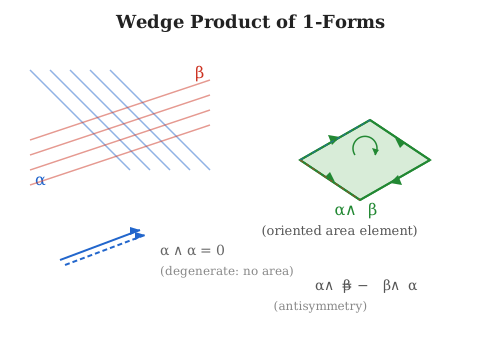
The graded commutativity is the key feature distinguishing the exterior algebra from the tensor algebra. In particular, if \( \alpha \) is a 1-form, then \( \alpha \wedge \alpha = 0 \), since \( (-1)^{1 \cdot 1} = -1 \) forces \( \alpha \wedge \alpha = -\alpha \wedge \alpha \).
\[
\Lambda^*(V^*) = \bigoplus_{k=0}^{n} \Lambda^k(V^*),
\]
which is a graded, associative, graded-commutative algebra of total dimension \( 2^n \).
With the pointwise algebra of alternating tensors in hand, we now globalize to manifolds. At each point \( p \) of a smooth manifold \( M \), we have the cotangent space \( T_p^*M \), and we can form \( \Lambda^k(T_p^*M) \). Assembling these vector spaces as \( p \) varies over \( M \) produces a vector bundle \( \Lambda^k(T^*M) \to M \).
Definition 9.4 (Differential \( k \)-form). A differential \( k \)-form (or simply a \( k \)-form) on a smooth manifold \( M \) is a smooth section of the bundle \( \Lambda^k(T^*M) \). The space of all smooth \( k \)-forms on \( M \) is denoted
\[
\Omega^k(M) = \Gamma(\Lambda^k(T^*M)).
\]
\[
\omega = \sum_{i_1 < \cdots < i_k} \omega_{i_1 \cdots i_k}\, dx^{i_1} \wedge \cdots \wedge dx^{i_k},
\]
where the coefficient functions \( \omega_{i_1 \cdots i_k} \in C^\infty(U) \) are smooth. The wedge product of differential forms is defined pointwise, making \( \Omega^*(M) = \bigoplus_{k=0}^{n} \Omega^k(M) \) into a graded algebra over \( C^\infty(M) \).
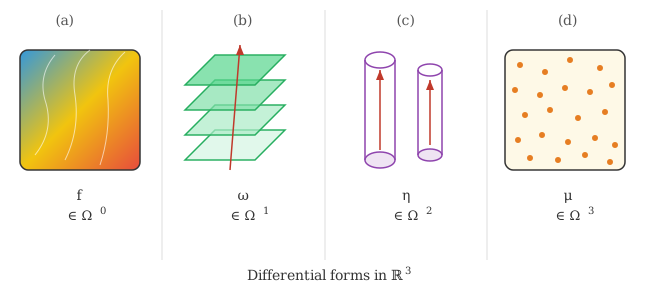
Example 9.5. On \( \mathbb{R}^3 \) with coordinates \( (x, y, z) \):
- The 1-form \( \omega = x\, dy - y\, dx \) encodes a rotational quantity.
- The 2-form \( \eta = x\, dy \wedge dz + y\, dz \wedge dx + z\, dx \wedge dy \) is related to the flux of the radial vector field through a surface.
- The 3-form \( \mu = f(x,y,z)\, dx \wedge dy \wedge dz \) is a "volume element" weighted by \( f \).
9.4 The Exterior Derivative
The exterior derivative is a first-order differential operator that generalizes the total derivative of a function to forms of arbitrary degree. It is the single most important operator in the calculus of differential forms.
Theorem 9.6 (Existence and uniqueness of the exterior derivative). There exists a unique collection of \( \mathbb{R} \)-linear maps \( d \colon \Omega^k(M) \to \Omega^{k+1}(M) \) for each \( k \ge 0 \), satisfying:
- \( d \) on functions: For \( f \in \Omega^0(M) = C^\infty(M) \), \( df \) is the differential of \( f \), i.e., \( df(X) = Xf \) for all vector fields \( X \).
- Nilpotency: \( d \circ d = 0 \), i.e., \( d(d\omega) = 0 \) for all \( \omega \).
- Graded Leibniz rule: For \( \alpha \in \Omega^k(M) \) and \( \beta \in \Omega^\ell(M) \),
\[
d(\alpha \wedge \beta) = d\alpha \wedge \beta + (-1)^k \alpha \wedge d\beta.
\]
\[
\omega = \sum_{I} \omega_I\, dx^I,
\]\[
d\omega = \sum_{I} d\omega_I \wedge dx^I = \sum_{I} \sum_{j=1}^{n} \frac{\partial \omega_I}{\partial x^j}\, dx^j \wedge dx^I.
\]
Proof sketch (that \( d^2 = 0 \)). It suffices to verify this on a coordinate domain. For a function \( f \),
\[
d(df) = d\Bigl(\sum_j \frac{\partial f}{\partial x^j} dx^j\Bigr) = \sum_{i,j} \frac{\partial^2 f}{\partial x^i \partial x^j} dx^i \wedge dx^j = 0,
\]
because mixed partial derivatives are symmetric while \( dx^i \wedge dx^j \) is antisymmetric. For a general \( k \)-form \( \omega = \omega_I\, dx^I \), we use the Leibniz rule:
\[
d^2(\omega_I\, dx^I) = d(d\omega_I \wedge dx^I) = d^2\omega_I \wedge dx^I - d\omega_I \wedge d(dx^I).
\]
Since \( d^2\omega_I = 0 \) by the function case, and \( d(dx^I) = 0 \) because each \( dx^j \) is closed (\( d(dx^j) = 0 \) by the coordinate computation), both terms vanish.
Example 9.7. On \( \mathbb{R}^3 \):
- If \( f \in C^\infty(\mathbb{R}^3) \), then \( df = \frac{\partial f}{\partial x} dx + \frac{\partial f}{\partial y} dy + \frac{\partial f}{\partial z} dz \). This corresponds to the gradient \( \nabla f \).
- If \( \omega = P\,dx + Q\,dy + R\,dz \) is a 1-form, then
\[
d\omega = \Bigl(\frac{\partial Q}{\partial x} - \frac{\partial P}{\partial y}\Bigr) dx \wedge dy + \Bigl(\frac{\partial R}{\partial y} - \frac{\partial Q}{\partial z}\Bigr) dy \wedge dz + \Bigl(\frac{\partial P}{\partial z} - \frac{\partial R}{\partial x}\Bigr) dz \wedge dx.
\]
This corresponds to the curl \( \nabla \times \mathbf{F} \).
- If \( \eta = A\, dy \wedge dz + B\, dz \wedge dx + C\, dx \wedge dy \) is a 2-form, then
\[
d\eta = \Bigl(\frac{\partial A}{\partial x} + \frac{\partial B}{\partial y} + \frac{\partial C}{\partial z}\Bigr) dx \wedge dy \wedge dz.
\]
This corresponds to the divergence \( \nabla \cdot \mathbf{F} \).
The identity \( d^2 = 0 \) unifies the classical vector calculus identities \( \nabla \times (\nabla f) = 0 \) and \( \nabla \cdot (\nabla \times \mathbf{F}) = 0 \).
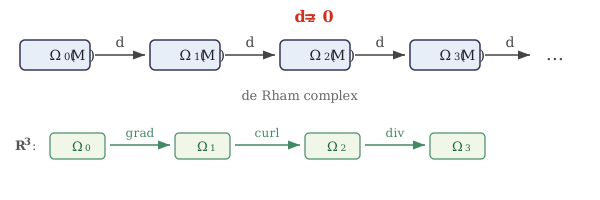
While the coordinate formula for \( d \) is useful for computation, it is often valuable to have a coordinate-free expression. For a \( k \)-form \( \omega \) and vector fields \( X_0, \ldots, X_k \), the exterior derivative is given by:
Proposition 9.8 (Invariant formula). For \( \omega \in \Omega^k(M) \) and smooth vector fields \( X_0, \ldots, X_k \),
\[
d\omega(X_0, \ldots, X_k) = \sum_{i=0}^{k} (-1)^i X_i\bigl(\omega(X_0, \ldots, \widehat{X}_i, \ldots, X_k)\bigr) + \sum_{i < j} (-1)^{i+j} \omega\bigl([X_i, X_j], X_0, \ldots, \widehat{X}_i, \ldots, \widehat{X}_j, \ldots, X_k\bigr),
\]
where a hat denotes omission of that argument.
\[
d\omega(X, Y) = X(\omega(Y)) - Y(\omega(X)) - \omega([X, Y]).
\]
This formula is extremely important in differential geometry, particularly in the theory of connections and curvature.
If \( F \colon M \to N \) is a smooth map and \( \omega \) is a differential form on \( N \), we can pull \( \omega \) back to a form on \( M \). This operation is contravariantly functorial and interacts beautifully with all the algebraic and differential operations on forms.
Definition 9.9 (Pullback of a \( k \)-form). Let \( F \colon M \to N \) be a smooth map and \( \omega \in \Omega^k(N) \). The pullback \( F^*\omega \in \Omega^k(M) \) is defined by
\[
(F^*\omega)_p(v_1, \ldots, v_k) = \omega_{F(p)}(dF_p(v_1), \ldots, dF_p(v_k))
\]
for all \( p \in M \) and \( v_1, \ldots, v_k \in T_pM \).
Proposition 9.10 (Properties of pullback). Let \( F \colon M \to N \) be smooth. Then:
- \( F^*(\alpha \wedge \beta) = (F^*\alpha) \wedge (F^*\beta) \) for all forms \( \alpha, \beta \) on \( N \).
- \( d(F^*\omega) = F^*(d\omega) \) for all \( \omega \in \Omega^k(N) \), i.e., pullback commutes with the exterior derivative.
- \( (G \circ F)^* = F^* \circ G^* \) for smooth maps \( F \colon M \to N \) and \( G \colon N \to P \).
- \( (\mathrm{Id}_M)^* = \mathrm{Id}_{\Omega^*(M)} \).
Property (2) is particularly significant: the exterior derivative is a natural operator. The proof uses the coordinate formula for \( d \) together with the chain rule for the differential \( dF \). Properties (3) and (4) express the fact that \( \Omega^*(-) \) is a contravariant functor from the category of smooth manifolds to the category of graded algebras.
In local coordinates, if \( F \colon M \to N \) is given in coordinates by \( y^j = F^j(x^1, \ldots, x^m) \), then the pullback of a basic 1-form is \( F^*(dy^j) = \sum_i \frac{\partial F^j}{\partial x^i} dx^i \), and pullback of a general form follows from linearity and the wedge product property.
The interior product (also called contraction) is an algebraic operation that “inserts” a vector field into a differential form, reducing its degree by one.
Definition 9.11 (Interior product). Let \( X \) be a smooth vector field on \( M \). The interior product (or contraction) \( \iota_X \colon \Omega^k(M) \to \Omega^{k-1}(M) \) is defined by
\[
(\iota_X \omega)(Y_1, \ldots, Y_{k-1}) = \omega(X, Y_1, \ldots, Y_{k-1}).
\]
By convention, \( \iota_X f = 0 \) for \( f \in \Omega^0(M) \).
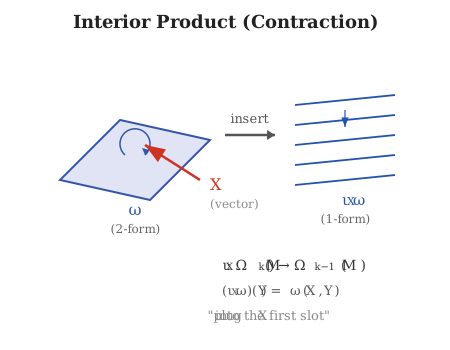
\[
\iota_X(\alpha \wedge \beta) = (\iota_X \alpha) \wedge \beta + (-1)^k \alpha \wedge (\iota_X \beta)
\]
for \( \alpha \in \Omega^k(M) \), and \( \iota_X \circ \iota_X = 0 \). It is \( C^\infty(M) \)-linear in \( X \) but not in \( \omega \).
The most remarkable formula involving the interior product connects it to the Lie derivative of differential forms.
Theorem 9.12 (Cartan's magic formula). Let \( X \) be a smooth vector field on \( M \) and \( \omega \in \Omega^k(M) \). Then the Lie derivative of \( \omega \) along \( X \) is given by
\[
\mathcal{L}_X \omega = \iota_X(d\omega) + d(\iota_X \omega).
\]
Equivalently, \( \mathcal{L}_X = \iota_X \circ d + d \circ \iota_X \).
Proof sketch. Both sides are operators \( \Omega^k(M) \to \Omega^k(M) \). One verifies: (a) both sides agree on 0-forms \( f \), since \( \mathcal{L}_X f = Xf \) and \( \iota_X(df) + d(\iota_X f) = df(X) + 0 = Xf \); (b) both sides satisfy the Leibniz rule with respect to wedge products; (c) both sides commute with \( d \). Since every form can be locally written as sums of products of functions and their differentials, these three properties determine the operator uniquely, and the two sides must agree.
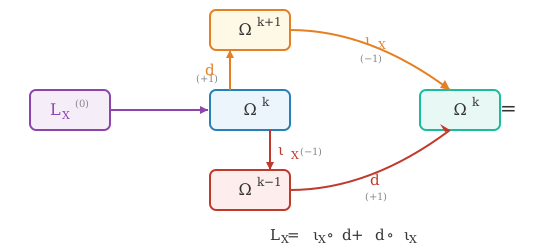
Cartan’s formula is indispensable in computations involving the Lie derivative. It also provides the key tool for proving homotopy invariance of de Rham cohomology.
Chapter 10: Orientations and Integration on Manifolds
10.1 Orientation of Vector Spaces
Before we can integrate differential forms on manifolds, we need the concept of orientation. The idea is simple: an orientation is a consistent choice of “which ordered bases are positively oriented.” We begin with the linear algebra.
Definition 10.1 (Orientation of a vector space). Let \( V \) be a real vector space of dimension \( n \). Two ordered bases \( (v_1, \ldots, v_n) \) and \( (w_1, \ldots, w_n) \) are said to be consistently oriented (or equivalently oriented) if the change-of-basis matrix \( A \) defined by \( w_j = \sum_i A^i_j v_i \) has positive determinant: \( \det A > 0 \).
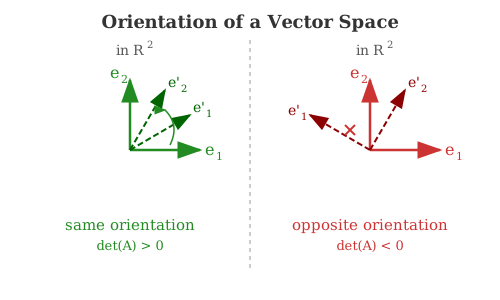
This relation is an equivalence relation on the set of ordered bases of \( V \), and it partitions the bases into exactly two equivalence classes. An orientation of \( V \) is a choice of one of these two equivalence classes. The chosen class is called the class of positively oriented bases; the other class consists of negatively oriented bases. A vector space together with a choice of orientation is called an oriented vector space.
There is an equivalent description using the top exterior power. Since \( \dim \Lambda^n(V^*) = 1 \), a nonzero element \( \mu \in \Lambda^n(V^*) \) determines an orientation: a basis \( (v_1, \ldots, v_n) \) is positively oriented if and only if \( \mu(v_1, \ldots, v_n) > 0 \). Two nonzero \( n \)-forms \( \mu \) and \( \mu' \) determine the same orientation if and only if \( \mu' = c\mu \) for some \( c > 0 \).
10.2 Orientations of Manifolds
We now extend the notion of orientation from vector spaces to manifolds by requiring a consistent, continuously varying choice of orientation on each tangent space.
Definition 10.2 (Orientation of a manifold). A smooth manifold \( M \) of dimension \( n \) is orientable if there exists a smooth atlas \( \{(U_\alpha, \varphi_\alpha)\} \) such that all transition maps \( \varphi_\beta \circ \varphi_\alpha^{-1} \) have positive Jacobian determinant everywhere. Such an atlas is called an oriented atlas, and a choice of oriented atlas determines an orientation of \( M \). A manifold equipped with an orientation is called an oriented manifold.
Equivalently, \( M \) is orientable if and only if there exists a nowhere-vanishing smooth \( n \)-form on \( M \). This is the most useful characterization in practice.
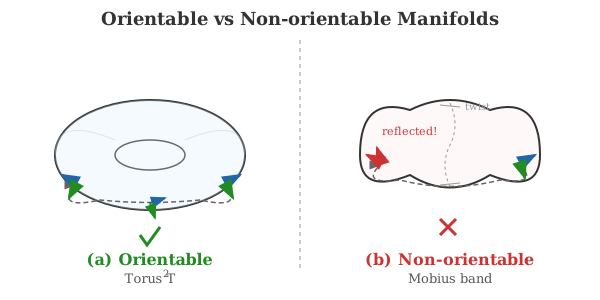
Proposition 10.3. A smooth \( n \)-manifold \( M \) is orientable if and only if there exists \( \mu \in \Omega^n(M) \) such that \( \mu_p \neq 0 \) for all \( p \in M \). Two such forms \( \mu \) and \( \mu' \) determine the same orientation if and only if \( \mu' = f\mu \) for some strictly positive smooth function \( f > 0 \).
Example 10.4.- Every \( \mathbb{R}^n \) is orientable, with the standard orientation given by \( dx^1 \wedge \cdots \wedge dx^n \).
- Every sphere \( S^n \) is orientable.
- Every Lie group is orientable (any nonzero left-invariant \( n \)-form is nowhere vanishing).
- The Möbius band is not orientable.
- The real projective space \( \mathbb{R}P^n \) is orientable if and only if \( n \) is odd.
A smooth map \( F \colon M \to N \) between oriented \( n \)-manifolds is orientation-preserving if the differential \( dF_p \colon T_pM \to T_{F(p)}N \) maps positively oriented bases to positively oriented bases for all \( p \), and orientation-reversing if it reverses the orientation at every point. For a diffeomorphism, this is equivalent to \( F^*\mu_N = f \mu_M \) with \( f > 0 \) everywhere (orientation-preserving) or \( f < 0 \) everywhere (orientation-reversing).
A nowhere-vanishing \( n \)-form on an oriented \( n \)-manifold serves as a “volume element.” On a Riemannian manifold, there is a canonical choice.
Definition 10.5 (Volume form). A volume form on an oriented \( n \)-manifold \( M \) is a nowhere-vanishing smooth \( n \)-form \( \mu \in \Omega^n(M) \) that is positively oriented (i.e., \( \mu(E_1, \ldots, E_n) > 0 \) for every positively oriented frame \( (E_1, \ldots, E_n) \)).
Theorem 10.6 (Riemannian volume form). Let \( (M, g) \) be an oriented Riemannian \( n \)-manifold. There exists a unique volume form \( dV_g \in \Omega^n(M) \), called the
Riemannian volume form, characterized by \( dV_g(E_1, \ldots, E_n) = 1 \) for every positively oriented orthonormal frame \( (E_1, \ldots, E_n) \).
\[
dV_g = \sqrt{\det(g_{ij})}\, dx^1 \wedge \cdots \wedge dx^n,
\]
where \( g_{ij} = g\bigl(\frac{\partial}{\partial x^i}, \frac{\partial}{\partial x^j}\bigr) \).
Example 10.7. On \( \mathbb{R}^n \) with the Euclidean metric, \( dV_g = dx^1 \wedge \cdots \wedge dx^n \). On \( S^2 \) with the round metric in spherical coordinates \( (\theta, \phi) \), we have \( dV_g = \sin\theta\, d\theta \wedge d\phi \).
We are now in a position to define integration of differential forms on oriented manifolds. The key observation is that an \( n \)-form on an oriented \( n \)-manifold can be integrated using partitions of unity, because a top-degree form transforms under coordinate changes by the absolute value of the Jacobian determinant (with the correct sign, thanks to orientation).
Definition 10.8 (Integration of a compactly supported \( n \)-form). Let \( M \) be an oriented smooth \( n \)-manifold and \( \omega \in \Omega^n_c(M) \) a compactly supported \( n \)-form.
- Single chart: If \( \operatorname{supp}(\omega) \) is contained in a single positively oriented coordinate chart \( (U, \varphi) \) with coordinates \( (x^1, \ldots, x^n) \), write \( \omega = f\, dx^1 \wedge \cdots \wedge dx^n \) on \( U \), and define
\[
\int_M \omega = \int_{\varphi(U)} f \circ \varphi^{-1}\, dx^1 \cdots dx^n,
\]
where the right-hand side is the ordinary Lebesgue integral on \( \mathbb{R}^n \).
- General case: Choose a partition of unity \( \{\psi_\alpha\} \) subordinate to a positively oriented atlas, and define
\[
\int_M \omega = \sum_\alpha \int_M \psi_\alpha \omega.
\]
The crucial point is that this definition is independent of the choice of oriented atlas and partition of unity. This follows from the change-of-variables formula for multiple integrals: if \( \varphi_\beta \circ \varphi_\alpha^{-1} \) is the transition map, the Jacobian determinant is positive (by the orientation assumption), so the absolute value signs in the change-of-variables formula can be dropped.
Proposition 10.9 (Properties of integration).- Linearity: \( \int_M (a\omega + b\eta) = a \int_M \omega + b \int_M \eta \).
- Orientation reversal: If \( \overline{M} \) denotes \( M \) with the opposite orientation, then \( \int_{\overline{M}} \omega = -\int_M \omega \).
- Diffeomorphism invariance: If \( F \colon M \to N \) is an orientation-preserving diffeomorphism, then \( \int_N \omega = \int_M F^*\omega \).
10.5 Manifolds with Boundary and Induced Orientation
To state Stokes’s theorem, we need manifolds with boundary and an orientation convention for the boundary.
Recall that a smooth manifold with boundary \( M \) is locally modeled on the upper half-space \( \mathbb{H}^n = \{x \in \mathbb{R}^n : x^n \ge 0\} \). The boundary \( \partial M \) is a smooth \( (n-1) \)-manifold (without boundary).
Definition 10.10 (Induced orientation on the boundary). Let \( M \) be an oriented smooth \( n \)-manifold with boundary. At each point \( p \in \partial M \), the outward-pointing normal vector \( \nu \) is the unique vector in \( T_pM \setminus T_p(\partial M) \) pointing "out of" \( M \). The induced orientation (or Stokes orientation) on \( \partial M \) is defined by declaring an ordered basis \( (v_1, \ldots, v_{n-1}) \) of \( T_p(\partial M) \) to be positively oriented if and only if \( (\nu, v_1, \ldots, v_{n-1}) \) is a positively oriented basis of \( T_pM \).
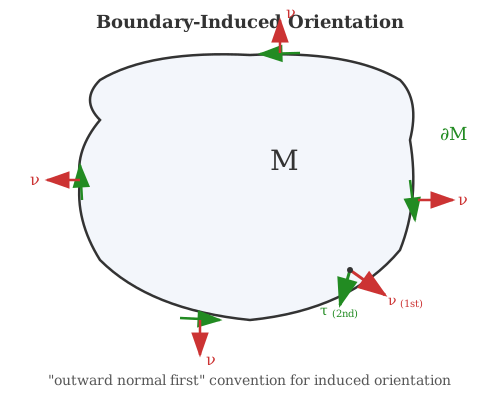
10.6 Stokes’s Theorem
We now arrive at the crowning result of the theory of differential forms and integration.
Theorem 10.12 (Stokes's Theorem). Let \( M \) be an oriented smooth \( n \)-manifold with boundary (possibly empty), and let \( \omega \in \Omega^{n-1}_c(M) \) be a compactly supported \( (n-1) \)-form. Then
\[
\int_M d\omega = \int_{\partial M} \omega,
\]
where \( \partial M \) carries the induced (Stokes) orientation. If \( \partial M = \emptyset \), the right-hand side is zero.
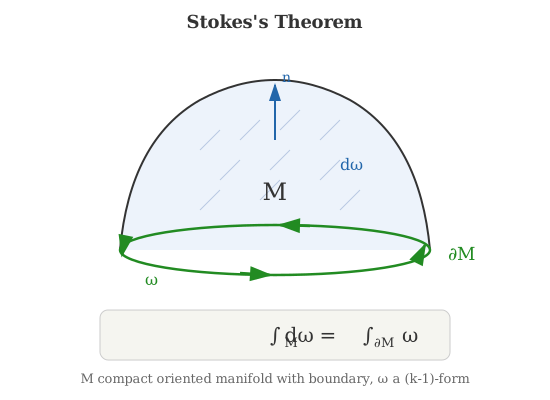
Proof sketch. Using a partition of unity, it suffices to prove the theorem when \( \operatorname{supp}(\omega) \) lies in a single coordinate chart. There are two cases.
\[
\omega = \sum_{j=1}^{n} (-1)^{j-1} f_j\, dx^1 \wedge \cdots \wedge \widehat{dx^j} \wedge \cdots \wedge dx^n.
\]\[
d\omega = \Bigl(\sum_{j=1}^{n} \frac{\partial f_j}{\partial x^j}\Bigr) dx^1 \wedge \cdots \wedge dx^n.
\]
The integral \( \int_M d\omega = \sum_j \int_{\mathbb{R}^n} \frac{\partial f_j}{\partial x^j}\, dx^1 \cdots dx^n \). Each term vanishes by iterated integration: integrating \( \frac{\partial f_j}{\partial x^j} \) with respect to \( x^j \) over all of \( \mathbb{R} \), the compact support ensures the integral of the derivative is zero. Since \( U \cap \partial M = \emptyset \), the right-hand side is also zero.
\[
\int_0^\infty \frac{\partial f_n}{\partial x^n}\, dx^n = -f_n(x^1, \ldots, x^{n-1}, 0),
\]
and tracking signs using the induced orientation shows this equals \( \int_{\partial M} \omega \).
10.7 Classical Special Cases of Stokes’s Theorem
The classical integral theorems of vector calculus are all special cases of Stokes’s theorem. This unification is one of the great achievements of the language of differential forms.
Corollary 10.13 (Fundamental Theorem of Calculus). If \( f \colon [a,b] \to \mathbb{R} \) is smooth, then
\[
\int_a^b f'(t)\, dt = f(b) - f(a).
\]
This is Stokes's theorem with \( M = [a,b] \), \( \omega = f \), and \( d\omega = f'\, dt \).
Corollary 10.14 (Green's theorem). Let \( D \subset \mathbb{R}^2 \) be a compact region with smooth boundary \( \partial D \), and let \( P, Q \in C^\infty(\mathbb{R}^2) \). Then
\[
\int_D \Bigl(\frac{\partial Q}{\partial x} - \frac{\partial P}{\partial y}\Bigr)\, dx\, dy = \oint_{\partial D} (P\, dx + Q\, dy).
\]
This is Stokes's theorem with \( \omega = P\, dx + Q\, dy \).
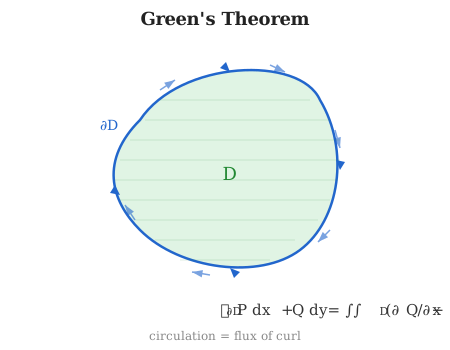
Corollary 10.15 (Classical Stokes's theorem). Let \( \Sigma \subset \mathbb{R}^3 \) be an oriented compact surface with boundary \( \partial \Sigma \), and let \( \mathbf{F} \) be a smooth vector field on \( \mathbb{R}^3 \). Then
\[
\iint_\Sigma (\nabla \times \mathbf{F}) \cdot d\mathbf{S} = \oint_{\partial \Sigma} \mathbf{F} \cdot d\mathbf{r}.
\]
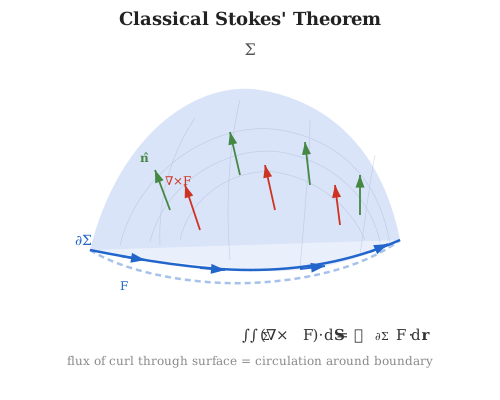
Corollary 10.16 (Divergence theorem). Let \( \Omega \subset \mathbb{R}^3 \) be a compact region with smooth boundary \( \partial \Omega \), and let \( \mathbf{F} \) be a smooth vector field. Then
\[
\iiint_\Omega (\nabla \cdot \mathbf{F})\, dV = \iint_{\partial \Omega} \mathbf{F} \cdot d\mathbf{S}.
\]
This is Stokes's theorem with \( \omega = F^1\, dy \wedge dz + F^2\, dz \wedge dx + F^3\, dx \wedge dy \).
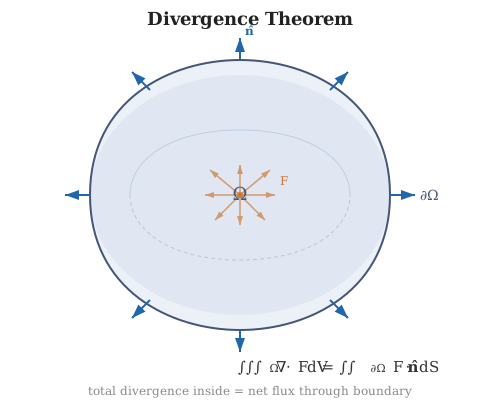
10.8 Divergence and the Divergence Theorem on Riemannian Manifolds
On a Riemannian manifold \( (M, g) \), one can define the divergence of a vector field and state the divergence theorem in a coordinate-free manner.
Definition 10.17 (Divergence). Let \( (M, g) \) be an oriented Riemannian manifold with volume form \( dV_g \). The divergence of a smooth vector field \( X \) on \( M \) is the smooth function \( \operatorname{div} X \) defined by
\[
\mathcal{L}_X(dV_g) = (\operatorname{div} X)\, dV_g,
\]
or equivalently, \( d(\iota_X\, dV_g) = (\operatorname{div} X)\, dV_g \) (by Cartan's formula, since \( d(dV_g) = 0 \)).
\[
\operatorname{div} X = \frac{1}{\sqrt{\det g}} \frac{\partial}{\partial x^i}\bigl(\sqrt{\det g}\, X^i\bigr).
\]
Theorem 10.18 (Divergence theorem on Riemannian manifolds). Let \( (M, g) \) be a compact oriented Riemannian manifold with boundary, and let \( X \) be a smooth vector field on \( M \). Let \( \nu \) be the outward-pointing unit normal along \( \partial M \). Then
\[
\int_M (\operatorname{div} X)\, dV_g = \int_{\partial M} g(X, \nu)\, dV_{\bar{g}},
\]
where \( \bar{g} \) is the induced metric on \( \partial M \).
Proof. By Stokes's theorem, \( \int_M d(\iota_X\, dV_g) = \int_{\partial M} \iota_X\, dV_g \). The left-hand side equals \( \int_M (\operatorname{div} X)\, dV_g \). For the right-hand side, one shows that the restriction of \( \iota_X\, dV_g \) to \( \partial M \) equals \( g(X, \nu)\, dV_{\bar{g}} \), which follows from the characterization of the Riemannian volume form.
Chapter 11: De Rham Cohomology
The identity \( d^2 = 0 \) — which states that the exterior derivative of an exterior derivative is always zero — is deceptively simple. Its consequences, however, are profound: it gives rise to a cohomology theory that captures deep topological information about the manifold.
Definition 11.1 (Closed and exact forms). A differential form \( \omega \in \Omega^k(M) \) is:
- Closed if \( d\omega = 0 \).
- Exact if \( \omega = d\eta \) for some \( \eta \in \Omega^{k-1}(M) \).
We denote the space of closed \( k \)-forms by \( Z^k(M) = \ker(d \colon \Omega^k(M) \to \Omega^{k+1}(M)) \) and the space of exact \( k \)-forms by \( B^k(M) = \operatorname{im}(d \colon \Omega^{k-1}(M) \to \Omega^k(M)) \).
Since \( d^2 = 0 \), every exact form is closed: \( B^k(M) \subseteq Z^k(M) \). The central question of de Rham cohomology is: is every closed form exact? The answer depends on the topology of \( M \). The discrepancy between closed and exact forms measures the “nontrivial topology” (holes, cycles) of the manifold.
Example 11.2. Consider the 1-form \( \omega = \frac{-y\, dx + x\, dy}{x^2 + y^2} \) on \( \mathbb{R}^2 \setminus \{0\} \). A direct computation shows \( d\omega = 0 \), so \( \omega \) is closed. However, \( \omega \) is not exact: if we integrate \( \omega \) around the unit circle, we get
\[
\oint_{S^1} \omega = \int_0^{2\pi} d\theta = 2\pi \neq 0.
\]
By Stokes's theorem, if \( \omega = df \) for some function \( f \), then this integral would be zero. Thus \( \omega \) is closed but not exact on \( \mathbb{R}^2 \setminus \{0\} \), reflecting the fact that \( \mathbb{R}^2 \setminus \{0\} \) has a "hole."
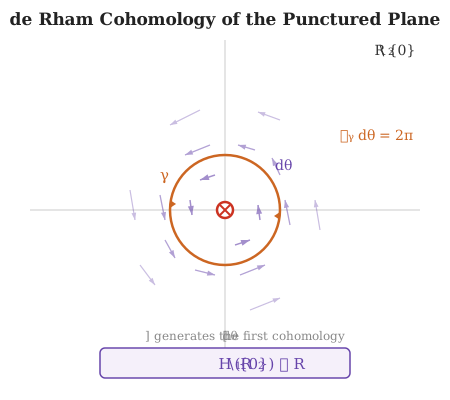
11.2 The De Rham Cohomology Groups
Definition 11.3 (De Rham cohomology). The \( k \)-th de Rham cohomology group of a smooth manifold \( M \) is the quotient vector space
\[
H^k_{\text{dR}}(M) = \frac{Z^k(M)}{B^k(M)} = \frac{\ker(d \colon \Omega^k \to \Omega^{k+1})}{\operatorname{im}(d \colon \Omega^{k-1} \to \Omega^k)}.
\]
Elements of \( H^k_{\text{dR}}(M) \) are equivalence classes \( [\omega] \), where \( \omega \) is a closed \( k \)-form and \( [\omega] = [\omega'] \) if and only if \( \omega - \omega' \) is exact.
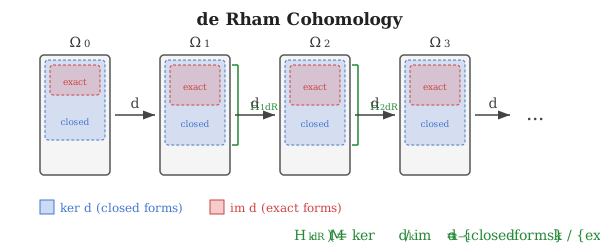
The de Rham cohomology groups are real vector spaces. They are diffeomorphism invariants of \( M \), and in fact, much more is true — they are homotopy invariants. We begin by computing the simplest case.
Proposition 11.4. For any smooth manifold \( M \),
\[
H^0_{\text{dR}}(M) \cong \mathbb{R}^c,
\]
where \( c \) is the number of connected components of \( M \).
Proof. A closed 0-form is a smooth function \( f \) with \( df = 0 \), i.e., a locally constant function. Since \( B^0(M) = 0 \) (there are no \( (-1) \)-forms), we have \( H^0_{\text{dR}}(M) = Z^0(M) = \) the space of locally constant functions. On a connected manifold, locally constant functions are constant, so \( H^0_{\text{dR}}(M) \cong \mathbb{R} \). For a manifold with \( c \) connected components, \( H^0_{\text{dR}}(M) \cong \mathbb{R}^c \).
11.3 Functoriality and Diffeomorphism Invariance
Smooth maps between manifolds induce maps on cohomology that go in the “reverse” direction, making de Rham cohomology a contravariant functor.
Proposition 11.5 (Functoriality). Let \( F \colon M \to N \) be a smooth map. The pullback \( F^* \colon \Omega^k(N) \to \Omega^k(M) \) satisfies:
- \( F^* \) maps closed forms to closed forms (since \( d \circ F^* = F^* \circ d \)).
- \( F^* \) maps exact forms to exact forms (since \( F^*(d\eta) = d(F^*\eta) \)).
Therefore \( F^* \) descends to a well-defined linear map on cohomology,
\[
F^* \colon H^k_{\text{dR}}(N) \to H^k_{\text{dR}}(M), \quad [\omega] \mapsto [F^*\omega].
\]
Moreover:
- \( (G \circ F)^* = F^* \circ G^* \) on cohomology.
- \( (\mathrm{Id}_M)^* = \mathrm{Id}_{H^*_{\text{dR}}(M)} \).
Corollary 11.6 (Diffeomorphism invariance). If \( F \colon M \to N \) is a diffeomorphism, then \( F^* \colon H^k_{\text{dR}}(N) \to H^k_{\text{dR}}(M) \) is an isomorphism for all \( k \). In particular, \( H^k_{\text{dR}}(M) \cong H^k_{\text{dR}}(N) \).
11.4 Homotopy Invariance
De Rham cohomology is invariant under a much weaker equivalence than diffeomorphism: it is a homotopy invariant. This is one of its most powerful features.
Definition 11.7. Two smooth maps \( F, G \colon M \to N \) are smoothly homotopic if there exists a smooth map \( H \colon M \times [0,1] \to N \) such that \( H(p, 0) = F(p) \) and \( H(p, 1) = G(p) \) for all \( p \in M \). Two manifolds \( M \) and \( N \) are homotopy equivalent if there exist smooth maps \( F \colon M \to N \) and \( G \colon N \to M \) such that \( G \circ F \) is homotopic to \( \mathrm{Id}_M \) and \( F \circ G \) is homotopic to \( \mathrm{Id}_N \).
Theorem 11.8 (Homotopy invariance of de Rham cohomology). If \( F, G \colon M \to N \) are smoothly homotopic, then
\[
F^* = G^* \colon H^k_{\text{dR}}(N) \to H^k_{\text{dR}}(M)
\]
for all \( k \). Consequently, homotopy equivalent manifolds have isomorphic de Rham cohomology.
\[
G^*\omega - F^*\omega = d(h\omega) + h(d\omega)
\]
for all \( \omega \in \Omega^k(N) \). If \( \omega \) is closed, this gives \( G^*\omega - F^*\omega = d(h\omega) \), which means \( [G^*\omega] = [F^*\omega] \) in \( H^k_{\text{dR}}(M) \). The operator \( h \) is constructed explicitly using integration along the fiber of the homotopy \( H \colon M \times [0,1] \to N \).
11.5 The Poincaré Lemma
The most fundamental computation in de Rham cohomology is the cohomology of \( \mathbb{R}^n \) (or, more generally, any contractible space).
Theorem 11.9 (Poincaré Lemma). For all \( k \ge 1 \),
\[
H^k_{\text{dR}}(\mathbb{R}^n) = 0.
\]
That is, every closed \( k \)-form on \( \mathbb{R}^n \) (with \( k \ge 1 \)) is exact. More generally, the same holds for any star-shaped open subset of \( \mathbb{R}^n \), or any contractible manifold.
Proof sketch. The space \( \mathbb{R}^n \) is contractible: the identity map \( \mathrm{Id}_{\mathbb{R}^n} \) is homotopic to the constant map \( c_0 \colon \mathbb{R}^n \to \{0\} \hookrightarrow \mathbb{R}^n \) via the homotopy \( H(x, t) = tx \). By homotopy invariance,
\[
H^k_{\text{dR}}(\mathbb{R}^n) \cong H^k_{\text{dR}}(\{\text{point}\}).
\]
Since the cohomology of a point is \( \mathbb{R} \) in degree 0 and 0 in all positive degrees, the result follows.
\[
(h\omega)(x) = \sum_I \sum_{j \in I} \pm \Bigl(\int_0^1 t^{k-1} f_I(tx)\, dt\Bigr) x^j\, dx^{I \setminus \{j\}},
\]
where the precise signs come from contracting with the radial vector field \( R = \sum_i x^i \frac{\partial}{\partial x^i} \) and integrating in \( t \). One then verifies that \( dh\omega + hd\omega = \omega \) for \( k \ge 1 \), so that closed implies exact.
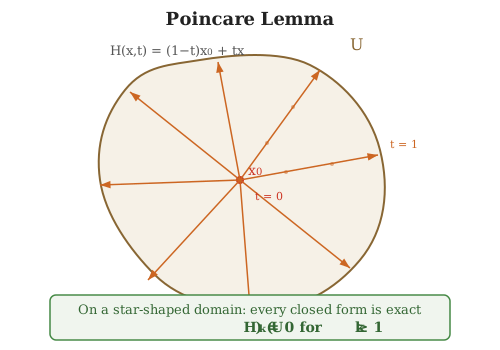
11.6 The Mayer–Vietoris Sequence
The Mayer–Vietoris sequence is the primary computational tool for de Rham cohomology. It allows us to compute the cohomology of a manifold by breaking it into simpler pieces.
Theorem 11.11 (Mayer–Vietoris sequence). Let \( M = U \cup V \) where \( U, V \subset M \) are open. There is a long exact sequence of vector spaces:
\[
\cdots \to H^{k-1}_{\text{dR}}(U \cap V) \xrightarrow{\delta^*} H^k_{\text{dR}}(M) \xrightarrow{(i^*, j^*)} H^k_{\text{dR}}(U) \oplus H^k_{\text{dR}}(V) \xrightarrow{k^* - \ell^*} H^k_{\text{dR}}(U \cap V) \xrightarrow{\delta^*} H^{k+1}_{\text{dR}}(M) \to \cdots
\]
where \( i, j \) are the inclusions of \( U, V \) into \( M \), and \( k, \ell \) are the inclusions of \( U \cap V \) into \( U, V \) respectively. The map \( \delta^* \) is the connecting homomorphism.
\[
0 \to \Omega^*(M) \xrightarrow{(i^*, j^*)} \Omega^*(U) \oplus \Omega^*(V) \xrightarrow{k^* - \ell^*} \Omega^*(U \cap V) \to 0.
\]
Surjectivity of the last map uses a partition of unity argument. The connecting homomorphism \( \delta^* \) is constructed by the usual diagram chase.
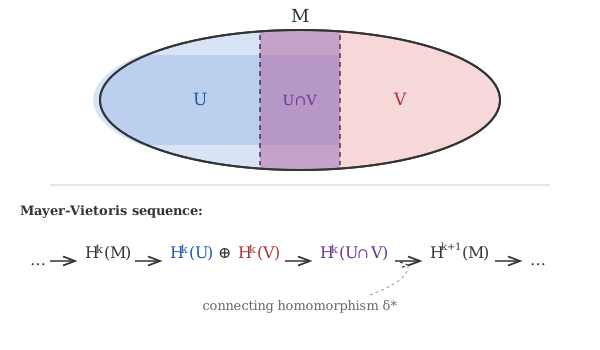
The Mayer–Vietoris sequence is extremely powerful because it reduces the computation of cohomology to knowledge of simpler pieces. Combined with the Poincaré lemma (which gives us the cohomology of contractible sets), it allows us to compute the cohomology of many manifolds by induction.
11.7 Computations
Example 11.12 (Cohomology of \( S^1 \)). Write \( S^1 = U \cup V \) where \( U \) and \( V \) are open arcs covering \( S^1 \), each contractible, with \( U \cap V \) consisting of two disjoint open arcs (each contractible). The Mayer–Vietoris sequence in degree 0 gives:
\[
0 \to H^0_{\text{dR}}(S^1) \to H^0_{\text{dR}}(U) \oplus H^0_{\text{dR}}(V) \to H^0_{\text{dR}}(U \cap V) \xrightarrow{\delta^*} H^1_{\text{dR}}(S^1) \to 0.
\]
This is \( 0 \to \mathbb{R} \to \mathbb{R}^2 \to \mathbb{R}^2 \xrightarrow{\delta^*} H^1_{\text{dR}}(S^1) \to 0 \). The map \( \mathbb{R}^2 \to \mathbb{R}^2 \) has rank 1 (one can verify), so \( \ker \delta^* \) is 1-dimensional and \( H^1_{\text{dR}}(S^1) \cong \mathbb{R} \). This confirms our earlier observation that the angle form \( d\theta \) represents a nontrivial cohomology class.
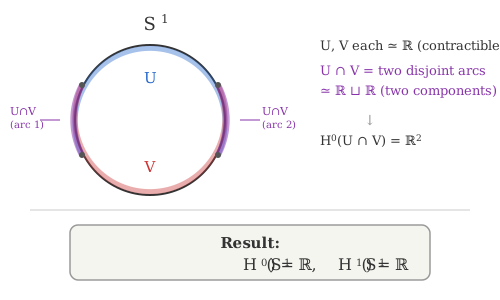
Example 11.13 (Cohomology of \( S^n \) for \( n \ge 1 \)). Using the Mayer–Vietoris sequence with \( U \) and \( V \) being the complements of the north and south poles (each contractible, \( U \cap V \simeq S^{n-1} \)), one shows by induction:
\[
H^k_{\text{dR}}(S^n) \cong \begin{cases} \mathbb{R} & \text{if } k = 0 \text{ or } k = n, \\ 0 & \text{otherwise.} \end{cases}
\]
The generator of \( H^n_{\text{dR}}(S^n) \) is the class of any volume form on \( S^n \), normalized so that \( \int_{S^n} \omega = 1 \).
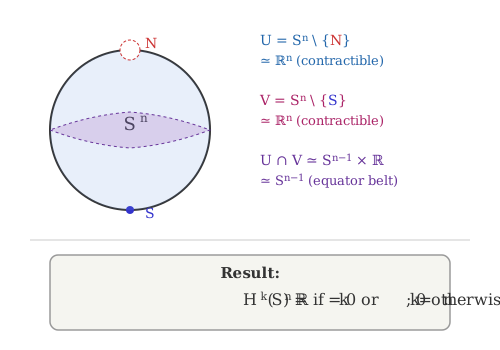
Example 11.14 (Cohomology of \( T^n \)). The \( n \)-torus \( T^n = S^1 \times \cdots \times S^1 \) has cohomology
\[
H^k_{\text{dR}}(T^n) \cong \mathbb{R}^{\binom{n}{k}}.
\]
This can be proved using the Künneth formula for de Rham cohomology: if \( M \) and \( N \) are manifolds of finite type, then
\[
H^k_{\text{dR}}(M \times N) \cong \bigoplus_{p+q=k} H^p_{\text{dR}}(M) \otimes H^q_{\text{dR}}(N).
\]
For \( T^n \), this gives \( H^*_{\text{dR}}(T^n) \cong \Lambda^*(\mathbb{R}^n) \), the exterior algebra on \( n \) generators of degree 1. The generators of \( H^1_{\text{dR}}(T^n) \) are represented by the \( n \) angle forms \( d\theta^1, \ldots, d\theta^n \), and the generators in higher degree are their wedge products.
11.8 Top Cohomology and Degree Theory
The top-degree cohomology of a manifold is closely related to orientability.
Theorem 11.15 (Top cohomology). Let \( M \) be a connected smooth \( n \)-manifold without boundary. Then:
- If \( M \) is compact and orientable, then \( H^n_{\text{dR}}(M) \cong \mathbb{R} \). Integration gives an isomorphism \( \int_M \colon H^n_{\text{dR}}(M) \xrightarrow{\sim} \mathbb{R} \).
- If \( M \) is compact and not orientable, then \( H^n_{\text{dR}}(M) = 0 \).
- If \( M \) is not compact, then \( H^n_{\text{dR}}(M) = 0 \).
This theorem has a beautiful application to degree theory. If \( F \colon M \to N \) is a smooth map between compact, connected, oriented \( n \)-manifolds, the induced map \( F^* \colon H^n_{\text{dR}}(N) \to H^n_{\text{dR}}(M) \) is a linear map \( \mathbb{R} \to \mathbb{R} \), hence multiplication by a scalar. This scalar is the degree of \( F \).
Definition 11.16 (Degree of a smooth map). Let \( F \colon M \to N \) be a smooth map between compact, connected, oriented \( n \)-manifolds. The degree of \( F \), denoted \( \deg F \), is the unique real number such that
\[
\int_M F^*\omega = (\deg F) \int_N \omega
\]
for all \( \omega \in \Omega^n(N) \).
The degree is always an integer, and it counts (with signs according to orientation) the number of preimages of a regular value. It is a homotopy invariant: homotopic maps have the same degree.
Chapter 12: Integral Curves, Flows, and the Frobenius Theorem
12.1 Integral Curves of Vector Fields
A vector field on a smooth manifold assigns a “direction of motion” to each point. The integral curves of a vector field are the curves that are everywhere tangent to the field — they represent the trajectories of particles moving according to the vector field.
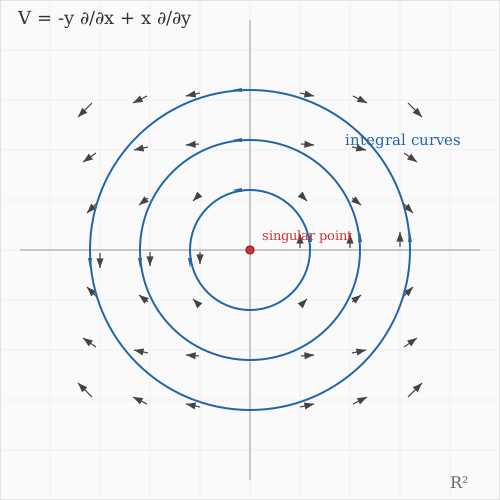
Definition 12.1 (Integral curve). Let \( V \) be a smooth vector field on a smooth manifold \( M \). An integral curve of \( V \) is a smooth curve \( \gamma \colon I \to M \) (where \( I \subseteq \mathbb{R} \) is an interval) satisfying
\[
\gamma'(t) = V_{\gamma(t)} \quad \text{for all } t \in I.
\]
In local coordinates \( (x^1, \ldots, x^n) \), if \( V = V^i \frac{\partial}{\partial x^i} \) and \( \gamma(t) = (\gamma^1(t), \ldots, \gamma^n(t)) \), this becomes the system of ordinary differential equations
\[
\frac{d\gamma^i}{dt}(t) = V^i(\gamma^1(t), \ldots, \gamma^n(t)), \quad i = 1, \ldots, n.
\]
The existence and uniqueness of integral curves is guaranteed by the fundamental theorem of ODEs.
Theorem 12.2 (Picard–Lindelöf / Existence and uniqueness). Let \( V \) be a smooth vector field on \( M \), and let \( p \in M \). Then there exists an open interval \( I \) containing \( 0 \) and a smooth curve \( \gamma \colon I \to M \) such that \( \gamma(0) = p \) and \( \gamma'(t) = V_{\gamma(t)} \) for all \( t \in I \). Moreover, any two integral curves starting at \( p \) agree on the intersection of their domains.
By the uniqueness assertion, for each \( p \in M \) there is a unique maximal integral curve \( \gamma_p \colon I_p \to M \) starting at \( p \), defined on the largest possible interval \( I_p \).
Example 12.3.- On \( \mathbb{R}^2 \), the vector field \( V = -y\, \frac{\partial}{\partial x} + x\, \frac{\partial}{\partial y} \) has integral curves \( \gamma(t) = (r\cos(t+\theta_0), r\sin(t+\theta_0)) \), which are circles centered at the origin.
- On \( \mathbb{R} \), the vector field \( V = x^2 \frac{\partial}{\partial x} \) has integral curves \( \gamma(t) = \frac{x_0}{1 - x_0 t} \) for \( \gamma(0) = x_0 \neq 0 \). For \( x_0 > 0 \), this blows up in finite time at \( t = 1/x_0 \), showing that integral curves need not exist for all time.
12.2 Flows
The collection of all integral curves of a vector field assembles into a single object called the flow of the vector field.
Definition 12.4 (Global flow). A
global flow on \( M \) is a smooth map \( \Theta \colon \mathbb{R} \times M \to M \), written \( \Theta(t, p) = \Theta_t(p) \), satisfying:
- \( \Theta_0 = \mathrm{Id}_M \), i.e., \( \Theta_0(p) = p \) for all \( p \).
- \( \Theta_{t+s} = \Theta_t \circ \Theta_s \) for all \( t, s \in \mathbb{R} \) (the group law).
A vector field that generates a global flow (i.e., all maximal integral curves are defined for all \( t \in \mathbb{R} \)) is called
complete.
The group law says that flowing for time \( s \) and then for time \( t \) is the same as flowing for time \( t + s \). In particular, each \( \Theta_t \) is a diffeomorphism of \( M \) with inverse \( \Theta_{-t} \). Thus a global flow is a smooth action of \( (\mathbb{R}, +) \) on \( M \) — a one-parameter group of diffeomorphisms.
Not every vector field is complete. When integral curves may fail to exist for all time, we need the notion of a local flow.
Definition 12.5 (Local flow). A local flow (or flow) of a vector field \( V \) is a smooth map \( \Theta \colon \mathcal{D} \to M \), where \( \mathcal{D} \subseteq \mathbb{R} \times M \) is an open subset containing \( \{0\} \times M \), such that for each \( p \in M \), the curve \( t \mapsto \Theta_t(p) \) is the maximal integral curve of \( V \) starting at \( p \).
The key theorems about flows establish existence, uniqueness, and the group property in the local setting.
Theorem 12.6 (Fundamental Theorem of Flows I). Let \( V \) be a smooth vector field on \( M \). There exists a unique maximal flow \( \Theta \colon \mathcal{D} \to M \) of \( V \). The flow domain \( \mathcal{D} \) is an open subset of \( \mathbb{R} \times M \) containing \( \{0\} \times M \), and \( \Theta \) is smooth. For each \( p \in M \), the curve \( t \mapsto \Theta_t(p) \) is the maximal integral curve of \( V \) starting at \( p \), defined on the maximal interval \( I_p = \{t \in \mathbb{R} : (t, p) \in \mathcal{D}\} \).
Theorem 12.7 (Fundamental Theorem of Flows II — the group law). Let \( \Theta \colon \mathcal{D} \to M \) be the maximal flow of a smooth vector field \( V \). Then:
- For each \( (t, p) \in \mathcal{D} \) and \( s \in \mathbb{R} \) such that \( (s, \Theta_t(p)) \in \mathcal{D} \), we have \( (t+s, p) \in \mathcal{D} \) and
\[
\Theta_s(\Theta_t(p)) = \Theta_{t+s}(p).
\]
- For each \( t \) such that \( \Theta_t \) is defined, it is a diffeomorphism from its domain onto its image, with \( \Theta_t^{-1} = \Theta_{-t} \).
Completeness is guaranteed under natural geometric conditions.
Proposition 12.8 (Sufficient conditions for completeness).- If \( V \) has compact support, then \( V \) is complete.
- If \( M \) is compact, then every smooth vector field on \( M \) is complete.
Proof sketch. For (2), suppose \( M \) is compact and \( V \) is a smooth vector field. The maximal integral curve \( \gamma \colon (a, b) \to M \) through any point must have \( a = -\infty \) and \( b = +\infty \). If, say, \( b < \infty \), then by compactness of \( M \), \( \gamma(t) \) has a convergent subsequence as \( t \to b^- \), and one can extend \( \gamma \) beyond \( b \) using the local existence theorem, contradicting maximality. Assertion (1) follows similarly, since the integral curve eventually leaves the support of \( V \) and then remains constant.
The behavior of integral curves is qualitatively different at points where the vector field vanishes compared to points where it does not.
Definition 12.9 (Regular and singular points). Let \( V \) be a smooth vector field on \( M \). A point \( p \in M \) is:
- A singular point (or zero) of \( V \) if \( V_p = 0 \).
- A regular point of \( V \) if \( V_p \neq 0 \).
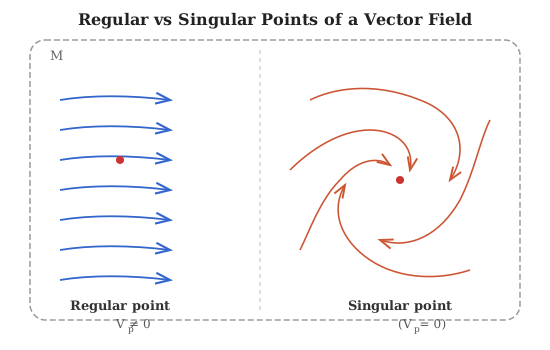
Lemma 12.10. If \( p \) is a singular point of \( V \), then the integral curve through \( p \) is the constant curve \( \gamma(t) = p \) for all \( t \). If \( p \) is a regular point, then the maximal integral curve through \( p \) is an immersion (i.e., \( \gamma'(t) \neq 0 \) for all \( t \)).
Near a regular point, the flow of a vector field can be completely “straightened out” by a suitable choice of coordinates. This is the content of the following important theorem.
Theorem 12.11 (Canonical Form Theorem / Flow-Box Theorem). Let \( V \) be a smooth vector field on \( M \) and let \( p \) be a regular point of \( V \). Then there exists a smooth coordinate chart \( (U, \varphi) \) centered at \( p \) with coordinates \( (y^1, \ldots, y^n) \) such that
\[
V = \frac{\partial}{\partial y^1} \quad \text{on } U.
\]
In these coordinates, the integral curves of \( V \) are simply the lines \( t \mapsto (y^1 + t, y^2, \ldots, y^n) \) — they are straight and parallel.
Proof sketch. Since \( V_p \neq 0 \), we may choose coordinates \( (x^1, \ldots, x^n) \) centered at \( p \) such that \( V_p = \frac{\partial}{\partial x^1}\big|_p \). Consider the map \( \Phi \colon \mathbb{R}^n \supset W \to M \) defined by
\[
\Phi(t, a^2, \ldots, a^n) = \Theta_t(0, a^2, \ldots, a^n),
\]
where \( \Theta \) is the flow of \( V \) and \( (0, a^2, \ldots, a^n) \) lies in the hyperplane \( \{x^1 = 0\} \). By construction, \( \Phi \) maps the line \( t \mapsto (t, a^2, \ldots, a^n) \) to the integral curve of \( V \) through \( (0, a^2, \ldots, a^n) \). The differential \( d\Phi_0 \) is the identity (one can check), so by the inverse function theorem, \( \Phi \) is a local diffeomorphism near the origin. Setting \( \varphi = \Phi^{-1} \) gives the desired coordinates.
12.4 Lie Derivatives of Vector Fields
We introduced the Lie derivative of differential forms in Chapter 9 via Cartan’s formula. Now we consider the Lie derivative of one vector field with respect to another, which has a more subtle definition involving the flow.
Definition 12.13 (Lie derivative of a vector field). Let \( V \) and \( W \) be smooth vector fields on \( M \), and let \( \Theta \) be the flow of \( V \). The Lie derivative of \( W \) with respect to \( V \) is the vector field defined by
\[
(\mathcal{L}_V W)_p = \lim_{t \to 0} \frac{(d\Theta_{-t})_{\Theta_t(p)}(W_{\Theta_t(p)}) - W_p}{t} = \frac{d}{dt}\bigg|_{t=0} (\Theta_{-t})_* W_{\Theta_t(p)}.
\]
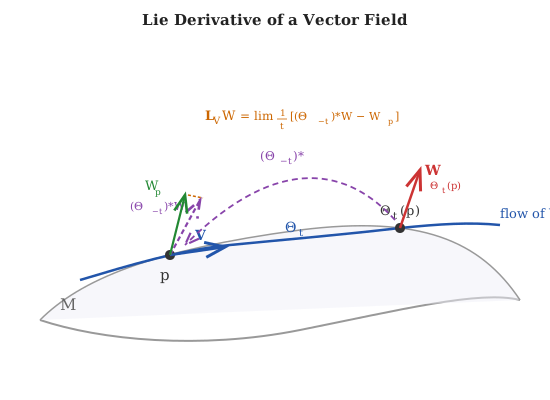
The key idea is that we cannot directly subtract \( W_{\Theta_t(p)} \) and \( W_p \), because they live in different tangent spaces. We use the flow \( \Theta_t \) to push \( W_{\Theta_t(p)} \) back to \( T_pM \) via the differential of \( \Theta_{-t} \), and then take the derivative.
Lemma 12.14. The Lie derivative \( \mathcal{L}_V W \) is a smooth vector field on \( M \).
The remarkable fact is that this dynamical construction yields the same result as the purely algebraic Lie bracket.
Theorem 12.15. For any smooth vector fields \( V \) and \( W \) on \( M \),
\[
\mathcal{L}_V W = [V, W].
\]
Proof sketch. It suffices to show that \( (\mathcal{L}_V W)(f) = [V, W](f) \) for all \( f \in C^\infty(M) \). One writes
\[
(\mathcal{L}_V W)_p(f) = \frac{d}{dt}\bigg|_{t=0} W_{\Theta_t(p)}(f \circ \Theta_{-t}).
\]
Expanding using the product rule for the derivative at \( t = 0 \), one obtains two terms: \( V_p(Wf) - W_p(Vf) = [V,W]_p(f) \).
The Lie derivative satisfies several important properties that make it a powerful tool for studying the geometry of vector fields.
Proposition 12.16 (Properties of the Lie derivative).- \( \mathcal{L}_X Y = -\mathcal{L}_Y X \) (antisymmetry, following from \( [X,Y] = -[Y,X] \)).
- \( \mathcal{L}_X(fY) = (Xf)Y + f\mathcal{L}_X Y \) for \( f \in C^\infty(M) \).
- The Jacobi identity: \( \mathcal{L}_X[Y,Z] = [\mathcal{L}_X Y, Z] + [Y, \mathcal{L}_X Z] \), i.e., \( \mathcal{L}_X \) is a derivation of the Lie bracket.
12.5 Commuting Vector Fields and Flows
The Lie bracket measures the failure of two flows to commute. When the bracket vanishes, the flows commute, and this has profound geometric consequences.
![Commuting flows: when [V,W] = 0, flowing along V then W gives the same result as flowing along W then V](/pics/pmath465/commuting-flows.svg)
Proposition 12.17 (Equivalent conditions for commuting vector fields). Let \( V \) and \( W \) be smooth vector fields on \( M \) with flows \( \Theta \) and \( \Psi \) respectively. The following are equivalent:
- \( [V, W] = 0 \).
- \( \mathcal{L}_V W = 0 \).
- \( \mathcal{L}_W V = 0 \).
- The flows commute wherever both sides are defined: \( \Theta_t \circ \Psi_s = \Psi_s \circ \Theta_t \).
- \( W \) is invariant under the flow of \( V \): \( (\Theta_t)_* W = W \) wherever defined.
- \( V \) is invariant under the flow of \( W \): \( (\Psi_s)_* V = V \) wherever defined.
Proof sketch of (1) \( \Leftrightarrow \) (4). If the flows commute, then \( (\Theta_t)_* W = W \), so \( \mathcal{L}_V W = \frac{d}{dt}\big|_0 (\Theta_{-t})_* W = 0 = [V,W] \). Conversely, if \( [V,W] = 0 \), consider \( \alpha(t) = (\Theta_{-t})_* W_{\Theta_t(p)} \). Then \( \alpha'(t) = (\Theta_{-t})_* (\mathcal{L}_V W)_{\Theta_t(p)} = 0 \), so \( \alpha(t) \) is constant, meaning \( (\Theta_t)_* W = W \). This implies \( \Theta_t \) preserves the integral curves of \( W \), which gives commutativity of the flows.
Example 12.18. On \( \mathbb{R}^n \), the coordinate vector fields \( \frac{\partial}{\partial x^i} \) and \( \frac{\partial}{\partial x^j} \) commute (their bracket is zero), and indeed their flows (translations in the \( x^i \) and \( x^j \) directions) commute. This is the simplest example; the canonical form theorem says that near a regular point, any single vector field can be put into this form.
We have already encountered Cartan’s magic formula in Chapter 9. Now that we have the flow interpretation of the Lie derivative, we can give a more conceptual treatment.
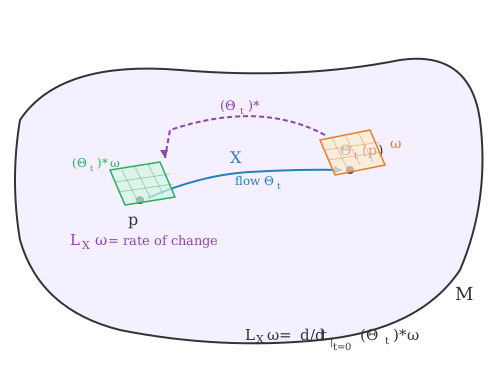
\[
(\mathcal{L}_X \omega)_p = \frac{d}{dt}\bigg|_{t=0} (\Theta_t^* \omega)_p.
\]
This pulls the form back from \( \Theta_t(p) \) to \( p \) using the flow and then differentiates.
Theorem 12.19 (Cartan's formula, revisited). For any smooth vector field \( X \) and \( \omega \in \Omega^k(M) \),
\[
\mathcal{L}_X \omega = \iota_X(d\omega) + d(\iota_X \omega).
\]
\[
\frac{d}{dt} \Theta_t^* \omega = \Theta_t^* (\mathcal{L}_X \omega).
\]
This identity is used constantly in applications to fluid dynamics, where it describes how a differential form is transported by a flow.
12.7 Tangent Distributions and the Frobenius Theorem
The Frobenius theorem is one of the fundamental results in differential geometry. It provides a necessary and sufficient condition for a family of subspaces of the tangent bundle to be “integrable” — that is, to arise as the tangent spaces to a foliation of the manifold by submanifolds.
Definition 12.20 (Tangent distribution). A tangent distribution (or simply a distribution) of rank \( k \) on a smooth manifold \( M \) is a smooth assignment \( p \mapsto D_p \), where \( D_p \subseteq T_pM \) is a \( k \)-dimensional linear subspace for each \( p \), and "smooth" means that near each point, \( D \) can be locally spanned by \( k \) smooth vector fields.
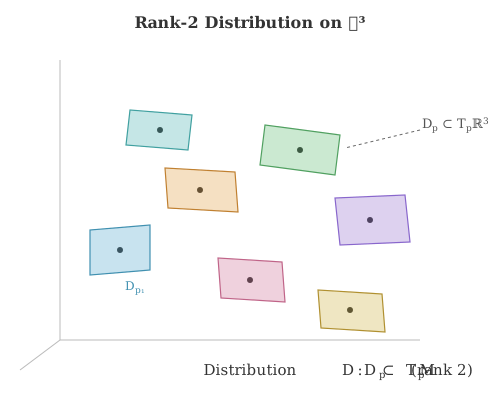
Definition 12.21 (Integral submanifold). An integral submanifold of a distribution \( D \) is a connected immersed submanifold \( N \subseteq M \) such that \( T_pN = D_p \) for all \( p \in N \).
Definition 12.22 (Integrable distribution). A distribution \( D \) is integrable if through every point of \( M \) there passes an integral submanifold of \( D \). Equivalently, \( M \) admits a foliation whose leaves are tangent to \( D \).
Definition 12.23 (Involutive distribution). A distribution \( D \) is involutive if for any two smooth vector fields \( X \) and \( Y \) that are everywhere tangent to \( D \) (i.e., \( X_p, Y_p \in D_p \) for all \( p \)), the Lie bracket \( [X, Y] \) is also everywhere tangent to \( D \).
If \( D \) is integrable, it must be involutive: if \( N \) is an integral submanifold through \( p \), and \( X, Y \) are tangent to \( D \), then \( X \) and \( Y \) restrict to vector fields on \( N \), so \( [X,Y] \) is also tangent to \( N \), hence tangent to \( D \). The Frobenius theorem is the remarkable converse.
Theorem 12.24 (Frobenius Theorem). A smooth distribution \( D \) on a smooth manifold \( M \) is integrable if and only if it is involutive.
Proof sketch. The "only if" direction (integrability implies involutivity) was explained above. For the "if" direction, we proceed by induction on the rank \( k \) of the distribution.
Base case \( k = 1 \): A rank-1 distribution is spanned by a single nonvanishing vector field \( V \). Any rank-1 distribution is automatically involutive (the bracket of multiples of \( V \) is again a multiple of \( V \)). The integral submanifolds are the integral curves of \( V \), which exist by the existence theorem for ODEs.
Inductive step: Assume the result for rank \( k-1 \). Let \( D \) be an involutive rank-\( k \) distribution, locally spanned by vector fields \( V_1, \ldots, V_k \). Using the flow-box theorem, we may choose coordinates so that \( V_1 = \frac{\partial}{\partial y^1} \). Since \( [V_1, V_j] \in D \) for all \( j \) (involutivity), we can modify \( V_2, \ldots, V_k \) so that \( [V_1, V_j] = 0 \) for \( j = 2, \ldots, k \) (by subtracting appropriate multiples of \( V_1 \)). Since these modified vector fields commute with \( V_1 = \frac{\partial}{\partial y^1} \), their coefficients are independent of \( y^1 \). The distribution spanned by the projections of \( V_2, \ldots, V_k \) onto the “transverse” slice \( \{y^1 = \text{const}\} \) is a rank-\( (k-1) \) involutive distribution, to which we apply the inductive hypothesis.
The Frobenius theorem has a clean statement for commuting vector fields, which can be viewed as a “simultaneous straightening” result.
Theorem 12.25 (Simple version of Frobenius). Let \( V_1, \ldots, V_k \) be smooth vector fields on \( M \) that are linearly independent at a point \( p \) and satisfy \( [V_i, V_j] = 0 \) for all \( i, j \). Then there exist local coordinates \( (y^1, \ldots, y^n) \) centered at \( p \) such that
\[
V_i = \frac{\partial}{\partial y^i}, \quad i = 1, \ldots, k.
\]
This is a generalization of the canonical form theorem (which handles the case \( k = 1 \)) and is proved similarly, using the commutativity of the flows to construct the coordinate chart.
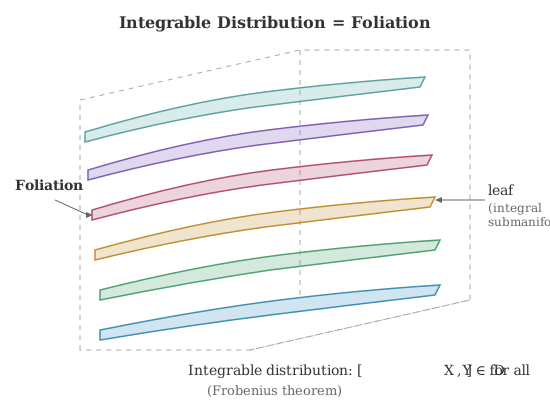
12.8 Affine Connections and Covariant Derivatives
We now introduce a fundamentally new structure on manifolds: the connection, which provides a way to differentiate vector fields (and more general tensor fields) along curves and in the direction of other vector fields. Unlike the Lie derivative, a connection allows us to differentiate a vector field at a point using only the direction of differentiation at that point, not a full vector field.
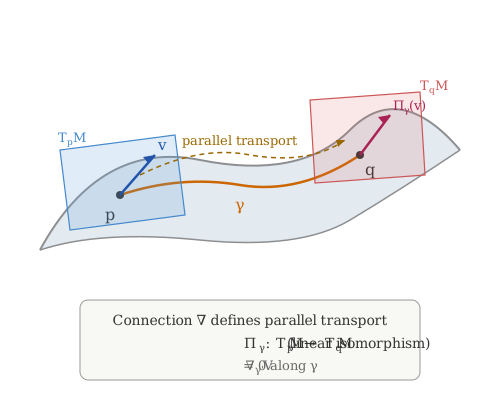
The need for connections arises because there is no canonical way to compare tangent vectors at different points of a manifold — the tangent spaces \( T_pM \) and \( T_qM \) are abstractly isomorphic but not canonically so. A connection provides the additional structure needed to “connect” nearby tangent spaces.
Definition 12.26 (Affine connection / covariant derivative). An
affine connection (or
covariant derivative) on a smooth manifold \( M \) is a map
\[
\nabla \colon \mathfrak{X}(M) \times \mathfrak{X}(M) \to \mathfrak{X}(M), \quad (X, Y) \mapsto \nabla_X Y,
\]
satisfying the following three properties:
- \( C^\infty(M) \)-linearity in \( X \): \( \nabla_{fX_1 + gX_2} Y = f \nabla_{X_1} Y + g \nabla_{X_2} Y \) for \( f, g \in C^\infty(M) \).
- \( \mathbb{R} \)-linearity in \( Y \): \( \nabla_X(aY_1 + bY_2) = a \nabla_X Y_1 + b \nabla_X Y_2 \) for \( a, b \in \mathbb{R} \).
- Leibniz rule in \( Y \): \( \nabla_X(fY) = (Xf)Y + f \nabla_X Y \) for \( f \in C^\infty(M) \).
The \( C^\infty(M) \)-linearity in \( X \) is crucial: it means that \( (\nabla_X Y)_p \) depends only on the value \( X_p \in T_pM \), not on the global behavior of \( X \). This is in stark contrast to the Lie bracket \( [X, Y] \), which depends on the derivatives of \( X \). On the other hand, the Leibniz rule in \( Y \) means that \( \nabla_X Y \) at \( p \) depends on the values of \( Y \) along a curve tangent to \( X_p \), not just at \( p \) itself. However, one can show the following locality results.
Lemma 12.27. The covariant derivative \( \nabla \) is local in both arguments: if \( X = \tilde{X} \) on an open set \( U \), then \( \nabla_X Y = \nabla_{\tilde{X}} Y \) on \( U \); and similarly for \( Y \). Moreover, \( (\nabla_X Y)_p \) depends only on \( X_p \) and on the values of \( Y \) along any curve tangent to \( X_p \) at \( p \).
12.9 Christoffel Symbols
In local coordinates \( (x^1, \ldots, x^n) \), a connection is completely determined by specifying the covariant derivatives of the coordinate vector fields with respect to each other.
Definition 12.28 (Christoffel symbols). The Christoffel symbols of a connection \( \nabla \) with respect to local coordinates \( (x^1, \ldots, x^n) \) are the \( n^3 \) smooth functions \( \Gamma^k_{ij} \) defined by
\[
\nabla_{\partial/\partial x^i} \frac{\partial}{\partial x^j} = \Gamma^k_{ij} \frac{\partial}{\partial x^k}.
\]
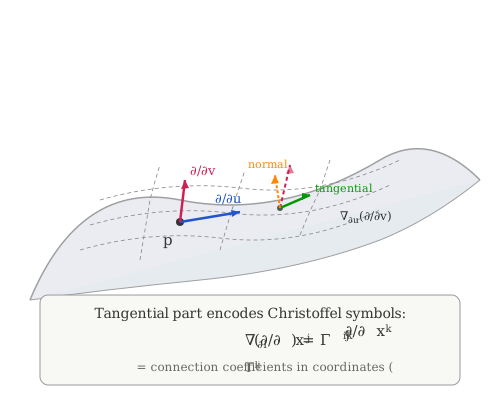
\[
\nabla_X Y = X^i \Bigl(\frac{\partial Y^k}{\partial x^i} + \Gamma^k_{ij} Y^j\Bigr) \frac{\partial}{\partial x^k}.
\]
The expression \( \frac{\partial Y^k}{\partial x^i} + \Gamma^k_{ij} Y^j \) represents the “covariant components” of \( \nabla_X Y \); the Christoffel symbols provide the “correction term” that accounts for the twisting of the coordinate frame.
12.10 Geodesics and Parallel Transport
Two of the most important constructions associated with a connection are geodesics and parallel transport.
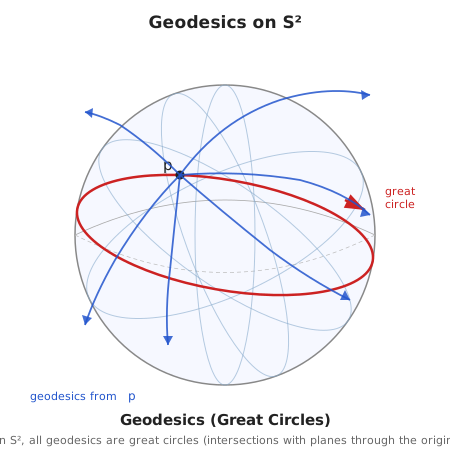
Definition 12.30 (Geodesic). A smooth curve \( \gamma \colon I \to M \) is a geodesic (with respect to the connection \( \nabla \)) if its velocity vector field is parallel along itself:
\[
\nabla_{\gamma'(t)} \gamma'(t) = 0 \quad \text{for all } t \in I.
\]
In local coordinates, this becomes the geodesic equation:
\[
\frac{d^2 \gamma^k}{dt^2} + \Gamma^k_{ij}(\gamma(t)) \frac{d\gamma^i}{dt} \frac{d\gamma^j}{dt} = 0, \quad k = 1, \ldots, n.
\]
This is a second-order system of ODEs, so by the existence and uniqueness theorem, given any point \( p \in M \) and any tangent vector \( v \in T_pM \), there exists a unique maximal geodesic \( \gamma \) with \( \gamma(0) = p \) and \( \gamma'(0) = v \).
Definition 12.31 (Parallel transport). Let \( \gamma \colon [a,b] \to M \) be a smooth curve. A vector field \( V \) along \( \gamma \) (i.e., a smooth map \( V \colon [a,b] \to TM \) with \( V(t) \in T_{\gamma(t)}M \)) is parallel along \( \gamma \) if
\[
\nabla_{\gamma'(t)} V(t) = 0 \quad \text{for all } t.
\]
Given \( v_0 \in T_{\gamma(a)}M \), there exists a unique parallel vector field \( V \) along \( \gamma \) with \( V(a) = v_0 \). The map \( P_\gamma \colon T_{\gamma(a)}M \to T_{\gamma(b)}M \) defined by \( P_\gamma(v_0) = V(b) \) is called parallel transport along \( \gamma \). It is a linear isomorphism.
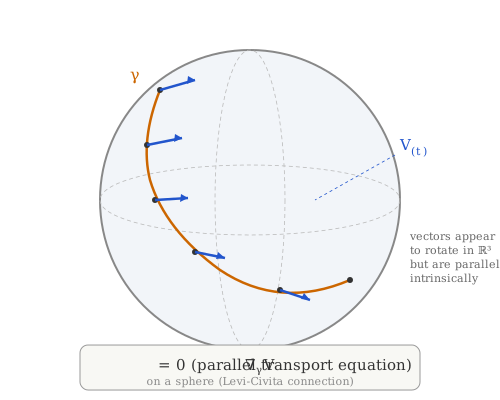
A geodesic is precisely a curve whose velocity vector is parallel along itself — the curve “goes straight” in the sense determined by the connection. Parallel transport moves vectors along curves “without rotating” them, according to the connection.
12.11 Torsion and the Levi-Civita Connection
Not all connections are created equal. On a Riemannian manifold, there is a canonical connection that is uniquely determined by two natural requirements.
Definition 12.32 (Torsion). The torsion of a connection \( \nabla \) is the tensor field \( T \colon \mathfrak{X}(M) \times \mathfrak{X}(M) \to \mathfrak{X}(M) \) defined by
\[
T(X, Y) = \nabla_X Y - \nabla_Y X - [X, Y].
\]
A connection is torsion-free (or symmetric) if \( T = 0 \). In coordinates, this means \( \Gamma^k_{ij} = \Gamma^k_{ji} \).
![Torsion of a connection: T(X,Y) = ∇_X Y - ∇_Y X - [X,Y] measures the antisymmetric failure of the connection](/pics/pmath465/torsion-connection.svg)
The torsion measures the extent to which the connection fails to be “symmetric.” While the torsion is a geometric object of interest in its own right (it appears in Einstein–Cartan theory and other generalizations of general relativity), the most important connection in Riemannian geometry is torsion-free.
Definition 12.33 (Metric compatibility). A connection \( \nabla \) on a Riemannian manifold \( (M, g) \) is compatible with the metric (or metric-compatible) if
\[
\nabla g = 0,
\]
or equivalently, for all vector fields \( X, Y, Z \):
\[
X(g(Y, Z)) = g(\nabla_X Y, Z) + g(Y, \nabla_X Z).
\]
This means that parallel transport preserves inner products.
Theorem 12.34 (Fundamental Theorem of Riemannian Geometry). On any Riemannian manifold \( (M, g) \), there exists a unique connection \( \nabla \), called the
Levi-Civita connection, that is:
- Torsion-free: \( \nabla_X Y - \nabla_Y X = [X, Y] \).
- Metric-compatible: \( \nabla g = 0 \).
It is determined explicitly by the
Koszul formula:
\[
2g(\nabla_X Y, Z) = X(g(Y,Z)) + Y(g(X,Z)) - Z(g(X,Y)) + g([X,Y], Z) - g([X,Z], Y) - g([Y,Z], X).
\]
Proof sketch. Uniqueness: If such a \( \nabla \) exists, write out the three equations obtained by cyclically permuting \( (X, Y, Z) \) in the metric compatibility condition \( X(g(Y,Z)) = g(\nabla_X Y, Z) + g(Y, \nabla_X Z) \), then use the torsion-free condition to eliminate cross terms. Adding and subtracting appropriately yields the Koszul formula, which determines \( \nabla_X Y \) uniquely (since \( g \) is nondegenerate).
Existence: Define \( \nabla_X Y \) by the Koszul formula (the right-hand side is \( C^\infty \)-linear in \( Z \), so it defines a vector field via the metric). One then verifies the three axioms of a connection and the two additional properties (torsion-free, metric-compatible).
\[
\Gamma^k_{ij} = \frac{1}{2} g^{k\ell}\Bigl(\frac{\partial g_{j\ell}}{\partial x^i} + \frac{\partial g_{i\ell}}{\partial x^j} - \frac{\partial g_{ij}}{\partial x^\ell}\Bigr).
\]
12.12 The Riemann Curvature Tensor
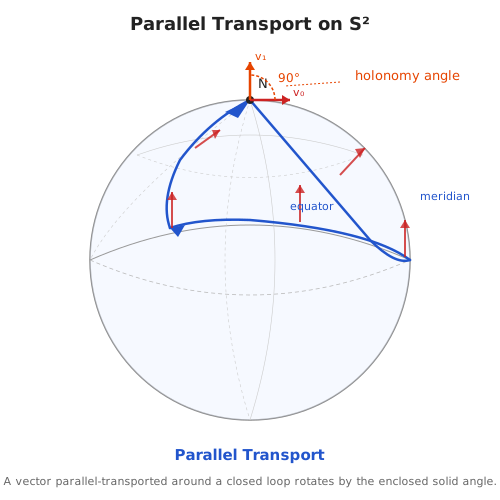
The curvature of a connection measures the extent to which parallel transport around an infinitesimal loop fails to return a vector to itself. It is the fundamental local invariant of Riemannian geometry.
Definition 12.35 (Riemann curvature tensor). The Riemann curvature tensor (or Riemann curvature endomorphism) of a connection \( \nabla \) is the map \( R \colon \mathfrak{X}(M)^3 \to \mathfrak{X}(M) \) defined by
\[
R(X, Y)Z = \nabla_X \nabla_Y Z - \nabla_Y \nabla_X Z - \nabla_{[X,Y]} Z.
\]
The curvature tensor measures the failure of second covariant derivatives to commute. If the connection is flat (\( R = 0 \)), then covariant differentiation in different directions commutes, and parallel transport is path-independent.
Proposition 12.36. The Riemann curvature tensor \( R(X, Y)Z \) is \( C^\infty(M) \)-linear in all three arguments, so it is indeed a tensor field — a section of \( T^1_3(TM) \).
\[
R^l{}_{ijk} = \frac{\partial \Gamma^l_{jk}}{\partial x^i} - \frac{\partial \Gamma^l_{ik}}{\partial x^j} + \Gamma^l_{im} \Gamma^m_{jk} - \Gamma^l_{jm} \Gamma^m_{ik}.
\]
12.13 Symmetries of the Riemann Tensor
For the Levi-Civita connection on a Riemannian manifold, the curvature tensor possesses remarkable symmetry properties. We define the fully covariant version \( \operatorname{Rm}(X, Y, Z, W) = g(R(X, Y)Z, W) \).
Theorem 12.37 (Symmetries of the Riemann tensor). Let \( (M, g) \) be a Riemannian manifold with Levi-Civita connection. For all vector fields \( X, Y, Z, W \):
- Skew-symmetry in the first pair: \( \operatorname{Rm}(X, Y, Z, W) = -\operatorname{Rm}(Y, X, Z, W) \).
- Skew-symmetry in the second pair: \( \operatorname{Rm}(X, Y, Z, W) = -\operatorname{Rm}(X, Y, W, Z) \).
- Pair symmetry: \( \operatorname{Rm}(X, Y, Z, W) = \operatorname{Rm}(Z, W, X, Y) \).
- First Bianchi identity: \( R(X, Y)Z + R(Y, Z)X + R(Z, X)Y = 0 \) (equivalently, \( \operatorname{Rm}(X, Y, Z, W) + \operatorname{Rm}(Y, Z, X, W) + \operatorname{Rm}(Z, X, Y, W) = 0 \)).
These symmetries drastically reduce the number of independent components. On an \( n \)-dimensional manifold, the Riemann tensor has \( \frac{n^2(n^2 - 1)}{12} \) independent components (for instance, 1 in dimension 2, 6 in dimension 3, and 20 in dimension 4).
12.14 Sectional, Ricci, and Scalar Curvature
The full Riemann tensor contains a wealth of information. Various traces and contractions extract geometrically meaningful quantities.
Definition 12.38 (Sectional curvature). Let \( \sigma \subset T_pM \) be a 2-dimensional subspace spanned by linearly independent vectors \( X, Y \). The sectional curvature of \( \sigma \) is
\[
K(\sigma) = K(X, Y) = \frac{\operatorname{Rm}(X, Y, Y, X)}{|X|^2 |Y|^2 - g(X, Y)^2}.
\]
This is independent of the choice of basis \( (X, Y) \) for \( \sigma \).
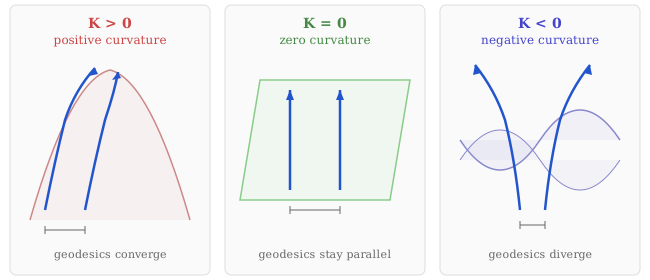
The sectional curvature \( K(\sigma) \) is the Gauss curvature of the “slice” of \( M \) through \( p \) tangent to \( \sigma \) — it measures how geodesics starting at \( p \) in the plane \( \sigma \) spread apart or converge. The sectional curvature completely determines the Riemann tensor.
Definition 12.39 (Ricci curvature). The Ricci curvature is the trace of the curvature endomorphism:
\[
\operatorname{Ric}(Y, Z) = \operatorname{tr}(X \mapsto R(X, Y)Z) = \sum_{i=1}^{n} \operatorname{Rm}(E_i, Y, Z, E_i),
\]
where \( (E_1, \ldots, E_n) \) is any orthonormal frame. The Ricci tensor is a symmetric \( (0,2) \)-tensor.
Definition 12.40 (Scalar curvature). The scalar curvature is the trace of the Ricci tensor:
\[
S = \operatorname{tr}_g(\operatorname{Ric}) = \sum_{i=1}^{n} \operatorname{Ric}(E_i, E_i) = \sum_{i,j} K(E_i, E_j).
\]
It is a smooth function on \( M \).
12.15 Einstein Manifolds
Definition 12.42 (Einstein manifold). A Riemannian manifold \( (M, g) \) is called an Einstein manifold if the Ricci tensor is proportional to the metric:
\[
\operatorname{Ric} = \lambda g
\]
for some constant \( \lambda \in \mathbb{R} \). Equivalently, \( S = n\lambda \), so the scalar curvature is constant.
Einstein manifolds arise naturally in general relativity (the vacuum Einstein field equations with cosmological constant are \( \operatorname{Ric} = \lambda g \)) and in many areas of differential geometry. Important examples include spaces of constant sectional curvature (spheres, Euclidean spaces, hyperbolic spaces), complex projective spaces with the Fubini–Study metric, and products of Einstein manifolds with equal Einstein constants.
12.16 The Exponential Map and the Hopf–Rinow Theorem
We conclude with two important results about geodesics on Riemannian manifolds.
\[
\exp_p \colon T_pM \supset U \to M, \quad \exp_p(v) = \gamma_v(1),
\]
where \( \gamma_v \) is the geodesic with \( \gamma_v(0) = p \) and \( \gamma_v'(0) = v \), and \( U \) is a neighborhood of \( 0 \in T_pM \) where this is defined.
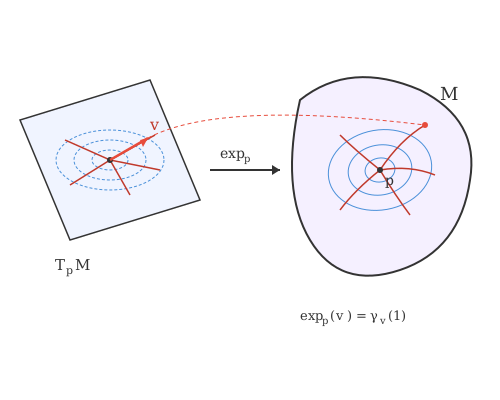 The exponential map is a local diffeomorphism near \( 0 \), and the coordinates it induces (called normal coordinates or geodesic coordinates) have the special property that \( \Gamma^k_{ij}(p) = 0 \) at the center point.
\[
d(p, q) = \inf \Bigl\{ \int_0^1 |\gamma'(t)|_g\, dt : \gamma \text{ is a piecewise smooth curve from } p \text{ to } q \Bigr\}.
\]
This makes \( (M, d) \) into a metric space whose topology agrees with the manifold topology.
Theorem 12.43 (Hopf–Rinow). Let \( (M, g) \) be a connected Riemannian manifold. The following are equivalent:
- \( (M, d) \) is a complete metric space (every Cauchy sequence converges).
- The exponential map \( \exp_p \) is defined on all of \( T_pM \) for some (equivalently, every) \( p \in M \).
- Every closed and bounded subset of \( M \) is compact.
Moreover, if any of these equivalent conditions holds, then any two points of \( M \) can be joined by a minimizing geodesic.
The Hopf–Rinow theorem is a cornerstone of Riemannian geometry. It guarantees that on a “geodesically complete” manifold (one where geodesics can be extended indefinitely), the geometric and topological notions of completeness coincide, and optimal paths between any two points always exist. All compact Riemannian manifolds are complete.