MATH 147: Calculus 1 for Honours Mathematics
Estimated study time: 1 hr 2 min
Table of contents
These notes cover MATH 147 (Calculus 1 for Honours Mathematics) at the University of Waterloo. The course is the rigorous companion to MATH 137: every definition is given the full \(\varepsilon\)-\(\delta\) treatment, every major theorem is proved, and the real number system itself is developed from first principles. The primary inspiration is Spivak’s Calculus and Rudin’s Principles of Mathematical Analysis, but the presentation is aimed at a student encountering rigorous analysis for the first time.
Chapter 1: The Real Number System
The calculus we develop in this course — limits, derivatives, integrals — ultimately rests on properties of the real numbers \(\mathbb{R}\). Most of us use real numbers every day without asking what they actually are. In MATH 147, we take that question seriously. The key insight is that \(\mathbb{R}\) is not just an algebraic object (a field) or an ordered object (like \(\mathbb{Q}\)), but a complete ordered field, and it is completeness that makes calculus possible.
1.1 Ordered Fields
An ordered field is a set equipped with addition, multiplication, and an ordering that all interact in the expected ways. The rationals \(\mathbb{Q}\) form an ordered field, but as we will see, they are fundamentally insufficient for analysis.
Definition 1.1 (Field). A field is a set \(F\) with two operations \(+\) and \(\cdot\) satisfying the usual axioms: commutativity, associativity, distributivity, identity elements \(0\) and \(1\) (with \(0 \ne 1\)), and the existence of additive and multiplicative inverses (the latter for all nonzero elements).
Definition 1.2 (Ordered Field). An ordered field is a field \(F\) together with a subset \(P \subset F\) (the positive elements) satisfying: (i) for every \(x \in F\), exactly one of \(x \in P\), \(x = 0\), or \(-x \in P\) holds (trichotomy); (ii) \(P\) is closed under addition and multiplication. We write \(x > 0\) to mean \(x \in P\), and \(x > y\) to mean \(x - y > 0\).
Both \(\mathbb{Q}\) and \(\mathbb{R}\) are ordered fields. The key difference comes next.
1.2 The Least Upper Bound Property
The rational numbers have a glaring gap: the set \(\{x \in \mathbb{Q} : x^2 < 2\}\) is bounded above in \(\mathbb{Q}\) (by \(2\), say), yet has no least upper bound in \(\mathbb{Q}\). The real numbers are distinguished precisely by the fact that this cannot happen.
Definition 1.3 (Upper Bound, Supremum). Let \(S \subset F\) be a nonempty subset of an ordered field. An element \(\alpha \in F\) is an upper bound for \(S\) if \(x \le \alpha\) for every \(x \in S\). If \(S\) has an upper bound, we say \(S\) is bounded above. The least upper bound or supremum of \(S\), written \(\sup S\), is an upper bound \(\alpha\) such that \(\alpha \le \beta\) for every upper bound \(\beta\). Similarly define infimum \(\inf S\).
Axiom 1.4 (Completeness / Least Upper Bound Property). Every nonempty subset of \(\mathbb{R}\) that is bounded above has a least upper bound in \(\mathbb{R}\).
We take this as an axiom characterising \(\mathbb{R}\): up to isomorphism of ordered fields, there is exactly one complete ordered field, and we call it the real numbers. Notice that the completeness axiom fails for \(\mathbb{Q}\): the set \(\{q \in \mathbb{Q} : q > 0, q^2 < 2\}\) has no supremum in \(\mathbb{Q}\).
Remark 1.5. A useful rephrasing: \(\alpha = \sup S\) if and only if (i) \(x \le \alpha\) for all \(x \in S\), and (ii) for every \(\varepsilon > 0\) there exists \(x \in S\) with \(x > \alpha - \varepsilon\). Condition (ii) says \(\alpha\) is the smallest upper bound — anything strictly smaller gets beaten by some element of \(S\).
1.3 Consequences: Archimedean Property and Density of \(\mathbb{Q}\)
Completeness has far-reaching consequences. Two of the most important are that \(\mathbb{N}\) is not bounded in \(\mathbb{R}\), and that between any two real numbers lies a rational.
Theorem 1.6 (Archimedean Property). For every \(x \in \mathbb{R}\), there exists \(n \in \mathbb{N}\) with \(n > x\).
Proof. If \(\mathbb{N}\) were bounded above in \(\mathbb{R}\), then by completeness \(\alpha = \sup \mathbb{N}\) would exist. Since \(\alpha - 1\) is not an upper bound, there is some \(n \in \mathbb{N}\) with \(n > \alpha - 1\), giving \(n + 1 > \alpha\). But \(n+1 \in \mathbb{N}\), contradicting that \(\alpha\) is an upper bound. \(\square\)
Corollary 1.7. For every \(\varepsilon > 0\) there exists \(n \in \mathbb{N}\) with \(1/n < \varepsilon\). Equivalently, \(\lim_{n \to \infty} 1/n = 0\).
Theorem 1.8 (Density of \(\mathbb{Q}\)). For every \(a, b \in \mathbb{R}\) with \(a < b\), there exists \(q \in \mathbb{Q}\) with \(a < q < b\).
Proof. By the Archimedean property, choose \(n \in \mathbb{N}\) with \(n > 1/(b-a)\), so \(1/n < b - a\). Let \(m = \lfloor na \rfloor + 1\), so \(m - 1 \le na < m\), giving \(a < m/n \le a + 1/n < a + (b-a) = b\). Then \(q = m/n\) works. \(\square\)
Geometrically, \(|x|\) is the distance from \(x\) to \(0\), and \(|a - b|\) is the distance between \(a\) and \(b\).
The triangle inequality is the single most-used estimate in all of analysis. Every \(\varepsilon\)-\(\delta\) proof eventually invokes it.
Chapter 2: Sequences
A sequence is the simplest setting in which to develop the idea of a limit. Before we can meaningfully speak of a function approaching a value, we need a rigorous account of what it means for a list of numbers to converge. The theory of sequences also provides the tools to prove completeness consequences like the Bolzano–Weierstrass theorem, which will be indispensable later.
2.1 Limits of Sequences
Definition 2.1 (Convergence of a Sequence). A sequence \(\{a_n\}_{n=1}^\infty\) converges to \(L \in \mathbb{R}\), written \(\lim_{n \to \infty} a_n = L\), if for every \(\varepsilon > 0\) there exists \(N \in \mathbb{N}\) such that \(n \ge N\) implies \(|a_n - L| < \varepsilon\). A sequence that does not converge is divergent.
The key idea is that \(\varepsilon\) is given first — it is the tolerance — and we must respond with an \(N\) that works for that tolerance. The order matters: \(N\) is allowed to depend on \(\varepsilon\).
Example 2.2. Show \(\lim_{n\to\infty} \frac{1}{n} = 0\). Given \(\varepsilon > 0\), by the Archimedean property choose \(N \in \mathbb{N}\) with \(N > 1/\varepsilon\). Then for \(n \ge N\), \(|1/n - 0| = 1/n \le 1/N < \varepsilon\). \(\square\)
Theorem 2.3 (Uniqueness of Limits). If \(\lim_{n\to\infty} a_n = L\) and \(\lim_{n\to\infty} a_n = M\), then \(L = M\).
Proof. Suppose \(L \ne M\); set \(\varepsilon = |L - M|/2 > 0\). Choose \(N_1\) so that \(n \ge N_1\) implies \(|a_n - L| < \varepsilon\), and \(N_2\) so that \(n \ge N_2\) implies \(|a_n - M| < \varepsilon\). For \(n \ge \max(N_1, N_2)\), the triangle inequality gives \(|L - M| \le |L - a_n| + |a_n - M| < 2\varepsilon = |L - M|\), a contradiction. \(\square\)
Definition 2.4 (Divergence to Infinity). We write \(\lim_{n\to\infty} a_n = +\infty\) if for every \(M > 0\) there exists \(N\) such that \(n \ge N\) implies \(a_n > M\). Similarly for \(-\infty\).
2.2 Limit Theorems
Theorem 2.5 (Arithmetic Rules for Sequences). Suppose \(\lim_{n\to\infty} a_n = L\) and \(\lim_{n\to\infty} b_n = M\). Then:
(i) \(\lim_{n\to\infty}(a_n + b_n) = L + M\).
(ii) \(\lim_{n\to\infty} c\,a_n = cL\) for any constant \(c\).
(iii) \(\lim_{n\to\infty} a_n b_n = LM\).
(iv) \(\lim_{n\to\infty} a_n/b_n = L/M\) if \(M \ne 0\).
Theorem 2.6 (Squeeze Theorem). If \(a_n \le b_n \le c_n\) for all sufficiently large \(n\), and \(\lim_{n\to\infty} a_n = \lim_{n\to\infty} c_n = L\), then \(\lim_{n\to\infty} b_n = L\).
Theorem 2.7 (Order Preservation). If \(\lim_{n\to\infty} a_n = L\) and \(a_n \ge 0\) for all \(n\), then \(L \ge 0\). More generally, if \(a_n \le b_n\) for all sufficiently large \(n\) and both sequences converge, then \(\lim a_n \le \lim b_n\).
2.3 Monotone Convergence Theorem
This is where completeness first pays off for sequences. A monotone sequence that is bounded has nowhere to go but converge.
Theorem 2.8 (Monotone Convergence Theorem). Let \(\{a_n\}\) be a monotone increasing sequence.
(i) If \(\{a_n\}\) is bounded above, then \(\{a_n\}\) converges and \(\lim_{n\to\infty} a_n = \sup\{a_n : n \in \mathbb{N}\}\).
(ii) If \(\{a_n\}\) is not bounded above, then \(\lim_{n\to\infty} a_n = +\infty\).
A symmetric statement holds for decreasing sequences.
Proof. Let \(L = \sup\{a_n\}\), which exists by completeness. Given \(\varepsilon > 0\), since \(L - \varepsilon\) is not an upper bound, there exists \(a_N > L - \varepsilon\). Since the sequence is increasing, for all \(n \ge N\) we have \(L - \varepsilon < a_N \le a_n \le L\), so \(|a_n - L| < \varepsilon\). \(\square\)
The Monotone Convergence Theorem is the engine behind many existence arguments: to prove a sequence converges, it often suffices to show it is monotone and bounded.
2.4 Subsequences and the Bolzano–Weierstrass Theorem
Definition 2.9 (Subsequence). Given \(\{a_n\}\) and strictly increasing indices \(n_1 < n_2 < n_3 < \cdots\), the sequence \(\{a_{n_k}\}_{k=1}^\infty\) is a subsequence of \(\{a_n\}\).
Theorem 2.10. If \(\lim_{n\to\infty} a_n = L\), then every subsequence also converges to \(L\).
The contrapositive is equally important: if two subsequences converge to different limits, the original sequence diverges.
Theorem 2.11 (Bolzano–Weierstrass). Every bounded sequence of real numbers has a convergent subsequence.
Proof. Let \(\{a_n\} \subset [A, B]\). We perform repeated bisection. Set \([A_0, B_0] = [A, B]\). Given \([A_k, B_k]\), at least one of \([A_k, \tfrac{A_k+B_k}{2}]\) or \([\tfrac{A_k+B_k}{2}, B_k]\) contains infinitely many terms; call it \([A_{k+1}, B_{k+1}]\). Pick \(n_{k+1} > n_k\) with \(a_{n_{k+1}} \in [A_{k+1}, B_{k+1}]\). The nested intervals have length \((B-A)/2^k \to 0\), so by completeness they share a unique point \(L\). Since \(a_{n_k} \in [A_k, B_k]\) and the interval widths shrink to zero, \(a_{n_k} \to L\). \(\square\)
2.5 Cauchy Sequences
The Bolzano–Weierstrass theorem tells us bounded sequences have convergent subsequences, but how can we verify convergence without knowing the limit in advance? Cauchy sequences answer this.
Definition 2.12 (Cauchy Sequence). A sequence \(\{a_n\}\) is a Cauchy sequence if for every \(\varepsilon > 0\) there exists \(N \in \mathbb{N}\) such that for all \(m, n \ge N\), \(|a_m - a_n| < \varepsilon\).
The definition says the terms of the sequence eventually cluster together, without reference to any putative limit.
Theorem 2.13 (Cauchy Criterion). A sequence of real numbers converges if and only if it is a Cauchy sequence.
Proof. (\(\Rightarrow\)) If \(a_n \to L\), given \(\varepsilon > 0\) choose \(N\) so that \(|a_n - L| < \varepsilon/2\) for \(n \ge N\). Then \(|a_m - a_n| \le |a_m - L| + |L - a_n| < \varepsilon\).
(\(\Leftarrow\)) Let \(\{a_n\}\) be Cauchy. First, every Cauchy sequence is bounded (choose \(N\) for \(\varepsilon = 1\); then \(|a_n| \le |a_N| + 1\) for \(n \ge N\), and the finitely many earlier terms are also bounded). By Bolzano–Weierstrass, there is a convergent subsequence \(a_{n_k} \to L\). Given \(\varepsilon > 0\), choose \(N\) so that \(m, n \ge N\) implies \(|a_m - a_n| < \varepsilon/2\), and \(K\) so that \(k \ge K\) implies \(|a_{n_k} - L| < \varepsilon/2\). For \(n \ge N\), pick \(k \ge K\) with \(n_k \ge N\); then \(|a_n - L| \le |a_n - a_{n_k}| + |a_{n_k} - L| < \varepsilon\). \(\square\)
This equivalence — Cauchy iff convergent — is another way of stating completeness. In the rationals, Cauchy sequences need not converge (e.g.\ the rational approximations to \(\sqrt{2}\)).
Chapter 3: Limits and Continuity
With sequences in hand, we can define limits of functions. The interplay between function limits and sequential limits is both elegant and practically powerful: many properties of function limits reduce immediately to the corresponding sequence results.
3.1 The Epsilon-Delta Definition
Notice the condition \(0 < |x - a|\): we never evaluate \(f\) at \(x = a\). The limit is about the behaviour of \(f\) near \(a\), not at \(a\).
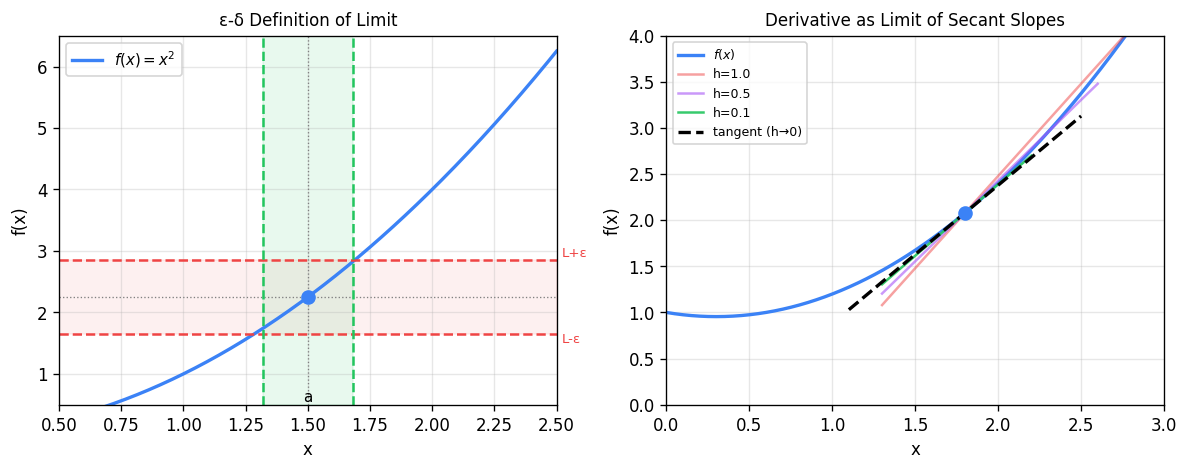
Left: the ε-δ definition of limit. The green vertical strip of width \(2\delta\) centred at \(a\) maps into the red horizontal band of height \(2\varepsilon\) around \(L\). Right: the derivative as the limiting slope of secant lines as \(h \to 0\); successive secant slopes (red, purple, green) converge to the tangent (black dashed).
Example 3.2. Prove \(\lim_{x \to 3}(2x - 1) = 5\) directly from the definition. We need \(|f(x) - 5| = |2x - 6| = 2|x - 3| < \varepsilon\) whenever \(0 < |x - 3| < \delta\). Choosing \(\delta = \varepsilon/2\) works: if \(|x-3| < \delta\) then \(|2x - 6| = 2|x-3| < 2\delta = \varepsilon\). \(\square\)
Example 3.3. Prove \(\lim_{x \to 2} x^2 = 4\). We want \(|x^2 - 4| < \varepsilon\). Write \(|x^2 - 4| = |x+2||x-2|\). If we restrict \(|x-2| < 1\) first, then \(|x| < 3\) so \(|x+2| < 5\). Thus \(|x^2 - 4| < 5|x-2|\). Set \(\delta = \min(1, \varepsilon/5)\); then \(|x-2| < \delta\) implies \(|x^2-4| < 5 \cdot (\varepsilon/5) = \varepsilon\). \(\square\)
3.2 Limit Laws
Theorem 3.4 (Sequential Characterization of Limits). \(\lim_{x \to a} f(x) = L\) if and only if for every sequence \(\{x_n\}\) with \(x_n \ne a\) and \(x_n \to a\), we have \(f(x_n) \to L\).
This theorem is the bridge between sequence theory and function limits. It means every result we proved for sequences carries over to function limits immediately.
Theorem 3.5 (Arithmetic Limit Laws). If \(\lim_{x\to a} f(x) = L\) and \(\lim_{x\to a} g(x) = M\), then:
(i) \(\lim_{x\to a}[f(x) + g(x)] = L + M\).
(ii) \(\lim_{x\to a} f(x)g(x) = LM\).
(iii) \(\lim_{x\to a} f(x)/g(x) = L/M\) when \(M \ne 0\).
(iv) \(\lim_{x\to a} |f(x)| = |L|\).
Theorem 3.6 (Squeeze Theorem for Functions). If \(g(x) \le f(x) \le h(x)\) near \(a\) (but not necessarily at \(a\)) and \(\lim_{x\to a} g(x) = \lim_{x\to a} h(x) = L\), then \(\lim_{x\to a} f(x) = L\).
Proof (sketch). For \(0 < \theta < \pi/2\), comparing areas of triangles and the circular sector on the unit circle gives \(\sin\theta < \theta < \tan\theta\), hence \(\cos\theta < \sin\theta/\theta < 1\). Since \(\cos\theta \to 1\), the Squeeze Theorem finishes it. \(\square\)
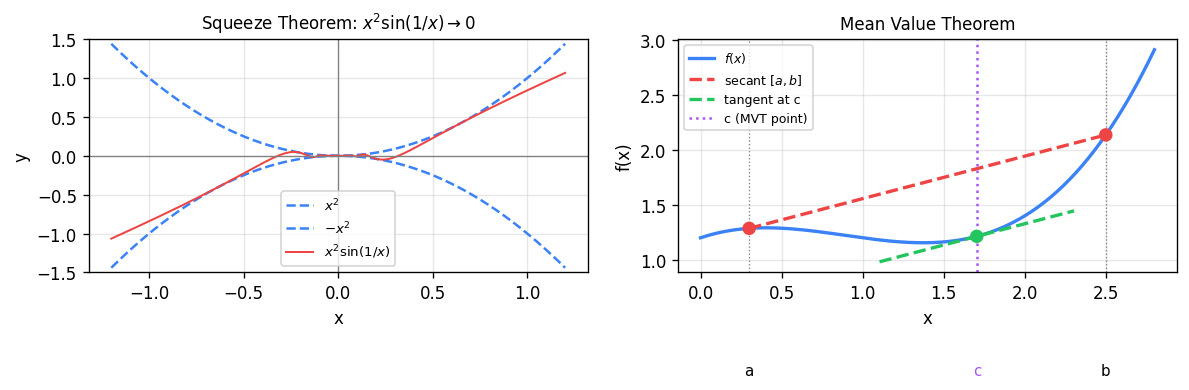
Left: the squeeze theorem in action — \(x^2\sin(1/x)\) (red) is sandwiched between \(-x^2\) and \(x^2\) (blue dashed), forcing the limit to 0 at the origin. Right: the MVT guarantees a point \(c\) (purple) where the tangent (green) is parallel to the secant through \((a, f(a))\) and \((b, f(b))\) (red dashed).
3.3 One-Sided Limits and Limits at Infinity
Definition 3.8 (One-Sided Limits). \(\lim_{x\to a^+} f(x) = L\) means: for every \(\varepsilon > 0\) there exists \(\delta > 0\) such that \(0 < x - a < \delta\) implies \(|f(x) - L| < \varepsilon\). Similarly define \(\lim_{x\to a^-} f(x) = L\).
Theorem 3.9. \(\lim_{x\to a} f(x) = L\) exists if and only if both one-sided limits exist and \(\lim_{x\to a^-} f(x) = L = \lim_{x\to a^+} f(x)\).
Definition 3.10 (Limits at Infinity). \(\lim_{x\to\infty} f(x) = L\) means: for every \(\varepsilon > 0\) there exists \(N\) such that \(x > N\) implies \(|f(x) - L| < \varepsilon\).
3.4 Continuity
Equivalently, for every \(\varepsilon > 0\) there exists \(\delta > 0\) such that \(|x - a| < \delta\) implies \(|f(x) - f(a)| < \varepsilon\). Note that now \(x = a\) is allowed.
Theorem 3.12 (Sequential Characterization of Continuity). \(f\) is continuous at \(a\) if and only if for every sequence \(x_n \to a\), we have \(f(x_n) \to f(a)\).
Theorem 3.13 (Algebra of Continuous Functions). If \(f\) and \(g\) are continuous at \(a\), so are \(f + g\), \(fg\), and \(f/g\) (when \(g(a) \ne 0\)). If \(f\) is continuous at \(a\) and \(g\) is continuous at \(f(a)\), then \(g \circ f\) is continuous at \(a\).
The elementary functions — polynomials, \(\sin x\), \(\cos x\), \(e^x\), \(\ln x\) — are all continuous on their natural domains. Combining them with the theorem above produces a vast class of continuous functions.
3.5 The Intermediate Value Theorem
The IVT captures the geometric intuition that a continuous function cannot jump: if \(f\) is \(2\) at one point and \(7\) at another, it must take every value in between. This seemingly obvious fact requires completeness to prove.
Theorem 3.14 (Intermediate Value Theorem). If \(f\) is continuous on \([a, b]\) and \(k\) is any value strictly between \(f(a)\) and \(f(b)\), then there exists \(c \in (a, b)\) with \(f(c) = k\).
Proof. Without loss of generality assume \(f(a) < k < f(b)\). Define \(S = \{x \in [a,b] : f(x) \le k\}\). Then \(a \in S\) so \(S \ne \emptyset\), and \(S\) is bounded above by \(b\). By completeness, \(c = \sup S\) exists. We claim \(f(c) = k\).
Suppose \(f(c) < k\). Since \(f\) is continuous at \(c\), with \(\varepsilon = k - f(c) > 0\) we find \(\delta > 0\) such that \(|x - c| < \delta\) implies \(|f(x) - f(c)| < \varepsilon\), i.e.\ \(f(x) < k\). Thus \([c, c+\delta) \subset S\) (as long as \(c + \delta \le b\)), contradicting that \(c\) is an upper bound for \(S\). Suppose \(f(c) > k\). Then by continuity, \(f(x) > k\) near \(c\), so \(c - \delta\) is also an upper bound of \(S\), contradicting \(c = \sup S\). Therefore \(f(c) = k\). \(\square\)
The IVT has powerful applications: it guarantees roots of polynomials of odd degree, underpins the bisection method for root-finding, and shows that continuous images of intervals are intervals.
3.6 The Extreme Value Theorem
The IVT tells us about intermediate values; the Extreme Value Theorem tells us about maximum and minimum values. Both require the interval to be closed and bounded, and both fail without these hypotheses.
Theorem 3.15 (Extreme Value Theorem). If \(f\) is continuous on \([a, b]\), then \(f\) attains a global maximum and a global minimum on \([a, b]\): there exist \(x_{\min}, x_{\max} \in [a,b]\) with \(f(x_{\min}) \le f(x) \le f(x_{\max})\) for all \(x \in [a,b]\).
Proof. Let \(M = \sup\{f(x) : x \in [a,b]\}\), which is finite by the claim below. Choose \(x_n \in [a,b]\) with \(f(x_n) > M - 1/n\). By Bolzano–Weierstrass, \(\{x_n\}\) has a convergent subsequence \(x_{n_k} \to x_{\max} \in [a,b]\) (the limit is in \([a,b]\) since the interval is closed). By continuity, \(f(x_{n_k}) \to f(x_{\max})\); since \(f(x_{n_k}) \to M\), we get \(f(x_{\max}) = M\). The minimum is handled similarly. That \(M < \infty\): if not, pick \(x_n\) with \(f(x_n) > n\); extract a convergent subsequence to \(x^*\); continuity forces \(f(x_n) \to f(x^*)\), contradicting \(f(x_n) \to \infty\). \(\square\)
3.7 Uniform Continuity
Ordinary continuity allows \(\delta\) to depend on both \(\varepsilon\) and the point \(a\). Uniform continuity is a stronger condition requiring a single \(\delta\) that works everywhere at once.
Example 3.17. \(f(x) = x^2\) is continuous on \(\mathbb{R}\) but not uniformly continuous: for any \(\delta > 0\), taking \(x = n\) and \(y = n + \delta/2\) for large \(n\) gives \(|x - y| < \delta\) but \(|f(x) - f(y)| = |(n+\delta/2)^2 - n^2| = n\delta + \delta^2/4 \to \infty\). However, \(f(x) = x^2\) is uniformly continuous on any closed bounded interval.
Theorem 3.18 (Heine–Cantor Theorem). If \(f\) is continuous on a closed bounded interval \([a, b]\), then \(f\) is uniformly continuous on \([a,b]\).
Proof. Suppose for contradiction that \(f\) is not uniformly continuous on \([a,b]\). Then there exists \(\varepsilon_0 > 0\) and sequences \(x_n, y_n \in [a,b]\) with \(|x_n - y_n| < 1/n\) but \(|f(x_n) - f(y_n)| \ge \varepsilon_0\). By Bolzano–Weierstrass, extract a convergent subsequence \(x_{n_k} \to c \in [a,b]\). Then \(y_{n_k} \to c\) too (since \(|x_{n_k} - y_{n_k}| \to 0\)). By continuity of \(f\) at \(c\), \(f(x_{n_k}) \to f(c)\) and \(f(y_{n_k}) \to f(c)\), so \(|f(x_{n_k}) - f(y_{n_k})| \to 0\), contradicting \(\ge \varepsilon_0\). \(\square\)
Chapter 4: Differentiation
Differentiation is the mathematical formalization of the notion of instantaneous rate of change. The derivative at a point is a limit — a single real number — that encodes the slope of the tangent line, the velocity of a moving particle, the sensitivity of an output to a change in input. What makes differentiation powerful is that it is local: the derivative at \(a\) depends only on the behaviour of \(f\) near \(a\).
4.1 The Derivative
exists. Equivalently, \(f'(a) = \lim_{x \to a} \frac{f(x) - f(a)}{x - a}\). The value \(f'(a)\) is the derivative of \(f\) at \(a\).
Geometrically, \(f'(a)\) is the slope of the tangent line to the graph of \(f\) at the point \((a, f(a))\). The tangent line itself is \(y = f(a) + f'(a)(x - a)\), the best linear approximation to \(f\) near \(a\).
Theorem 4.2 (Differentiability Implies Continuity). If \(f\) is differentiable at \(a\), then \(f\) is continuous at \(a\).
Proof. Write \(f(x) - f(a) = \frac{f(x)-f(a)}{x-a} \cdot (x-a)\). As \(x \to a\), the first factor tends to \(f'(a)\) and the second to \(0\), so the product tends to \(0\). \(\square\)
The converse is false: \(f(x) = |x|\) is continuous everywhere but not differentiable at \(0\), since \((|h| - 0)/h = \pm 1\) depending on the sign of \(h\).
4.2 Differentiation Rules
Theorem 4.3 (Linearity and Product Rule). If \(f\) and \(g\) are differentiable at \(a\):
(i) \((f + g)'(a) = f'(a) + g'(a)\).
(ii) \((cf)'(a) = cf'(a)\).
(iii) (Product Rule) \((fg)'(a) = f'(a)g(a) + f(a)g'(a)\).
(iv) (Quotient Rule) \((f/g)'(a) = \dfrac{f'(a)g(a) - f(a)g'(a)}{[g(a)]^2}\) when \(g(a) \ne 0\).
Theorem 4.4 (Power Rule). For any \(\alpha \in \mathbb{R}\), \(\frac{d}{dx} x^\alpha = \alpha x^{\alpha-1}\) wherever \(x^{\alpha-1}\) is defined.
4.3 The Chain Rule
The chain rule is perhaps the most important differentiation rule, governing how derivatives compose. Its proof requires care because the naive approach (dividing by \(g(x) - g(a)\)) fails when \(g(x) = g(a)\) at a sequence of points converging to \(a\).
Dividing by \(x - a\) (for \(x \ne a\)) and taking \(x \to a\): \(f(x) \to f(a)\) (by continuity), so \(\phi(f(x)) \to \phi(f(a)) = g'(f(a))\), and \((f(x)-f(a))/(x-a) \to f'(a)\). \(\square\)
4.4 Implicit Differentiation and Inverse Functions
When a relation \(F(x,y) = 0\) defines \(y\) implicitly as a differentiable function of \(x\), we differentiate both sides with respect to \(x\) using the Chain Rule on \(y\)-terms, then solve for \(dy/dx\). This technique gives us derivatives of inverse functions.
Applying this to \(f(x) = e^x\) (so \(g = \ln\)) gives \((\ln x)' = 1/x\). Applying to \(f(x) = \sin x\) on \([-\pi/2, \pi/2]\) gives \((\arcsin x)' = 1/\sqrt{1-x^2}\); similarly \((\arctan x)' = 1/(1+x^2)\).
4.5 Higher Derivatives
Definition 4.7 (Higher Derivatives). The second derivative is \(f'' = (f')'\), and the \(n\)-th derivative \(f^{(n)} = (f^{(n-1)})'\). We say \(f\) is \(C^n\) on an interval if \(f^{(n)}\) exists and is continuous there, and \(C^\infty\) if it is \(C^n\) for all \(n\).
The second derivative measures concavity: \(f'' > 0\) on \(I\) means the graph bends upward (concave up), while \(f'' < 0\) means it bends downward. An inflection point is where concavity changes.
Chapter 5: The Mean Value Theorem and Applications
The Mean Value Theorem is the central result of one-variable differential calculus. It connects the local notion of a derivative at a point to the global behaviour of a function over an interval. Most of the key applications of differentiation — monotonicity, L’Hôpital’s Rule, Taylor’s theorem — ultimately flow from it.
5.1 Rolle’s Theorem and the MVT
Theorem 5.1 (Rolle’s Theorem). If \(f\) is continuous on \([a,b]\), differentiable on \((a,b)\), and \(f(a) = f(b)\), then there exists \(c \in (a,b)\) with \(f'(c) = 0\).
Proof. By the EVT, \(f\) attains a maximum and minimum on \([a,b]\). If both are attained at the endpoints, then \(f\) is constant (since \(f(a)=f(b)\)) and \(f' \equiv 0\) on \((a,b)\). Otherwise, at least one extreme value is attained at an interior point \(c \in (a,b)\); at such a point the Local Extrema Theorem forces \(f'(c) = 0\). \(\square\)
Proof. Apply Rolle’s Theorem to the auxiliary function \(g(x) = f(x) - \frac{f(b)-f(a)}{b-a}(x-a)\). One checks \(g(a) = g(b) = f(a)\), so there is \(c\) with \(g'(c) = 0\), giving the result. \(\square\)
Geometrically, the MVT says the tangent line at some interior point is parallel to the secant through the endpoints. Analytically, it says the instantaneous rate of change equals the average rate of change at some moment — a rigorous form of the intuition that a car traveling 60 km in one hour must at some instant be going exactly 60 km/h.
5.2 Monotonicity
Theorem 5.3 (Monotonicity Theorem).
(i) If \(f'(x) > 0\) for all \(x \in (a,b)\), then \(f\) is strictly increasing on \([a,b]\).
(ii) If \(f'(x) < 0\) for all \(x \in (a,b)\), then \(f\) is strictly decreasing on \([a,b]\).
(iii) If \(f'(x) = 0\) for all \(x \in (a,b)\), then \(f\) is constant on \([a,b]\).
Proof. For (i), let \(a \le x_1 < x_2 \le b\). By the MVT there is \(c \in (x_1, x_2)\) with \(f(x_2) - f(x_1) = f'(c)(x_2 - x_1) > 0\). \(\square\)
5.3 L’Hôpital’s Rule
L’Hôpital’s Rule handles indeterminate forms \(0/0\) and \(\infty/\infty\) by replacing the ratio of functions with the ratio of their derivatives. Its proof uses the Cauchy Mean Value Theorem.
Proof. Apply Rolle’s to \(h(x) = [f(b)-f(a)]g(x) - [g(b)-g(a)]f(x)\). Then \(h(a) = f(b)g(a) - f(a)g(b) = h(b)\), so there is \(c\) with \(h'(c) = 0\). \(\square\)
Theorem 5.5 (L’Hôpital’s Rule). Suppose \(f\) and \(g\) are differentiable on \((a, b)\) (possibly with \(a = -\infty\) or \(b = +\infty\)), \(g'(x) \ne 0\) on \((a,b)\), and that one of the following holds:
(H1) \(\lim_{x\to a^+} f(x) = 0\) and \(\lim_{x\to a^+} g(x) = 0\) (the \(0/0\) case); or
(H2) \(\lim_{x\to a^+} |g(x)| = +\infty\) (the \(\infty/\infty\) case).
If \(\lim_{x\to a^+} f'(x)/g'(x) = L\) (with \(L \in \mathbb{R} \cup \{\pm\infty\}\)), then \(\lim_{x\to a^+} f(x)/g(x) = L\). The same holds for \(x \to b^-\) and for two-sided limits.
As \(x \to a^+\), we have \(c_x \to a^+\), and hence \(f'(c_x)/g'(c_x) \to L\). \(\square\)
The most frequently used instances: \(\lim_{x\to 0}\frac{\sin x}{x} = 1\), \(\lim_{x\to\infty}\frac{\ln x}{x} = 0\), \(\lim_{x\to\infty}\frac{x^n}{e^x} = 0\).
5.4 Convexity
\(f\) is concave (concave down) if the inequality is reversed.
Theorem 5.7 (Second Derivative and Convexity). If \(f\) is twice differentiable on \((a,b)\):
(i) \(f\) is convex on \((a,b)\) if and only if \(f'' \ge 0\) on \((a,b)\).
(ii) If \(f'' > 0\) on \((a,b)\), then \(f\) is strictly convex.
Theorem 5.8 (Second Derivative Test). Suppose \(f'(c) = 0\). If \(f''(c) > 0\), then \(f\) has a local minimum at \(c\); if \(f''(c) < 0\), then \(f\) has a local maximum at \(c\).
Chapter 6: Taylor Polynomials and Approximation
The derivative captures the first-order behaviour of a function near a point. Higher derivatives capture higher-order behaviour, and Taylor’s theorem lets us assemble all of this information into a polynomial approximation with a quantitative error bound. This is the starting point for numerical analysis, asymptotic analysis, and eventually the theory of power series.
6.1 Taylor Polynomials
Notice that \(T_{n,a}\) is the unique polynomial of degree at most \(n\) whose first \(n\) derivatives at \(a\) match those of \(f\): \(T_{n,a}^{(k)}(a) = f^{(k)}(a)\) for \(k = 0, 1, \ldots, n\). The case \(n = 1\) recovers the linear (tangent line) approximation.
\[ e^x = \sum_{k=0}^{n} \frac{x^k}{k!} + R_n(x), \quad \sin x = \sum_{k=0}^{m} \frac{(-1)^k x^{2k+1}}{(2k+1)!} + R_{2m+1}(x), \]\[ \cos x = \sum_{k=0}^{m} \frac{(-1)^k x^{2k}}{(2k)!} + R_{2m}(x), \quad \frac{1}{1-x} = \sum_{k=0}^{n} x^k + R_n(x) \text{ for } |x| < 1. \]6.2 Taylor’s Theorem with Remainder
One checks that \(g(x) = 0\) and \(g(a) = 0\) (by construction of \(M\)). Computing \(g'(t)\): the terms in \(T_{n,t}(x)\) telescope when differentiated with respect to \(t\), leaving \(g'(t) = -\frac{f^{(n+1)}(t)}{n!}(x-t)^n + M(n+1)(x-t)^n\). By Rolle’s Theorem applied to \(g\) on the interval with endpoints \(a\) and \(x\), there is \(c\) with \(g'(c) = 0\), giving \(M = f^{(n+1)}(c)/(n+1)!\). \(\square\)
When \(n = 0\), Taylor’s Theorem reduces to the Mean Value Theorem. The Lagrange form of the remainder is what makes Taylor polynomials useful: if we can bound \(|f^{(n+1)}|\), we get a concrete error bound.
6.3 Applications
Example 6.4. Approximate \(e\) to four decimal places. We use \(T_{n,0}(1) = \sum_{k=0}^n 1/k!\) with the error bound \(|e - T_{n,0}(1)| \le e/((n+1)!)\). Since \(e < 3\), for \(n = 9\) the error is at most \(3/10! \approx 8.3 \times 10^{-7} < 0.5 \times 10^{-4}\), so 9 terms suffice.
Example 6.5 (Computing limits with Taylor expansions). To find \(\lim_{x\to 0}\frac{e^x - 1 - x}{x^2}\), substitute \(e^x = 1 + x + x^2/2 + O(x^3)\) to get \(\frac{x^2/2 + O(x^3)}{x^2} = 1/2 + O(x) \to 1/2\). This is far cleaner than two applications of L’Hôpital’s Rule.
then \(p = T_{n,a}\). Equivalently (using Big-O), \(T_{n,a}\) is the unique degree-\(n\) polynomial with \(f(x) = T_{n,a}(x) + O((x-a)^{n+1})\).
Chapter 7: Series
An infinite series is a sum with infinitely many terms. This is not a priori a well-defined operation, and its meaning must be defined through limits of partial sums. The key questions are: when does a series converge, and how do its properties (like absolute vs.\ conditional convergence) affect that?
7.1 Convergence of Series
Definition 7.1 (Series and Partial Sums). Given a sequence \(\{a_n\}_{n=1}^\infty\), the associated series is \(\sum_{n=1}^\infty a_n\). The \(k\)-th partial sum is \(S_k = \sum_{n=1}^k a_n\). The series converges to \(S\) if \(\lim_{k\to\infty} S_k = S\); otherwise it diverges.
Theorem 7.2 (Divergence Test). If \(\sum a_n\) converges, then \(\lim_{n\to\infty} a_n = 0\). Equivalently, if \(a_n \not\to 0\), then \(\sum a_n\) diverges.
Proof. If \(S_k \to S\), then \(a_n = S_n - S_{n-1} \to S - S = 0\). \(\square\)
The converse is famously false: \(\sum 1/n\) diverges (the harmonic series) despite \(1/n \to 0\).
7.2 Geometric and \(p\)-Series
Proof. Partial sums satisfy \(S_k = (1 - r^{k+1})/(1-r)\) when \(r \ne 1\). If \(|r| < 1\), \(r^{k+1} \to 0\); if \(|r| \ge 1\), the terms do not tend to zero. \(\square\)
Theorem 7.4 (\(p\)-Series Test). The series \(\sum_{n=1}^\infty \frac{1}{n^p}\) converges if and only if \(p > 1\).
The divergence of \(\sum 1/n\) (\(p = 1\)) can be seen by grouping: \(1 + 1/2 + (1/3 + 1/4) + (1/5 + \cdots + 1/8) + \cdots\), where each group sums to at least \(1/2\).
7.3 Convergence Tests
Theorem 7.5 (Comparison Test). Suppose \(0 \le a_n \le b_n\) for all sufficiently large \(n\).
(i) If \(\sum b_n\) converges, then \(\sum a_n\) converges.
(ii) If \(\sum a_n\) diverges, then \(\sum b_n\) diverges.
Theorem 7.6 (Limit Comparison Test). Suppose \(a_n, b_n > 0\) and \(\lim_{n\to\infty} a_n/b_n = L\) with \(0 < L < \infty\). Then \(\sum a_n\) and \(\sum b_n\) either both converge or both diverge.
Theorem 7.7 (Ratio Test). Let \(\sum a_n\) be a series of positive terms and suppose \(\lim_{n\to\infty} a_{n+1}/a_n = r\). If \(r < 1\), the series converges; if \(r > 1\), it diverges. If \(r = 1\), the test is inconclusive.
Theorem 7.8 (Root Test). Let \(r = \limsup_{n\to\infty} a_n^{1/n}\). If \(r < 1\), then \(\sum a_n\) converges absolutely; if \(r > 1\), it diverges. If \(r = 1\), the test is inconclusive.
Theorem 7.9 (Alternating Series Test / Leibniz Criterion). If \(\{b_n\}\) is a decreasing sequence with \(b_n \ge 0\) and \(b_n \to 0\), then the alternating series \(\sum_{n=1}^\infty (-1)^{n-1} b_n\) converges. Moreover, the error in truncating after \(N\) terms satisfies \(|S - S_N| \le b_{N+1}\).
Proof. The even partial sums \(S_{2k}\) are increasing and bounded above by \(S_1 = b_1\); the odd partial sums \(S_{2k+1}\) are decreasing and bounded below by \(S_2\). Both subsequences converge, and since \(S_{2k+1} - S_{2k} = b_{2k+1} \to 0\), they share the same limit \(S\). \(\square\)
7.4 Absolute and Conditional Convergence
The distinction between absolute and conditional convergence is one of the deeper surprises of series theory.
Definition 7.10 (Absolute and Conditional Convergence). A series \(\sum a_n\) is absolutely convergent if \(\sum |a_n|\) converges. It is conditionally convergent if \(\sum a_n\) converges but \(\sum |a_n|\) diverges.
Theorem 7.11 (Absolute Convergence Implies Convergence). If \(\sum |a_n|\) converges, then \(\sum a_n\) converges.
Proof. Define \(b_n = a_n + |a_n|\), so \(0 \le b_n \le 2|a_n|\). Since \(\sum |a_n|\) converges, so does \(\sum b_n\) by comparison. Then \(\sum a_n = \sum b_n - \sum |a_n|\) converges. \(\square\)
The archetypal conditionally convergent series is \(\sum_{n=1}^\infty (-1)^{n-1}/n = \ln 2\), which converges by the alternating series test but whose absolute values form the divergent harmonic series.
Theorem 7.12 (Riemann Rearrangement Theorem). Let \(\sum a_n\) be a conditionally convergent series. For any \(L \in \mathbb{R} \cup \{+\infty, -\infty\}\), there exists a rearrangement \(\sum a_{\sigma(n)}\) (where \(\sigma : \mathbb{N} \to \mathbb{N}\) is a bijection) that converges to \(L\).
This theorem is genuinely shocking: by reordering the terms of a conditionally convergent series, we can make it sum to any value we like. The key is that for a conditionally convergent series, both the positive-term subseries and the negative-term subseries must diverge (to \(+\infty\) and \(-\infty\) respectively), providing unlimited “credit” and “debt” to spend.
By contrast, absolutely convergent series can be rearranged freely: every rearrangement converges to the same sum. This is why absolute convergence is the “safe” notion in analysis.
These notes cover the core material of MATH 147. The approach throughout has been to develop each concept rigorously while keeping the geometric and analytic intuition in the foreground. The completeness of \(\mathbb{R}\) is the invisible thread running through every major theorem: it gives us the Monotone Convergence Theorem, Bolzano–Weierstrass, the Cauchy Criterion, the Extreme Value Theorem, the Intermediate Value Theorem, and ultimately all the machinery of analysis.